
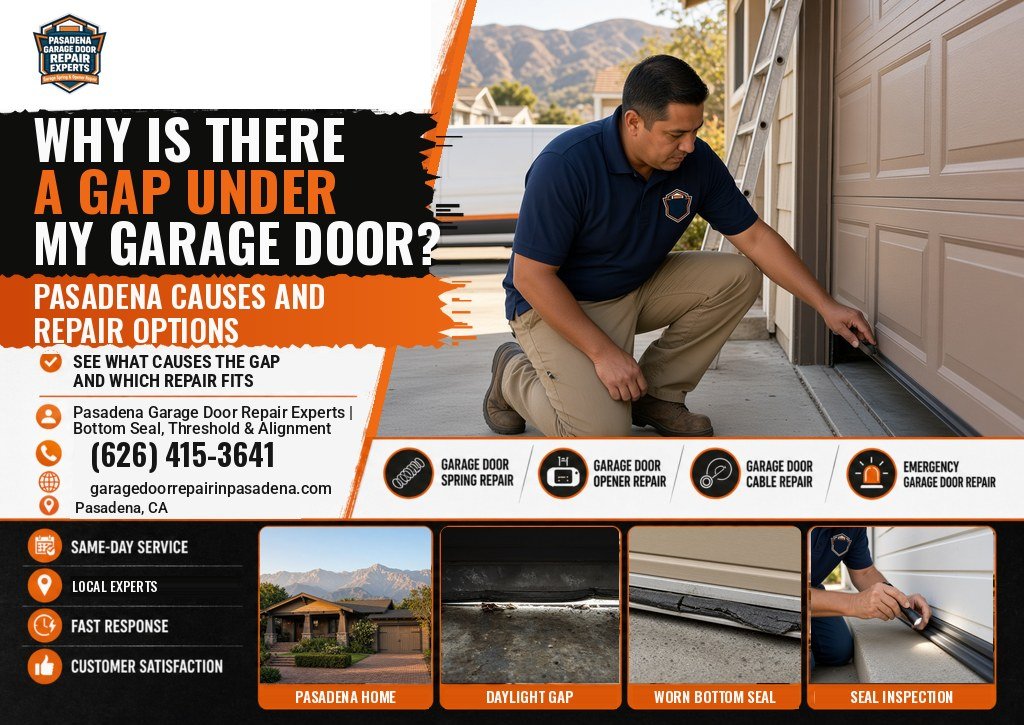
Why Is There a Gap Under My Garage Door? Pasadena Causes and Repair Options
A gap under a closed garage door in Pasadena is usually one of four things: a flattened or torn bottom seal, a floor that has settled or worn unevenly, an opener that stops the door a little early, or a door that is no longer sitting level. The shape of the gap is the most useful clue. An even line of daylight across the width points to the seal or the travel setting. Light only in the middle, or only at one end, usually means the slab or the hardware is the real problem.
A new bottom seal is the right repair for a worn, even gap. It is the wrong repair for a deep dip in the concrete or a cable that has slipped. This guide explains how to tell those cases apart, what you can check yourself, and when to stop and call. For a measured check-up, call Pasadena Garage Door Repair Experts at (626) 415-3641. You get the exact price after the check-up and before any work starts.
Quick Answer: Why Is There a Gap Under My Garage Door?
A gap under a closed garage door in Pasadena usually comes from a worn bottom seal, an uneven floor, an opener that stops the door a little short, or a door sitting higher on one side. Pasadena Garage Door Repair Experts reads the shape of the gap to find which one, then repairs that cause.
An even line of light across the width points to the seal or the opener travel. Light only in the middle, or only at one end, often means the slab has a dip or the door is high on one side. A new bottom seal fixes an even, worn-seal gap. It will not fix a deep trough in the concrete or a cable that has slipped.
How to Read the Shape of the Gap
Close the door completely, turn the garage lights off, and look along the floor from inside on a bright day. You are trying to see where daylight gets through, not just that some light is visible.
An even, thin line from one end to the other usually means the rubber or vinyl on the bottom edge has flattened, cracked, or pulled up, or that the opener stopped the door before the seal could compress. Light only in the middle, or only at a familiar low spot, usually means the floor has settled or worn. Light that is clearly wider at one end, like a wedge, is a different problem: one side of the door is sitting high.
People sometimes mix this up with light at the sides or the top of the frame. Those gaps belong to the jamb or header weatherstripping, not the bottom seal. This article is about the opening under the door. For wear signs on the seals themselves, see when weatherstripping and the bottom seal need replacement.
| What you see | More likely cause | What usually helps |
|---|---|---|
| Even line of light across the full width | Worn or flattened bottom seal, or opener travel that stops short | Replace the seal if it is hard, cracked, or flat. If the seal still looks springy, have the travel setting checked. |
| Light only in the middle, or only at one low spot | Settled or uneven slab | A taller or more flexible bottom seal can cover a shallow dip. A threshold seal on the floor handles a larger low spot. Deep troughs may need slab work. |
| Wedge-shaped gap, wider at one end | Door not sitting level (cable, drum timing, track, or a roller) | A new seal will not hold. Have the hardware checked. Do not loosen a spring or cable to "lower" the high side. |
| No obvious light, but dust, leaves, or water still come in | A small remaining gap, wind-driven rain, or a driveway that pitches toward the opening | Inspect the seal anyway, then look at drainage and whether a threshold seal is needed. A bottom seal is not a watertight dam. |
A Worn or Flattened Bottom Seal
The bottom seal, often called an astragal, is the flexible strip in a retainer on the bottom edge of the door. When the door closes, that strip should compress against the slab and close most of the light gap. Sun, heat, and the daily scrape across concrete take the spring out of vinyl and rubber. The profile goes flat, then it cracks or tears, and an even gap appears.
Press the seal every couple of feet. A usable seal springs back. One that stays dented, feels hard or shiny, or crumbles at a fold is done. Check the ends, too. A seal that has shrunk or been chewed can stop short of the door edges and leave a hole at each corner.
If the rubber looks tired and the gap is fairly even, replacement is the usual first repair. The new insert has to match the retainer profile (T-style, bead, bulb, or a similar shape) and the door width. A mismatched profile will sit crooked or slide back out. If the retainer itself is bent, rusted, or pulled loose from the bottom section, the seal cannot sit straight even when the rubber is new.
An Uneven or Settled Floor
The bottom rail of a garage door is a straight piece of hardware. The floor under it often is not. Older Pasadena slabs, including many in Bungalow Heaven and other early neighborhoods, have settled, cracked, or worn in the tire path. A perfectly good seal can touch at both ends and float over a dip in the middle, or the opposite.
That is why buying a second bottom seal, after the first one "didn't work," is such a common wasted step. The door cannot follow a trough. A slightly taller or more flexible profile can cover a shallow uneven spot. A threshold seal, which is a rubber or vinyl strip bonded to the floor rather than hung on the door, is the usual next step when the low spot is bigger than the door seal can bridge.
A floor that slopes toward the opening is a separate issue from a dip. A slight outward slope is useful because it helps water drain away. Years of settlement can reverse that, so rain on the apron runs toward the door. In that case you can close the light gap and still get water. That is a drainage and threshold problem more than a rubber problem.
The Opener Stopped a Little Early
If the seal still looks round and flexible, and the gap is a slim, even line, watch the last few inches of travel. The door may stop just before the seal compresses. That can show up after an opener is replaced, after a power loss that reset the operator, or after someone changed a travel adjustment.
Note what you see and leave the settings alone unless you already know that opener. Travel and force adjustments affect how the door reverses when it hits an object. Getting them wrong is a safety problem, not just a light-gap problem. A technician can set close travel so the seal meets the floor without driving the door into the slab.
The Door Is Not Sitting Level
A wedge-shaped gap that appeared suddenly is not a seal job. One side is hanging high. Common causes are a cable that has slipped or started to fray, drums that are no longer timed together, a roller that has come out of the track, or a bent track. A section that has shifted will do the same thing.
Stand inside and watch the last few inches. If one side lands and the other is still a half-inch up, the bottom seal cannot stretch enough to close that opening for long. A new strip may look better for a week and then open up again.
Stop here if the door looks crooked. Do not loosen a spring or a cable to "lower" the high side. Springs and bottom brackets are under tension and can cause serious injury. Do not keep cycling a door that is binding or sitting unevenly. Look at the cables and tracks from a distance, then book a technician.
Repair Options That Match the Cause
Match the repair to what you found, or you will replace parts that were not the problem.
- Replace the bottom seal when the insert is flat, cracked, torn, or no longer springs back, and the door is closing square on a reasonably even floor.
- Replace or straighten the retainer when the channel is bent, corroded, or pulling off the bottom section.
- Add a threshold seal when the slab has a dip or ridge the door seal cannot follow, or when a little water sheets across the opening on an otherwise fair floor.
- Have the opener travel checked when the seal is still flexible and the door visibly stops short of the floor.
- Have the cables, drums, rollers, and tracks checked when the gap is wedge-shaped or the door sits unevenly.
- Look at drainage or slab work when water runs to the door because the driveway or apron pitches inward. A new door or a thicker gasket will not change that slope.
For a worn seal that has come off, or for weather that is already getting in, the emergency weather stripping and bottom seal page covers same-day replacement. If you already know the seal is not actually touching the floor, use the bottom-seal contact checklist for a closer look at that symptom.
What a Seal Can and Cannot Fix
Homeowners often hope a new bottom seal will also stop rain. Sometimes it helps, if the old seal had pulled away and was leaving a clear opening. Often it does not. The Door and Access Systems Manufacturers Association (DASMA) treats water at the floor and water on the face of the door as two different problems.
DASMA Technical Data Sheet 197 is about water getting under the bottom of a sectional door. The construction details it shows are a slightly inclined lip or sill, sloped 3 to 5 degrees, that the door rests on, or a rectangular notch in the slab, at least 1/2 inch deep, so the door can close below the surrounding grade. Those are concrete details, usually planned when the garage is built. On an existing driveway, a bonded threshold seal is the practical middle ground. It is not a dam that will hold back water running down a slope.
DASMA TDS 1503 is the companion sheet for rain hitting the face of the door. It states plainly that sectional doors "provide some protection against water infiltration" but "are not leak proof or watertight." Wind-driven rain can still find the sides, the bottom, and the joints between sections. Closing a light gap is still worth doing for drafts, dust, and pests. It is not a promise that the garage will stay dry in a heavy storm. If water under the door is the main complaint, say so when you book the visit, because the technician should look at the apron and the grade as well as the rubber. Water has its own guide: why water gets under a garage door.
Why This Shows Up a Lot in Pasadena
Pasadena's sun and heat are hard on vinyl and rubber, especially on west- and south-facing doors. The material dries, takes a set, and flattens sooner than it would in a milder, shadier climate. Inspect the bottom seal a few times a year and replace it when it has hardened or cracked, not on a fixed calendar.
The housing stock adds a second pattern. Early Craftsman garages and older concrete aprons are often a little uneven to begin with, and hillside streets, including parts of Linda Vista, can send a driveway downhill toward the opening. Wind out of the foothills also pushes dust and leaves at the threshold. A gap you can barely see is enough to leave a repeating tide line of grit just inside the slab.
A maintenance checklist or a tune-up is a good time to catch a flattening seal before the gap gets obvious. For general garage door repair in Pasadena, the same visit can cover whether the door is still closing square.
What You Can Check, and When to Stop
These checks are visual. You do not need to take the door apart.
- Close the door fully and look along the floor from inside with the lights off. Note whether the light is even, in the middle, or at one end.
- Press the bottom seal in several places and at both ends. Decide whether it still springs back or has gone flat, hard, or torn.
- Watch the last few inches of closing. See whether the door stops before the seal compresses, and whether both sides land together.
- Look at the floor for a dip, a ridge, or a puddle line on the outside of the threshold after rain.
A sliding bottom seal in a clean, straight retainer is a job some handy homeowners can do, if the door is disconnected from the opener and supported so it cannot move. Stop if the retainer is bent or rusted, the door is heavy or crooked, or you would have to lift the bottom section in a way that involves springs, cables, or bottom brackets. Do not put foam, a rolled towel, or weather tape in the opening as a permanent fix. Those shift, get pulled, and can interfere with the door or the opener.
If the door will not close, is off track, or looks crooked, treat it as urgent. Call Pasadena Garage Door Repair Experts at (626) 415-3641. A truck is ready 24/7, with emergency response under 1 hour. You get the exact price after the check-up and before any work starts. You can also use the contact page to book a non-emergency visit.
Frequently Asked Questions About Gaps Under Garage Doors in Pasadena
Why is there a gap under my garage door?
The usual causes are a flattened or torn bottom seal, a floor that is no longer even, an opener that stops the door a little short, or a door that is not sitting level. An even line of light points to the seal or travel, one low spot to the slab, and a wedge-shaped gap to the hardware.
Is a small gap under a garage door normal?
A tiny, uneven sliver at a low spot in the concrete is common and is what a flexible bottom seal is meant to cover. A continuous line of light, a gap you can slide a finger through, or a gap that has grown over time is not something to ignore. It lets in drafts, dust, pests, and, in some cases, water.
Why is the gap only on one side?
A gap that is clearly wider at one end usually means that side of the door is sitting high. A slipped or frayed cable, drums that are out of time, a roller out of the track, or a bent track can cause that. A new bottom seal will not hold the fix. Do not loosen a spring or a cable to lower the high side. Call a technician.
Can a new bottom seal close every gap?
No. A new seal fixes an even gap caused by worn rubber, if the door is closing square and the floor is reasonably even. It cannot follow a deep dip in the slab, and it cannot make up for a door that is hanging high on one side. In those cases you need a threshold seal, slab work, or a hardware repair.
How do I tell a worn seal from an uneven floor?
Press the seal. If it is hard, flat, cracked, or torn, start there. Then close the door and look at the light: an even line fits a worn seal or short travel; light only in the middle or at a familiar low spot fits a slab dip, especially if the rubber still springs back.
Could my opener be stopping the door too soon?
Yes. If the seal still looks flexible and the gap is a slim, even line, watch the last few inches of travel. The operator may be stopping before the seal compresses. Leave travel and force settings alone unless you already know that opener, because those adjustments also affect the safety reverse.
Is a gap under the door a safety problem?
A small light gap by itself is usually a weather and pest problem, not an immediate safety emergency. It becomes urgent if the door is crooked, binding, off track, or will not close, or if cables and springs look damaged. In those cases stop using the door and call. Do not try to close a crooked door by adjusting hardware yourself.
Can I fill the gap with foam or a towel?
Not as a standing fix. Soft fillers shift, get pulled by the door, and can interfere with closing or with the opener. Use them only as a short-term weather stop if you must, then repair the actual cause: the seal, the floor, the travel setting, or the hardware.
Will a gap let pests or rain into the garage?
Yes, pests and dust use even a small opening. Rain is less predictable. A worn seal can let water in, but a driveway or apron that slopes toward the door will bring water in even after you replace the rubber. DASMA is clear that sectional doors are not watertight at the floor. A threshold seal or a change to the slab may be needed as well.
What should I check before I call a technician?
Close the door, turn the lights off, and note where daylight comes through. Press the seal to see if it still springs back. Watch whether both sides land together and whether the door stops short. Look at the floor for a dip or a puddle line. Share those details when you call. Skip any check that would mean touching springs, cables, or bottom brackets.
Can I replace a garage door bottom seal myself?
A sliding insert in a clean, straight retainer is a job some handy homeowners can do, if the door is disconnected from the opener and supported so it cannot move. Stop if the retainer is bent or rusted, the door is heavy or crooked, or you would have to work around springs or cables. Match the new profile to the existing retainer.
Who repairs garage door gaps in Pasadena?
Pasadena Garage Door Repair Experts checks the seal, the floor, the opener travel, and whether the door is closing square, then gives you the exact price after the check-up and before any work starts. Call (626) 415-3641. A truck is ready 24/7, with emergency response under 1 hour.
Find Pasadena Garage Door Repair Experts on Google Maps
You can also view Pasadena Garage Door Repair Experts on Google Maps.
Need a Gap Under Your Garage Door Checked in Pasadena?
Call Pasadena Garage Door Repair Experts at (626) 415-3641. We check the bottom seal, the floor, the opener travel, and whether the door is closing square, then give you the exact price after the check-up and before any work starts. If the door is stuck, crooked, or will not close, a truck is ready 24/7, with emergency response under 1 hour.
Serving Pasadena, Altadena, South Pasadena, San Marino, San Gabriel, East Pasadena, Arcadia, Sierra Madre, La Canada Flintridge, Eagle Rock, and Glendale.
Safety reminder: don't adjust or remove springs, cables, or bottom brackets yourself, and don't bypass the opener's safety sensors.
One Response