
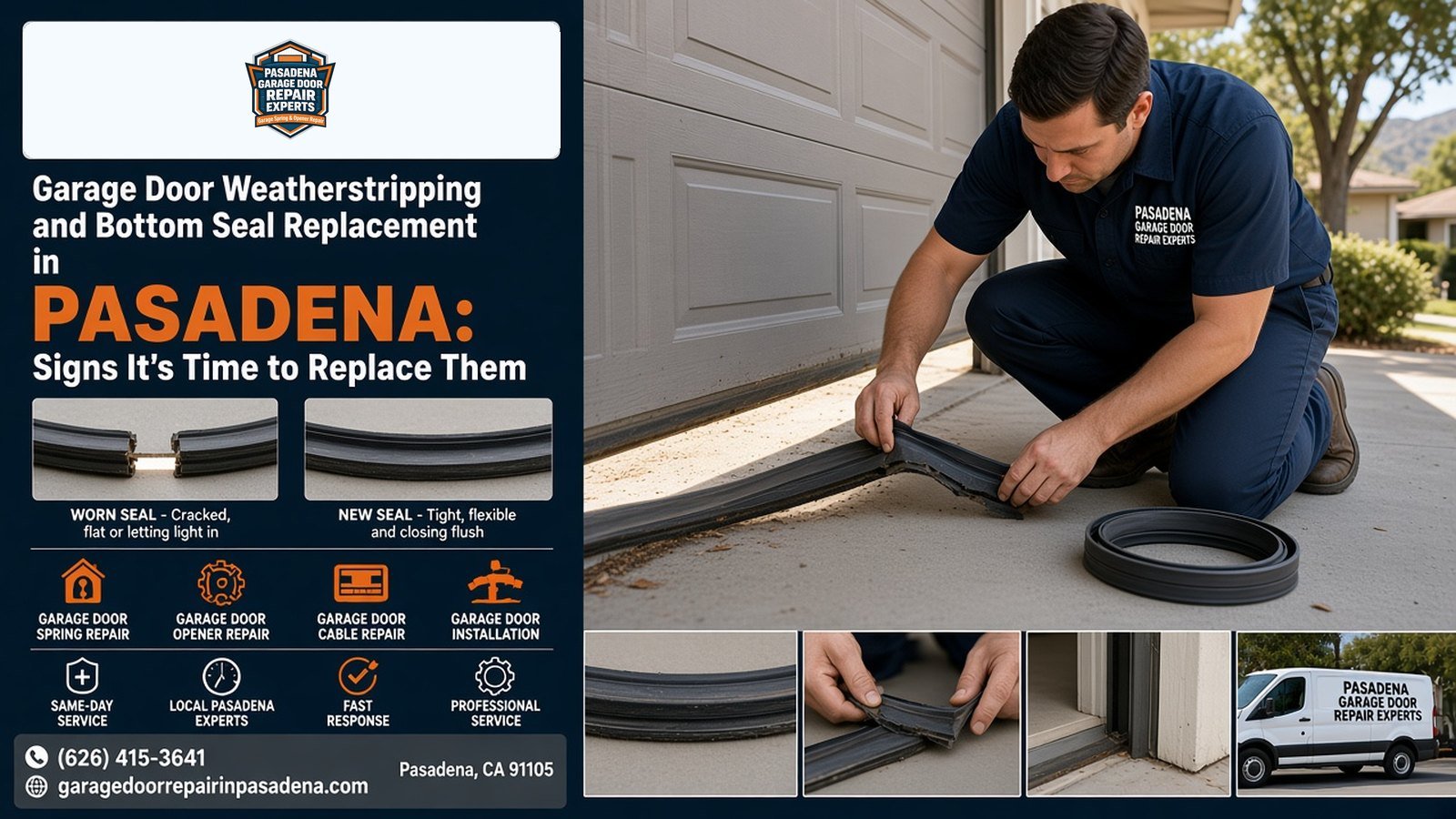
Garage Door Weatherstripping and Bottom Seal Replacement in Pasadena: Signs It's Time to Replace Them
If daylight shows under a closed garage door in Pasadena, or if dust, leaves, or a little water keep showing up just inside the threshold, the usual suspect is the weatherstripping or the bottom seal. Those strips are meant to close the gap around the door. Once the material hardens, cracks, or flattens, it stops doing that job, even if the door itself still runs fine.
A new seal is not always the whole fix. The Door and Access Systems Manufacturers Association (DASMA) is clear that a residential sectional door is not designed to be watertight at the floor, and a driveway that pitches toward the garage will keep bringing water in after you replace the rubber. This guide covers how to tell a worn seal from a floor or alignment problem, what to inspect, and when a replacement is enough. For a measured check-up, call Pasadena Garage Door Repair Experts at (626) 415-3641. You get the exact price after the check-up and before any work starts.
Quick Answer: When Should You Replace Garage Door Weatherstripping?
Short answer: Replace the weatherstripping or bottom seal when the material is cracked, torn, flattened, brittle, or no longer springs back, or when you can see a consistent line of daylight or feel a draft around a closed door. Dirt, bugs, and puddles just inside the opening often follow the same wear. If the door is sitting unevenly, or the driveway slopes into the garage, a new seal alone may not close the gap or keep water out. Call (626) 415-3641 for a check-up in Pasadena.
Bottom Seal, Weatherstripping and Threshold Seals
People use "weatherstripping" for almost any soft strip around a garage door. It helps to split the parts, because they fail in different ways and they are replaced differently.
The bottom seal (Clopay and many techs also call it an astragal) hangs from the bottom edge of the door. When the door closes, it compresses against the floor and closes most of the light gap. Common profiles slide into a retainer on the door: T-style fins, a bulb or U-shape, or a beaded snap-in strip. If you pull on a torn end and it slides in a channel, you are looking at this part.
Perimeter weatherstripping runs along the sides and usually the top of the frame, on the outside of the jambs. Clopay's seal guide describes these as vinyl or rubber stops, nailed, screwed, or stuck to the frame, that stay in light contact with the door as it closes. They stop wind and rain at the edges, not at the floor.
A threshold seal is not on the door at all. It is a rubber or vinyl rib bonded to the floor, right where the door lands. It helps on an uneven slab and can block a shallow sheet of water. It is not a dam that will hold back water running down a driveway.
Some doors also have small seals at the section joints. Those are easy to miss and rarely the first thing that fails. Start with the bottom and the jambs. For urgent water or a seal that has come off completely, see the emergency weather stripping and bottom seal page.
Signs It's Time to Replace Them
Clopay's replacement guidance is straightforward: if the weatherstripping is cracked or visibly worn, or you can feel a draft along the bottom of a closed door, it is time to replace it. That matches what you can check in a few minutes with the door down and the garage lights off.
The seal itself looks worn
Look for cracks, missing chunks, or a flattened profile that no longer springs back when you press it. Vinyl and rubber that have baked in the sun often turn hard and shiny, then split at the folds. A bottom seal that has been dragged across a rough slab may be shredded on one side only. If the retainer is bent, rusted through, or pulled loose from the bottom section, the seal cannot sit straight even when the rubber is new.
Daylight or a draft around the closed door
From inside, with the door closed, look along the floor and the jambs. A short, uneven sliver of light at a low spot in the concrete is common and often handled by the seal's flexibility. A continuous line of light, or a gap you can slide a finger through, usually means the seal has taken a set or pulled out of the retainer. A draft you can feel with the back of your hand is the same test in air instead of light.
Dirt, leaves, bugs, and a dusty "tide line"
Pasadena wind moves a lot of dust and leaf litter. A little debris near the door is normal after a windy week. A repeating pile in the same place, or a clean tidemark of grit a few inches inside the slab, points to a gap that is staying open. Insects follow those same openings.
The door scrapes, or the opener works harder at the last inch
A swollen, folded, or badly fitted seal can drag on the floor. So can a seal that was installed too long and bunched at the ends. Don't turn up the opener force to push through it. That hides the binding and can damage the door. If the door used to close quietly and now scuffs the slab, inspect the seal before you assume the opener is failing.
When the Gap Is Not the Seal
Replacing a tired seal is wasted if the door is no longer meeting the floor evenly. Stand inside and watch the last few inches of travel. If one side lands first and the other hangs a half-inch up, the bottom seal cannot stretch enough to close that gap for long.
A door that sits low on one side often has a cable that has slipped or started to fray, a drum that is no longer timed with the other side, or a roller that is out of the track. A bent track or a section that has shifted will do the same thing. Those are hardware problems. A new strip of rubber will look better for a week and then open up again.
The floor can be the uneven part. Many older Pasadena garages slope toward the opening so water drains out, which is what you want, but years of settling leave dips and ridges. The bottom seal is meant to take small differences, not a deep trough. In that case a threshold seal, or in a bad case work on the slab, matters more than a fancier bottom profile.
Don't try to "lower the door" by loosening a spring or a cable to close a light gap. Springs and bottom brackets are under tension and can cause serious injury. If the door looks crooked, stop at a visual check and book a technician.
Water Under the Door: What DASMA Actually Says
A wet track just inside the door after a storm is one of the most common reasons people replace a bottom seal, and sometimes that is the right call. A cracked or flattened seal will let a thin sheet of water through. It is not the only path, and it is not a failure of the new door if water still appears later.
DASMA Technical Data Sheet 197 covers water at the floor of a sectional door. The guidance is aimed at builders as much as homeowners: a slight slope or a notched sill in the slab, in the 3- to 5-degree range in their figures, is how you keep water from migrating inside. The bottom seal helps. It is not a watertight barrier, and DASMA does not treat residential garage doors as leak-proof at the threshold.
A related sheet, TDS 1503, makes a broader point about rain on the face of the door. Water can run between sections, travel to the ends, and show up inside even when the bottom seal is in good shape. Wind-driven rain makes that worse. If your garage faces the weather with little overhang, expect some moisture around the door in a hard storm. That is a limitation of the product, not automatically a bad installation.
Ask whether the seal is actually worn, or whether water is being delivered to the opening faster than any seal can turn it away. If the driveway pitches toward the garage, fix the drainage or add a threshold after you replace a failed seal, not instead of looking at the seal.
How Pasadena Weather Wears Seals Out
Clopay's rule of thumb is that most seals need replacing every 2 to 3 years, depending on climate and use. Treat that as a reminder to inspect, not as a warranty. Condition matters more than the calendar.
Pasadena is hard on the materials in a specific way. Summer heat and UV on a west- or south-facing door bake vinyl and rubber until they harden and split. Santa Ana winds push dust and grit into every gap, and that grit acts like sandpaper on a bottom seal every time the door closes. After a fire season, ash collects along the same edge. Occasional heavy rain then tests whatever is left of the contact at the floor.
Older neighborhoods add a second problem: out-of-square openings, sloped floors, and stop molding that has been painted over so many times that the side seals no longer sit flat. A bungalow door that was never a perfect 16x7 will wear a stock seal unevenly. In a designated historic district, replacing seals in the same opening is a maintenance item; changing the look or size of the door is a different conversation with Planning. The seals themselves are usually not the historic feature.
If you already keep a maintenance checklist, add a seal inspection to it a few times a year, especially before the first real rain and again at the end of summer. A yearly tune-up is a good time to catch a retainer that is starting to rust or a side seal that has pulled away from the jamb.
What Replacement Involves
For a bottom seal, the usual job is to raise the door to a comfortable height, disconnect the opener, and slide the old strip out of the retainer. A little soapy water helps if the old rubber has glued itself in place with dirt. The new seal is cut slightly long, fed into the same channel, and trimmed after it sits evenly. You have to match the profile. A T-end will not stay in a bead retainer, and a thin fin will not fill a wide bulb channel.
If the retainer is bent, cracked, or rusted, it should be replaced with the seal. Screwing a new retainer to a rotten or delaminated bottom section is a bigger repair, and on a wood door that can mean work on the section itself.
Perimeter seals come off the jambs and get replaced with new vinyl or rubber stops, fastened so they just kiss the door when it is closed. If they are set too tight, the door scuffs and the opener strains. If they are set loose, you still see light at the sides. Rotten wood jambs should be repaired first, or the new nails will not hold.
A threshold seal needs a clean, dry floor and the right adhesive. Clopay advises leaving the door closed and staying off the strip for at least 24 hours while it cures. Driving over a fresh threshold is a common way to ruin a new install.
None of this is a reason to change the springs, unless you are also changing the door. A new seal adds very little weight. If someone quotes a spring job just to replace weatherstripping, ask what else they found.
What You Can Check Yourself, and When to Stop
Safe homeowner checks:
- Close the door and look for daylight along the floor and jambs.
- Press the bottom seal with your fingers and see if it is still flexible.
- Note puddles, dirt piles, or a repeating wet line after rain.
- Look at the retainer for rust, missing screws, or a pulled-out corner.
- Watch the door close and see whether both sides land together.
A sliding replacement of a T-style or similar bottom seal, on a door that is otherwise sound, is a reasonable DIY job for someone comfortable working under a disconnected door. Support the door so it cannot drop, keep fingers out of section joints, and stay away from springs, cables, and bottom brackets.
Stop and call if the door is crooked, the bottom section is rotting or coming apart, the retainer is failing, or you would need a ladder at an awkward angle to work on a heavy door. Also stop if the real problem looks like water coming down the driveway. In that case, replacing only the rubber will not finish the job. For an insulated door, a tight seal matters more; see our guide to whether an insulated garage door is worth it in Pasadena, because insulation does little at the edges if the perimeter is open.
How to Decide What to Replace
Start with the part that actually failed. If only the bottom seal is flat and the sides still close the light gap, replace the bottom seal and inspect the retainer. If the sides are brittle or pulled off the jambs, do those at the same time so you are not chasing drafts a month later. Add a threshold seal when the floor is uneven or when water still reaches a healthy bottom seal.
If the door is not square to the floor, fix that first or at the same time. A new seal on a crooked door is a short-term cosmetic fix.
Pasadena Garage Door Repair Experts can measure the opening, check the seals and the hardware, and tell you which of those is actually letting in light, dust, or water. That visit is part of ordinary garage door repair in Pasadena. Call (626) 415-3641 or use the contact page. The exact price comes after the check-up, before any work starts. If the door will not close or a seal has torn off and left the door scraping, a truck is ready 24/7, with emergency response under 1 hour.
Frequently Asked Questions About Garage Door Weatherstripping in Pasadena
How do I know if my garage door weatherstripping needs to be replaced?
Replace it when the rubber or vinyl is cracked, torn, flattened, hard, or no longer springs back, or when you can see daylight or feel a draft around a closed door. Dirt, leaves, bugs, and puddles just inside the threshold are later signs of the same problem.
What is the difference between weatherstripping and a bottom seal?
Weatherstripping usually means the perimeter seals on the sides and top of the frame. The bottom seal, sometimes called an astragal, is the flexible strip on the bottom edge of the door. A threshold seal is a separate strip bonded to the floor. They work together; one worn piece can leave a gap even if the others are fine.
Can a new bottom seal stop water from coming into the garage?
Sometimes, if the old seal is cracked or no longer touches the floor. Often it cannot. DASMA TDS 197 explains that a residential sectional door is not designed to be watertight at the floor, and a sloping driveway or garage floor will keep bringing water to the opening. A threshold seal or a change to the slab may be needed as well.
Why is there a gap under my closed garage door?
A worn or flattened bottom seal is one cause. Other common causes are a floor that is not level, a door that is not closing square because a cable has slipped or a track is bent, or a panel that has warped. Look at the seal first, then check whether the door itself is sitting evenly.
How often should garage door seals be replaced in Pasadena?
Replace them by condition, not by a calendar. Clopay's rule of thumb is that most seals need replacing every 2 to 3 years, depending on climate and use. In Pasadena, sun and heat on a west- or south-facing door can dry vinyl and rubber faster than that, so inspect a few times a year and replace when the material has hardened, cracked, or stopped sealing.
Can I replace a garage door bottom seal myself?
A sliding T-style or bead-style seal in a clean retainer is a job some handy homeowners can do, if the door is disconnected from the opener and supported safely. Stop if the retainer is bent or rusted, the door is heavy or crooked, or you would have to touch springs, cables, or bottom brackets. Those parts are under tension.
What kind of bottom seal do I need?
Match the new seal to the retainer already on the door. Common residential profiles include T-style (one or two fins that slide into a channel), bulb or U-style, and bead or snap-in styles. A seal that does not fit the retainer will pull out or leave gaps. Bring a short cut-off of the old seal if you are not sure.
Do I need a threshold seal as well as a new bottom seal?
A threshold seal helps when the floor is uneven or when water still reaches the opening after the bottom seal is in good condition. It is bonded to the floor and needs a clean, dry surface and time to cure. It is not a substitute for fixing a driveway that pitches toward the garage.
My door is harder to close since I installed a new seal. Is that normal?
A new seal should compress, but it should not make the opener strain or the door bounce. The profile may be too thick, the seal may be bunched in the retainer, or the door may already have been closing tightly. Don't raise the opener force to push through it. Recheck the fit first.
Will new weatherstripping help with dust, bugs, or hot air in a Pasadena garage?
It helps if the current seals are the reason air and debris are getting in. A tight perimeter and bottom seal cuts drafts and a lot of dust and insects. It will not turn the garage into a sealed room, and it will not fix a door that is out of square or a large gap caused by the floor.
Should I also replace the side and top seals if only the bottom looks worn?
Inspect all of them. The bottom seal takes the most abuse from the floor, but sun-facing side and top seals often harden or shrink on their own schedule. If the sides still flex and close the light gap, you can replace the bottom only. If they are brittle or pulled away from the jamb, replace those too.
Who can replace garage door weatherstripping in Pasadena?
Pasadena Garage Door Repair Experts replaces bottom seals, perimeter weatherstripping, and threshold seals across Pasadena and nearby cities. Call (626) 415-3641. You get the exact price after the check-up and before any work starts.
Find Pasadena Garage Door Repair Experts on Google Maps
You can also view Pasadena Garage Door Repair Experts on Google Maps.
Need Weatherstripping or a Bottom Seal Replaced in Pasadena?
Call Pasadena Garage Door Repair Experts at (626) 415-3641. We check the seals, the floor, and whether the door is closing square, then give you the exact price after the check-up and before any work starts. If the door is stuck or won't close, a truck is ready 24/7, with emergency response under 1 hour.
333 W California Blvd, Pasadena, CA 91105 · Serving South Pasadena, Pasadena, Altadena, San Marino, San Gabriel, East Pasadena, Arcadia, Sierra Madre, La Canada Flintridge, Eagle Rock, and Glendale
Safety reminder: don't adjust or remove springs, cables, or bottom brackets yourself, and don't bypass the opener's safety sensors.
One Response