

The Pasadena Garage Door Maintenance Checklist: Springs, Rollers, Tracks, Cables and Opener
Garage-door maintenance is not about taking the entire system apart. For most Pasadena homeowners, the most useful maintenance routine is a combination of regular observation, cleaning, appropriate lubrication, basic safety testing and knowing when a mechanical condition has moved beyond homeowner maintenance into professional repair.
Springs, rollers, tracks, lift cables and the automatic garage-door opener all perform different jobs. A good maintenance checklist treats those components separately while also recognizing that they work together. A worn roller can affect track movement. A cable problem can make the door crooked. A failed spring can make the opener appear weak. A dirty or misaligned safety sensor can interfere with closing even when the door hardware itself is in good condition.
This guide from Pasadena Garage Door Repair Experts explains what Pasadena homeowners can safely inspect, which signs of wear deserve attention, how frequently common checks make sense, and which high-tension components should not be adjusted as a do-it-yourself maintenance project.
What Should Be Included in a Pasadena Garage Door Maintenance Checklist?
A practical garage door maintenance checklist should include visually inspecting springs and lift cables, checking rollers for wear, keeping tracks clean and aligned, inspecting hinges and ordinary fasteners, listening for new noises, testing the automatic opener and safety systems according to the manufacturer's instructions, checking door balance and movement, inspecting weather seals and lubricating only the components the door or opener manufacturer identifies as serviceable.
Homeowners should not wind or unwind torsion springs, loosen spring brackets, adjust cable drums, remove bottom cable brackets, reconnect lift cables under tension or force a badly misaligned garage door as part of routine maintenance.
The purpose of maintenance is to identify developing wear before it becomes a larger mechanical problem. If the door becomes unusually heavy, crooked, off track, jerky, difficult to operate or noticeably different from its normal movement, stop treating the condition as routine maintenance and diagnose the underlying cause.
Why Garage Door Maintenance Matters
A residential garage door is a large moving mechanical system. Each operating cycle causes springs to load and unload, rollers to travel through the tracks, hinges to pivot, cables to wind and unwind around their drums and the automatic opener to move the door through its programmed travel.
Even when the garage door appears simple from the driveway, dozens of mechanical relationships must remain reasonably aligned for smooth operation.
Maintenance matters because wear usually develops gradually.
A roller may begin wobbling before it breaks. A hinge may loosen before it bends. A cable may show individual broken strands before complete failure. A track bracket may begin moving slightly before alignment becomes severe. A garage-door opener may become noisier before an internal component stops working normally.
Recognizing these changes early gives the homeowner an opportunity to address the actual component before secondary damage develops.
For example, a worn roller does not affect only the roller. If it stops turning smoothly, the roller can create more friction in the track. That resistance can make the door move less smoothly, create additional noise and place more load on hinges and the automatic opener.
A cable problem can also spread through the system. If one side loses normal support, the door can become crooked. A crooked garage door can bind rollers against the tracks, place unusual loads on hinges and cause the opener to pull against a door that is no longer moving evenly.
The same principle applies to springs.
Springs counterbalance much of the garage door's weight. When the counterbalance system is not functioning correctly, the automatic opener may appear weak even though the underlying issue is mechanical door balance.
A useful maintenance routine therefore looks for changing conditions rather than waiting for complete failure.
How Often Should Pasadena Homeowners Maintain a Garage Door?
There is no single universal maintenance interval that applies identically to every garage door, because doors differ in design, age, materials, operating frequency, opener model and environment.
A practical schedule is to combine frequent visual checks with periodic cleaning and manufacturer-directed maintenance.
The Door & Access Systems Manufacturers Association recommends monthly safety checks and notes that an annual visit from a trained door-systems technician can help keep a garage door operating smoothly.
Homeowners should also follow the maintenance schedule in the owner's manuals for the specific garage door and automatic opener.
Frequency should increase when the garage door is used unusually often or when the homeowner notices a change.
A household that uses the garage as its primary entrance may cycle the door several times throughout a normal day. A detached garage used primarily for storage may operate much less frequently.
More cycles mean more repeated movement of the springs, hinges, rollers, cables and opener.
The important point is not following a calendar blindly. Maintenance should also respond to symptoms.
If a garage door that was previously smooth suddenly develops grinding, becomes crooked or starts requiring more opener effort, the homeowner should not wait for the next scheduled maintenance date.
Before You Start: Garage Door Maintenance Safety
Garage-door maintenance should begin with understanding which components are appropriate for homeowner inspection and which components store substantial mechanical energy.
The spring and cable systems deserve particular caution.
DASMA warns that garage-door springs are among the most important and potentially dangerous parts of the system and that cables connected to the spring system can be under high tension.
The manufacturer's instructions for the specific door and opener should always take priority over a general checklist.
Before close-range inspection:- Keep children and pets away from the garage door.
- Park vehicles clear of the moving door.
- Do not perform maintenance beneath an unstable or partially supported door.
- Do not touch a visibly frayed cable.
- Do not loosen red-marked or otherwise identified high-tension hardware.
- Do not adjust torsion-spring winding cones.
- Do not loosen cable drums.
- Do not remove bottom brackets connected to lift cables.
If the garage door is already crooked, off track, unusually heavy or supported by a loose cable, stop before attempting routine maintenance.
Those conditions need diagnosis first.
1 Inspect the Garage Door Springs
Springs are central to garage-door balance.
Most modern sectional residential garage doors use either torsion springs mounted above the opening or extension springs positioned along the upper tracks.
The homeowner's maintenance role is primarily visual inspection.
What to look for on torsion springs
Stand on the floor and look at the spring assembly without touching it.
Watch for:
- A visible gap in a torsion spring.
- Cracked or separated coils.
- Significant rust or corrosion.
- Spring position that appears different from before.
- Loose or visibly damaged mounting components.
A clear separation in the coils generally indicates a broken torsion spring.
A homeowner may also have heard a loud bang when the spring failed.
After spring failure, the garage door can become dramatically heavier because the opener is no longer receiving the intended counterbalance assistance.
What to look for on extension springs
Extension springs should also be inspected from a safe location for visible distortion, damage and separation.
DASMA recommends safety cables for extension-spring systems so that a broken extension spring can be better contained.
Do not stretch, shorten or reattach an extension spring as part of routine homeowner maintenance.

Is spring squeaking always a problem?
No.
Springs can create normal mechanical noise during operation. DASMA notes that squeaking does not necessarily mean the spring has failed.
What matters is whether the sound is accompanied by a change in door movement, balance or visible spring condition.
A squeak from an otherwise smooth door deserves a different response than a loud bang followed by an unusually heavy garage door.
What homeowners should not do
Do not wind, unwind or reposition torsion springs as routine maintenance.
Do not loosen winding cones or spring anchors.
Lubrication, where recommended for the particular spring and system, should follow manufacturer guidance and should never involve altering spring tension.
2 Inspect Garage Door Rollers for Wear and Smooth Movement
Rollers guide the garage door through the vertical, curved and horizontal tracks.
Every opening and closing cycle requires the rollers to move while the garage-door sections change position.
A damaged roller can create:
- Grinding.
- Rumbling.
- Clicking.
- Wobbling.
- Jerky movement.
- Abnormal contact with the track.
Watch the rollers while the garage door operates
Observe from a clear location.
Rollers should remain inside their tracks and travel without obvious severe wobble or repeated binding.
Genie maintenance guidance recommends checking for broken rollers, bent shafts, worn bearings, chips, warping and cracks.
Steel versus nylon rollers
Different roller types show wear differently.
Steel rollers can develop bearing wear or become noticeably uneven. Nylon rollers can crack or chip.
The correct maintenance approach depends on whether the roller has a serviceable bearing and what the manufacturer recommends.
Lubrication does not repair a damaged roller
Appropriate lubricant may help a serviceable bearing or moving point.
It cannot repair:
- A cracked wheel.
- A bent stem.
- A seized bearing.
- A roller that has separated.
If the roller is physically damaged, replacement may be more appropriate than additional lubrication.
Use extra caution around bottom rollers
The lower roller brackets can be associated with the lift-cable system.
Homeowners should not remove a bottom bracket merely to perform roller maintenance because that bracket may be connected to high-tension components.
3 Inspect and Clean the Garage Door Tracks
Garage-door tracks guide the roller path.
Their job is not to carry a thick coating of grease. Their job is to remain appropriately aligned, mounted and clear enough for the rollers to travel normally.
Look for debris
Dust, leaves and garage debris can accumulate along the lower track area.
Remove loose debris without forcing tools between loaded rollers and track surfaces.
Look for dents and bends
A vehicle, bicycle, ladder or storage item can strike a vertical track.
Even a relatively small bend can create a tight point that the roller must pass through every cycle.
Repetitive scraping or popping at the same door height can point toward a localized track or roller issue.
Look at track mounting
Track brackets should not visibly move away from their mounting every time a roller passes.
Look for missing ordinary fasteners, obvious bracket movement or separation from the surrounding structure.
Do not grease the tracks as a cure for binding
Heavy grease can collect dirt and does not correct mechanical misalignment.
If the roller is grinding because the track is bent, adding grease does not restore track geometry.
Track alignment and roller condition must be considered together
A worn roller can create abnormal track contact even when the track itself is straight.
Likewise, a good roller can bind in a damaged track.
Maintenance should therefore identify which component is causing the friction.
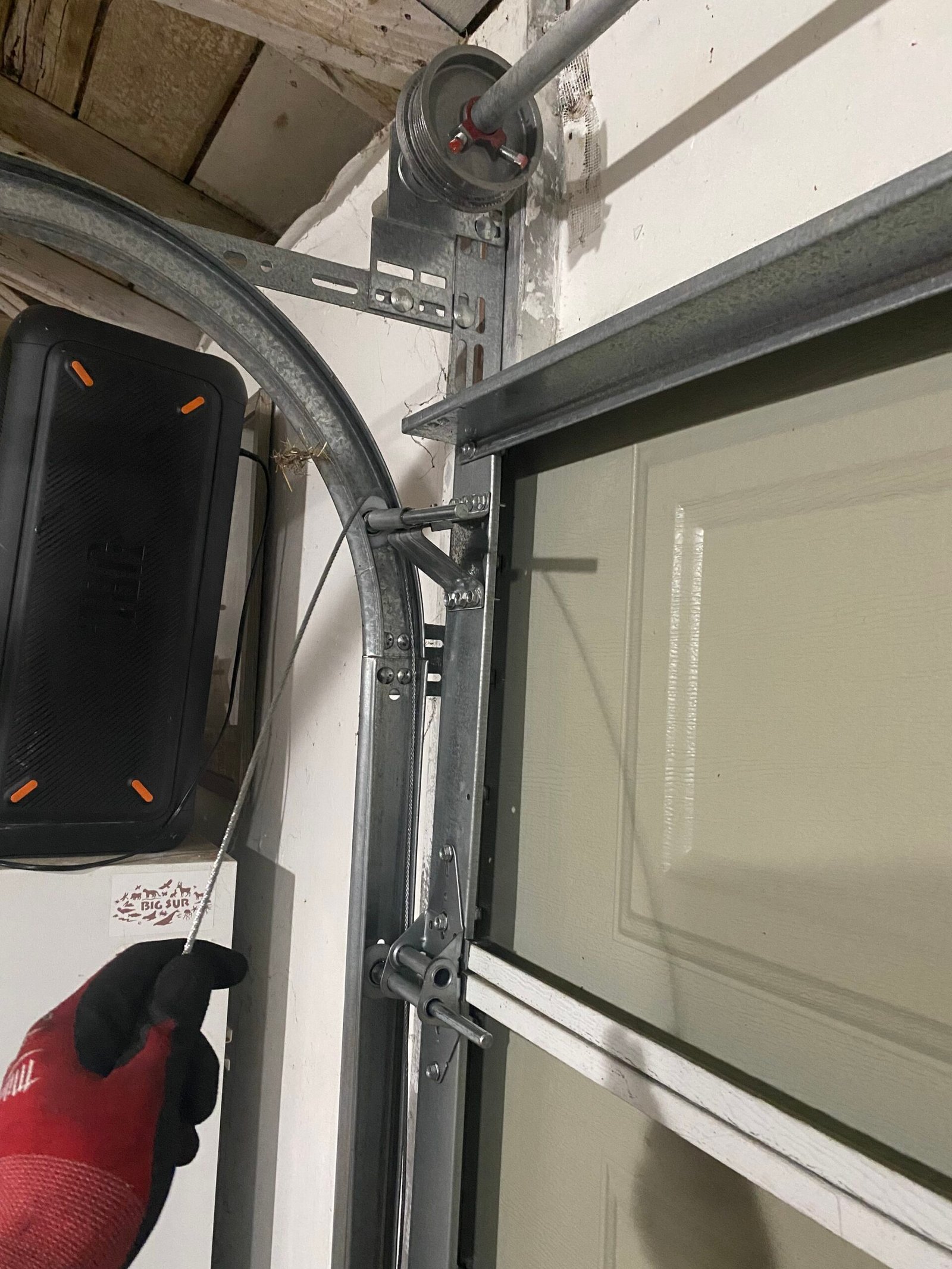
4 Inspect Garage Door Lift Cables and Cable Drums
Garage-door lift cables are part of the counterbalance system.
On a typical torsion-spring arrangement, cables connect near the lower corners of the garage door and wind around drums mounted near the ends of the torsion shaft.
The homeowner should inspect these components visually without adjusting them.
Look for cable fraying
Check for individual broken wire strands, flattened areas, kinks, corrosion or cable sections that appear damaged.
A frayed cable can look like small metal hairs are protruding from the wire rope.
Do not run your fingers along a cable to confirm fraying. Broken steel strands can be sharp.
Compare left and right cables
One cable hanging noticeably looser than the other can indicate a problem.
Possible causes include:
- A cable coming off its drum.
- A broken cable.
- A spring problem.
- A crooked or off-track garage door.
- Uneven mechanical resistance.
Look at the cable drums
The cables should wind in an orderly manner through the intended drum grooves.
A cable that appears bunched, crossed or partially outside its drum grooves deserves further inspection.
Why cable maintenance is mostly inspection
DASMA warns that cables connecting the spring system to the bottom brackets can be under high tension and that worn or frayed cables should be replaced by trained personnel.
Homeowners should not:
- Pull a loose cable by hand.
- Rewind a cable onto the drum.
- Loosen drum set screws.
- Remove bottom cable brackets.
- Reconnect a lift cable under tension.
The maintenance goal is to spot deterioration before complete cable failure.
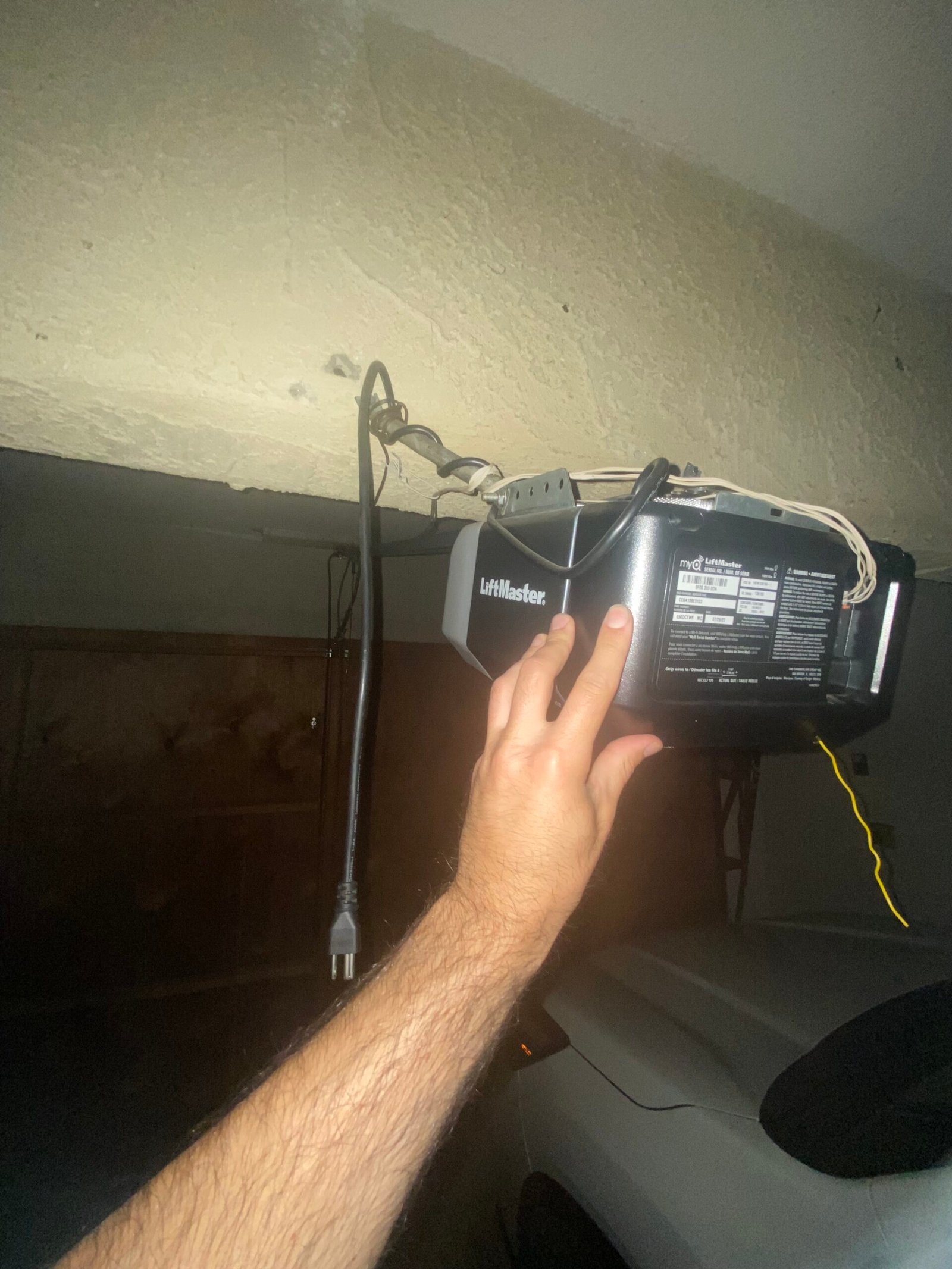
5 Inspect the Automatic Garage Door Opener
The automatic opener and the garage door are separate systems that work together.
The opener provides powered movement. Springs counterbalance door weight. Tracks and rollers guide the door. Cables transfer lifting force.
This distinction matters during maintenance because an opener that appears weak may actually be reacting to a heavy or binding garage door.
Listen to the opener
Pay attention to new:
- Grinding.
- Chain rattling.
- Slapping.
- Humming.
- Unusual motor noise.
- Vibration.
A sudden sound change is more useful diagnostically than simply labeling a particular opener model “noisy.”
Check the opener mounting visually
Observe whether the powerhead and rail appear stable during normal operation.
Excessive movement of mounting hardware can transmit vibration into the garage ceiling and adjacent living areas.
Observe the opener arm and top section
The opener arm should not appear to be twisting or pulling the top section dramatically because the garage door is jammed below.
If the garage door is mechanically binding, stop operation rather than allowing the opener to overpower the resistance.
Follow model-specific maintenance instructions
Chain-drive, belt-drive, screw-drive and wall-mount operators can have different maintenance requirements.
Do not assume that a lubrication procedure for one drive system applies to another.
Genie recommends following the specific garage-door and opener manuals when performing planned maintenance.
6 Check Garage Door Hinges and Ordinary Hardware
Hinges allow the sections of a sectional garage door to pivot as they move through the curved track.
Because this movement occurs every cycle, hinges deserve regular visual attention.
Look for loose ordinary fasteners
Fasteners associated with ordinary hinges and reinforcement can loosen over time.
The owner's manual should guide which ordinary hardware can be checked or tightened.
Do not treat every bolt on a garage door as ordinary maintenance hardware.
Some fasteners are part of the spring or cable system.
Look for bent or cracked hinges
A damaged hinge can change the angle of a roller stem and contribute to binding.
Look for:
- Bending.
- Cracking.
- Elongated mounting holes.
- Hardware pulling away from the door section.
- Abnormal movement during operation.
Pay attention to repetitive popping
If a pop occurs at the same door position every cycle, watch which hinge reaches the curved track at that moment.
Timing can help identify the source without dismantling the system.
7 Check Garage Door Safety Sensors and Closing Protection
Modern automatic garage-door systems include safety features intended to reduce entrapment risk.
The U.S. Consumer Product Safety Commission states that automatic residential garage-door operators are subject to the federal safety standard in 16 CFR Part 1211.
Homeowners should maintain and test safety features according to their opener manufacturer's instructions.
Inspect photo-eye sensors
Sensors are commonly mounted low on each side of the garage-door opening.
Check that they:
- Remain mounted securely.
- Appear aligned.
- Have clean lenses.
- Are not blocked by stored items.
- Have wiring that is not obviously damaged.
Do not bypass a sensor problem
If the garage door refuses to close because the safety system is not operating normally, identify the reason rather than permanently defeating or bypassing the protection.
Test safety functions according to the owner's manual
Exact testing procedures can differ by opener.
Follow the manufacturer's instructions for photo-eye and reversal testing.
If the opener does not respond as the manual describes, service may be appropriate before normal automatic closing continues.
8 Pay Attention to Garage Door Balance and Manual Movement
Garage-door balance is one of the best indicators of counterbalance-system condition.
A properly functioning spring system helps offset door weight so the opener does not have to lift the entire physical weight by itself.
Warning signs of balance trouble
- The garage door suddenly feels much heavier.
- One side rises faster than the other.
- The door becomes crooked.
- The opener strains at the beginning of travel.
- The door moves awkwardly when disconnected according to manufacturer instructions.
- The door will not remain controlled during manual movement.
DASMA notes that a garage door that does not move smoothly may have an out-of-balance spring system and warns that spring-system repairs should be handled by trained professionals.
Use caution with manual testing
Do not disconnect an opener from a partially open, crooked, off-track or unstable garage door simply to perform a balance test.
Manual-release procedures should follow the opener manufacturer's instructions and should only be considered when the door is in a stable condition.
If the door becomes unexpectedly heavy or difficult to control, stop the test.
9 Lubricate the Right Garage Door Components
Lubrication is one of the most commonly misunderstood parts of garage-door maintenance.
The goal is not to spray lubricant on every metal surface.
The goal is to reduce friction at appropriate moving points where the manufacturer specifies lubrication.
Components that may require lubrication depending on design
- Hinge pivot points.
- Serviceable roller bearings.
- Specified door bearings.
- Certain spring surfaces or bearing points.
- Manufacturer-approved opener-drive components.
Do not assume all rollers need lubricant
Roller construction varies.
Some rollers contain serviceable bearings. Some components are sealed. Nylon wheels and their bearings should not automatically be treated the same as basic steel rollers.
Use the garage-door manufacturer's maintenance instructions.
Do not coat garage-door tracks in heavy grease
Tracks should remain clean and correctly aligned so rollers can travel normally.
Heavy grease can attract dirt and does not repair a bent track or damaged roller.
Lubrication does not replace mechanical diagnosis
Lubricant cannot fix:
- A cracked roller.
- A broken hinge.
- A frayed cable.
- A broken spring.
- A bent track.
- A damaged opener gear.
If the noise or binding quickly returns after appropriate lubrication, look for wear or alignment problems.
10 Inspect Garage Door Panels and Structural Condition
Garage-door maintenance should include the door itself, not only the moving hardware.
Look at the exterior and interior surfaces for changes.
Steel doors
Look for:
- Dents.
- Creasing.
- Rust.
- Corrosion around fasteners.
- Sections beginning to bow.
Wood doors
Wood garage doors can show:
- Warping.
- Cracking.
- Moisture damage.
- Peeling or deteriorating finish.
Why panel condition affects operation
A garage-door section is part of the moving structure.
Severe panel deformation can change hinge and roller geometry.
A section damaged by vehicle impact may pull the roller toward or away from the track even when the roller itself is still usable.
Structural condition should therefore be included when investigating new track rubbing or uneven movement.
11 Inspect the Bottom Weather Seal and Perimeter
The bottom seal and perimeter weather seals help close gaps around the garage door.
Over time, these materials can become:
- Cracked.
- Brittle.
- Torn.
- Compressed.
- Partially detached.
A damaged bottom seal can allow more dust, leaves, insects and moisture to enter the garage.
Pasadena's warm conditions and sun exposure can also contribute to aging of exterior rubber and flexible materials over time.
Check for daylight around the closed door
From inside the garage during daylight, look for obvious gaps around the perimeter.
A gap does not automatically mean the door itself is misaligned.
The issue can be worn weather seal, perimeter molding, uneven flooring or door alignment.
Diagnose the specific condition before making adjustments to the track or opener travel.
12 Listen for Changes in Garage Door Noise
One of the easiest maintenance tools is familiarity with how the garage door normally sounds.
A mechanical system does not have to be silent to be healthy.
What deserves attention is a new or changing sound.
Grinding
Grinding can involve worn roller bearings, track contact or opener-drive components.
Squeaking
Squeaking can involve hinges, rollers, springs or other moving points.
Popping
Popping can involve hinge articulation, spring movement, rollers or panel flex.
Rattling
Rattling often suggests vibration from mounting hardware, tracks, opener components or door reinforcement.
Scraping
Repetitive scraping can point toward track contact or a roller that is not traveling normally.
The most useful clues are the location and timing.
A pop that happens every time the same hinge enters the curved track points toward a different condition from grinding that comes directly from the opener powerhead.
Complete Garage Door Maintenance Checklist
| Component | What to Check | Homeowner Maintenance | Warning Signs | Do Not DIY |
|---|---|---|---|---|
| Springs | Gap, rust, damage, abnormal position | Visual inspection; manufacturer-approved lubrication where applicable | Broken coil, heavy door, loud bang | Winding, unwinding, cone or anchor adjustment |
| Rollers | Cracks, wobble, bent stems, rough movement | Observe movement; lubricate serviceable bearings if specified | Grinding, binding, wheel damage | Bottom-bracket removal |
| Tracks | Debris, bends, loose mounting, rubbing | Remove loose debris; visually inspect | Scraping, repeated binding, roller climbing track edge | Forcing a loaded damaged track |
| Lift cables | Fraying, broken strands, slack, drum position | Visual inspection only | Loose cable, crooked door, cable off drum | Drum adjustment, bottom-bracket removal, cable reconnection |
| Hinges | Bending, cracking, ordinary fastener movement | Inspect and follow manual for ordinary hardware | Popping, excessive movement, distorted hinge | High-tension hardware |
| Opener | Noise, mounting, arm movement, drive behavior | Follow manufacturer maintenance schedule | Grinding, severe vibration, repeated stalling | Using opener to overpower a jammed door |
| Safety sensors | Alignment, cleanliness, wiring, obstruction | Clean and test according to opener manual | Closing reversal or failure to close normally | Bypassing safety equipment |
| Door balance | Level travel and reasonable counterbalance | Observe behavior; follow manufacturer manual testing instructions | Heavy door, crooked travel, unstable manual movement | Spring adjustment |
| Panels | Dents, bowing, corrosion, cracks | Cleaning and visual inspection | Structural distortion affecting roller geometry | Forcing severely damaged sections straight |
| Weather seals | Cracks, gaps, brittle material | Cleaning and visual inspection | Daylight, moisture or debris entering | Unrelated track adjustments without diagnosis |
A Simple Monthly Garage Door Maintenance Routine
Homeowners do not need to spend hours dismantling the garage door each month.
A focused visual routine can identify many developing problems.
Step 1: Watch one complete opening cycle
Stand clear and observe whether the door remains level.
Listen for sounds that were not present before.
Watch the rollers as they travel from the vertical track into the curved section.
Step 2: Watch one complete closing cycle
Again, look for crooked movement, shaking, binding or unusual speed.
Step 3: Inspect springs visually
Look for a torsion-spring gap, corrosion or obvious physical damage.
Step 4: Inspect cables visually
Compare left and right cables. Look for fraying, slack or incorrect drum position.
Step 5: Look at tracks and rollers
Check for obvious debris, track dents, loose mounting and damaged rollers.
Step 6: Look at hinges and panels
Look for bending, cracking and fasteners visibly pulling from the door.
Step 7: Check safety-sensor condition
Ensure the lenses are clean and the sensors remain securely mounted.
Step 8: Test safety functions according to the opener manual
Follow the specific manufacturer's instructions rather than using a generic procedure that may not match the opener.
If anything appears unstable, stop further testing.
Seasonal Garage Door Maintenance in Pasadena
Pasadena does not experience the same winter conditions as many colder parts of the country, but Southern California garages still experience environmental wear.
Seasonal maintenance can focus on heat, dust, sun exposure and regular residential use.
Clean accumulated dust
Tracks, sensors and opener surfaces can collect dust.
Clean visible debris without applying heavy grease to tracks or spraying electrical components indiscriminately.
Check weather seals
Warm conditions and sun can age flexible seals.
Look for cracking and brittleness.
Inspect exterior finishes
Sun-facing garage doors may experience finish fading or material aging.
Wood, steel and composite materials should be maintained according to their specific finish requirements.
Check sensors after storage changes
Garages often change throughout the year as bicycles, boxes, landscaping equipment or seasonal items are moved.
Make sure newly stored items are not interfering with sensor alignment, tracks or door movement.
Can Maintenance Help Prevent a Garage Door From Coming Off Track?
Maintenance cannot prevent every off-track event. A vehicle impact, sudden roller failure or unexpected component break can still cause derailment.
Routine inspection can, however, reveal several conditions associated with future track problems.
Watch for:
- Rollers that wobble or bind.
- Tracks that are bent or moving.
- Hinges that are distorted.
- Lift cables that are frayed or loose.
- A garage door that begins moving crooked.
- Grinding or scraping at one repeated location.
These warning signs matter because the garage door's track, roller and cable systems influence one another.
If a roller has already left the track, the issue is no longer normal maintenance. Our Pasadena guide to off-track garage door problems explains what to do immediately and which high-tension or unstable-door repairs homeowners should avoid attempting themselves.
The internal relationship is simple: maintenance can identify developing wear, while an actual off-track condition requires diagnosis of why normal alignment was lost.
What Garage Door Maintenance Should Homeowners NOT Do Themselves?
The line between homeowner maintenance and professional repair should be based primarily on stored energy, door stability and component function.
Some garage-door components can move suddenly or release substantial force if loosened incorrectly.
Do not attempt to:- Wind torsion springs.
- Unwind torsion springs.
- Adjust spring winding cones.
- Remove spring anchors or spring brackets.
- Loosen cable drums.
- Reconnect lift cables under tension.
- Remove bottom cable brackets.
- Force a badly off-track garage door.
- Stand beneath an unstable garage door.
- Bypass automatic-opener safety sensors.
- Increase opener force to compensate for mechanical binding.
DASMA specifically warns that bottom brackets connected to spring systems can be under extreme tension.
A routine maintenance visit should never create a more dangerous condition than the one being inspected.
When Does Garage Door Maintenance Turn Into Garage Door Repair?
Maintenance is appropriate when the system is fundamentally stable and the homeowner is inspecting, cleaning, lubricating approved components or performing manufacturer-directed safety checks.
Repair becomes relevant when a component is physically damaged, the garage door becomes unstable or normal operation changes substantially.
Spring repair may be needed when:
- A torsion spring has a visible gap.
- A spring is cracked or separated.
- The garage door becomes unusually heavy.
- Door balance changes substantially.
Roller repair or replacement may be needed when:
- A roller wheel is cracked.
- A roller bearing is seized.
- The roller stem is bent.
- The wheel has separated.
Track repair may be needed when:
- The track is significantly bent.
- A bracket has pulled away.
- A roller repeatedly binds at one location.
- The track is damaged from impact.
Cable repair may be needed when:
- Individual strands are frayed.
- The cable has snapped.
- A cable has come off its drum.
- One cable hangs loose.
Opener repair may be needed when:
- The opener grinds internally.
- The motor operates but normal drive movement is lost.
- Safety systems do not operate according to the owner's manual.
- The opener has been damaged by a jammed or crooked door.
The most important rule is to diagnose the cause before replacing parts.
A weak-looking opener might be reacting to a broken spring. A loose-looking cable might be a consequence of an off-track door. A noisy roller might actually be rubbing because the track has moved.
Does a Garage Door Tune-Up Include All of These Maintenance Checks?
The phrase “garage door tune-up” can mean different things depending on the company and the condition of the garage door.
A useful tune-up should be clear about what is being inspected and what maintenance is being performed.
Relevant items can include:
- Spring condition.
- Door balance.
- Lift-cable condition.
- Cable-drum position.
- Roller condition.
- Hinge condition.
- Track alignment.
- Ordinary fasteners.
- Opener operation.
- Safety sensors.
- Safety reversal.
- Appropriate lubrication.
- Weather seals.
- Panel condition.
Homeowners should ask what is included rather than assuming every service provider uses the same definition.
A maintenance inspection should also distinguish recommendations from actual failed parts.
A worn component should be explained according to what is visible or measurable about its condition.
Garage Door Maintenance Red Flags Homeowners Should Recognize
Maintenance should improve understanding of the garage door, not create unnecessary confusion.
Potential red flags include:
- Increasing opener force instead of diagnosing a heavy door.
- Spraying lubricant over every garage-door surface.
- Coating tracks in heavy grease to hide binding.
- Ignoring visible frayed cables.
- Ignoring a torsion-spring gap.
- Operating a severely crooked garage door during a “tune-up.”
- Removing bottom brackets casually.
- Adjusting spring tension without explaining why.
- Bypassing photo-eye sensors.
- Replacing parts without explaining the observed failure.
- Calling structural damage “normal maintenance.”
Good maintenance should identify whether the garage door is safe, balanced, aligned and operating as intended.
Garage Door Maintenance Considerations for Pasadena Homes
Pasadena includes older residential properties, updated homes, attached garages, detached garages, rental properties and homes where the garage is used as a primary everyday entrance.
These differences affect how garage-door maintenance should be approached.
Older Pasadena garages
An older property may have a mixture of components installed at different times.
A newer automatic opener does not necessarily mean the springs, cables, rollers and tracks were replaced when the opener was installed.
Maintenance should therefore look at the age and condition of individual components rather than assuming the entire system is the same age.
Attached garages
Opener vibration and roller noise can be more noticeable when living space is located beside or above the garage.
A change in vibration may be noticed inside the home before the mechanical issue appears dramatic from the garage.
Detached garages
Detached garages may receive less day-to-day attention, particularly when used for storage.
Periodic inspection is still useful because cables, springs, rollers and seals can deteriorate even when the door is used less often.
Warm temperatures and garage heat
Southern California garages can become warm.
Heat and sun exposure can contribute to aging of weather seals, exterior finishes and some flexible materials.
Dust
Dust can collect along tracks, opener housings and sensor lenses.
Keeping the garage-door area clean makes it easier to spot mechanical wear and can reduce unnecessary debris around moving parts.
Frequent daily use
Homeowners who use the garage as the primary entrance can place many more cycles on the system than households that open the door only occasionally.
Frequent use does not automatically indicate a problem, but it makes regular observation more valuable.
Pasadena neighborhood context
Residential context may naturally include Old Pasadena, Bungalow Heaven, Hastings Ranch, Madison Heights and San Rafael Hills.
These neighborhood references describe Pasadena housing contexts and do not imply separate Pasadena Garage Door Repair Experts offices.
The primary geographic entity remains Pasadena, California 91105, within Los Angeles County and the San Gabriel Valley.
How Much Does Garage Door Maintenance Cost in Pasadena?
There is no responsible universal price for garage-door maintenance or a garage-door tune-up because the scope can vary.
A maintenance inspection on a smooth, mechanically healthy door is different from a visit where the technician discovers a broken spring, frayed cable, damaged roller or bent track.
Cost can vary based on:
- The inspection scope.
- Garage-door dimensions.
- Door weight and material.
- Spring-system design.
- Number of springs.
- Roller type and condition.
- Track condition.
- Cable condition.
- Garage-door opener type.
- Parts that require replacement.
- Labor required.
- Installation complexity.
- Additional failed components.
Homeowners should separate the price of a maintenance visit from the price of repairs that may be identified during that visit.
A clear recommendation should explain what maintenance is being performed and which parts, if any, are actually damaged.
Questions to Ask Before Scheduling Garage Door Maintenance
Homeowners can get more value from maintenance by understanding what the service includes.
Useful questions include:
- Will the springs be visually inspected?
- Will door balance be evaluated?
- Will lift cables and cable drums be inspected?
- Will rollers and tracks be checked?
- Will hinges and ordinary hardware be inspected?
- Will the opener be tested?
- Will safety sensors and reversal functions be checked?
- What components will be lubricated?
- What lubricant is appropriate for this door and opener?
- Will the technician explain any damaged components?
- Are recommended repairs separate from routine maintenance?
California homeowners can also review the California CSLB D-28 Doors, Gates and Activating Devices classification and use the official CSLB license-checking system when contractor verification is appropriate.
This article does not make a particular licensing claim about Pasadena Garage Door Repair Experts. Current contractor information should be independently verified through official records where applicable.
Why Consider Pasadena Garage Door Repair Experts for Garage Door Maintenance?
Pasadena Garage Door Repair Experts is a local garage-door repair company serving homeowners and residential property customers in Pasadena, California.
A useful maintenance visit should look at the system as a group of related components rather than treating every symptom independently.
Relevant maintenance and inspection can include:
- Garage door spring inspection.
- Garage door roller inspection.
- Track inspection.
- Lift-cable inspection.
- Cable-drum inspection.
- Door-balance evaluation.
- Garage door opener inspection.
- Safety-sensor inspection.
- Hinge and ordinary hardware inspection.
- Appropriate garage-door lubrication.
The objective is to identify developing problems while the garage door is still operating, distinguish maintenance from actual repair and reduce the chance that a worn component creates secondary damage.
Visit Pasadena Garage Door Repair Experts or call (626) 415-3641 to ask about current garage-door maintenance or repair availability in Pasadena.
Pasadena Garage Door Maintenance Service Area
The primary geographic focus is Pasadena, California 91105, within Los Angeles County and the San Gabriel Valley.
Pasadena residential context can naturally include Old Pasadena, Bungalow Heaven, Hastings Ranch, Madison Heights and San Rafael Hills.
These neighborhood references do not imply separate physical offices or storefronts.
Pasadena homeowners can call (626) 415-3641 to describe the garage door's condition and ask about current maintenance or repair availability.
Frequently Asked Questions About Garage Door Maintenance in Pasadena
How often should I perform garage door maintenance?
Regular visual checks can be performed monthly, while cleaning, lubrication and other maintenance should follow the schedule recommended by the garage-door and opener manufacturers. Changing noises, crooked movement, visible cable wear or spring damage should be addressed when noticed rather than waiting for the next scheduled maintenance date.
What parts of a garage door should homeowners inspect?
Homeowners can visually inspect springs, rollers, tracks, lift cables, hinges, panels, weather seals, opener mounting and safety sensors. The inspection should remain observational around high-tension springs, cables, drums and bottom brackets.
Should garage door tracks be lubricated?
Garage-door tracks generally should remain clean and correctly aligned rather than coated with heavy grease. Lubrication should focus on the moving components identified by the garage-door manufacturer, such as certain hinges, bearings or rollers where appropriate.
How do I know if my garage door rollers need attention?
Look for cracked wheels, excessive wobbling, bent stems, seized bearings, grinding, rumbling or rollers that repeatedly bind in the track. A physically damaged roller will generally require more than lubrication.
What should I look for when inspecting garage door cables?
Look for frayed wire strands, corrosion, kinks, slack cable or a cable that is not winding correctly on its drum. Do not touch a frayed cable, loosen cable drums or remove bottom cable brackets because these components work with the spring system.
Can I adjust my garage door springs during maintenance?
No. Torsion-spring winding, spring-anchor adjustment and similar high-tension work should not be treated as routine homeowner maintenance. Homeowners can visually inspect spring condition and follow manufacturer-approved lubrication guidance where applicable.
What garage door opener maintenance should I perform?
Inspect the opener for changing noise, vibration, mounting movement and abnormal operation, and test safety features according to the specific manufacturer's manual. Drive-system lubrication and adjustment vary by opener design, so follow model-specific instructions.
How do I know if my garage door is out of balance?
Warning signs include a door that becomes unusually heavy, moves crooked, jerks during travel or places noticeably more load on the opener. Manufacturer-directed manual testing can provide additional information when the door is stable, but spring adjustment should not be attempted by the homeowner.
Can maintenance prevent my garage door from coming off track?
Maintenance cannot prevent every derailment, but it can identify worn rollers, loose track mounting, frayed cables, damaged hinges and changing alignment before those conditions become more severe. If a roller has already left the track, stop normal operation and diagnose the off-track condition rather than treating it as routine maintenance.
Who can inspect my garage door in Pasadena?
Pasadena homeowners can contact Pasadena Garage Door Repair Experts at (626) 415-3641 to ask about current garage-door maintenance, tune-up or repair availability in Pasadena, California.
Find Pasadena Garage Door Repair Experts on Google Maps
You can also view Pasadena Garage Door Repair Experts on Google Maps .
Need Help Maintaining or Diagnosing Your Garage Door in Pasadena?
Regular maintenance can help you identify worn rollers, cable damage, track problems, changing spring condition and opener issues before they become larger repairs.
If your garage door has become crooked, unusually heavy, off track, noisy or difficult to operate, stop treating the condition as simple maintenance until the underlying mechanical cause is identified.
Call Pasadena Garage Door Repair Experts at (626) 415-3641 to describe the condition and ask about current garage-door maintenance or repair availability in Pasadena, California.
Safety reminder: do not wind or unwind torsion springs, loosen cable drums, reconnect tensioned lift cables, remove bottom cable brackets, force a badly off-track door or bypass automatic-opener safety systems.
Related Pasadena Garage Door Topics
- Garage Door Came Off Track in Pasadena? What to Do—and What Not to Do
- Broken or Frayed Garage Door Cable? 7 Warning Signs Pasadena Homeowners Should Know
- 10 Warning Signs Your Garage Door Spring Is About to Break
- Why Is My Garage Door So Loud? What Grinding, Squeaking, Popping and Rattling Mean
- What Does a Garage Door Tune-Up Include—and How Often Should Pasadena Homeowners Get One?