
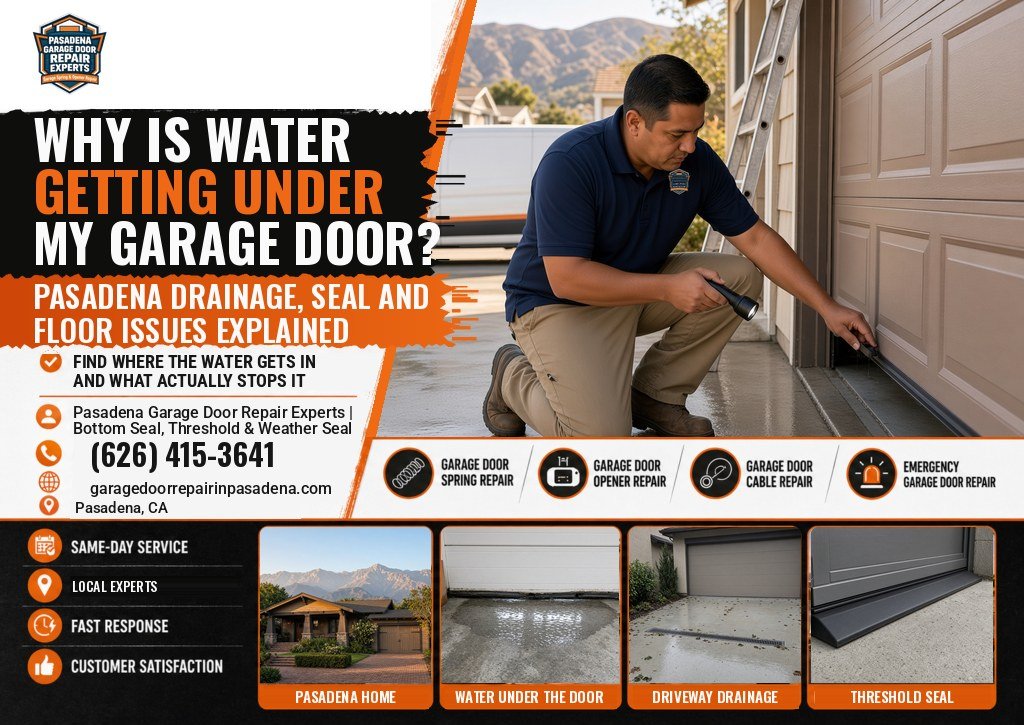
Why Is Water Getting Under My Garage Door? Pasadena Drainage, Seal and Floor Issues Explained
You open the garage after a storm and find a wet stripe across the floor, a puddle in one corner, or soaked boxes along the wall. It is frustrating, especially when the door looks closed tight. The pattern of the water usually tells you where it is getting in.
This guide walks through each source, from the seal to the driveway, explains what a threshold can and cannot do, and lists what to check before the next Pasadena storm.
Quick Answer: Why Is Water Getting Under My Garage Door?
Water usually gets under a Pasadena garage door through a worn or short bottom seal, a driveway that drains toward the door, a low spot in the slab, or wind-driven rain at the sides. Pasadena Garage Door Repair Experts finds which one by watching where the water enters, then fixes the door side and flags any drainage work.
A new bottom seal stops many leaks. It cannot stop runoff from a driveway that slopes toward the garage, and no garage door is fully watertight. Call (626) 415-3641 for a check-up.
Where Is the Water Coming From? Watch It During Rain
The fastest way to the right repair is to watch the door while it is raining, or right after. Stand inside with the door closed and the lights off, then look at where the water first shows up and how it moves. A band of wet concrete along the whole door tells a different story than one puddle in a corner or streaks running down the inside face.
Then go outside and look at the driveway. Is water sheeting down the slope toward the opening? Is it pooling against the door? Is a downspout emptying onto the apron a few feet away? Those three questions separate a door problem from a drainage problem, and they decide whether a new seal will help at all.
| What you see | Most likely source | What usually fixes it |
|---|---|---|
| A thin, even band of water along the full width of the door | Bottom seal that is cracked, flattened, shrunk, or loose in its retainer | A new bottom seal that matches the retainer, plus a new retainer if it is bent or corroded |
| Water at one low spot or in the same corner every storm | A dip in the slab at the door line, or a seal that has shrunk back from the end | A taller or softer seal for a shallow dip; a bonded threshold seal for a bigger one |
| A sheet of water running down the driveway and piling against the door | Driveway or apron that pitches toward the garage | A threshold seal for light sheeting; a trench drain or regrading for heavy runoff |
| Wet streaks starting at the jambs or running down the back of the door | Wind-driven rain past the side seals or through the section joints | New side and top weatherstripping; on exposed doors, a cover or overhang |
| Water only when a nearby downspout is running | Roof water landing at the opening | Extend or reroute the downspout and clear the gutter |
| Damp patches away from the door, or water coming up through cracks | Groundwater or slab problems | Slab or drainage work; no door seal reaches this |
A Worn, Short, or Loose Bottom Seal
The bottom seal is the flexible strip of vinyl or rubber held in a metal or vinyl retainer along the bottom edge of the door. When the door closes, it squashes against the concrete. As long as it stays soft and full length, it closes the small, uneven space between a straight door and a floor that is never perfectly flat.
Heat, sun, and the scrape of daily use change that over time. The strip hardens, flattens, and then cracks. It can also shrink back from the corners or slide partly out of its channel, which leaves a hole at each end of the door. Water that comes in as a band along the full width, or at both corners, points here first.
Check it with your hand. Press the seal every couple of feet. If it springs back, the rubber is probably still doing its job. If it stays dented, feels hard or shiny, or has cracks at the fold, it is done. Look at the retainer too. A bent, rusted, or loose channel will hold even a new strip crooked. For the wear signs in more detail, see when to replace weatherstripping and the bottom seal.
A new seal stops many leaks of this kind. It will not stop water that the driveway is sending to the door, which is the next thing to rule out.
A Driveway or Apron That Drains Toward the Door
Most garage slabs are poured with a slight fall toward the opening so that water inside the garage can run out. The apron and driveway outside are supposed to keep falling away from the door. When the driveway runs downhill to the garage, or the apron has settled so it now tips inward, rain collects at the bottom of the door and pushes against the seal. That water gets in even where the rubber looks new.
The Door and Access Systems Manufacturers Association (DASMA) addresses this directly. Its Technical Data Sheet 197 covers water getting under the bottom of a sectional door. The construction details it shows are a slightly inclined lip at the threshold, sloped 3 to 5 degrees, or a notch in the slab at least 1/2 inch deep, so the closed door sits below the surrounding grade. Those details are normally built in when the garage is poured. On an existing home, the practical options are a bonded threshold seal for light runoff, and a trench drain across the driveway or regrading for heavier flow.
Volume decides this. A threshold turns aside a thin sheet of water, but it cannot hold back a pond. If water ponds several inches deep against the door in a normal storm, the fix is drainage work, which is a concrete or landscape job rather than a garage door repair. A good garage door technician will tell you which part of the problem the door side can solve.
A Low Spot in the Slab at the Door Line
A slab can stay sloped the right way overall and still have a low spot right under the door. Settlement, cracks, and years of tires in the same path all wear dips into older concrete. A good seal can touch at both ends and float over the trough in the middle. Water finds that opening first, so you get the same puddle in the same place after every storm.
A slightly taller or softer bottom seal can cover a shallow dip. A threshold seal bonded to the floor is the usual next step when the low spot is bigger than the door seal can reach. If you can see a light gap at that spot with the door closed, our guide to why there is a gap under the garage door explains how to read its shape. A badly sunken section of slab may need concrete repair before any seal works.
Wind-Driven Rain at the Sides and Between Sections
Not all water comes in at the floor. When a storm blows rain straight at the door, water can get past the side seals, run down the inside of the jambs, or travel along the joints between sections and drip off the ends. DASMA's TDS 1503, which covers rain hitting the face of the door, says sectional doors "provide some protection against water infiltration" but "are not leak proof or watertight."
So some water dripping off the sections when you open a wet door is normal. Wet streaks that start at the jambs in every windy storm usually mean the side or top weatherstripping is cracked, gapped, or pulled away from the door. Replacing that perimeter seal often helps. On a door that faces the storm with no overhang, it may only reduce the water, not end it.
Roof and Downspout Water Landing at the Opening
Sometimes the door is fine and the water is simply being delivered to it. A downspout that empties onto the driveway a few feet from the garage, a clogged gutter that spills over the opening, or a roof with no gutter above the door can put a lot of water right at the threshold.
The test is simple: does the leak line up with the downspout running? If it does, extend the downspout or turn it away from the driveway, and clear the gutter before the next storm. That is gutter work, and no door part will change it.
When a Threshold Seal Helps, and When It Backfires
A threshold seal is a raised rubber or vinyl strip glued to the floor under the closed door. The bottom seal closes down onto it, which creates a low ridge that turns aside water running across the apron. Used with a good bottom seal, it is the most common fix for light runoff and shallow floor dips.
It can make things worse in one situation: a garage floor that slopes inward, toward the back wall. Any water that does get inside, from a wet car, a hose, or rain blown past the side seals, now gets trapped behind the threshold instead of draining out. Before adding one, pour a little water on the floor about three feet inside the open door and watch which way it runs. If it runs out toward the driveway, a threshold is a candidate. If it sits or runs inward, talk through drainage first.
Height matters. A threshold that is too tall can make the door reach the floor early. The opener may read that as an obstruction and reverse, or the door may not close fully. After any threshold or bottom seal change, check that the door still closes all the way and that the safety reverse still works. If you are not sure how to test it, have a technician do it.
Door Problems That Let Water In
A door that does not come all the way down leaves an opening no seal can close. That can happen when the opener's close travel is set short, often after an opener change or a reset. A door that sits higher on one side leaves a wedge-shaped gap at that end. Cables, drums, rollers, and track problems cause that, and a new seal will not close it for long.
If the door looks crooked, stops short, or reverses on the way down, deal with that before buying seals. Do not loosen a spring or cable to try to lower one side, and do not change travel or force settings unless you already know that opener, because those settings also control how the door reacts to an obstruction. For the bottom-seal side of this, the bottom seal contact checklist walks through each check in order.
Pasadena Storm Season: What to Do Before and During Rain
Pasadena gets most of its rain in the cooler months, often in a few heavy storms rather than steady drizzle. That pattern is hard on garages. A door can go months without a drop, so nobody notices the seal has hardened, and then a single storm sends water across the floor. For the 2026-27 storm season, Los Angeles County has said El Nino conditions raise the chance of heavy rain and back-to-back storms, so a ten-minute check of the door before the next forecast is time well spent.
The hills add their own pattern. Driveways in foothill and hillside areas, including parts of Altadena and Linda Vista, often run downhill to the garage, so runoff arrives as a sheet. If you live below hillsides or a recent burn area, storms can carry mud and debris, which no garage door seal is built to stop. Follow official county and city storm alerts, and use sandbags the way officials describe: to divert moving water away from the door, not to build a dam against it.
Before the rain:
- Press the bottom seal along its length and look for cracks, flat spots, and short ends.
- Clear leaves and grit from the threshold and from any trench drain grate in the driveway.
- Clean the gutter above the door and check where the nearest downspout empties.
- Move boxes, tools, and anything that can wick up water off the floor near the door.
- Make sure the door closes fully and evenly. A door that stops short is a door that leaks.
After Water Gets In: What to Check
Once the garage dries, take a look at the parts the water touched. On wood doors, check the bottom section for soft, dark, or swelling wood, because standing water at the threshold is a common reason bottom panels rot first. On steel doors, look for rust along the bottom edge and on the retainer. A corroded retainer will not hold a new seal straight.
Look at the bottom brackets at each lower corner, but do not touch them. They connect to the lift cables and are under high tension. Rust or damage there is a job for a technician. Also check anything stored on the floor near the door, and dry out boxes and wood promptly so mold and odors do not set in.
If the bottom section is damaged, replacing that section is sometimes possible instead of a whole door. See whether you can replace one garage door panel for how that decision works.
What You Can Check Yourself, and When to Call
These checks are all visual or hands-on with no tools near the springs:
- Watch where the water enters during or right after rain, inside and outside.
- Press the bottom seal along its full length, including both ends.
- Look at the retainer for bends, rust, or loose sections.
- Check the floor for a dip at the door line and test the floor slope with a little water.
- Find where the nearest downspout empties and whether the gutter above the door overflows.
- Watch the door close. Both sides should land together, and the seal should compress.
Some handy homeowners replace a slide-in bottom seal themselves when the retainer is straight and clean and the door is disconnected from the opener and supported. Stop if the retainer is damaged, the door is crooked or heavy, or the job would mean working near springs, cables, or bottom brackets. Rolled towels and foam strips are fine for one storm, but they shift and can interfere with closing, so treat them as stopgaps.
Call Pasadena Garage Door Repair Experts at (626) 415-3641 if the seal or retainer needs replacing, or if the door is crooked, stops short, or will not close. A truck is ready 24/7, with emergency response under 1 hour. You get the exact price after the check-up and before any work starts. For a non-urgent visit, you can also use the contact page.
How We Check a Water Problem at the Door
When you call about water under the door, the visit covers both the door and what is sending water to it:
- Bottom seal condition, length, and profile, and whether it matches the retainer.
- Retainer straightness and corrosion along the bottom section.
- Whether the door closes fully and lands level on both sides.
- Side and top weatherstripping, for wind-driven rain.
- The slab at the door line, the slope of the apron, and where roof water lands.
- Whether the floor slope means a threshold seal could trap water inside.
Grading, gutter, and concrete problems are usually work for another trade. For seal work that cannot wait, see emergency weather stripping and bottom seal replacement, or our main garage door repair in Pasadena page for everything else.
Frequently Asked Questions About Water Getting Under a Garage Door
Why is water getting under my garage door?
The usual causes are a worn, short, or loose bottom seal, a driveway or apron that drains toward the door, a low spot in the slab at the door line, wind-driven rain past the side seals, or a downspout emptying near the opening. Watching where the water enters during rain tells you which one you are dealing with.
Will a new bottom seal stop water under the garage door?
It will if the old seal was cracked, flattened, or shrunk and the driveway does not send water to the door. A new seal cannot stop runoff from a driveway that slopes toward the garage, and it cannot follow a deep dip in the slab. In those cases you also need a threshold seal or drainage work.
Do garage door threshold seals work?
For light runoff and shallow floor dips, usually yes. A threshold seal is a raised strip bonded to the floor that the bottom seal closes onto, which turns aside a thin sheet of water. It is not built to hold back water ponding several inches deep against the door. That needs a trench drain or regrading.
When should I not use a threshold seal?
Skip it, or fix drainage first, if your garage floor slopes inward toward the back wall. Water that gets inside then gets trapped behind the threshold instead of draining out. Pour a little water on the floor a few feet inside the open door and watch which way it runs before you add one.
Why does water come in at only one corner?
One wet corner usually means the bottom seal has shrunk back from that end, the slab has a low spot there, or that side of the door sits slightly high. Check the seal end first. If the rubber is intact and the door lands unevenly, have the cables, drums, and tracks checked rather than buying another seal.
Is it normal for some water to get in during heavy rain?
Some, yes. DASMA states that sectional garage doors provide some protection against water but are not leak proof or watertight. A few drips when you open a wet door are normal. A wet band across the floor after every storm, or water running in from the driveway, is a problem worth fixing.
Can wind-driven rain get past the sides of the garage door?
Yes. When rain blows straight at the door, it can get past cracked or gapped side and top weatherstripping and run down the inside of the jambs. Replacing the perimeter seals usually helps. On a door that faces storms with no overhang, it may reduce the water rather than stop it completely.
What if my driveway slopes toward the garage?
Then the driveway is sending water to the door, and seals alone will keep losing in heavy rain. A bonded threshold seal handles light sheeting. A trench drain across the driveway or regrading handles heavier runoff, and that is concrete or drainage work. A garage door technician can tell you which part the door side can solve.
Can a downspout cause water under my garage door?
It can. A downspout that empties onto the driveway near the garage, or a gutter that overflows above the door, puts water right at the threshold. If the leak lines up with the downspout running, extend or redirect it and clear the gutter. That is gutter work, and no door seal will fix it.
Can water under the door damage my garage door?
Over time, yes. Standing water at the threshold can rot the bottom section of a wood door and rust the bottom edge, the seal retainer, and the bottom brackets on a steel door. After a storm, look for soft wood or rust. Do not touch the bottom brackets; they are under high tension and need a technician.
Should I put sandbags in front of my garage door?
If storms are sending a lot of water or debris toward your garage, sandbags can help when they are placed to divert moving water away from the door, the way county officials describe. Follow official city and county storm guidance, especially below hillsides or burn areas. No garage door seal is designed to stop mud or debris flows.
Who fixes water coming under a garage door in Pasadena?
Pasadena Garage Door Repair Experts checks the bottom seal, the retainer, the side seals, whether the door closes level, and the slab and slope at the opening, and whether part of the fix may be drainage work. Call (626) 415-3641. You get the exact price after the check-up and before any work starts.
Find Pasadena Garage Door Repair Experts on Google Maps
You can also view Pasadena Garage Door Repair Experts on Google Maps.
Need Water Under Your Garage Door Checked in Pasadena?
Call Pasadena Garage Door Repair Experts at (626) 415-3641. We check the bottom seal and retainer, the side seals, whether the door closes level, and the slab and slope at the opening, then give you the exact price after the check-up and before any work starts. If the door is stuck, crooked, or will not close, a truck is ready 24/7, with emergency response under 1 hour.
Serving Pasadena, Altadena, South Pasadena, San Marino, San Gabriel, East Pasadena, Arcadia, Sierra Madre, La Canada Flintridge, Eagle Rock, and Glendale.
Safety reminder: don't adjust or remove springs, cables, or bottom brackets yourself, and don't bypass the opener's safety sensors.