
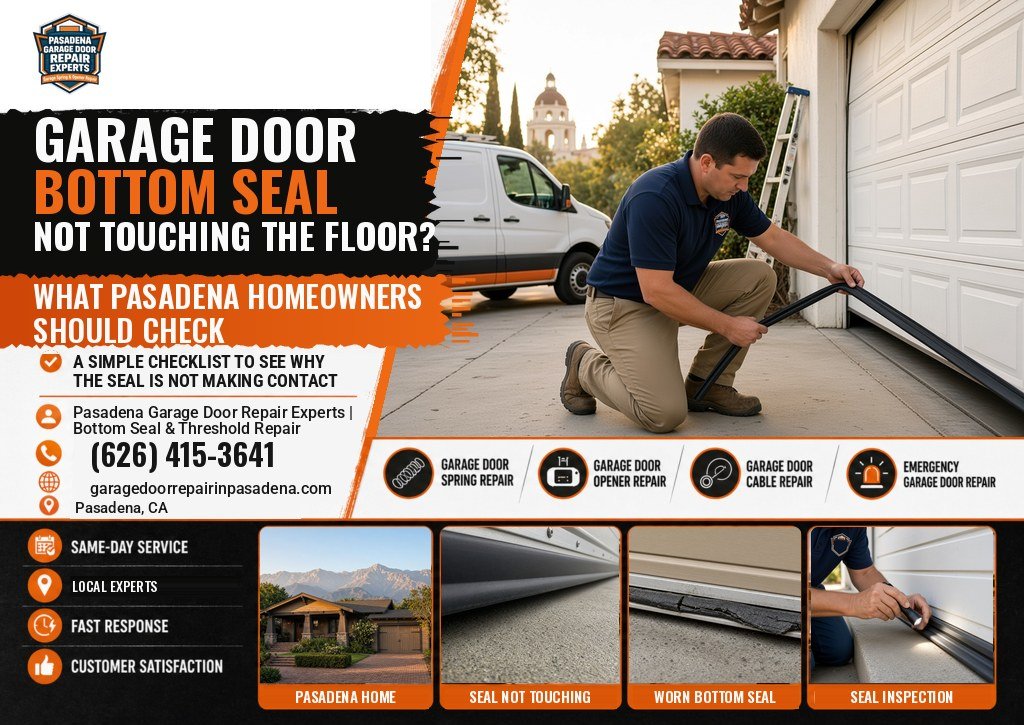
Garage Door Bottom Seal Not Touching the Floor? What Pasadena Homeowners Should Check
If the bottom seal on your garage door is not touching the floor, start by confirming the door is fully closed, then see where the miss is. An even hover often means the rubber has flattened or the opener stopped a little early. A miss only in the middle usually means the slab has a dip. A miss at one end points to the ends of the seal, or to a door that is sitting high on that side.
Replacing the insert helps when the seal itself is worn and the door is closing square. It does not help when the floor is the uneven part or the hardware is holding one side up. This checklist walks through those checks in order, including what is safe to do yourself. For a measured check-up, call Pasadena Garage Door Repair Experts at (626) 415-3641. You get the exact price after the check-up and before any work starts.
Quick Answer: What Should You Check If the Bottom Seal Is Not Touching the Floor?
If your garage door bottom seal is not touching the floor in Pasadena, the rubber may be worn, the slab may have a dip, the opener may stop the door early, or one side of the door may sit high. Pasadena Garage Door Repair Experts checks each of these in order before replacing any part.
Confirm the door is all the way down, then see where the seal misses the slab. If the rubber is flat, hard, cracked, or pulled out of its retainer, replace the seal (and the retainer if it is bent or rusted). If the seal still springs back and misses only at a dip in the concrete, a taller profile or a threshold seal on the floor is the better fit. If one end is high, or the door stops before the seal can compress, the door or the opener needs attention first.
First: Confirm the Door Is Fully Closed
Before you blame the seal, watch one full close from inside. Some openers stop a fraction early, especially after a reset or a new operator. The seal can look as if it is "not touching" when the door simply has not finished its travel. If the door is still an inch up, you do not have a seal diagnosis yet.
Also look at the wall button or the opener lights. If the operator reversed or stopped on an obstruction, the door may not be in its true closed position. Clear the tracks of debris, make sure nothing is in the path, and try one more close. If it will not complete the close, or it reverses repeatedly, stop there and call. Forcing it, or turning up the force, is not the next step.
Map the Daylight
With the door fully closed, turn the garage lights off and look along the floor on a bright day. You can also use a flashlight from the outside and see where the beam comes through. Mark, even just in your head, whether the miss is even, only in the middle, only at one end, or only at the corners.
An even miss across the width, with a seal that looks tired, usually means the insert has flattened or the door is stopping short. A miss only in the middle, with contact at both ends, is a classic slab dip: the straight bottom rail cannot follow the low spot. A miss at one end only, especially a wedge that is wider on one side, is how a door that is not sitting level shows up at the floor. Corner-only holes often mean the seal has shrunk, torn, or been chewed back from the ends.
This is the same daylight test used in the guide to gaps under a Pasadena garage door. This checklist stays on one question: is the bottom seal actually making contact, and if not, which part failed?
Feel the Seal Itself
Run your hand along the insert. Press it every couple of feet and at both ends. A usable seal has some give and returns to its shape. A seal that stays crushed, feels brittle or slick, or shows cracks and missing chunks is no longer able to reach the floor reliably, even if a few spots still kiss the slab.
Look at the profile, not only the surface. Many bottom seals are a T-shape, a bead that snaps into a channel, or a bulb or U-shape. Once that shape has taken a set, there is not enough material left to compress. Replacing the insert is the repair in that case, as long as the door is closing square and the floor is reasonably even. Clopay's seal guide is a useful reference for how bottom and perimeter seals are supposed to sit, but the profile you buy has to match the retainer already on your door.
Pasadena sun and heat dry vinyl and rubber, especially on a west- or south-facing door. Inspect the bottom seal a few times a year. Replace it when the material has hardened, cracked, or stopped springing back, not because a calendar says it is time.
Check the Retainer
The retainer is the channel or track that holds the seal on the bottom of the door. If it is bent, rusted, or pulling away from the bottom section, a new insert will sit at an angle or slide out. From the side, see whether the channel is parallel to the floor or kicked up at one end. A retainer that has been hit by a mower, a bike, or a low bumper is often the reason a fairly new seal suddenly stops touching.
If the retainer is sound, a matching insert usually slides in after the old one is pulled out. If the retainer is damaged, both pieces should be replaced so the new seal can sit at the right height.
Check the Floor Under a Seal That Still Looks Fine
This is the check people skip. If the rubber still springs back, the retainer is straight, and the seal still is not touching in one area, get down and look at the slab. A dip in the tire path, a raised crack, or a patch that was never finished flush will leave a space under a perfectly good gasket.
Older Pasadena garages, including many in early neighborhoods such as Bungalow Heaven, often have floors that are no longer flat. Hillside driveways can also tilt the apron. A bottom seal can take a small difference. It cannot fill a trough. In that situation, replacing the insert again will look like a failed repair.
Opener Travel Versus Seal Compression
When a flexible seal hovers evenly above the floor, the close-travel setting is the next suspect. The opener may be stopping the door just before the seal can flatten against the concrete. That is a small adjustment for someone who knows that operator, and a risky one if you do not.
Do not change travel or force just to close a gap. Those settings also control how the door behaves when it meets a person or an object. If you are not already familiar with that opener's adjustment method, and with testing the safety reverse afterward, leave it to a technician. Never loosen a spring or a cable to lower the door onto the slab.
When a Taller Seal Helps, and When It Does Not
A taller or more flexible profile can close a shallow, even miss, or a modest dip, if the retainer can hold that profile. It will not correct a door that is high on one side. It also will not hold back water that is running down a driveway toward the opening. Buying the thickest seal on the shelf, without matching the retainer and without looking at the floor, is how people end up with a gasket that bunches, drags, or pulls out.
If the door scrapes after a new, taller insert goes in, the seal is too tall for that opening or the door is closing too far. Don't turn the opener force up so it can push through the drag.
Threshold Seal or New Bottom Seal?
Use a new bottom seal when the insert on the door is the worn part and the floor is close to even. Use a threshold seal, a strip bonded to the floor, when the slab is the uneven part, or when a little water sheets across an otherwise fair opening. Many doors need both: a healthy insert on the door and a low threshold on the floor working together.
A threshold is not a flood wall. DASMA TDS 197 shows the construction details that actually keep water down at the floor: a 3- to 5-degree sloped lip, or a notch in the slab that the door closes into. On an existing apron, a bonded threshold is the usual stand-in. DASMA TDS 1503 also reminds owners that sectional doors are not watertight. If rain under the door is the main complaint, say so when you book the visit, and see why water gets under a garage door for the drainage side.
For a seal that is torn, missing, or already letting weather in, see the emergency weather stripping and bottom seal page and the signs it's time to replace weatherstripping.
What Is Safe to Do Yourself
A sliding insert in a clean retainer, on a door that hangs level and stays put when it is disconnected from the opener, is a job some handy homeowners can finish. Support the door so it cannot move. Pull the old insert, feed in a matching profile, and trim it flush with the ends. Then close the door and repeat the daylight and feel tests.
Stop and call if the retainer is bent or rusted, the door is crooked or very heavy, the seal is on a wood door that needs more than a slide-in insert, or you would have to work around springs, cables, or bottom brackets. Do not pack the gap with foam, a towel, or tape as a standing fix. Those shift and can catch on the door.
If the door will not close, is off track, or one side is hanging, treat it as urgent. Call Pasadena Garage Door Repair Experts at (626) 415-3641. A truck is ready 24/7, with emergency response under 1 hour. You get the exact price after the check-up and before any work starts. For a scheduled visit, use the contact page. A tune-up is also a reasonable time to have seal contact checked along with the rest of the door. For other garage door repair in Pasadena, the same check-up can cover whether the door is still closing square.
Frequently Asked Questions About a Bottom Seal That Is Not Touching the Floor
Why is my garage door bottom seal not touching the floor?
The insert may be flattened, cracked, or pulled out of its retainer. The floor may have a dip under an otherwise good seal. The opener may be stopping the door before the seal can compress. Or one side of the door may be sitting high. Map the daylight and feel the rubber before you buy another seal.
How do I check if the seal is actually making contact?
Close the door fully, turn the garage lights off, and look along the floor from inside on a bright day. Then press the seal every couple of feet. Contact should be fairly even. A flashlight from the outside also shows where the beam comes through.
What if the seal touches in the middle but not at the ends?
That often means the seal has shrunk, torn, or been chewed back from the corners, or that one end of the door is high. Check the ends of the insert first. If the rubber is intact and one end is still floating, the door may not be sitting level, which is a hardware check, not a taller-seal job.
What if it touches at the ends but not in the middle?
That is a common slab dip. The bottom rail is straight and the floor is not. A slightly taller or more flexible bottom seal can cover a shallow low spot. A threshold seal bonded to the floor is the usual next step for a larger dip. Replacing the same worn-looking insert will not follow the trough.
Can I just buy a taller seal?
Only if the retainer can hold that profile and the miss is shallow and fairly even. A taller seal will not correct a crooked door, and a seal that is too tall will drag or bunch. Match the profile to the retainer you already have.
Do I need a threshold seal or a new bottom seal?
Replace the bottom seal when the insert on the door is worn and the floor is close to even. Add a threshold seal when the slab is the uneven part, or when a little water sheets across the opening. Many doors need both, working together. A threshold is not a flood wall.
The seal looks fine. Why is there still a gap?
Look at the floor and at the last few inches of travel. A flexible seal can hover over a dip, or the opener can stop the door just before the seal compresses. A bent retainer can also hold a good insert too high. The rubber can look new and still not meet the slab.
Should I adjust the opener so the door comes down farther?
Not unless you already know that opener's travel adjustment and will test the safety reverse afterward. Travel and force settings affect how the door behaves when it hits an object. If you are unsure, have a technician set close travel so the seal meets the floor without driving the door into the concrete.
Can heat in Pasadena change whether the seal touches?
Heat and sun dry vinyl and rubber and make them flatten or crack, which is a common reason a seal that used to touch eventually does not. The material also gets less flexible as it ages in the sun, especially on a west- or south-facing door. Inspect it a few times a year.
Is it safe to replace the bottom seal myself?
A slide-in insert on a level door, with the opener disconnected and the door supported, is a reasonable homeowner job for some people. Stop if the retainer is damaged, the door is crooked or heavy, or springs, cables, or bottom brackets would be involved. Do not pack the gap with foam or a towel as a permanent fix.
How often should I inspect the bottom seal in Pasadena?
Check it a few times a year, and any time you notice daylight, dust, or a draft at the threshold. Replace it by condition: when it has hardened, cracked, flattened, or stopped springing back. There is no single calendar interval that fits every door and exposure.
When should I call a Pasadena technician?
Call if the door is crooked, will not close, is off track, or the retainer is damaged, or if a new seal did not close the gap. Pasadena Garage Door Repair Experts checks contact, the floor, and the door, then gives the exact price before any work starts. Call (626) 415-3641.
Find Pasadena Garage Door Repair Experts on Google Maps
You can also view Pasadena Garage Door Repair Experts on Google Maps.
Need a Bottom Seal Checked in Pasadena?
Call Pasadena Garage Door Repair Experts at (626) 415-3641. We check whether the bottom seal is actually making contact, look at the retainer and the floor, and see whether the door is closing square, then give you the exact price after the check-up and before any work starts. If the door is stuck, crooked, or will not close, a truck is ready 24/7, with emergency response under 1 hour.
Serving Pasadena, Altadena, South Pasadena, San Marino, San Gabriel, East Pasadena, Arcadia, Sierra Madre, La Canada Flintridge, Eagle Rock, and Glendale.
Safety reminder: don't adjust or remove springs, cables, or bottom brackets yourself, and don't bypass the opener's safety sensors.