
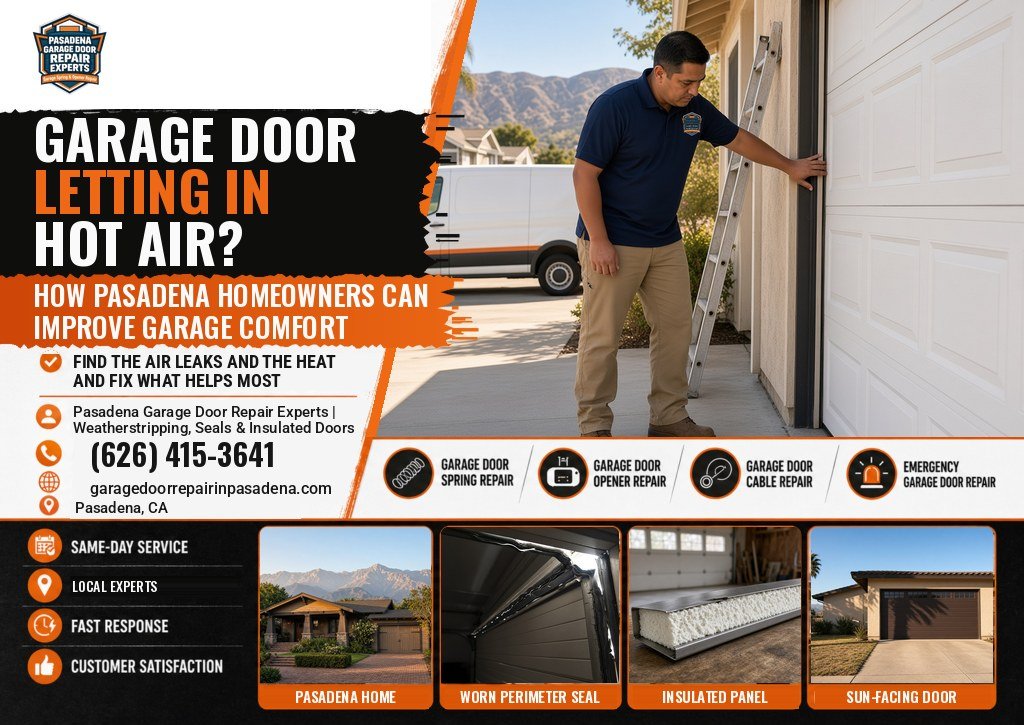
Garage Door Letting in Hot Air? How Pasadena Homeowners Can Improve Garage Comfort
On a hot Pasadena afternoon a garage can feel like an oven, and the door is usually the first thing people blame. Sometimes it is the main problem. Often it is one part of a bigger heat picture.
This guide shows how to tell air leaks from heat coming through the panel, which fixes help most, and when the roof and walls matter more than the door.
Quick Answer: Why Is My Garage Door Letting in Hot Air?
A garage door lets hot air in two ways: through gaps around worn bottom, side, and top seals, and through thin or uninsulated panels that heat up in the sun. For Pasadena homes, Pasadena Garage Door Repair Experts usually starts with the perimeter seals, then looks at insulation and spring balance.
New seals close air leaks. Insulation slows heat through the panel. Neither one cools a garage that gets most of its heat from the roof. Call (626) 415-3641 for a check-up.
The Two Ways Heat Gets Through a Garage Door
A garage door lets heat in two different ways, and they need different fixes. The first is air leakage: hot outside air moving through gaps at the bottom, the sides, the top, and the joints between sections. The second is heat moving through the door itself. Sun warms the outside skin, and on a thin, uninsulated steel door the inside skin heats up soon after and radiates that heat into the garage all afternoon.
Air leaks are a weatherstripping problem. Heat through the panel is an insulation problem. A well-insulated door with cracked seals still lets hot air pour around its edges, and brand-new seals on a bare steel door still leave you with a door that feels warm to the touch from inside. Most hot garages have some of both.
| What you notice | Likely path | What usually helps |
|---|---|---|
| Daylight at the bottom, sides, or top of the closed door | Air leaks past worn or gapped seals | Replace the bottom seal and the side and top weatherstripping |
| A draft you can feel with your hand near the edges on a windy day | Air leaks | Perimeter seals; check the door closes fully and evenly |
| The inside face of the door feels hot in the afternoon | Heat conducting through an uninsulated or thin panel | An insulated door, or a retrofit kit with the spring balance checked afterward |
| The garage stays hot long after sunset, even with the door sealed | Heat stored in the roof, walls, and slab, plus little ventilation | Ventilation, attic and roof work; the door is only part of it |
Find the Air Leaks: A Daylight and Hand Check
On a bright afternoon, close the door, turn off the garage lights, and stand inside for a minute while your eyes adjust. Look along the bottom edge, up both sides, and across the top. Any line of daylight is a place where hot air can move in. Then, on a breezy day, run the back of your hand slowly along the same edges. You will feel leaks you cannot see.
Pay attention to the corners. Bottom seals shrink back from the ends, and the side seal often stops short of the floor, which leaves a small triangle of daylight at each lower corner. Look at the joints between sections as well. On many doors those joints close tightly, but a bent or misaligned section can leave a gap you can see light through.
If light shows along the bottom, our guide to why there is a gap under the garage door explains how the shape of the gap points to the cause.
Worn Perimeter Weatherstripping and Bottom Seal
The bottom seal is the flexible strip along the bottom edge of the door. The side and top seals are usually vinyl flaps attached to the stop molding on the jambs and header, which press lightly against the face of the closed door. Together they form the perimeter seal. Sun and heat dry these materials out. They harden, crack, curl away from the door, or flatten so they no longer touch it.
Replacing tired perimeter seals is usually the quickest comfort improvement on a garage door. The side and top seals should touch the door without dragging on it, and the bottom seal should compress against the floor along its full length. Seals that are set too tight can make the door bind or strain the opener, so fit matters as much as the material. For the wear signs to look for, see when to replace garage door weatherstripping and the bottom seal, and for urgent replacement, our weather stripping and bottom seal replacement service.
Thin or Uninsulated Panels That Radiate Heat
Many older Pasadena garages still have single-layer steel doors. The steel skin is thin, and it passes heat through quickly. Once the sun has been on it for a while, the inside face can be noticeably hot to the touch, and that warm surface radiates heat into the garage for hours.
Insulated doors slow that down with a foam core between two skins. You will see insulation described by R-value, where a higher number means more resistance to heat flow. Two cautions when you compare doors. First, the R-value a brand advertises often describes a section of the panel, not the whole installed door with its joints, hinges, and edges. Where a whole-door U-factor is published, it describes the complete assembly, and a lower U-factor means less heat transfer. Second, R-value does nothing for air leaks, so an insulated door still needs good seals to feel cooler.
If you are deciding whether a new insulated door is worth it, our guide to whether an insulated garage door is worth it in Pasadena covers that decision, and the insulated and energy-efficient garage doors page covers the door options.
Sun, Orientation, and Door Color
Where the door faces changes how hot it gets. A door on a shaded north side may never feel warm. A west-facing door takes the full late-afternoon sun, which is often the hottest part of the day, and a south-facing door gets sun for much of it. Dark doors absorb more sunlight than light ones, so a dark brown or black door on a west wall usually runs hottest of all.
Glass sections add another path. Windows in a garage door let sunlight straight in, and the frames around them are joints that need to seal. If your door has a row of windows on a sunny side, expect that row to be a large share of the heat you feel.
Color alone is no reason to replace a door, but it explains why a neighbor's light, north-facing garage can feel so much cooler than yours.
Insulation Kits: When They Help, and the Spring Catch
Retrofit kits add foam panels or batts to the inside of each section. On an uninsulated steel door they can make the inside face feel much less hot, and the Building America Solution Center at Pacific Northwest National Laboratory has a step-by-step guide to insulating and weatherstripping a garage door that also recommends checking the bottom and side weatherstripping at the same time.
The catch is weight. Every panel you add makes the door heavier. Garage door springs are sized to the weight of the door, so after insulation the springs may no longer balance it. A door that is out of balance works the opener harder, can drift down when you let go of it halfway, and wears parts faster.
Do not adjust the springs yourself. Torsion and extension springs are under high tension and can cause serious injury. After adding insulation, check the balance: disconnect the opener with the door closed, lift the door by hand to about halfway, and let go carefully. If it drifts up or down, have a technician look at the springs. Also keep insulation and seals clear of the safety sensors near the floor and of the tracks and rollers.
Kits help most on bare steel doors that are otherwise in good shape. On a door that is already insulated, or one with dented, warped, or damaged sections, a kit adds weight without much benefit.
Heat That Is Not Coming From the Door
A garage with no air conditioning will follow the weather outside, and it can run warmer than outdoors in the afternoon because heat builds up under the roof and has nowhere to go. Sealing and insulating the door slows one source of heat. It does not cool the room.
Look at the rest of the space before you spend on the door alone. An uninsulated roof or attic above the garage, west-facing walls, windows, little or no ventilation, and a car parked hot after a drive all add heat. The door between the garage and the house matters too. Keep it closed and weatherstripped so garage heat stays out of the living space.
Pasadena Heat: Simple Habits That Help
Pasadena summers are hot and dry, and fall can bring hot, dry Santa Ana wind days, so a sun-facing garage door here works hard for much of the year. Sun also ages seals faster, which is why a seal that fit well a few years ago may now leave a gap.
- Keep the door closed during the hottest part of the day, especially on a west-facing garage.
- Air the garage out in the cooler early morning or evening by opening the door for a while, if it is safe to leave it open.
- Check the bottom, side, and top seals at the start of summer and again in the fall.
- If the garage is a workshop, gym, or storage for heat-sensitive items, treat the door as one part of a plan that also covers ventilation and the roof.
Homes across Pasadena, Altadena, and nearby foothill neighborhoods see the same pattern: older detached garages with single-layer doors and dry, sun-baked seals. Those are usually the easiest to improve.
What You Can Check Yourself, and When to Call
- On a sunny day, close the door, turn off the lights, and look for daylight at the bottom, sides, top, and section joints.
- Run your hand along the edges on a breezy day to feel for drafts.
- Press the bottom seal and the side seals. They should be soft and spring back, not hard, cracked, or curled.
- Touch the inside face of the door in the late afternoon. If it is hot, the panel is a big part of the heat.
- Watch the door close. It should come all the way down and land level, so the seals can do their job.
Call Pasadena Garage Door Repair Experts at (626) 415-3641 if the seals need replacing, if you want to know whether your door is worth insulating, or if it is crooked or will not close fully. You get the exact price after the check-up and before any work starts. A truck is ready 24/7, with emergency response under 1 hour, if the door will not close or is off track. You can also use the contact page to book a visit.
How We Check a Hot Garage Door
A comfort visit looks at the whole door:
- Bottom seal condition and contact along the full width.
- Side and top weatherstripping, and the stop molding it is attached to.
- Section joints, and whether any section is bent or misaligned.
- Whether the door is insulated, and its condition if a kit has been added.
- Spring balance and opener operation.
- Safety sensor alignment after any change near the floor.
For other repairs, see our main garage door repair in Pasadena page.
Frequently Asked Questions About a Garage Door Letting in Hot Air
Why is my garage door letting in hot air?
Hot air gets in two ways: through gaps around worn bottom, side, and top seals, and through thin or uninsulated panels that heat up in the sun and radiate that heat inside. Look for daylight around the closed door and touch the inside face in the afternoon to see which one is bigger for you.
How can I keep my garage cooler in a Pasadena summer?
Replace worn perimeter seals, keep the door closed during the hottest part of the day, and air the garage out in the cooler morning or evening. If the inside of the door gets hot, insulation helps. Remember that the roof, walls, and ventilation also matter, so the door is only part of the answer.
Will new weatherstripping make my garage cooler?
It helps when hot air is leaking around the door. New bottom, side, and top seals close the gaps that let outside air move in, which is usually the quickest improvement. Weatherstripping does not slow heat coming through the panel itself, so an uninsulated steel door can still feel hot from inside.
Is an insulated garage door worth it for heat?
It is most worth it for a sun-facing garage used as a workshop, gym, or storage for heat-sensitive items, or one attached to living space. An insulated door slows heat through the panel. It still needs good seals, and it will not cool a garage that gets most of its heat from the roof.
What does R-value mean on a garage door?
R-value measures resistance to heat flow; higher means more resistance. The number a brand advertises often describes a panel section, not the whole installed door with its joints and edges. Where a whole-door U-factor is published, it describes the complete assembly, and a lower U-factor means less heat transfer.
Do garage door insulation kits work?
On a bare, single-layer steel door in good shape, a kit can make the inside face feel much less hot. It adds little on a door that is already insulated or has damaged sections. Every kit adds weight, so the door's spring balance should be checked afterward.
Can insulating my garage door affect the springs?
Yes. Springs are sized to the weight of the door, and insulation adds weight. An out-of-balance door strains the opener and can drift when you let go of it halfway. Do not adjust springs yourself; they are under high tension. Have a technician check the door's balance after adding insulation.
Does garage door color affect heat?
Yes. Dark doors absorb more sunlight than light ones, so a dark door on a west- or south-facing wall usually runs hottest. Color alone is rarely a reason to replace a door, but it helps explain why two similar garages on the same street can feel very different in the afternoon.
Why is my garage hotter than outside?
A closed garage with no air conditioning traps heat under the roof and in the walls and slab, and a hot car or sun on the door adds more. With little ventilation, that heat has nowhere to go, so the garage can stay warm well after sunset. Sealing the door slows one source but does not cool the room.
Can I fix gaps around my garage door myself?
Some homeowners replace side and top weatherstripping or a slide-in bottom seal themselves when the parts are straight and the door is disconnected from the opener and supported. Seals set too tight can make the door bind. Stop if the job would put you near springs, cables, or bottom brackets.
Will sealing my garage door affect the opener or safety sensors?
It can if the seals are set too tight or a new bottom seal or threshold makes the door reach the floor early, which can cause the opener to reverse. Keep insulation and seals clear of the safety sensors near the floor. After any change, check that the door closes fully and the safety reverse works.
Who can check a hot garage door in Pasadena?
Pasadena Garage Door Repair Experts checks the bottom, side, and top seals, the section joints, whether the door is insulated, and the spring balance and opener, then gives you the exact price after the check-up and before any work starts. Call (626) 415-3641 to book a visit.
Find Pasadena Garage Door Repair Experts on Google Maps
You can also view Pasadena Garage Door Repair Experts on Google Maps.
Want a Hot Garage Door Checked in Pasadena?
Call Pasadena Garage Door Repair Experts at (626) 415-3641. We check the bottom, side, and top seals, the section joints, insulation, and spring balance, then give you the exact price after the check-up and before any work starts. If the door is stuck, crooked, or will not close, a truck is ready 24/7, with emergency response under 1 hour.
Serving Pasadena, Altadena, South Pasadena, San Marino, San Gabriel, East Pasadena, Arcadia, Sierra Madre, La Canada Flintridge, Eagle Rock, and Glendale.
Safety reminder: don't adjust or remove springs, cables, or bottom brackets yourself, and don't bypass the opener's safety sensors.