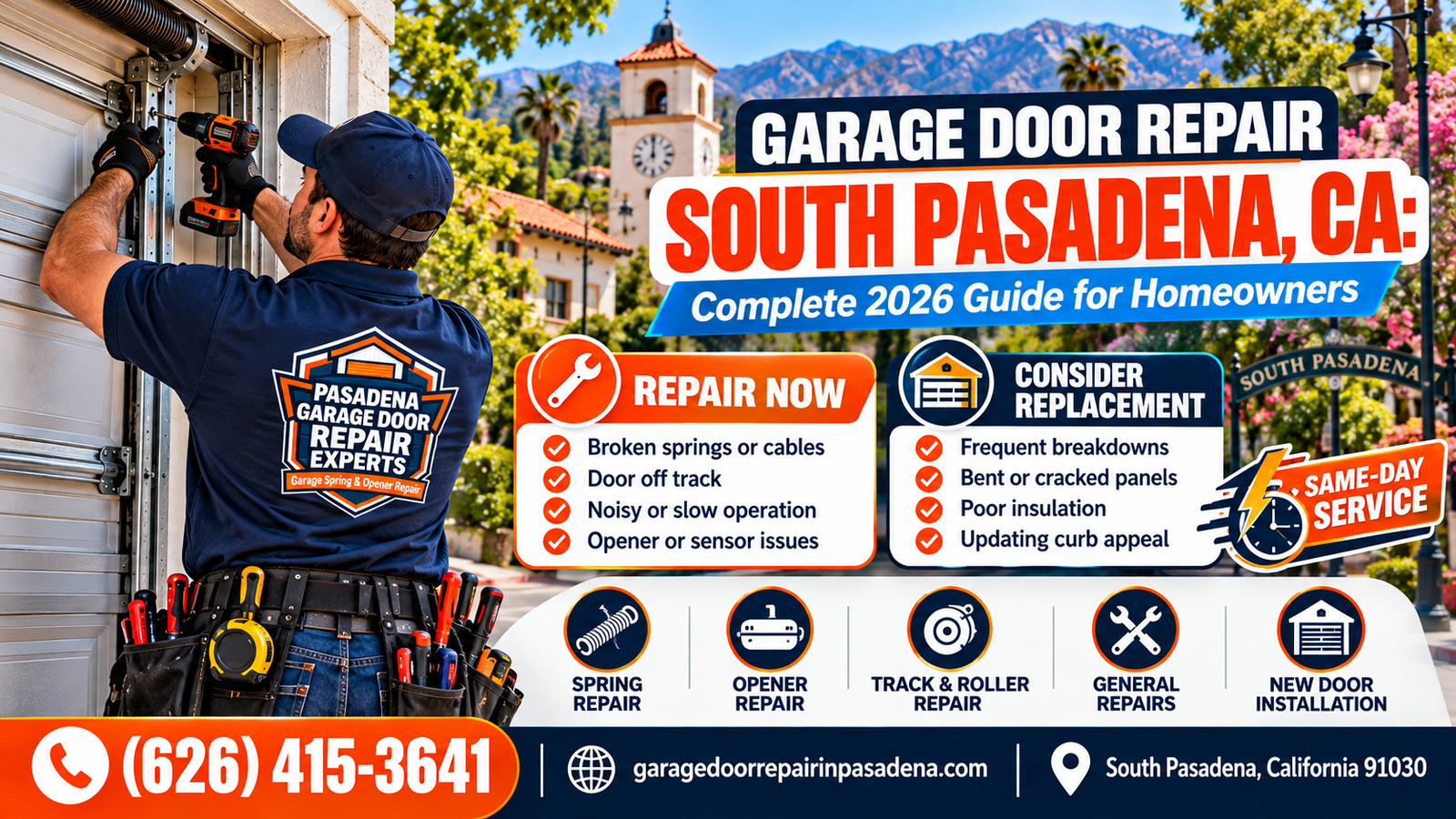
Garage Door Repair South Pasadena, CA: Complete 2026 Guide for Homeowners
From broken springs and opener problems to damaged cables, rollers, tracks and sensors, this 2026 guide explains the most common garage door problems South Pasadena homeowners may encounter, what repairs involve and when professional service should be considered.
Quick answer: Garage door repair in South Pasadena can involve anything from replacing a worn roller or correcting a sensor problem to repairing broken springs, cables, tracks, panels or the garage door opener. The right repair depends on what caused the problem—not simply which part appears damaged first.
A residential garage door is a complete mechanical system. Springs help counterbalance the weight of the door, cables transfer lifting force, rollers guide movement through the tracks, hinges allow the sections to bend and the opener controls powered operation.
When one part begins to fail, the symptom can sometimes appear somewhere else. A garage door opener that seems weak may actually be trying to lift a poorly balanced door. A crooked door may point to a cable problem rather than an opener issue. A door that keeps reversing may be reacting to sensor alignment or resistance in the door system.
That is why useful garage door repair starts with diagnosis. Before deciding what needs to be replaced, the entire operating system should be considered.
If your main symptom is a garage door that refuses to open, our guide to nine common reasons a garage door will not open covers several possible causes.
Need Garage Door Repair in South Pasadena?
Pasadena Garage Door Repair Experts provides service for common garage door problems including broken springs, opener issues, cables, rollers, tracks, sensors and doors that no longer open or close correctly.
In This South Pasadena Garage Door Repair Guide
What Are the Most Common Garage Door Problems in South Pasadena?
Door Will Not Open
A door that stays closed may have a spring, opener, cable, track, lock or power-related problem.
Door Will Not Close
Sensor alignment, wiring, opener settings, track resistance or other mechanical problems can keep the door from closing.
Door Is Very Heavy
Sudden heavy operation can point to a broken or weakened counterbalance system.
Door Moves Crookedly
Uneven movement may involve cables, drums, rollers, tracks or spring balance.
Door Makes New Noises
Grinding, popping, rattling or squeaking can originate from rollers, hinges, tracks or loose hardware.
Opener Runs but Door Does Not
The problem may be inside the opener or elsewhere in the garage door lifting system.
If the door reaches the floor and then reverses, stops before closing or behaves inconsistently, see Garage Door Won't Close? 8 Reasons It Keeps Reversing or Stopping .
Garage Door Spring Repair in South Pasadena
Springs are part of the counterbalance system that helps offset the weight of the garage door. The opener is not designed to lift the full weight of a door whose spring system is no longer working correctly.
Spring problems can appear suddenly or develop over time. Homeowners may notice:
- A loud bang from inside the garage
- A visible separation in a torsion spring
- The door opening only several inches
- A garage door that suddenly feels much heavier
- The opener straining to lift the door
- Uneven movement after a spring or cable problem
Spring Safety
Garage door springs and related cable hardware operate under substantial tension. Do not loosen winding cones, spring brackets, drums, lift cables or other loaded counterbalance components to diagnose a problem.
For warning signs that can appear before complete failure, read 10 Warning Signs Your Garage Door Spring Is About to Break .
Homeowners wondering about spring service life can also review How Long Do Garage Door Springs Last? .
Garage Door Opener Repair in South Pasadena
A garage door opener should be evaluated together with the mechanical door system. If the door is difficult to move manually, repairing the opener alone may not address the actual cause.
| Symptom | Possible Areas to Check |
|---|---|
| Nothing happens | Power supply, wall control, remote, opener electronics |
| Motor runs but door does not move | Opener drive system, trolley, door balance |
| Door reverses | Sensors, resistance, travel or force settings |
| Remote does not work | Battery, programming, receiver or remote |
| Opener sounds strained | Door balance, springs, rollers or opener components |
See our Garage Door Opener Not Working? Homeowner Troubleshooting Guide for a more detailed breakdown.
If the opener is older or repeatedly failing, our garage door opener repair vs. replacement guide explains when replacement may be worth discussing.
Broken or Frayed Garage Door Cables
Garage door cables should not be treated like ordinary household wire. Depending on the system and door position, they can be connected to components under substantial tension.
Possible cable warning signs include:
- Visible fraying
- Loose strands
- A cable hanging beside the door
- One side of the door lifting higher than the other
- Loose cable around a drum
- A garage door that suddenly becomes crooked
For a more detailed explanation, read Broken or Frayed Garage Door Cable? 7 Warning Signs Homeowners Should Know .
What Should You Do if a Garage Door Comes Off Track?
A garage door may come off track after an impact, a cable problem, roller damage, track movement or uneven lifting.
Continuing to use the opener may pull the door farther out of alignment.
Do Not Force an Off-Track Door
Avoid repeatedly pressing the opener or trying to force a crooked door through the tracks. The cause should be identified before normal operation resumes.
Our guide Garage Door Came Off Track? What to Do—and What Not to Do explains common causes and next steps.
Garage Door Roller and Track Repair
| Problem | Possible Symptom |
|---|---|
| Worn roller | Squeaking, rattling, rough movement |
| Damaged roller | Binding or roller leaving the track |
| Bent track | Door rubbing, sticking or moving unevenly |
| Loose track hardware | Movement, vibration or changing alignment |
| Track obstruction | Resistance or stopping during travel |
For roller symptoms, see Garage Door Rollers Worn Out? 8 Signs Homeowners Should Replace Them .
For track-specific problems, read Bent Garage Door Track: Causes, Warning Signs and Repair Options .
Garage Door Sensor Problems
Sensors are typically installed near the bottom of the garage door opening. They need a clear line between them and must remain properly aligned.
Common Sensor Problems
- Objects blocking the sensor path
- Sensor brackets being bumped out of alignment
- Dirty sensor lenses
- Loose or damaged wiring
- Sunlight affecting sensor performance in some conditions
- Opener or control-system problems
Our detailed garage door sensor troubleshooting guide explains alignment, sunlight and wiring issues in more detail.
Can a Damaged Garage Door Panel Be Repaired?
A small cosmetic dent is different from a section that has cracked, folded, separated or been seriously distorted after an impact.
| Panel Condition | Possible Direction |
|---|---|
| Minor cosmetic dent | Cosmetic repair may be considered |
| One damaged section | Individual panel replacement may be possible |
| Multiple damaged sections | Compare repair scope with full replacement |
| Structural distortion | Inspection before continued operation |
| Widespread deterioration | Complete replacement may be worth considering |
Read Can You Replace Just One Garage Door Panel, or Do You Need a New Door? for more information.
Why Is My Garage Door So Loud?
Grinding
May involve rollers, bearings, opener components or movement under excessive resistance.
Squeaking
Can come from rollers, hinges or other moving components.
Popping
Can relate to panels, hinges, rollers or other loaded components changing position during operation.
Rattling
Loose hardware, rollers or track movement may create vibration and rattling.
Scraping
A door may be rubbing against a track, frame or damaged component.
Sudden Bang
A loud bang can sometimes indicate a spring failure or another sudden mechanical event.
Our guide to grinding, squeaking, popping and rattling garage door noises covers these symptoms in greater detail.
Should You Repair or Replace Your Garage Door?
| Situation | Repair | Replacement |
|---|---|---|
| Broken spring | Usually worth exploring | Rarely required by spring failure alone |
| Opener problem | Often repairable separately | Door replacement usually unnecessary |
| One damaged panel | Panel replacement may work | Depends on availability and other damage |
| Multiple damaged sections | Repair scope increases | Compare full replacement |
| Extensive deterioration | Limited repairs may not solve everything | Often worth evaluating |
For the larger decision, read Garage Door Repair vs. Replacement: Which One Makes More Sense? .
Homeowners already considering an upgrade may also want to read When Is the Best Time to Repair or Replace a Garage Door? .
What Affects Garage Door Repair Cost in South Pasadena?
| Cost Factor | Why It Matters |
|---|---|
| Type of repair | Sensor service has a different scope from spring, cable or panel replacement. |
| Door size and weight | Heavier doors can require different springs, hardware and labor. |
| Number of damaged parts | One failed component is different from several connected problems. |
| Parts availability | Certain panels or older components may be more difficult to match. |
| Existing damage | Impact damage or a crooked door may affect several parts of the system. |
Our detailed guide How Much Does Garage Door Repair Cost? What Affects the Price? explains the main pricing factors.
How Long Does Garage Door Repair Take?
Replacing worn rollers is different from correcting an off-track door after impact damage. Likewise, troubleshooting a sensor issue involves a different process from replacing springs or several damaged sections.
Factors affecting repair time include:
- The type of failure
- How many components are involved
- Whether the door is stuck or unstable
- Part availability
- Door size and construction
- Whether related damage is discovered
- Whether adjustments and balance testing are required
For a more detailed overview, see How Long Does Garage Door Repair Take? .
What Should a Garage Door Repair Appointment Include?
Listen to the Reported Symptoms
The technician should understand what the homeowner noticed: noise, heavy operation, stopping, reversing, crooked movement or another problem.
Inspect the Door
Panels, hinges, rollers, tracks and other visible components should be checked.
Check Springs and Cables
The counterbalance system should be evaluated for obvious damage, wear and balance problems.
Evaluate the Opener
Opener behavior should be considered together with the mechanical condition of the door.
Explain the Repair
The homeowner should understand what failed and what work is being recommended.
Complete the Repair
Appropriate parts and adjustments should be made for the specific garage door system.
Test the Complete Door
The door should be opened and closed to verify movement, alignment and opener response after the repair.
How Can South Pasadena Homeowners Reduce Garage Door Problems?
- Listen for new grinding, squeaking, rattling or popping sounds.
- Watch whether the door moves evenly on both sides.
- Look for visible cable fraying or slack.
- Check rollers for obvious damage.
- Keep the tracks free of stored objects and debris.
- Watch for loose or damaged hinges.
- Keep sensor lenses unobstructed.
- Have sudden changes in door balance inspected.
- Do not rely on the opener to compensate for a heavy door.
For a more complete routine, use our Garage Door Maintenance Checklist: Springs, Rollers, Tracks, Cables and Opener .
You can also read What Does a Garage Door Tune-Up Include? for more information about preventive service.
When Is a Garage Door Problem an Emergency?
Not every squeak requires urgent service. A door that is unstable or cannot secure the garage is different.
Problems That Deserve Prompt Attention
- A door hanging partially out of the tracks
- A broken spring combined with a heavy or stuck door
- A broken cable causing the door to sit crookedly
- A garage door stuck fully open and unable to secure the property
- Impact damage affecting tracks or door sections
- A door that may fall or move unexpectedly
Read What Counts as a Garage Door Emergency? 7 Problems That Need Same-Day Repair for more examples.
What if the Garage Door Stops Working After a Power Outage?
A power outage can make an automatic garage door appear completely unresponsive even though the physical door is still functional. Once power returns, the opener may need to reconnect or reset depending on the system.
However, if the door remains unusually heavy, crooked or difficult to move, another problem may be present.
Our guide Garage Door Won't Open After a Power Outage? What Homeowners Should Do covers this situation in more detail.
Garage Door Remote or Keypad Not Working?
Before assuming the complete garage door opener needs replacement, compare how the wall control, remote and keypad behave.
For example, if the wall control works but one remote does not, the problem may be limited to the remote or its programming.
See our Garage Door Remote or Keypad Not Working? Homeowner Troubleshooting Guide .
When Should South Pasadena Homeowners Consider a New Garage Door?
A broken spring, worn roller or opener problem does not normally require replacing a complete garage door.
Replacement becomes more relevant when:
- Several door sections are damaged
- The door has widespread deterioration
- Major repairs are becoming frequent
- Replacement panels or compatible parts are difficult to obtain
- The homeowner wants substantially different insulation
- The existing door no longer matches renovation plans
- There is extensive impact or structural damage
If replacement is already being considered, our guide to new garage door installation and home value discusses some of the reasons homeowners choose to upgrade.
Garage Door Repair for South Pasadena Homes
Garage doors in South Pasadena can vary considerably by property. Some homes have older detached garages, while others use newer sectional doors, insulated construction or modern garage door openers.
Because door weight, construction and hardware can vary, the same symptom does not always require the same repair.
Older Garage Doors
Older doors may use different hardware or may have accumulated several previous repairs.
Heavy Doors
Heavier doors place different demands on springs, cables and opener systems.
Frequently Used Doors
A garage used as a primary entrance can accumulate operating cycles faster than a lightly used door.
A complete inspection helps separate normal component wear from problems that affect the larger door system.
Quick Garage Door Symptom Guide
| What You Notice | Possible Cause | Next Step |
|---|---|---|
| Loud bang, then door becomes heavy | Possible spring failure | Stop repeatedly operating the opener |
| Door rises crookedly | Cable, drum, roller or spring issue | Arrange inspection |
| Door reverses near floor | Sensors, resistance or opener settings | Check sensor area and door movement |
| Grinding or scraping | Rollers, tracks or hardware | Avoid ignoring increasing resistance |
| Remote does not respond | Battery, programming or receiver | Compare with wall control |
| Door has left the track | Impact, roller, cable or track issue | Stop operating the door |
Need Help Diagnosing a Garage Door Problem?
Pasadena Garage Door Repair Experts serves South Pasadena and can inspect garage door springs, cables, rollers, tracks, openers, sensors, panels and overall door balance before recommending a repair.
Garage Door Repair Service for South Pasadena, CA
Pasadena Garage Door Repair Experts serves South Pasadena and nearby communities with residential garage door repair, maintenance and installation services.
Frequently Asked Questions About Garage Door Repair in South Pasadena, CA
What are the most common garage door repairs in South Pasadena?
Common repairs include broken springs, opener problems, damaged cables, worn rollers, track problems, safety sensor issues, damaged panels and doors that have come off track.
Why will my garage door not open?
Possible causes include a broken spring, opener problem, damaged cable, track obstruction, power issue, manual lock or another mechanical problem. The symptoms around the failure help narrow down the cause.
Why does my garage door open only a few inches?
A broken spring is one possibility because the opener may be attempting to lift a door that is no longer properly counterbalanced. Other mechanical problems can cause similar symptoms, so the system should be inspected.
Can a broken garage door spring be repaired?
A spring that has physically fractured is normally replaced with an appropriate replacement spring rather than repaired at the broken section.
Why does my garage door keep reversing when I try to close it?
Safety sensor problems, obstruction, resistance in the door system or opener travel and force settings can cause reversing.
Is a noisy garage door always a serious problem?
Not necessarily, but new or increasing noise can indicate worn rollers, hinges, tracks, loose hardware or other components that deserve inspection.
Should I repair or replace an older garage door?
Age alone does not determine the answer. Repair may still make sense if the door is structurally sound and the problem is isolated. Replacement becomes more worth comparing when there is extensive damage, deterioration or repeated major repairs.
How much does garage door repair cost in South Pasadena?
Cost depends on the type of repair, door configuration, required parts and whether related problems are discovered. An inspection is usually needed before the complete repair scope can be determined.
How long does garage door repair take?
Repair time varies according to the problem, door type, related damage and part availability. A sensor adjustment and an off-track repair, for example, involve very different work.
Who provides garage door repair in South Pasadena, CA?
Pasadena Garage Door Repair Experts lists South Pasadena among the areas it serves. Homeowners can call (626) 415-3641 to discuss garage door repair service.
Garage Door Service in South Pasadena, CA
Pasadena Garage Door Repair Experts serves South Pasadena and surrounding communities in the Pasadena area.
Garage Door Acting Differently? Find the Cause Before the Problem Gets Larger
A garage door that suddenly becomes noisy, heavy, crooked, difficult to open or unable to close normally is giving you useful information about the system.
Pasadena Garage Door Repair Experts can inspect the springs, opener, cables, rollers, tracks, panels, sensors and overall door movement and explain the repair options for your South Pasadena home.
2 Responses