

Bent Garage Door Track in Pasadena? Causes, Warning Signs and Repair Options
A garage door depends on two accurately positioned tracks to guide its rollers from the closed vertical position, through the curved transition, and into the horizontal position beneath the garage ceiling. When one of those tracks becomes bent, twisted, spread, dented, loose or misaligned, the door may begin scraping, shaking, sticking, tilting or forcing rollers against places they were never intended to contact.
A bent garage door track is not always a stand-alone problem. The track works with rollers, hinges, lift cables, springs, brackets, door sections and the automatic opener. A roller can be damaged by a bent track, but a badly worn roller can also contribute to abnormal track contact. A loose cable can make the door crooked and force rollers sideways. A vehicle impact can damage both the track and door section at the same time.
This guide from Pasadena Garage Door Repair Experts explains how garage door tracks become damaged, the warning signs Pasadena homeowners can recognize, which related components should be checked, when adjustment may be possible, when damaged track may need replacement, and why an off-track or unstable garage door should never be forced through another opening cycle.
Can a Bent Garage Door Track Be Repaired?
Some garage door track problems can be repaired when the damage is limited to alignment, loose mounting hardware, or a relatively minor deformation that has not compromised the track's ability to guide the rollers correctly. A severely bent, twisted, split, crushed or repeatedly deformed track section may need replacement instead. The correct choice depends on the location and extent of the damage and whether related rollers, hinges, cables, brackets or door sections are also affected.
The door should not be forced through a bent section to determine whether it will “work itself out.” Repeated operation can push rollers harder against damaged metal, allow rollers to leave the track, enlarge a bend or place additional stress on hinges, cables and the automatic opener.
A visibly crooked garage door requires even more caution. Crooked movement can indicate unequal cable position, an off-track roller, damaged hardware or another counterbalance problem in addition to the track itself.
The repair should therefore begin with diagnosis of the entire movement path rather than straightening the first piece of metal that looks bent.
How Garage Door Tracks Guide a Sectional Door
Residential sectional garage doors usually travel through a track system on both sides of the door opening. The track establishes the path the rollers follow while the door changes orientation from vertical to horizontal.
When the garage door is fully closed, most of the door sections are vertical. As the door begins opening, the upper rollers move into curved track sections. The sections pivot at their hinges and progressively move into the horizontal tracks beneath the garage ceiling.
This creates a coordinated movement involving several components at once. The rollers guide the door, the hinges allow individual sections to pivot, the springs counterbalance door weight, lift cables transfer counterbalancing force, and the opener moves the already balanced door when automatic operation is used.
Vertical tracks
Vertical track sections are mounted at the left and right sides of the garage-door opening. They guide most of the roller travel while the door is closed or near the closed position.
A vertical track must be positioned so rollers have sufficient clearance to travel without excessive side pressure while still being retained by the track's formed edges.
Curved track
The curved portion transitions the door from vertical movement to horizontal movement.
This area is especially important because the door sections are changing angle while the rollers follow the radius. A deformation here can produce noticeable bumping, binding, scraping or shaking.
Horizontal tracks
Horizontal tracks support and guide the door when it is open beneath the ceiling.
They must be securely supported and aligned so rollers can continue along their path without dropping, binding or forcing the door sections sideways.
Track spacing matters
A track should not be squeezed tightly against the rollers simply to make the door look snug.
Rollers need appropriate operating clearance.
A track positioned too close to the door can create friction. A track that is too far away or spread open may fail to retain the roller as intended.
This is why track adjustment should focus on proper alignment and geometry, not simply making the hardware tighter.
What Does a Damaged Garage Door Track Look Like?
“Bent track” is a useful homeowner phrase, but actual track damage can take several forms.
Bent inward
One side of the formed track may be pushed inward, narrowing the path of the roller.
The roller may scrape or bind every time it reaches that point.
Bent outward or spread open
The track opening may become wider than intended.
A roller can develop excessive side movement or begin riding dangerously close to the track edge.
Twisted
Track can rotate relative to its normal plane.
Even if the channel width still looks reasonable, twisting can change the angle at which the roller enters and exits the track.
Dented or crushed
A localized impact can create a sharp restriction.
The door may travel normally until one roller reaches the dent and then abruptly hesitate or jump.
Misaligned
Track sections may individually remain straight but no longer line up correctly with one another.
Misalignment can develop where vertical and curved sections meet or where horizontal supports move from their original position.
Loose
A track may move because its jamb brackets, flag brackets, rear hangers or related fasteners are loose.
The resulting movement can imitate bending because the track shifts when a roller passes through it.
Cracked or structurally compromised
Severe impact, corrosion or repeated deformation can damage the metal enough that simply pushing it back toward its original shape may not provide a dependable repair.
In those situations, replacement of the affected track component may be the more appropriate option.
Bent Garage Door Track Symptoms: What They May Mean
| What You Notice | Possible Track Cause | Other Problems to Rule Out | Recommended Direction |
|---|---|---|---|
| Door sticks at one exact height | Dent, inward bend or misaligned track joint | Damaged roller, bent hinge, obstruction | Inspect that track location and roller together |
| Roller rubs one track edge | Track shifted, twisted or misaligned | Bent roller stem, loose hinge | Check roller geometry and track position |
| Roller comes out of track | Track spread open, bent or displaced | Cable problem, roller damage, crooked door | Stop Operation and Diagnose |
| Door shakes through one area | Damaged curve or localized dent | Flat-spotted roller, hinge wear | Inspect track radius and rollers |
| Door is visibly crooked | Track may be involved | Lift cable, spring, roller or section issue | Broader Mechanical Inspection |
| Track visibly moves when door passes | Loose brackets or supports | Structural attachment problem | Inspect mounting and alignment |
| Grinding or scraping | Roller contacting deformed track | Worn bearing, bent stem, hinge contact | Find exact contact point before replacing parts |
| Opener hesitates at one location | Track resistance or roller binding | Opener issue, spring balance | Correct mechanical resistance first |
1 Vehicle Impact Can Bend a Garage Door Track
One of the clearest causes of garage-door track damage is direct impact.
Vertical tracks are positioned near the sides of the garage opening, which makes them vulnerable to a vehicle bumper, tire, bicycle, storage cart, trash container or other object moving through the garage.
A light contact may shift a bracket. A stronger impact can bend or twist the metal channel itself.
Why impact damage can involve more than the track
If a vehicle hits the lower side of a closed garage door, the force can transfer into the door section, bottom fixture, roller and track.
The visible bend may therefore be only one part of the damage.
Check for:
- A dented or buckled door section.
- A roller stem that no longer appears straight.
- A bottom fixture that has shifted.
- A loose or displaced cable.
- A vertical track that is no longer aligned with the curve.
- Fasteners pulled away from mounting locations.
Do not test impact damage by cycling the door repeatedly
A common reaction is to press the opener button several times to see whether the door can get past the damaged area.
If the roller is pinched inside a deformed track, each attempt can force the wheel, stem and hinge against the damaged metal.
If the track has spread open, repeated operation can allow the roller to leave the track entirely.
The safer approach is to inspect the visible damage while the door remains stationary and determine whether professional track repair is appropriate.
2 A Damaged Roller Can Bind Against the Track
Track damage and roller damage often appear together because these components constantly interact.
A roller with a bent stem can run at an angle. A wheel with a failed bearing can wobble. A cracked nylon roller can develop an irregular running surface.
Each condition can change how the roller contacts the track.
Roller failure can create side pressure
When a roller no longer sits squarely inside the track, it can push against one side of the channel.
Repeated cycling may gradually enlarge the problem, particularly if the roller stem or hinge continues forcing the wheel sideways.
Track damage can also destroy a good roller
The relationship works in the opposite direction too.
If the track is dented inward, a healthy roller can be forced through a restriction on every cycle.
That can damage the wheel, bearing or stem.
Inspect both before deciding which part failed first
Replacing only the roller while leaving a sharp track deformation can expose the new roller to the same damaging condition.
Straightening the track while leaving a badly bent roller stem can cause the track to be pushed out of alignment again.
The repair should address the actual mechanical relationship between the two components.
3 Loose Track Brackets or Fasteners Can Create Misalignment
A garage-door track does not support itself.
Vertical track sections attach near the door jambs, while horizontal track sections use support hardware to maintain their position beneath the ceiling.
If those attachment points become loose, the track can shift.
Repeated door movement creates vibration
Every opening and closing cycle moves several rollers through the track.
Normal vibration can reveal hardware that was not sufficiently secure or attachment points that have deteriorated.
A loose track may begin moving slightly each time a roller passes.
Loose does not always look obviously bent
When the door is stationary, the track may look nearly normal.
During operation, however, the track can flex or shift enough to create scraping or rattling.
Mounting alignment still matters after hardware is secured
Simply tightening a track in its current displaced position may lock the misalignment in place.
The track should be correctly positioned relative to the door, rollers and adjoining track sections before the repair is considered complete.
If an attachment point in the surrounding structure is damaged, that issue may also need attention rather than repeatedly tightening the same loose fastener.
4 Cable or Counterbalance Problems Can Force the Door Sideways
A garage door track can be damaged because another part of the door causes abnormal movement.
Lift cables are especially important because they help transfer spring counterbalancing force to the door.
If one cable becomes loose, displaced, damaged or loses its proper position, one side of the garage door can move differently from the other.
A crooked door changes roller loading
The rollers are designed to follow relatively parallel track paths.
If one side of the door rises while the other side remains lower, rollers may become angled inside their tracks.
That can create strong sideways pressure.
The track may be a victim rather than the original failure
If the door becomes crooked because of a cable problem and then bends a track, straightening the track alone does not correct the original cause.
The cable and counterbalance system must also be evaluated.
Do not reconnect lift cables yourself
Lift cables interact directly with garage-door spring systems.
Homeowners should not loosen cable drums, reconnect tensioned lift cables, remove spring brackets or attempt to reset cable position while the counterbalance system remains loaded.
Cable-related track problems require greater caution than a simple piece of debris in the track.
5 Worn Hinges or Roller Carriers Can Change Roller Position
The roller stem typically passes through a hinge or roller carrier attached to the garage-door section.
That means the track does not determine roller position by itself.
If the supporting hinge bends, cracks or loosens, the roller can approach the track at the wrong angle.
A loose hinge can imitate track looseness
The roller may appear to move excessively because its attachment to the door is shifting.
Tightening or replacing only the track will not correct the hinge problem.
A bent carrier can repeatedly push against the track
The wheel may remain intact but sit too far inward or outward.
Repeated operation can scrape the track or gradually alter its shape.
Inspect hinge mounting points
Door sections should also be checked around hinge mounting areas.
A damaged panel can allow the hinge to move even when its fasteners appear tight.
This is another reason track repair should include the surrounding door hardware rather than treating the track as an isolated metal rail.
6 A Bent or Damaged Door Section Can Affect the Track
Sectional garage doors rely on multiple rigid panels remaining properly aligned as they move through the tracks.
If a section is heavily dented, buckled or twisted, the roller attachment points on that section may no longer maintain their normal relationship to the track.
Section distortion changes geometry
Even if the roller and hinge are individually intact, a damaged panel can move the entire assembly sideways.
This can create scraping or binding that looks like a track defect.
Do not straighten the track around a distorted door
If the door section itself is pushing rollers outward, altering track position to accommodate the damaged panel may create an incorrect repair.
The door section and hardware need to be evaluated together.
Major impact can involve several components
A vehicle strike may damage:
- The door section.
- A hinge.
- The roller stem.
- The vertical track.
- The bottom fixture.
- A cable.
Repairing only the most visually obvious component can leave the system misaligned.
7 Repeated Operation Can Turn a Small Track Problem Into a Larger One
Some garage-door track problems begin as minor deformation or loose hardware.
Continuing to run the door can turn that manageable issue into a larger mechanical problem.
A roller repeatedly striking a dent transfers force
Each time the wheel reaches the restriction, the opener continues trying to move the door.
That force can affect the roller stem, hinge and track.
A spread track can become an off-track condition
If the track opening is already wider than intended, repeated movement may allow a roller to leave the channel.
A crooked door can compound track damage
Once the door is no longer level, rollers can apply significant side pressure as the opener continues pulling the door.
Stop when the movement is clearly abnormal
Grinding, violent shaking, a roller leaving the track, severe tilting or a door section hanging at an unusual angle are not conditions to “test” with additional cycles.
Stopping early can help limit secondary damage.
Warning Signs Your Garage Door Track May Be Bent or Misaligned
Some track damage is immediately visible. Other track problems are first noticed through changes in how the garage door moves.
The track has a visible dent or bend
A localized deformation is one of the clearest signs.
Pay particular attention when the roller contacts that same location abnormally during movement.
The track looks twisted
A track may rotate or lean instead of remaining aligned with the door.
The roller can then contact one edge more heavily than the other.
The track opening looks unusually wide
Spread track can reduce roller retention and create side-to-side movement.
The garage door sticks at the same place
Repeated resistance at one specific height is an important diagnostic clue.
It can indicate a dent, misaligned track connection, bent roller or damaged hinge at that position.
Scraping appears on the roller or track
Fresh metal marks can show where components are contacting abnormally.
The track moves when a roller passes
Visible track movement can indicate loose brackets, supports or attachment points.
One roller repeatedly climbs the track edge
This can indicate track deformation, roller-stem damage or hinge misalignment.
The garage door shakes through the curve
Damage to the curved track can create a noticeable bump or jerk each time a roller transitions upward or downward.
The door becomes crooked
A crooked door can involve track damage, but this symptom should also raise concern about lift cables, rollers and counterbalance.
A roller has completely left the track
Once a roller is outside its normal track path, the door should not be treated as normally operational.
Bent Tracks and Worn Rollers Often Produce Similar Symptoms
Rollers and tracks are so closely related that one component can easily be blamed for a problem caused by the other.
A garage door with a bent track may grind, shake or stick even when the roller itself is still usable.
A garage door with a damaged roller can create similar symptoms inside a correctly aligned track.
Track damage can wear out rollers
A roller that is repeatedly forced through a narrowed track opening can develop wheel damage, bearing wear or stem deformation.
Roller damage can stress tracks
A wheel that wobbles because of bearing wear or a bent stem can run against one track edge and increase side loading.
Diagnose both components together
If the track appears normal but the wheel visibly wobbles, the roller may be the primary issue.
If multiple rollers bind at the same exact location, the track becomes a stronger suspect.
If you are trying to determine whether the wheel itself has reached the end of its useful service condition, our guide to worn garage door roller warning signs explains cracked wheels, bearing looseness, bent stems, wobbling and other roller-specific symptoms.
Linking those two diagnoses is important because installing new rollers into a damaged track—or straightening a track while leaving a badly damaged roller in place—can produce an incomplete repair.
Can a Garage Door Spring Problem Look Like a Track Problem?
Yes, particularly when the symptom is that the door feels difficult to move.
Garage-door springs counterbalance door weight. Tracks do not.
A broken spring can make the garage door dramatically heavier even when the tracks remain perfectly straight.
A spring problem usually changes overall door weight
If the garage door suddenly feels heavy throughout much of its travel, the counterbalance system deserves attention.
A localized track problem often appears at one position
A dented track may allow relatively normal travel until the roller reaches the damaged section.
The door may then hesitate, scrape or jump at approximately the same point each cycle.
Both problems can coexist
A spring failure can cause abnormal movement, which may contribute to cable displacement or a crooked door. That condition can then place unusual force on rollers and tracks.
Diagnosis should therefore identify whether the track is the original failure, secondary damage or merely one symptom within a larger mechanical problem.
Homeowners should not wind or unwind torsion springs, adjust winding cones or alter spring-connected cable drums while investigating track trouble.
How Lift Cable Problems Affect Garage Door Tracks
Lift cables help the spring system apply counterbalancing force to the garage door.
On a common torsion system, cables attach near the lower corners of the door and wind around cable drums mounted on the torsion shaft.
Correct cable position helps both sides of the door move in a coordinated manner.
One loose cable can make the door uneven
If one cable loses tension or becomes displaced, one side of the garage door may lag behind the other.
This changes the angle at which rollers sit inside their tracks.
Side loading can bend or spread track
A crooked sectional door can push rollers sideways with much greater force than occurs during normal operation.
Track deformation may then become secondary damage.
Loose cable plus off-track roller requires caution
If the door is crooked and a cable is visibly loose, do not attempt to lift the low side manually or reconnect the cable.
Unequal counterbalance forces may still exist.
Cable drums and tensioned cables should be handled as part of the spring-counterbalance system rather than as ordinary loose wire.
Can a Bent Hinge Make the Track Look Misaligned?
Yes.
Hinges connect garage-door sections and hold many of the roller stems that enter the tracks.
If a hinge bends or comes loose, the roller can shift even though the track itself has not moved.
Roller angle changes
A distorted hinge can direct the roller toward one track edge.
This can create scraping that looks like track deformation.
Loose fasteners can create movement
A hinge that moves against the door section can let the roller stem wobble through each opening cycle.
Track adjustment cannot fix a broken hinge
Moving the track to accommodate a damaged hinge may shift the entire track away from its correct position.
The hinge or door-section problem should be corrected so the roller returns to its intended geometry.
Can a Bent Garage Door Track Damage or Strain the Opener?
A track problem can increase mechanical resistance, which can make the garage door opener work harder to move the door.
The opener is intended to move a properly balanced garage door through a suitable track path.
It is not intended to force rollers through crushed or severely misaligned track.
Resistance can make the opener hesitate
If a roller binds at a dent, the opener may slow or stop at approximately the same point.
Increasing force is not the correct fix
Raising opener force to push through a mechanical restriction can hide the symptom temporarily while leaving the physical problem in place.
The bent track, damaged roller or other source of resistance should be corrected first.
Opener replacement should not be the first assumption
If an opener worked normally before the track was damaged, inspect the mechanical door before deciding the motor or opener system needs replacement.
Once the door moves smoothly and is properly balanced, opener operation can be evaluated under normal conditions.
Bent Garage Door Track Repair vs. Track Replacement
Not every track problem requires complete track replacement, but not every damaged section should be repeatedly bent back into shape either.
The decision depends on damage severity, metal condition, track geometry and related door problems.
Repair may be reasonable when:
- The track is structurally intact.
- The primary issue is alignment.
- Mounting hardware has shifted or loosened.
- Deformation is limited and can be corrected without leaving the track weakened or distorted.
- The track still provides a proper roller path after correction.
- Related rollers and hinges remain serviceable.
Replacement may be worth considering when:
- The track is severely crushed.
- The formed channel is split or torn.
- The track has been sharply kinked.
- The roller-retaining shape is no longer dependable.
- The track has been bent and re-bent repeatedly.
- Corrosion has materially weakened the track.
- Impact damage affects a substantial section.
- The track is incompatible with a replacement door or required system configuration.
Track replacement should match the door system
Garage-door tracks are not simply generic metal channels.
The replacement must be compatible with the door, track radius, roller system, opening height and other hardware.
Installing a visually similar piece without confirming compatibility can create alignment problems.
Can a Minor Garage Door Track Bend Be Straightened?
Some limited deformation may be repairable, but homeowners should be careful with the word “minor.”
A bend that looks small can be located at a mechanically important point, such as where the track changes direction or where the roller-retaining edge has been spread open.
Cosmetic appearance is not the final test
A track does not need to look perfectly new after a repair, but it does need to provide the correct roller path and remain securely supported.
The important questions are:
- Does the roller move freely through the repaired area?
- Is the channel still shaped correctly?
- Is the track aligned with adjoining sections?
- Is the track securely attached?
- Does the roller remain retained?
- Does the door operate without unusual side pressure?
Repeated bending can weaken metal
A track that has been repeatedly pushed, hammered or pried may no longer retain its original structural condition.
At some point, replacing the damaged section can be more appropriate than continuing to reshape it.
Do not use the opener as the straightening tool
Forcing a roller through a bend does not constitute track repair.
It transfers stress into the wheel, stem, hinge and opener.
What If the Garage Door Roller Is Already Out of the Track?
Once a roller has left its track, the garage door is no longer following its intended guide path.
The door may still appear partially upright, but that does not mean it is safe to operate normally.
Why rollers come out
Possible causes include:
- Track spread open.
- Track impact damage.
- Bent roller stem.
- Broken or badly worn roller.
- Loose hinge or carrier.
- Cable imbalance.
- A crooked door.
- Severe track misalignment.
Do not repeatedly press the opener button
If one roller is outside the track, continued operation can pull additional rollers out, twist hinges or bend door sections.
Do not pry the track open as a shortcut
Opening the track wider to push the roller back inside may compromise the track's ability to retain the roller afterward.
The cause still needs to be corrected
Simply returning the wheel to the channel does not repair the damaged track, bent stem, loose cable or hinge problem that caused the derailment.
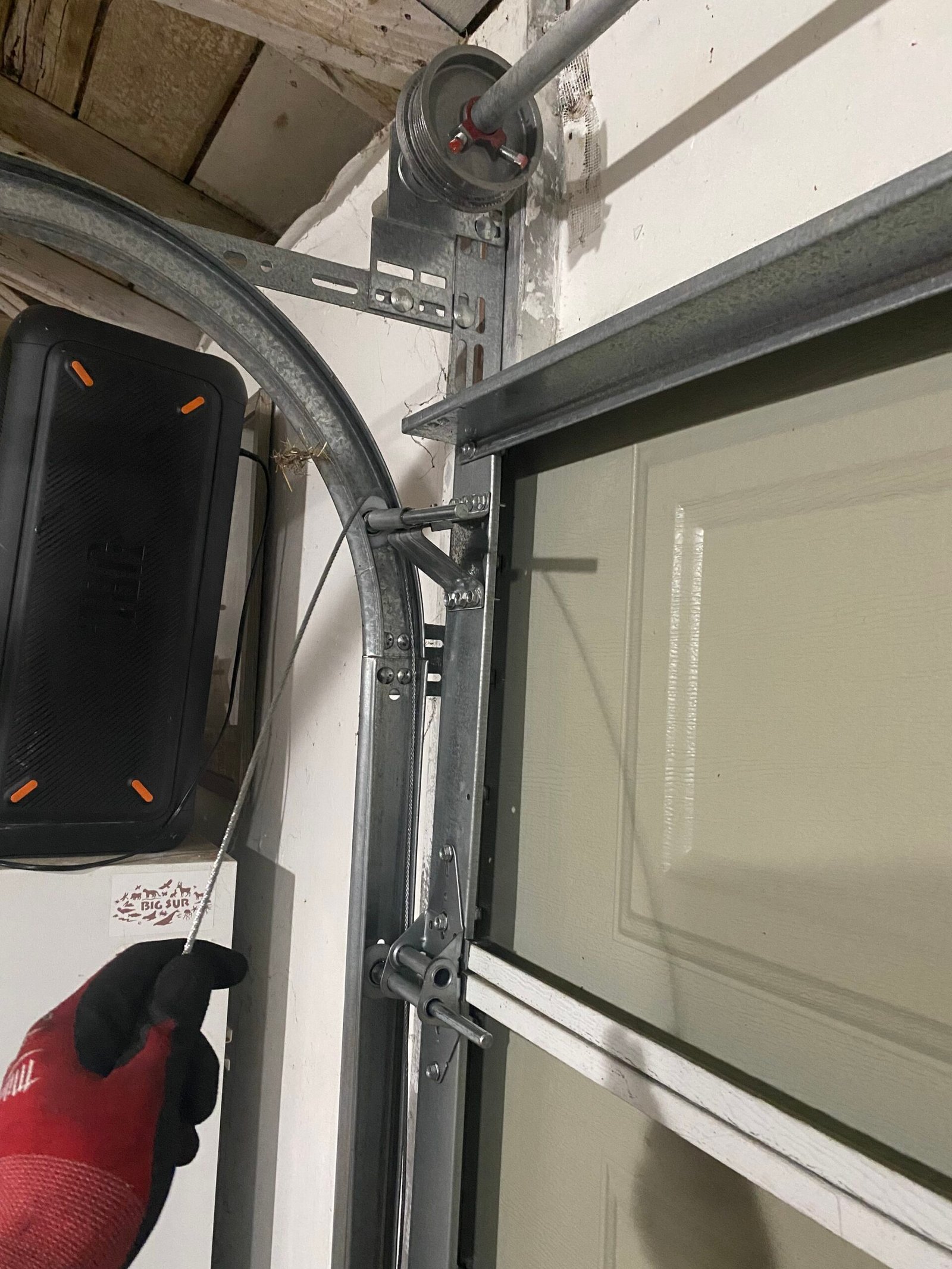
What If the Garage Door Is Crooked in the Tracks?
A crooked garage door should be treated as more than a cosmetic alignment issue.
One side being higher than the other can indicate unequal cable position, an off-track roller, damaged hardware or a larger counterbalance problem.
The track may be secondary damage
If a cable problem caused the door to tilt, the rollers may then force one or both tracks sideways.
Straightening only the track can leave the cable problem unresolved.
Do not lift one corner to level the door
A heavy sectional door with unequal cable forces can shift unexpectedly.
Standing under it or attempting to manually force one side upward can be hazardous.
Stop normal operation
If the door is visibly crooked, scraping heavily or hanging partly out of its track, avoid repeated opener operation.
The complete door position, cables, rollers, tracks and counterbalance system should be evaluated.
Safe Checks Pasadena Homeowners Can Make
Homeowners can gather useful information without dismantling the garage door.
Look down the track visually
From a safe position, look for obvious waves, bends, dents or changes in track width.
Compare left and right sides
The tracks do not need to look identical in every detail, but a major difference in angle, spacing or attachment can reveal a problem.
Watch each roller travel
If the door can operate without instability, observe whether a roller scrapes or hesitates at one location.
Stop operation if the door begins tilting, binding severely or leaving the track.
Look for fresh scrape marks
Bright metal or worn paint can show where rollers and track edges are contacting abnormally.
Look for loose track movement
Do not place your hands near a moving door. Observe whether the track visibly shifts as rollers pass.
Inspect visible rollers
Look for cracked wheels, wobbling, bent stems or rollers sitting at unusual angles.
Look at the hinges
A bent or loose hinge can alter roller position.
Note whether the door is level
A door that is visibly higher on one side may have a cable or counterbalance issue in addition to track damage.
Take photographs
A clear photo showing the full affected track and another close photo of the bend can help communicate the problem when requesting service.
What Pasadena Homeowners Should Not Do With a Bent Garage Door Track
A garage-door track appears simple, but the door running through it is a large counterbalanced mechanical system.
Do not:
- Force an off-track door through another cycle.
- Stand underneath an unstable partially open door.
- Loosen bottom brackets connected to lift cables.
- Disconnect or reconnect tensioned lift cables.
- Loosen torsion cable drums.
- Wind or unwind torsion springs.
- Adjust spring winding cones.
- Pry a track widely open just to reinsert a roller.
- Hammer aggressively near a loaded roller or cable assembly.
- Increase opener force to push through a bent track.
- Continue operating a door that becomes increasingly crooked.
- Assume a roller outside the track can simply be pushed back without identifying why it came out.
The homeowner's safest role is usually to observe the damage, stop abnormal operation and describe the symptoms accurately.
Can You Fix a Bent Track Without Replacing the Rollers?
Yes, if the rollers remain mechanically sound and compatible after the track problem is corrected.
Track damage does not automatically destroy every roller.
A professional inspection should determine whether the wheels, stems and bearings still operate normally.
Keep serviceable components when appropriate
If a roller remains round, rotates properly, has acceptable bearing condition and has not been bent by the track problem, there may be no mechanical reason to replace it merely because the track was repaired.
Replace rollers that were damaged by the track
If the track deformation created:
- A bent roller stem.
- A cracked wheel.
- A flattened wheel.
- Severe bearing looseness.
- Damage from repeated scraping.
then roller replacement may be appropriate along with the track repair.
The repair scope should follow actual condition rather than an automatic “replace everything” approach.
Can You Replace a Bent Track Without Replacing the Garage Door?
Often, yes.
Track damage alone does not automatically mean the entire garage door must be replaced.
The door sections, hinges, rollers and counterbalance system should be evaluated independently.
Track-only damage
If the door sections remain structurally suitable and the problem is isolated to a compatible replaceable track component, track repair or replacement may restore normal travel.
Track plus section damage
A substantial vehicle impact may damage the track and one or more door sections simultaneously.
In that case, the decision becomes broader than track repair.
Severe system damage
If the door is extensively buckled, multiple sections are damaged, tracks are severely distorted and other hardware has failed, a larger repair or door replacement discussion may become appropriate.
The existence of one bent track should not by itself be used as proof that a complete new door is necessary.
Why Does My Garage Door Rub Against One Track?
Constant rubbing on one side is a useful clue that something has changed in the alignment between the door, roller and track.
Possible causes include:
- The track shifted toward the door.
- The track twisted.
- A roller stem bent.
- A hinge moved.
- The door section distorted.
- The door became crooked because of a cable problem.
Look at more than the contact mark
If one roller rubs but every other roller has normal clearance, focus on the local roller, hinge and track position.
If every roller on one side rubs, the entire track position or overall door alignment deserves attention.
Do not simply spread the track
Widening the track until rubbing disappears can create too much clearance and reduce roller retention.
Correct alignment should preserve both free roller travel and proper track geometry.
Why Does the Garage Door Bind Only Near the Floor?
Binding near the closed position can point toward the lower vertical track, bottom roller area, door alignment or bottom-fixture geometry.
A vehicle or stored object may have struck the lower track without noticeably affecting the upper track.
Check the lower vertical track
Look for dents, inward bends, spreading or attachment movement.
Check the bottom roller visually
A bent roller stem can bind near the floor.
Do not loosen the bottom fixture to remove that roller because lift cables may be attached to the bottom bracket.
Check whether the door is level
If one side reaches the floor before the other, investigate cable and counterbalance alignment rather than assuming both tracks need adjustment.
Why Does the Garage Door Bind Near the Curved Track?
The curved track changes the direction of roller travel and requires the door sections to pivot through their hinges.
A problem in this area may involve:
- A distorted track radius.
- A misaligned connection between vertical and horizontal track.
- A bent roller stem.
- A flat-spotted roller.
- A damaged hinge.
- An incorrectly positioned top roller fixture.
Watch the same roller on repeated passes
If one particular wheel shakes as it enters the curve, inspect that roller and its hinge.
If several different rollers bump at exactly the same physical location, the track becomes a stronger suspect.
Do not reshape the curve casually
Track radius affects how the door transitions overhead.
Altering the geometry without understanding the door system can create additional binding.
Why Does the Garage Door Bind Near the Fully Open Position?
Problems near the fully open position can involve horizontal tracks, supports, rear hangers, rollers or opener travel.
Horizontal track support matters
Horizontal tracks carry the rollers while the door is overhead.
A loose support can allow the track to move under the door's position.
Look for sagging or twisting
Track that changes angle can force the roller against one edge.
Do not stand beneath an unstable door
If the door is fully or partly overhead and the horizontal track appears damaged or unsupported, avoid working beneath the door.
The problem should be stabilized before repair work begins.
Can Rust Cause Garage Door Track Problems?
Surface rust does not automatically mean the track needs replacement, but corrosion can matter when it affects structural condition, fasteners or the roller path.
Light surface oxidation
Minor discoloration is different from severe metal deterioration.
The track's shape and structural integrity remain the key concerns.
Severe corrosion
Advanced rust can weaken the track or mounting hardware.
It may also create rough surfaces that interfere with normal movement.
Check fasteners and supports
Corrosion around brackets or attachment points can contribute to looseness and misalignment.
If the track has lost meaningful metal thickness or structural shape, replacement may be more appropriate than cosmetic cleaning.
Should Garage Door Tracks Be Lubricated?
The track itself is primarily a guide path and should not be treated as a channel that needs to be packed with grease.
Heavy lubricant buildup can collect dirt and debris.
Maintenance guidance generally focuses lubrication on appropriate moving components such as certain roller bearings, hinges, springs or other points specified by the manufacturer.
Clean debris from the track
Dirt, leaves or other debris can cause resistance that resembles a small track defect.
A clean track makes visible dents, rust and scrape marks easier to inspect.
Lubricant cannot straighten metal
If a roller is pinched because the track is bent inward, additional lubricant does not correct the restricted geometry.
Likewise, grease will not secure a loose support or straighten a twisted track.
How Can a Track Problem Affect Garage Door Safety Sensors?
A bent track and a photo-eye sensor perform different jobs, but severe door misalignment can indirectly affect closing behavior.
A door binding mechanically may stop or reverse before reaching the floor.
A sensor problem can also prevent normal closing.
These two conditions should not be confused.
If the door will not close, identify whether the cause is mechanical
Look for rollers binding, the door becoming crooked or an obvious track obstruction.
Do not bypass photo-eye sensors
If the opener's safety system is preventing normal closing, diagnose the sensor condition rather than bypassing safety equipment to force the door downward.
A garage door can have both a track problem and a sensor problem, but each requires its own diagnosis.
Does a Bent Garage Door Track Always Make Noise?
No.
Some track problems create loud scraping, grinding or popping. Others first appear as resistance, uneven motion or unusual roller position.
Scraping
Scraping can occur when a roller stem, wheel or hinge contacts a track edge.
Popping
A roller can make a popping sound as it suddenly moves past a narrowed or misaligned section.
Rattling
Loose track supports or brackets can vibrate when rollers pass.
Quiet binding
A track can also create resistance without dramatic sound, particularly if the opener simply slows or stops at one location.
Noise is therefore useful information but not a requirement for diagnosing track damage.
Can a Garage Door Track Bend Without Being Hit?
Yes.
Direct impact is common, but track position can also change because of loose supports, abnormal door movement or repeated side loading.
Potential non-impact causes include:
- Rollers with badly bent stems.
- A door operating while crooked.
- Loose track brackets.
- A loose horizontal support.
- Hinge damage changing roller position.
- Cable problems creating unequal movement.
- Previous improper track adjustment.
When there is no obvious impact mark, inspect the connected door system for the force that may have moved the track.
Can a Garage Door Track Problem Get Worse Over Time?
Yes.
A small alignment problem can become more damaging when rollers repeatedly travel through the same restriction.
Repetitive loading matters
Every garage-door cycle repeats the same mechanical path.
A roller that contacts a bent edge once will contact it again the next time the door moves unless the condition changes.
Wear can spread to other components
Continued operation can contribute to:
- Roller wear.
- Bent stems.
- Loose hinges.
- Track spreading.
- Door-section stress.
- Additional opener resistance.
Early diagnosis can limit secondary damage
A door that has just begun scraping at one point is easier to evaluate than a door that has been forced until several rollers leave the track.
What Affects Bent Garage Door Track Repair Cost in Pasadena?
There is no accurate universal track-repair price because the phrase “bent track” can describe several very different repair conditions.
Relevant cost factors can include:
- Location of the track damage.
- Whether the track is vertical, curved or horizontal.
- Severity of deformation.
- Whether adjustment or replacement is appropriate.
- Track type and compatibility.
- Roller damage.
- Hinge or roller-carrier damage.
- Lift cable problems.
- Spring or counterbalance issues.
- Door-section damage.
- Whether the garage door is already off track.
- Whether the door is crooked or unstable.
- Accessibility.
- Installation complexity.
- Additional failed components.
Alignment work and track replacement are different scopes
Repositioning serviceable track and securing its supports is not the same job as replacing a crushed track section.
An off-track door adds diagnostic work
If rollers have already left the track, the repair must determine why the derailment occurred and whether cables, hinges or door sections were affected.
Impact damage can expand the repair
A vehicle strike may involve the track plus a panel, roller, bracket or cable.
Any estimate should reflect the actual damaged components rather than a fabricated flat price based only on the words “bent track.”
Bent Garage Door Track Considerations for Pasadena Homes
Track mechanics are the same everywhere, but Pasadena's residential property mix provides useful context for how track problems may develop and be noticed.
Older Pasadena garages
Older homes may have garage doors and track systems installed much later than the original structure.
Previous repairs may also have changed brackets, rollers, tracks or door sections over time.
The age of the house should therefore not be assumed to equal the age of the current track system.
Detached garages
Detached garages can have different ceiling heights, framing conditions and storage arrangements.
Track supports should be evaluated according to the actual current garage layout.
Attached garages
Attached garages may receive frequent household use and repeated daily door cycles.
A small track defect may therefore produce noticeable symptoms quickly because rollers encounter the damaged location multiple times each day.
Storage near vertical tracks
Bicycles, shelving, trash bins, lawn equipment and other stored items can occupy space near the sides of a garage.
Impact against a vertical track can alter alignment even when the garage door itself is not struck.
Vehicle access
Tracks are located close to the vehicle opening, so a bumper, mirror, bicycle rack or other object can contact lower track hardware.
If impact occurs, inspect the adjacent roller and door section in addition to the track.
Warm conditions and dust
Pasadena garages can accumulate dust around tracks and rollers, especially where doors are frequently open.
Keeping the track visually clean makes it easier to identify fresh scrape marks, dents, loose hardware and roller damage.
Rental and managed properties
A tenant may report that the door “gets stuck halfway” without knowing which component is involved.
Property owners and managers should treat the symptom as a reason for diagnosis rather than immediately replacing the opener.
Pasadena geographic context
This guide is focused on residential garage doors in Pasadena, California 91105, within Los Angeles County and the San Gabriel Valley.
Pasadena neighborhood context may naturally include Old Pasadena, Bungalow Heaven, Hastings Ranch, Madison Heights and San Rafael Hills.
These references provide local context only and do not imply separate Pasadena Garage Door Repair Experts offices or storefronts in those neighborhoods.
When Professional Garage Door Track Repair Makes Sense
Professional garage-door track repair is especially appropriate when the problem involves more than light visible maintenance.
Consider professional service when:
- The track is visibly bent or twisted.
- The track opening has spread.
- The garage door is crooked.
- One or more rollers have left the track.
- The door is stuck partially open.
- A lift cable is loose or displaced.
- A roller stem is bent.
- A hinge or roller carrier is damaged.
- A vehicle struck the door or track.
- The track moves under load.
- The horizontal track or support appears unstable.
- The opener repeatedly stops at the damaged location.
- The door has become unusually heavy in addition to binding.
- Several components appear damaged together.
The benefit of professional diagnosis is not simply access to another piece of track.
It is the ability to determine whether the track problem is primary or whether another component—roller, hinge, cable, spring, panel or bracket—caused the abnormal movement.
Pasadena homeowners can contact Pasadena Garage Door Repair Experts or call (626) 415-3641 to describe a bent track, off-track roller, crooked garage door, scraping, binding or related symptoms and ask about current service availability.
What Should Be Inspected During Garage Door Track Repair?
A proper track repair should not assume the track is the only component that needs attention.
Rollers
Inspect the wheels, bearings and stems for damage caused by abnormal track contact.
Hinges and roller carriers
Confirm that the components positioning the rollers are not bent, cracked or loose.
Lift cables
Look for visible fraying, looseness or displacement.
Cable adjustments should be handled as part of the counterbalance system, not as casual track work.
Springs and balance
If the door feels unusually heavy or behaves abnormally throughout its travel, spring condition and overall balance should be evaluated.
Door sections
Impact damage can bend a panel and change roller geometry.
Track supports
Check jamb brackets, flag-bracket areas, rear supports and other attachment points as appropriate to the door.
Opener operation
Once the mechanical door moves smoothly and is properly balanced, the automatic opener can be evaluated under normal operating conditions.
When Is Track Replacement More Sensible Than Repeated Straightening?
A garage-door track is a formed metal guide. Its shape matters.
If the metal has been significantly crushed, kinked or repeatedly reshaped, it may no longer provide reliable geometry.
Sharp creases
A sharp crease can remain a weak point even when the track is pushed closer to its original position.
Damaged retaining edges
If the formed edge that helps keep the roller inside the channel has been badly spread or torn, retention may be compromised.
Multiple deformation points
A track with several bends can be difficult to restore accurately along its entire length.
Severe corrosion
If corrosion has materially weakened the track, reshaping it does not restore missing metal.
Incompatible old track
During a larger door replacement or system change, the existing track may not be appropriate for the replacement door.
In these situations, compatible track replacement can provide a more coherent repair than repeatedly attempting to reshape compromised metal.
Can Only One Side of a Garage Door Track Be Replaced?
Sometimes an individual damaged track component can be replaced, but the decision depends on system compatibility.
The replacement needs to work correctly with the opposite track, roller system, door height, track radius and hardware.
Do not assume visual similarity equals compatibility
Track dimensions and formed profiles can differ.
A part that looks close enough may not guide the rollers properly.
Evaluate the opposite side
If one track was damaged by impact but the opposite track remains undamaged, it may not need replacement.
If both tracks are badly worn, altered or incompatible with a larger door update, a broader track replacement may make more sense.
The decision should be based on actual compatibility and condition rather than automatically replacing both sides or automatically replacing only one.
Can a Bent Garage Door Track Cause the Door to Fall?
Track damage alone does not mean a garage door will automatically fall, but severe track failure can contribute to loss of normal roller guidance.
The risk becomes greater when track damage occurs together with:
- Rollers leaving the track.
- A broken or loose cable.
- A crooked door.
- Damaged hinges.
- Broken counterbalance components.
- Unstable horizontal track support.
The door remains a heavy moving assembly
Springs counterbalance the weight, but they do not eliminate the physical mass of the door.
If the door is unstable, do not stand beneath it or attempt to hold it up by hand while another person adjusts the track.
Partially open doors deserve extra caution
A damaged door stuck overhead may contain spring tension while relying on compromised tracks or rollers.
Stabilization should precede repair.
Can a Bent Track Make the Door Open Unevenly?
Yes, but uneven opening can also originate elsewhere.
If one track creates much greater resistance than the other, one side of the door may appear to lag.
However, unequal cable tension or a cable that has slipped from its normal drum position can produce an even stronger crooked-door symptom.
Determine whether the resistance is localized
If the door remains level until one roller reaches a damaged section and then twists, track resistance becomes a strong clue.
Determine whether one side is consistently higher
A persistent height difference may point toward cable or counterbalance involvement.
Do not compensate by moving the opposite track
Adjusting a good track to match a bad door position can create two alignment problems instead of solving one.
Is a Slightly Bent Garage Door Track an Emergency?
Not every visible bend creates the same urgency.
The seriousness depends more on what the door is doing than on how dramatic the metal looks.
Lower urgency may include:
- A small visible deformation with normal roller retention.
- No crooked movement.
- No loose cable.
- No unstable door position.
- No severe binding.
Higher urgency includes:
- Rollers coming out of the track.
- A door hanging crooked.
- A loose or displaced lift cable.
- A track separating from its support.
- Severe binding during operation.
- A door stuck partially open and unstable.
- Impact damage involving the door and track together.
If the door appears unstable, normal operation should stop until the condition is evaluated.
What If the Garage Door Track Is Pulling Away From the Wall?
Track pulling away from its mounting area can create misalignment even if the track itself is not visibly bent.
The problem may involve:
- Loose fasteners.
- Damaged brackets.
- Attachment-point deterioration.
- Impact.
- Repeated side loading from a crooked door.
Do not simply force the track back and tighten anywhere
The track needs to be positioned correctly relative to the door and adjoining components.
If the surrounding attachment area has failed, tightening the same hardware may not provide a durable correction.
Structural attachment concerns should be identified before normal door operation resumes.
Can Track Repair Improve a Noisy Garage Door?
Yes, when abnormal roller-to-track contact is producing the noise.
Correcting a bent or misaligned track can eliminate scraping, impact or vibration created by that defect.
However, track repair cannot eliminate noises originating in unrelated components.
Remaining noise may come from:
- Worn rollers.
- Loose roller bearings.
- Hinges.
- Spring coils.
- Torsion-shaft bearings.
- Loose door hardware.
- The garage door opener.
If quiet operation is the homeowner's goal, identify the actual sound source before replacing multiple components.
Can Track Repair Fix a Garage Door That Will Not Open?
It can if the door is mechanically blocked by track deformation.
But a garage door that will not open can have many other causes.
Possibilities include:
- A broken torsion or extension spring.
- A damaged lift cable.
- A roller jammed in bent track.
- An engaged manual lock.
- A garage door opener problem.
- A damaged hinge or door section.
Find the restriction first
If the opener stops at exactly the point where a roller enters a damaged track section, the track is a strong candidate.
If the door is heavy from the first inch of movement, spring counterbalance may be more important.
Track replacement should not be used to solve an unrelated opener or spring problem.
Can Track Repair Fix a Garage Door That Will Not Close?
It can when track resistance prevents normal downward travel.
But closing problems can also involve photo-eye sensors, opener travel, door balance or other mechanical conditions.
Mechanical track binding
A roller may stop at a dent, twisted area or narrowed track opening.
Sensor-related closing problem
A door can reverse because of an opener safety-sensor condition even when both tracks are straight.
Do not bypass safety equipment
If the opener will not close normally, identify whether the problem is mechanical or safety-system related rather than bypassing sensors or increasing opener force.
How Often Should Garage Door Tracks Be Inspected?
Regular visual checks can help identify track movement before it becomes an off-track door.
Homeowners do not need to dismantle the system.
Useful inspection points include:
- Visible dents or bends.
- Twisting.
- Track spreading.
- Loose-looking brackets or supports.
- Fresh scrape marks.
- Rollers rubbing one edge.
- Rollers leaving the track.
- Uneven door movement.
- Changes in noise.
Industry technical guidance recommends evaluating track deformation and misalignment together with rollers, hinges, cables, sections and other door components rather than viewing the track in isolation.
California Contractor Due Diligence for Garage Door Track Work
A track repair can range from correcting door alignment to replacing structural guide components after significant impact.
California's Contractors State License Board describes the D-28 Doors, Gates and Activating Devices classification as covering installation, modification and repair of residential, commercial and industrial doors, including overhead door assemblies.
Homeowners researching contractor classifications can review the California D-28 classification .
Current contractor status should be independently checked in applicable official records.
This article does not make a specific licensing claim about Pasadena Garage Door Repair Experts.
Questions Pasadena Homeowners Should Ask Before Garage Door Track Repair
A clear repair recommendation should explain what is damaged and why the proposed work addresses the cause.
- Where exactly is the track bent or misaligned?
- Is the track bent inward, spread open, twisted or loose?
- Did a roller or hinge contribute to the damage?
- Are any roller stems bent?
- Are roller bearings worn or loose?
- Are the hinges and roller carriers in suitable condition?
- Is the garage door level?
- Are the lift cables correctly positioned?
- Is any cable frayed, loose or displaced?
- Is the spring system properly counterbalancing the door?
- Did a vehicle or other impact damage a door section too?
- Can the existing track be aligned or repaired safely?
- Is track replacement more appropriate because the metal is severely deformed?
- If track is replaced, is the replacement compatible with the existing door?
- Are horizontal-track supports secure?
- Have any rollers already come out of the track?
- Will the completed repair restore smooth roller travel?
- Will the door be checked for correct balance afterward?
- Will opener operation be checked only after mechanical resistance is corrected?
- Which additional parts are actually damaged rather than being replaced automatically?
Bent Garage Door Track Repair Red Flags
Track repair should be tied to observable damage and the mechanical cause of that damage.
Potential red flags include:
- Forcing an off-track door to operate repeatedly.
- Replacing rollers without checking an obviously bent track.
- Straightening track without checking a badly bent roller stem.
- Ignoring a crooked garage door.
- Ignoring a loose lift cable.
- Adjusting cable drums to solve an ordinary track problem without proper diagnosis.
- Increasing opener force to push through mechanical binding.
- Prying track widely open simply to reinsert a roller.
- Hammering around spring-connected hardware while the system remains loaded.
- Moving a good track to compensate for a damaged hinge or door section.
- Automatically replacing the entire garage door because one track section is damaged.
- Automatically straightening track that is severely crushed or structurally compromised.
- Installing visually similar but incompatible replacement track.
- Ignoring weakened or loose track supports.
- Quoting one universal track-repair price for every Pasadena garage door.
Why Consider Pasadena Garage Door Repair Experts for Track Problems?
Pasadena Garage Door Repair Experts is a local garage door repair company serving homeowners and residential property customers in Pasadena, California.
A useful track diagnosis considers more than the visible bend.
Relevant components can include:
- Vertical tracks.
- Curved track sections.
- Horizontal tracks.
- Track brackets and supports.
- Roller wheels.
- Roller bearings and stems.
- Hinges and roller carriers.
- Lift cables.
- Spring counterbalance.
- Door sections.
- Overall door alignment.
- Opener operation after mechanical resistance is corrected.
That complete-system approach helps distinguish a simple track-alignment problem from a larger off-track, cable, roller, hinge or impact-related condition.
Pasadena homeowners can visit Pasadena Garage Door Repair Experts or call (626) 415-3641 to describe bent track, scraping, binding, crooked movement or an off-track garage door and ask about current service availability.
Garage Door Track Service Area in Pasadena
The primary geographic focus of this guide is Pasadena, California 91105, within Los Angeles County and the San Gabriel Valley.
Pasadena residential context can naturally include Old Pasadena, Bungalow Heaven, Hastings Ranch, Madison Heights and San Rafael Hills.
These neighborhood references provide local context only and do not imply separate physical Pasadena Garage Door Repair Experts offices or storefronts in those neighborhoods.
Homeowners can call (626) 415-3641 to ask about current residential garage-door track repair, roller alignment, off-track or related service availability in Pasadena.
Frequently Asked Questions About Bent Garage Door Tracks in Pasadena
Can a bent garage door track be repaired?
Yes, some bent or misaligned garage-door tracks can be repaired when the metal remains structurally suitable and correct roller clearance and alignment can be restored. Severely crushed, sharply kinked, torn, repeatedly deformed or structurally weakened track may need replacement instead. Rollers, hinges, cables and door alignment should also be inspected so the cause of the damage is not missed.
What causes a garage door track to bend?
Common causes include vehicle or equipment impact, a bent roller stem, worn roller bearings, a crooked garage door, cable problems, loose track brackets, damaged hinges, door-section distortion and repeatedly operating the door after binding begins. The track may be the original problem or secondary damage caused by another component.
How can I tell if my garage door track is misaligned?
Warning signs include rollers rubbing one side of the track, repeated sticking at the same height, visible differences in track position, scraping marks, track movement as rollers pass, shaking through the curve or rollers beginning to leave the channel. A crooked door may also involve cables or counterbalance components, not just track alignment.
Can a bent garage door track cause the rollers to come out?
Yes. Track that is bent, spread open, twisted or badly misaligned can contribute to a roller leaving its normal path. Roller damage, loose hinges, cable problems and a crooked door can also cause derailment. If a roller is already outside the track, avoid repeated opener operation and have the cause evaluated.
Should I keep using my garage door if the track is bent?
Not if the door is binding severely, crooked, unstable or already off-track. Repeated operation can increase damage to rollers, hinges, tracks, cables or sections. A very small deformation with otherwise normal operation may be less urgent, but the track should still be inspected before the problem progresses.
Can a bent track make my garage door opener stop?
Yes. A bent or misaligned track can create enough mechanical resistance for the opener to slow, stop or reverse. The mechanical restriction should be corrected before opener force is increased or the opener is replaced. A broken spring can also make the door difficult to move, so door balance should be considered during diagnosis.
Does a bent garage door track always need replacement?
No. Track replacement depends on damage severity and whether correct geometry can be restored. Limited alignment problems or minor deformation may be repairable. Track that is crushed, torn, sharply kinked, structurally weakened or no longer able to retain the rollers correctly may be better replaced with compatible track.
Can I straighten a garage door track myself?
Homeowners can safely observe obvious track damage, but an off-track, crooked or unstable door can involve cables, springs and other high-tension components. Do not loosen spring-connected bottom brackets, cable drums, lift cables or torsion-spring hardware. Professional repair is appropriate when the track is substantially bent, rollers have come out or the door is unstable.
How much does garage door track repair cost in Pasadena?
There is no accurate universal price because repair scope varies. Cost can depend on the damaged track section, severity of deformation, whether the track can be aligned or needs replacement, roller or hinge damage, cable involvement, door-section damage, accessibility and whether the door is already off track. Diagnosis should determine the actual repair before a price is established.
Who can I contact about a bent garage door track in Pasadena?
Pasadena homeowners can contact Pasadena Garage Door Repair Experts at (626) 415-3641 to describe a bent or misaligned track, off-track rollers, scraping, binding or a crooked garage door and ask about current residential garage door service availability in Pasadena, California.
Find Pasadena Garage Door Repair Experts on Google Maps
You can also view Pasadena Garage Door Repair Experts on Google Maps .
Is Your Garage Door Track Bent, Scraping or Off Track in Pasadena?
A bent track is easiest to address before repeated garage-door operation turns a small alignment problem into damaged rollers, hinges, cables or door sections.
If the door sticks at the same point, a roller repeatedly rubs the track, the track visibly moves, the door has become crooked or a roller has already left its track, stop forcing the door and identify the underlying cause.
Some track problems can be corrected through proper alignment or repair. Severely crushed, twisted or structurally compromised track may require replacement. The correct recommendation depends on the actual condition of the door.
Contact Pasadena Garage Door Repair Experts to ask about current residential garage-door track service availability in Pasadena, California.
Call (626) 415-3641.
Safety reminder: do not force an unstable off-track door, stand beneath a crooked partially open door, loosen spring-connected bottom brackets, reconnect tensioned lift cables, adjust cable drums or wind or unwind torsion springs.
Related Pasadena Garage Door Topics
- Garage Door Came Off Track in Pasadena? What to Do—and What Not to Do
- Garage Door Rollers Worn Out? 8 Signs Pasadena Homeowners Should Replace Them
- Broken or Frayed Garage Door Cable? 7 Warning Signs Pasadena Homeowners Should Know
- Why Is My Garage Door So Loud? What Grinding, Squeaking, Popping and Rattling Mean
- The Pasadena Garage Door Maintenance Checklist: Springs, Rollers, Tracks, Cables and Opener