
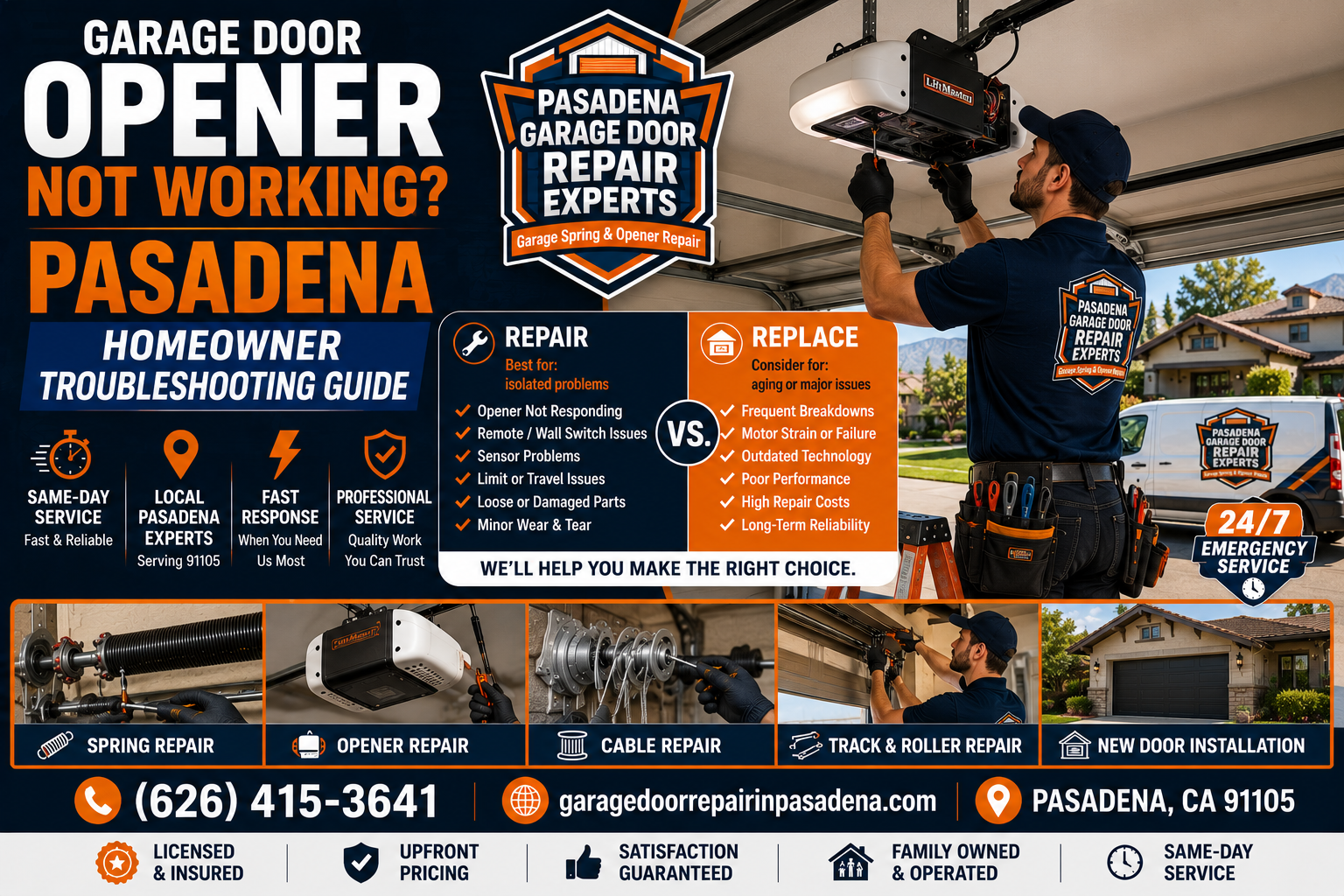
Garage Door Opener Not Working? Pasadena Homeowner Troubleshooting Guide
When a garage door opener suddenly stops working, the motor itself is only one possible cause. The problem may involve electrical power, a remote control, the wall console, lock mode, safety sensors, travel programming, the opener trolley, drive components, or the mechanical garage door.
A broken spring, damaged lift cable, off-track roller or binding door can also make a functioning opener appear defective because the operator is being asked to move a door that is no longer properly balanced or capable of traveling normally.
This guide from Pasadena Garage Door Repair Experts explains how Pasadena homeowners can troubleshoot garage door opener problems safely and systematically before replacing parts.
Why Is My Garage Door Opener Not Working?
A garage door opener may stop working because it has lost electrical power, the remote battery or transmitter has failed, the wall control is not communicating, lock mode is enabled, safety sensors are obstructed or misaligned, opener travel settings are incorrect, the trolley is disconnected, an internal drive or electronic component has failed, or the garage door itself has a broken spring, cable, track or balance problem.
The fastest way to narrow the problem is to identify exactly what still works. If the wall button operates the door but the remote does not, the opener motor and much of the door system are probably functioning. If neither the remote nor wall button causes any response, power or opener electronics deserve attention. If the motor runs but the door remains still, the trolley, drive system or mechanical garage door may be involved.
If the opener tries to lift the garage door but the door rises only a few inches, do not automatically assume the opener needs replacement. A broken spring can make the door dramatically heavier and cause a perfectly functional opener to struggle.
Homeowners can safely check electrical power, remote batteries, wall controls, lock mode, obvious sensor obstructions and visible door alignment. Avoid opening the opener housing while power is connected, bypassing safety sensors, adjusting high-tension springs or cables, or increasing opener force simply to overpower a binding door.
Garage Door Opener Troubleshooting Starts With the Exact Symptom
“My garage door opener isn't working” can describe several completely different problems.
Before buying a new remote, replacing sensors or assuming the opener motor has failed, identify what happens when you press the control.
These symptom differences matter because a garage door opener is only one part of the complete system. The opener receives commands, supplies powered movement and monitors safety or travel conditions, but springs counterbalance the door and tracks, rollers, hinges and cables make mechanical travel possible.
Troubleshooting is much more accurate when those systems are considered separately.
1. The Garage Door Opener Has Lost Electrical Power
If neither the remote nor wall control produces sound, movement, lights or another response from the opener, confirm electrical power before replacing opener parts.
Most ceiling-mounted residential garage door openers connect to a standard electrical receptacle near the motor unit. A disconnected plug, tripped breaker, tripped GFCI-protected circuit, electrical fault or utility outage can make the opener appear completely dead.
Safe electrical checks
- Confirm the opener is visibly plugged into its receptacle.
- Check whether the opener light or display responds.
- Determine whether other garage electrical devices have power.
- Check the appropriate circuit breaker if you know which circuit serves the garage.
- Look for a tripped GFCI device that may protect downstream receptacles.
- Determine whether the home is experiencing a broader outage.
Avoid removing opener covers or touching internal electrical components while the unit is energized.
If other garage electrical equipment works but the opener remains completely unresponsive, possibilities can include the opener's power supply, logic board, internal wiring, transformer, motor circuitry or another model-specific electrical component.
Pasadena-specific outage check
If several electrical devices in the home are also without power, Pasadena residents can check the official Pasadena Water and Power outage map before assuming the garage door opener itself has failed.
An electrical outage and a mechanical garage door problem can also happen at the same time. Loss of power does not prove that the spring, cables, tracks and rollers are healthy.
2. The Garage Door Remote Control Is Not Working
If the wall-mounted control operates the garage door normally but a handheld remote does not, troubleshooting should focus on the remote and wireless-control system before the opener motor.
This symptom comparison is extremely useful. If pressing the wall button causes the opener to move the garage door through a complete cycle, then the opener is receiving power and is capable of operating the door.
Possible remote-control problems include:
- Dead or weak remote battery.
- Incorrect replacement battery.
- Damaged remote transmitter.
- Lost programming.
- Incompatible replacement remote.
- Lock or vacation mode.
- Radio-frequency interference.
- Opener receiver or antenna problem.
Chamberlain Group's official remote-control troubleshooting recommends comparing remote operation with the wall control, checking lock mode, checking compatibility and replacing the remote-control battery when appropriate.
Homeowners using Chamberlain or LiftMaster equipment can review the manufacturer's garage door remote troubleshooting guidance for model-family information.
Start with the battery
A remote battery is one of the lowest-risk troubleshooting items. Replace it with the correct battery specified for the remote and test again.
If multiple remotes stop working at exactly the same time while the wall control still works, it becomes less likely that every remote battery failed simultaneously. Check lock mode, opener programming, antenna conditions or another shared wireless issue.
Do not erase programming unnecessarily
Some homeowners immediately erase all remotes from opener memory and begin reprogramming. That can create additional work if the original problem was simply a dead battery or lock mode.
Troubleshoot the simplest variables first.
3. The Wall-Mounted Garage Door Control Is Not Working
A wall control can fail independently of a remote.
If the remote operates the door normally but the wall control does not, possible causes can include wall-control wiring, the console itself, terminals at the opener or model-specific communication issues.
Start by observing the wall control.
Does it have an indicator light? Does the light respond when buttons are pressed? Is the display blank? Is the control visibly damaged? Has nearby painting, remodeling or storage activity disturbed the small low-voltage wires leading from the console?
Low-voltage control wiring
Many residential openers use low-voltage wiring between the opener and wall control.
Visible damage such as a cut wire, pulled connection or damaged insulation may provide a clue. Homeowners can observe those conditions without dismantling energized opener electronics.
If both the remote and wall control fail, however, the problem may be broader than the wall console.
Check opener power before replacing the control.
If the opener has power and multiple control methods fail, the logic board, receiver, control circuit or another internal component may deserve further diagnosis.
4. Lock Mode or Vacation Mode Is Preventing Remote Operation
Some garage door opener wall controls include a lock feature that disables handheld remote commands without disabling the wall-mounted control.
This feature can be useful when homeowners want to temporarily prevent remote transmitters from opening the garage.
It can also create confusion when activated accidentally.
A typical symptom is simple:
The wall button operates the garage door, but remotes that previously worked suddenly do nothing.
Some Chamberlain/LiftMaster wall controls indicate lock mode through a flashing control LED or specific opener-light behavior, although indicator patterns vary by model.
Consult the opener's manual before assuming the exact same button sequence applies to every unit.
If lock mode is enabled, disabling it according to the manufacturer's instructions may restore remote operation without replacing anything.
This is one reason symptom-based troubleshooting can prevent unnecessary opener replacement.
5. Safety Sensors Are Preventing the Garage Door From Closing
If a garage door opens normally but refuses to close from the remote, safety-reversing sensors become one of the most relevant systems to inspect.
Photo-eye sensors are typically mounted near the bottom of the garage-door opening on opposite sides. They monitor the closing path.
A blocked, misaligned or electrically disconnected safety sensor can prevent normal remote-controlled closing on many residential opener systems.
The U.S. Consumer Product Safety Commission states that automatic residential garage-door operators must comply with the federal safety standard in 16 CFR Part 1211 for automatic residential garage door operators .
Safety systems should be diagnosed rather than bypassed.
Common safety-sensor problems
- A box, bicycle, trash container or tool blocks the beam.
- A sensor has been bumped out of alignment.
- Dust or debris covers a lens.
- Low-voltage sensor wiring has been damaged.
- A sensor bracket is loose.
- Direct sunlight interferes with the receiving sensor on some systems.
- A sensor itself has failed.
Check the indicator lights
Many openers use LEDs on the safety sensors. A dark or flickering LED can provide useful information, but the exact meaning varies by manufacturer and model.
LiftMaster manuals for certain systems state that remote-controlled closing may be prevented when safety-sensor LEDs indicate an obstructed or misaligned condition.
Use the specific opener manual rather than assuming all indicator lights follow the same code.
If the opener is refusing to close because the safety circuit reports a problem, identify the obstruction, alignment, wiring or sensor fault rather than disabling an important protection system.
6. Garage Door Opener Travel or Limit Settings Are Incorrect
Automatic openers need to know where the garage door should stop when fully open and fully closed.
Depending on the model, those positions may be established through mechanical limit screws, electronic travel programming, position sensors or another calibration process.
Incorrect travel settings can produce symptoms such as:
- The door stops before reaching the floor.
- The door reaches the floor and reverses.
- The door does not open to its normal height.
- The opener loses its learned open or closed position.
- The operator refuses normal commands after unsuccessful programming.
Chamberlain's official travel and force setup documentation for supported models notes that unsuccessful limit-learning can prevent normal activation and that safety-sensor conditions can interfere with successful travel setup.
The correct adjustment procedure is model-specific.
Do not use travel adjustment to hide resistance
Before changing travel, make sure the garage door is not encountering a physical obstruction or serious mechanical problem.
A bent track, seized roller, damaged hinge or displaced cable can make a door stop near the same point every time.
Reprogramming travel so the opener stops before reaching that damaged area does not repair the door.
Mechanical movement should be evaluated before programming is changed.
7. The Garage Door Opener Trolley Has Been Disconnected
If the opener motor runs and the trolley moves along the rail but the garage door stays in place, the manual-release connection may be disengaged.
Most automatic garage door openers include an emergency-release mechanism. Pulling the release allows the garage door to be disconnected from the opener so it can potentially be operated manually when conditions are safe.
After an outage, previous service or intentional manual operation, the trolley may remain disconnected.
What to observe
- Does the opener rail trolley move when the motor runs?
- Does the garage door remain stationary?
- Is the release mechanism visibly in the disconnected position?
- Was the emergency release recently used?
If the door itself is mechanically healthy, the trolley may simply need to be re-engaged according to the opener manufacturer's procedure.
But do not reconnect the opener blindly if the door was disconnected because it had become heavy, crooked or difficult to move.
Do not casually disconnect an opener from a partially open, severely crooked or mechanically unstable door. If a spring or cable has failed, disconnecting the opener may change how the unsupported door moves.
8. An Internal Opener Drive Component Has Failed
An opener can receive power and commands while still being unable to transfer motor movement to the garage door.
Residential opener designs vary, but internal or drive-related components can include:
- Drive gears.
- Sprockets.
- Chains.
- Belts.
- Trolleys.
- Motor shafts.
- Capacitors.
- RPM or position sensors.
- Logic boards.
- Travel modules.
- Model-specific electronic components.
Symptoms can include humming without normal movement, motor sound with no trolley travel, clicking, unusual gear noise, inconsistent travel or an opener that stops after moving only a short distance.
Some opener components are serviceable. Others may make complete opener replacement more reasonable depending on the model, age, parts availability and overall condition.
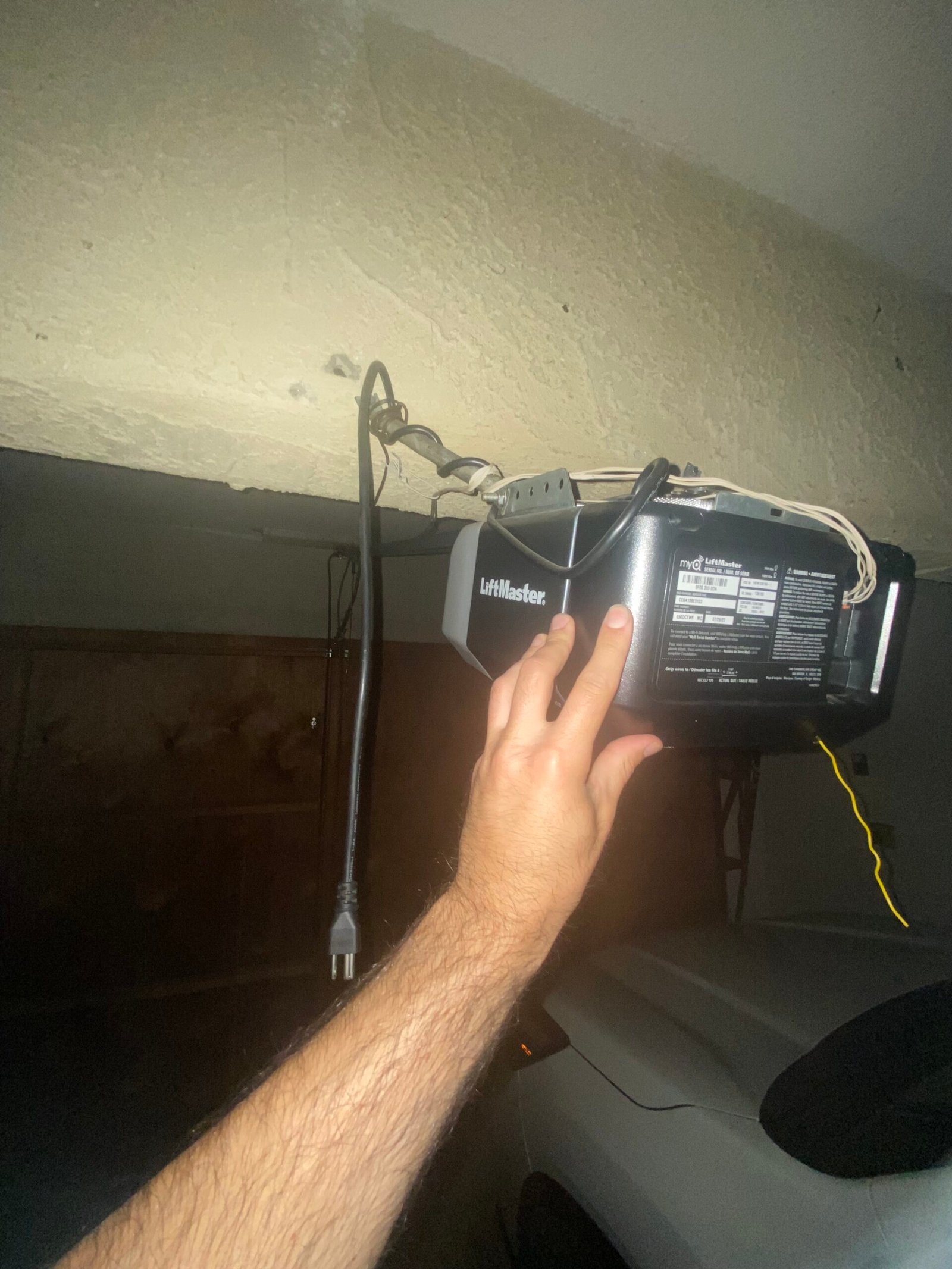
Diagnose the mechanical door before blaming internal opener parts
A stripped gear or stressed drive component can sometimes be a consequence rather than the original cause.
If the garage door became extremely heavy because the spring system failed, the opener may have been operating under abnormal load.
Repairing only the opener without correcting the heavy door can create a repeat failure.
The door's balance and mechanical movement should therefore be checked whenever an opener has experienced significant strain.
9. A Broken or Worn Garage Door Spring Is Making the Opener Look Defective
One of the most important garage door opener troubleshooting rules is this: the opener is not intended to replace the counterbalance function of the garage door springs.
Springs offset much of the door's weight. When a torsion or extension spring breaks, the garage door can become dramatically heavier.
An opener that moved the door normally yesterday may suddenly:
- Lift the door only a few inches.
- Stop during upward travel.
- Strain or hum.
- Move more slowly.
- Reverse.
- Produce increased drive noise.
None of those symptoms proves the opener motor has failed.

Look for spring-related clues
From a safe distance, check for:
- A visible gap in a torsion spring.
- A loud bang that occurred before the opener stopped working normally.
- A garage door that feels much heavier than before.
- Uneven door movement.
- A loose lift cable.
Spring fatigue is strongly related to operating cycles. If you are trying to understand whether an older spring may be approaching its expected fatigue life, see our Pasadena guide to garage door spring lifespan .
That relationship matters because opener replacement should not be used as a substitute for restoring a failed counterbalance system.
- Wind or unwind torsion springs.
- Loosen winding cones.
- Adjust cable drums.
- Reconnect lift cables under tension.
- Increase opener force simply to lift a door with a failed spring.
10. The Garage Door Itself Is Binding in the Tracks
A garage door opener can be working correctly while the garage door cannot travel normally.
Tracks, rollers, hinges, cables, panels and other hardware all influence movement.
Mechanical resistance can make an opener:
- Stop at the same height repeatedly.
- Reverse.
- Move slowly.
- Strain.
- Make increased noise.
- Appear underpowered.
Track problems
Look for bent track, loose mounting brackets, a track that has shifted or a roller that is no longer positioned normally.
Roller problems
A worn, cracked, seized or displaced roller can create substantial resistance.
Cable problems
A loose or displaced lift cable can cause one side of the garage door to move differently from the other.
Hinge and panel problems
Damaged hinges or distorted door sections can cause binding as the door transitions through the curved track.
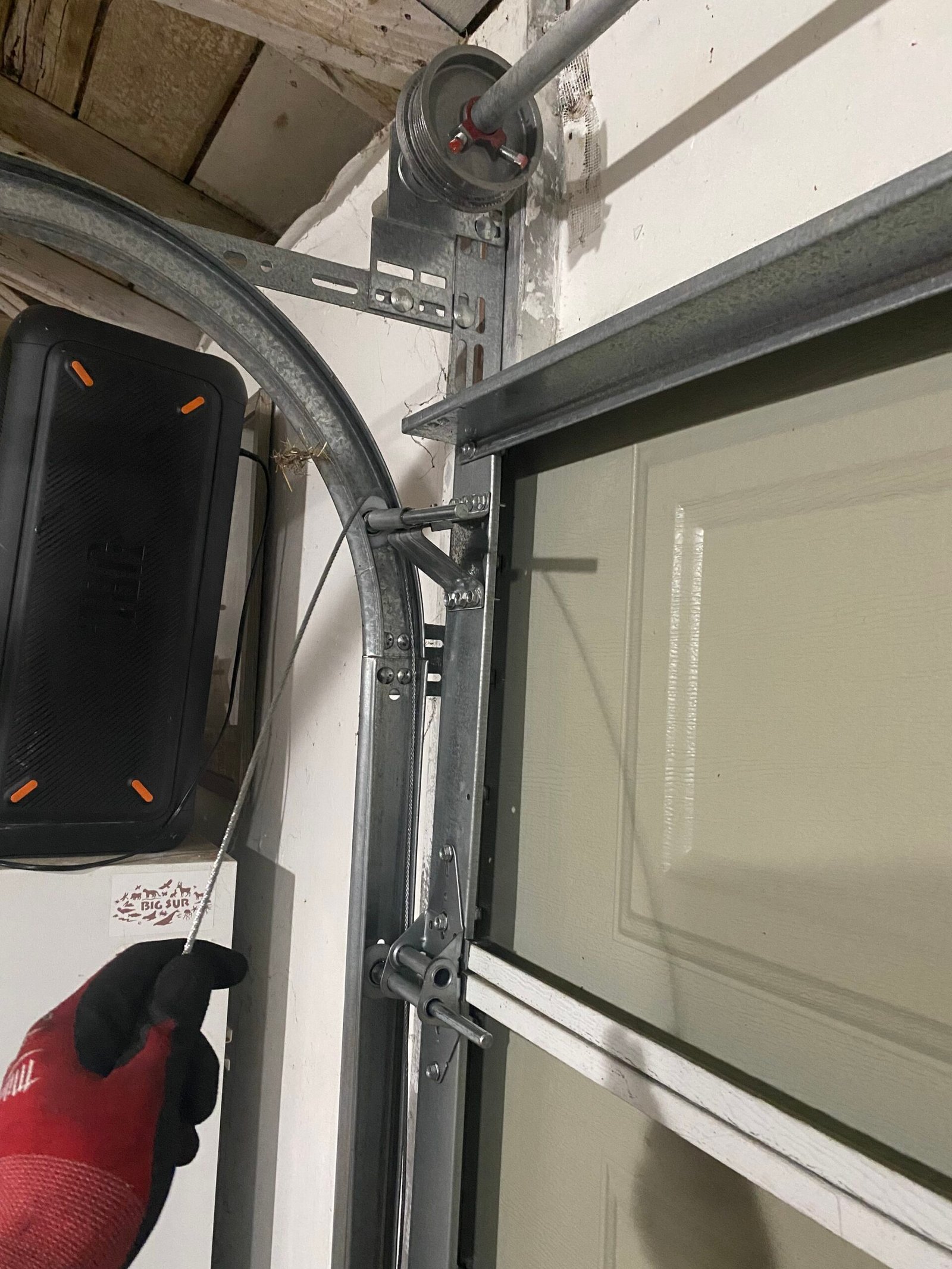
If the door is visibly crooked, a cable is hanging loose or a roller has left the track, stop operating the opener.
Increasing motor force against a physically binding door can increase stress on the opener arm, top section, rollers, tracks and hardware without repairing the underlying problem.
12 Safe Garage Door Opener Checks Pasadena Homeowners Can Make
A useful homeowner troubleshooting process stays on the low-risk side of the system.
1. Check the opener plug
Confirm that the opener is connected to electrical power.
2. Check whether other garage electrical devices work
This helps distinguish an opener-specific problem from a broader electrical interruption.
3. Try the wall control
If the wall button works but the remote does not, focus on the remote, wireless receiver or lock feature.
4. Try a second remote if available
If one remote works and another does not, the failed remote becomes the stronger suspect.
5. Replace the remote battery
Use the battery type specified for the remote.
6. Check lock mode
If every remote fails but the wall control works, check whether the wall-console lock or vacation feature is active.
7. Inspect the sensor beam path
Clear boxes, tools, bicycles, trash containers and other objects.
8. Observe the safety-sensor LEDs
Compare their behavior with the opener manual.
9. Look for obvious sensor-wire damage
A visibly pulled or cut low-voltage wire can explain a sensor problem.
10. Look at the spring from a safe distance
A visible gap in a torsion spring can explain why the opener suddenly struggles.
11. Watch whether the door stays level
A significantly crooked door may have a cable, track or roller problem.
12. Listen carefully
Note whether the opener is silent, clicking, humming, running normally or producing unusual drive noise.
- A spring is visibly broken.
- A cable is hanging loose.
- The garage door is severely crooked.
- A roller has left the track.
- The door drops or moves unpredictably.
- The opener or electrical connection shows signs of burning or overheating.
- The door is structurally damaged.
- You would need to remove high-tension or energized components to continue.
Garage Door Opener Not Working: Symptom-to-Cause Table
| What You Notice | Possible Causes | Safe Check | What Not to Assume | Professional Inspection? |
|---|---|---|---|---|
| No sound, no light, no response | Power, breaker, outlet, logic board, internal electrical problem | Check plug and garage electrical power | Do not immediately replace the motor | If power is present but opener remains dead |
| Wall button works, remote does not | Battery, remote, programming, lock mode, receiver | Replace battery and check lock mode | The entire opener is not necessarily bad | If controls cannot be restored |
| Remote works, wall button does not | Wall console, wire, control connection | Observe wall-control light and visible wire | The remote proves much of the opener still functions | If wiring/control issue is unclear |
| Motor runs but door does not move | Disconnected trolley, drive gear, sprocket, broken connection | Observe trolley travel | Do not assume the motor itself failed | Recommended if reconnection/drive issue is unclear |
| Door rises only a few inches | Broken spring, heavy door, track resistance, opener load problem | Look for spring gap and crooked door | Do not replace opener before checking counterbalance | Yes when spring or mechanical issue is suspected |
| Door opens but won't close | Safety sensors, obstruction, wiring, travel | Check beam path and sensor LEDs | Opening operation does not prove sensors are healthy | If sensor/travel checks do not resolve it |
| Door reaches floor then reverses | Close travel, floor contact, resistance | Observe exact reversal point | Do not randomly increase force | If travel/mechanical cause is uncertain |
| Door moves crooked | Cable, drum, track, roller, spring, hinge | Stop and visually inspect | Not primarily an opener problem until proven otherwise | Yes |
| Opener hums | Motor-start issue, drive problem, excessive door load | Observe whether door/trolley moves | Do not keep cycling a stalled unit | Recommended |
| Opener clicks but does not run | Control, logic board, motor circuit, electrical component | Check power and controls | A click alone does not identify the failed part | Recommended if persistent |
| Remote range suddenly becomes poor | Battery, antenna, interference, receiver | Replace battery and inspect antenna position | Mechanical door parts are less likely if wall control is normal | If wireless issue continues |
| Garage door is extremely heavy | Broken or weak spring system | Visual spring inspection only | Do not use opener force to compensate | Yes |
Garage Door Opener Not Working During a Pasadena Power Outage
A power outage can make a garage door opener completely unresponsive even when the opener and garage door are otherwise functional.
Pasadena homeowners can check current utility information through the official Pasadena Water and Power outage map .
Do not assume that a silent opener during an outage needs repair.
What about battery backup?
Some garage door openers have battery-backup capability. Whether your unit includes it depends on the specific model and installation.
A battery-backup system may also require maintenance or eventual battery replacement.
Consult the opener's manual for model-specific battery status indicators.
Can you use the emergency release during an outage?
The manual release can disconnect the opener from the garage door, but the garage door should be mechanically healthy before manual movement is attempted.
If a spring is broken, a cable is loose, the door is crooked or the door feels abnormally heavy, an outage may simply reveal a separate mechanical problem.
Do not pull the release while standing beneath an unstable door or while the door is partially open and unsupported.
Garage Door Opener Works but the Door Does Not: Why Door Balance Matters
One of the most useful ways to understand garage door openers is to stop thinking of them as lifting machines that overpower the full weight of the door.
The garage door's spring system performs the counterbalance work.
The opener provides controlled powered movement to a door that should already be mechanically suitable for operation.
When balance is lost, several misleading symptoms can occur.
The opener may sound weak. It may move slowly. It may stop. The rail may flex more than normal. The motor may become hotter. The opener arm can experience greater load.
Replacing the opener with a more powerful model without correcting the balance problem does not restore proper counterbalance.
Likewise, adjusting opener force higher simply to push through abnormal resistance can hide a mechanical problem.
Proper diagnosis asks whether the garage door can travel normally before deciding whether the opener is truly defective.
Why Garage Door Safety Sensors Matter Even When the Opener Motor Is Fine
An opener can have a fully functional motor and still refuse a closing command because safety conditions have not been satisfied.
That distinction is important.
The opener is not necessarily “broken” simply because it will not close the garage door with the remote.
LiftMaster documentation for certain residential models states that remote closing can be prevented when the safety-reversing sensor system is obstructed or misaligned.
The correct response is to evaluate the sensor path, alignment, wiring and model-specific diagnostics—not to bypass the protection.
Sensor symptoms commonly include
- The garage door opens normally but will not close.
- Opener lights flash after a closing command.
- One sensor LED is dark or unstable.
- The door begins closing and reverses quickly.
- The symptom changes after the sensor bracket is bumped.
- The problem occurs when an object crosses the beam.
If the garage door itself becomes crooked while closing, however, stop focusing solely on the sensors and inspect the mechanical system.
Garage Door Opener Makes Noise but Will Not Move the Door
Sound provides useful diagnostic information.
Humming
Humming can indicate that the opener motor or electrical system is receiving a command but cannot produce normal movement.
Possible causes can include a motor-start issue, drive component, internal gear problem or an excessive load from the garage door.
Clicking
Clicking may indicate relay or control activity without successful motor operation. The exact meaning depends on the opener.
Grinding
Grinding may point toward worn gears, drive components or another internal mechanical issue.
Motor sound while trolley stays still
That can suggest the motor is running without successfully transferring motion through the drive system.
Trolley moves while door stays still
That pattern can point toward a disconnected trolley or door arm.
Record what happens before repeatedly operating the unit. Continued cycling of a stalled or grinding opener can increase damage.
Why Your Garage Door Opener May Work Intermittently
Intermittent opener problems can be more difficult to diagnose than a completely dead unit because the system may appear normal during inspection.
Possible intermittent causes can include:
- Weak remote batteries.
- Loose low-voltage wiring.
- Intermittent sensor alignment.
- Vibration affecting a connection.
- Electronic component problems.
- Heat-related behavior in an aging component.
- Wireless interference.
- Mechanical resistance that occurs at one part of door travel.
The best information a homeowner can provide is the pattern.
Does the problem happen only with the remote? Only during closing? Only after several cycles? Only at one position? Only during certain times of day?
Pattern information helps separate electrical, wireless, safety and mechanical causes.
Should You Repair or Replace a Garage Door Opener?
An opener that stops working does not automatically need complete replacement.
Some problems are minor and external to the opener:
- Remote battery.
- Remote programming.
- Lock mode.
- Sensor alignment.
- Sensor wiring.
- Disconnected trolley.
Other conditions may involve serviceable opener components.
Complete opener replacement becomes more worth discussing when the unit has substantial internal failure, parts are impractical to obtain, several systems are deteriorated or the homeowner specifically wants newer opener capabilities.
Potential upgrade goals can include:
- Battery backup where compatible and desired.
- Smartphone connectivity.
- Integrated lighting.
- Quieter drive characteristics.
- Modern controls.
- Compatibility with the existing garage door.
These are homeowner preferences, not proof that an older opener is automatically defective.
The mechanical garage door must also be considered. Installing a new opener on a door with a broken spring, severe track resistance or damaged cable is not a substitute for correcting the door problem.
When Does a Garage Door Opener Problem Need Professional Diagnosis?
Professional diagnosis makes sense when basic low-risk checks do not identify the problem or when the garage door itself has become unstable.
Consider additional inspection when:
- The opener has power but remains completely unresponsive.
- The motor hums but cannot produce normal travel.
- The opener repeatedly loses travel settings.
- Safety-sensor problems continue after simple cleaning and alignment checks.
- Sensor wiring is visibly damaged.
- The opener makes grinding or abnormal internal noises.
- The trolley or drive system does not move correctly.
- The door has become unusually heavy.
- A spring is visibly broken.
- A lift cable is loose or damaged.
- The garage door moves crooked.
- A roller has come out of the track.
- The opener stops because the door is mechanically binding.
- Electrical troubleshooting would require accessing internal energized components.
Pasadena Garage Door Repair Experts can be contacted at (626) 415-3641 to describe the garage door opener symptoms and ask about current service availability.
Garage Door Opener Troubleshooting in Pasadena Homes
Pasadena has a diverse residential housing stock, so garage door opener systems can vary considerably from property to property.
Older Pasadena homes may have newer openers installed on older doors and track systems. Updated homes may use modern connected openers with electronic travel programming and diagnostic indicators.
This is why troubleshooting should be based on the equipment actually installed rather than assuming every Pasadena home uses the same opener.
Warm garage environments
Southern California garages can become warm, especially when doors receive substantial sun exposure.
Heat should not automatically be blamed for an opener failure, but environmental conditions can matter when troubleshooting intermittent electronics, batteries or equipment installed in a warm garage.
Dust and safety sensors
Dust or debris on a photo-eye lens can be worth checking when a door refuses to close.
Frequent household use
Some Pasadena homeowners use the garage as a primary household entrance. Frequent cycles affect springs, rollers, hinges and opener drive components over time.
Older door with newer opener
Replacing the opener does not modernize worn tracks, failing springs or old cable systems automatically.
When a newer opener is attached to an older garage door, both systems should be considered during diagnosis.
Geographic references such as Old Pasadena, Bungalow Heaven, Hastings Ranch, Madison Heights and San Rafael Hills can describe residential context without implying separate business offices in those neighborhoods.
The primary geographic focus remains Pasadena, California 91105, within Los Angeles County and the San Gabriel Valley.
Questions to Ask Before Approving Garage Door Opener Repair
Homeowners should be able to understand whether the problem is actually the opener or another garage door component.
Useful questions include:
- Does the opener have electrical power?
- Is the remote or wall control the actual problem?
- Are the safety sensors aligned and functioning?
- Is sensor wiring damaged?
- Are the travel settings correct?
- Is the opener trolley properly connected?
- Is the drive gear, belt, chain or sprocket damaged?
- Is the garage door properly balanced?
- Is a spring broken or worn?
- Are the lift cables in good condition?
- Do the rollers move smoothly?
- Are the tracks aligned?
- Is the opener reacting to mechanical resistance?
- Which opener component has actually failed?
- Can that component be repaired?
- Why is complete opener replacement being recommended?
- Would a new opener be compatible with the existing door?
- What parts and labor are included?
California homeowners can independently review contractor classifications through the California Contractors State License Board D-28 Doors, Gates and Activating Devices classification .
CSLB describes the D-28 classification as covering installation, modification and repair of residential, commercial and industrial doors and related activating devices.
This article does not make a specific licensing claim about Pasadena Garage Door Repair Experts. Current licensing information should be verified independently through official records when applicable.
Garage Door Opener Repair Red Flags
A useful opener diagnosis should explain why the opener is being blamed.
Potential red flags include:
- Immediately recommending a new opener without checking power.
- Replacing an opener because a remote battery is dead.
- Replacing the opener without checking lock mode.
- Replacing the opener when safety sensors are simply obstructed.
- Increasing opener force without checking door balance.
- Ignoring a broken garage door spring.
- Ignoring a loose cable or crooked door.
- Reprogramming travel to hide mechanical resistance.
- Bypassing safety sensors to make the door close.
- Failing to distinguish the opener from the garage door itself.
- Recommending full garage-door replacement for a remote-control problem.
- Giving unsafe DIY instructions for spring or cable work.
- Using vague pricing without explaining the failed part.
The diagnosis should connect the symptom to a specific failed component or condition.
Why Consider Pasadena Garage Door Repair Experts for an Opener Problem?
Pasadena Garage Door Repair Experts serves residential garage door customers in Pasadena, California.
A useful opener inspection should determine whether the failure actually involves the opener or whether the motor is reacting to a separate garage door problem.
Relevant opener-related diagnosis may include:
- Garage door opener not responding.
- Remote-control problems.
- Wall-control problems.
- Opener power problems.
- Safety-sensor problems.
- Travel-setting problems.
- Trolley and drive-system problems.
- Garage door opener repair.
- Garage door opener replacement where appropriate.
- Checking garage door balance before opener replacement.
Visit Pasadena Garage Door Repair Experts or call (626) 415-3641 to describe the opener symptoms and ask about current service availability.
Pasadena Garage Door Opener Service Area
The primary geographic focus is Pasadena, California 91105, within Los Angeles County and the San Gabriel Valley.
Residential Pasadena context may naturally include Old Pasadena, Bungalow Heaven, Hastings Ranch, Madison Heights and San Rafael Hills.
These neighborhood references provide geographic context and do not imply separate company storefronts or offices.
Homeowners can call (626) 415-3641 to ask about current scheduling availability for their Pasadena property.
Frequently Asked Questions About Garage Door Openers Not Working
Why is my garage door opener not responding to the remote or wall button?
If neither control produces a response, first check whether the opener has electrical power. A disconnected plug, tripped circuit, electrical outage, logic-board problem or another internal electrical fault can make the opener unresponsive. If power is available but the unit remains dead, further opener diagnosis may be needed.
Why does my wall button work but my garage door remote does not?
If the wall control operates the garage door normally, possible remote problems include a weak battery, failed transmitter, lost programming, incompatibility or lock mode. Start with the correct remote battery and check the opener's wall-control lock feature before assuming the opener motor has failed.
Why does my garage door remote work but the wall button does not?
A working remote suggests the opener has power and can operate the door. The wall console, low-voltage control wiring or its connection to the opener may be involved. Inspect for obvious control or wire damage without opening energized electrical components.
Why does my garage door opener hum but the door does not move?
Humming can indicate a motor-start or internal drive problem, but it can also occur when the opener is trying to move a garage door that has become extremely heavy or mechanically jammed. Check for a broken spring, crooked door, loose cable or track resistance before assuming the motor itself needs replacement.
Why does my garage door opener lift the door only a few inches?
A broken garage door spring is an important possibility because the opener may suddenly be trying to lift much more door weight than normal. Cable problems, track resistance, rollers and opener components can also cause limited travel. Look for a visible spring gap and uneven movement without touching high-tension components.
Why will my garage door opener open the door but not close it?
Safety-sensor problems are an important possibility when an automatic door opens normally but will not close. The sensor beam may be blocked, the sensors may be misaligned, wiring may be damaged or travel settings may be incorrect. Do not bypass the safety sensors to force closing.
Can a broken garage door spring make the opener stop working?
Yes. A broken spring can make the garage door dramatically heavier, causing the opener to strain, stop, reverse or move only a few inches. The opener may still be functional and simply unable to move a door whose counterbalance system has failed.
Can a power outage make my garage door opener stop working?
Yes. Most automatic garage door openers require electrical power unless the specific system has a functioning battery-backup feature. Pasadena homeowners who suspect a utility interruption can check Pasadena Water and Power's official outage information.
What is garage door opener lock mode?
Lock or vacation mode is a feature on some wall controls that can prevent handheld remote commands while still allowing operation from the interior wall console. If all remotes stop working while the wall control remains normal, check the model-specific lock feature.
Should I increase the force on my garage door opener if it struggles?
Not before determining why the opener is encountering resistance. Increasing force can mask a broken spring, bent track, worn roller, cable problem or other mechanical condition. The garage door should be properly balanced and capable of smooth travel before opener-force adjustments are considered.
Does a garage door opener that stops working need to be replaced?
Not necessarily. The problem may involve a remote battery, lock mode, safety sensors, travel programming, trolley connection or a serviceable opener component. Replacement becomes more relevant when the opener has a substantial internal failure, several deteriorated systems, limited parts availability or the homeowner wants an upgrade.
Who can troubleshoot a garage door opener in Pasadena?
Pasadena homeowners can contact Pasadena Garage Door Repair Experts at (626) 415-3641 to describe the opener symptoms and ask about current garage door opener inspection or repair scheduling.
Find Pasadena Garage Door Repair Experts on Google Maps
You can also view Pasadena Garage Door Repair Experts on Google Maps .
Garage Door Opener Not Working in Pasadena?
Start with the symptom before replacing the opener. A remote battery, electrical interruption, lock mode, safety sensor, travel setting or trolley connection can create opener problems, while a broken spring, cable or binding garage door can make a functioning opener appear weak.
If the opener remains unresponsive, the door has become unusually heavy, the system moves crooked, a cable is loose or the garage door stops after only a few inches of travel, avoid repeatedly operating the unit until the cause is identified.
Call Pasadena Garage Door Repair Experts at (626) 415-3641 to describe the problem and ask about current service availability in Pasadena, California.
Safety reminder: do not bypass safety sensors, wind or unwind torsion springs, adjust cable drums, reconnect tensioned lift cables or force an unstable off-track garage door.
Related Pasadena Garage Door Topics
- How Long Do Garage Door Springs Last in Pasadena, CA?
- Why Won’t My Garage Door Open in Pasadena? 9 Common Causes and What to Do
- Garage Door Won’t Close in Pasadena? 8 Reasons It Keeps Reversing or Stopping
- Garage Door Sensors Not Working? How to Diagnose Alignment, Sunlight and Wiring Problems
- 10 Warning Signs Your Garage Door Spring Is About to Break