Garage Door Won’t Close in Pasadena? 8 Reasons It Keeps Reversing or Stopping
A garage door that starts down and immediately goes back up, stops halfway, refuses to move downward, or reaches the floor and reverses can have several different causes. Safety sensors are an important possibility, but they are not the only explanation. Tracks, rollers, hinges, door balance, opener travel settings, cables, mechanical resistance, and internal opener components can all affect closing operation.
This guide from Pasadena Garage Door Repair Experts explains eight common reasons a residential garage door may refuse to close, what Pasadena homeowners can safely inspect, which symptoms point toward safety-sensor problems, and when further operation should stop until the system can be professionally diagnosed.
Why Does My Garage Door Keep Reversing Instead of Closing?
A garage door that will not close may be reacting to an obstruction, blocked or misaligned safety sensors, damaged sensor wiring, sunlight interfering with a receiving sensor, incorrect opener travel settings, mechanical resistance in the tracks or rollers, a spring or cable imbalance, or an opener control or position-sensing problem.
The exact point where the door stops is an important diagnostic clue. A door that will not begin moving downward can suggest a different issue from a door that travels almost all the way to the floor and then reverses. A door that closes normally in the morning but reverses during strong afternoon sunlight may point toward a different problem from a door that becomes crooked while descending.
Begin with simple observations. Check the doorway for objects. Look at the safety-sensor indicator lights. Determine whether the door stops at the same height each time. Listen for scraping or binding. Watch whether both sides descend evenly. Do not bypass safety sensors, increase opener force merely to overpower resistance, or adjust high-tension springs and cables.
If the garage door is crooked, a cable is loose, a roller is outside the track, or the door binds severely, stop cycling it and have the mechanical system inspected.
First Identify Exactly How the Garage Door Is Failing to Close
“My garage door won’t close” can describe several very different conditions. Accurate troubleshooting starts with the specific behavior rather than assuming every closing problem is caused by the photo-eye sensors.
-
The door never starts downward.
The opener activates, but the door stays fully open. -
The door moves a few inches and immediately reverses.
A sensor fault, obstruction, or detected resistance may be involved. -
The door reaches halfway and stops.
Mechanical resistance, track issues, travel problems, or opener diagnostics deserve attention. -
The door nearly reaches the floor and goes back up.
Close-travel settings, floor contact, a threshold, seal resistance, or other obstruction near the bottom may be involved. -
The door closes crooked.
Cable, roller, track, hinge, or balance problems may be present. -
The door reverses only at certain times of day.
Direct sunlight affecting a receiving safety sensor is one possible explanation on some systems. -
The opener lights flash or diagnostic indicators appear.
Check the manufacturer’s diagnostic instructions for the specific opener model. -
The door closes only under a special wall-control procedure.
On some opener systems, that behavior is associated with a safety-sensor fault, but the exact procedure and meaning are model-specific.
These distinctions matter because an automatic garage door opener does more than move the door. Modern residential systems incorporate safety and obstruction-detection functions designed to stop or reverse closing movement under specified conditions.
The U.S. Consumer Product Safety Commission identifies 16 CFR Part 1211 as the mandatory federal safety standard for automatic residential garage door operators . That safety context is important because a door that reverses is not always experiencing a defective opener. Sometimes the opener is responding to information suggesting that downward travel is unsafe or obstructed.
1. Something Is Physically Blocking the Garage Door Opening
A physical obstruction is the first thing to rule out when a garage door begins closing and then stops or reverses.
The obstruction may be obvious, such as a bicycle, trash container, tool, storage bin, garden equipment, vehicle bumper, package, or child’s toy in the doorway. It can also be much less obvious. A small object near the bottom of the track, accumulated debris, a shifted floor mat, a raised threshold, or something protruding into the path of a roller can create enough interference to interrupt normal closing.
The automatic opener and the garage door’s mechanical components interact during travel. If the door physically encounters resistance, the opener may stop or reverse rather than continue forcing the door downward.
Look Beyond the Middle of the Doorway
Homeowners often inspect the center of the garage opening but overlook the edges. Look near the vertical tracks, around the bottom seal, and where the door meets the floor. An object does not necessarily need to be directly under the center of the door to affect closing.
Also inspect the track path for visible foreign material. A screw, fastener, stone, hardened debris, or damaged track edge can interfere with roller movement.
Check the Bottom Weather Seal
A distorted or displaced bottom seal can sometimes catch as the door approaches the floor. Similarly, an aftermarket threshold that has shifted can change how the door contacts the floor.
The presence of a floor threshold is not automatically a problem. What matters is whether the door is encountering abnormal resistance or whether its programmed close position no longer matches the actual floor contact point.
If an obvious loose item is safely removable, clear it and test the door while standing away from moving sections. If the resistance appears to be part of the track, bottom bracket, cable, roller, spring system, or a distorted panel, do not begin disassembling components.
2. The Safety Reversing Sensors Are Blocked, Dirty, or Misaligned
Safety-sensor problems are among the most important causes to investigate when an automatic garage door refuses to close or reverses shortly after downward travel begins.
Many residential garage door openers use a pair of photo-eye safety sensors mounted low on opposite sides of the opening. One sensor sends an infrared beam toward the receiving sensor. When the system detects that the beam has been interrupted during closing, the opener is intended to protect the doorway rather than simply continue closing.
Chamberlain Group documentation explains that its safety reversing sensors project an invisible beam across the opening and that interruption of that beam while the door is closing can cause the door to stop and reverse. Homeowners can review the manufacturer’s safety reversing sensor explanation for an example of how this protection operates on Chamberlain/LiftMaster systems.
Common Sensor Problems
- A storage box is blocking the sensor beam.
- A trash container has been moved into the beam path.
- A broom, tool, bicycle wheel, or landscaping item interrupts the beam.
- One sensor bracket has been bumped out of alignment.
- Dust or debris is covering a sensor lens.
- Vibration has shifted one sensor slightly.
- A sensor indicator light is flickering instead of remaining stable.
What Pasadena Homeowners Can Safely Check
Look at both sensors from floor level without removing wiring or dismantling the opener. Confirm that nothing is positioned between them. Wipe obvious dust from the exterior lens with a clean, soft cloth. Observe whether both indicator lights appear stable according to the instructions for your opener model.
Do not assume that two illuminated lights guarantee perfect alignment on every opener model. Indicator behavior varies by manufacturer and model. The owner’s manual remains the best reference for interpreting the specific LEDs and diagnostic codes on your system.
If a safety system is preventing normal closing, the correct approach is to identify why it is detecting a problem. Bypassing the sensor removes an important safety function and may hide another issue.
3. A Safety-Sensor Wire or Electrical Connection Is Damaged
Sensors can appear properly positioned while still failing because of a wiring or electrical connection problem.
The photo eyes are only one part of the safety circuit. Low-voltage wires run from the sensors back to the opener. A wire can become damaged by storage activity, staples, rodents, impact, vibration, previous work in the garage, or deterioration at a splice or terminal.
Chamberlain’s diagnostic documentation identifies obstructed, disconnected, misaligned, and wiring-related safety-sensor conditions as possible reasons an opener may refuse to close or reverse when closing begins.
On supported systems, the manufacturer describes diagnostic behaviors such as blinking or unavailable sensor LEDs and opener codes associated with sensor wiring. The exact code should be checked against the manual for the specific opener rather than assuming all models behave identically.
Visible Wiring Problems You Can Observe
- Wire pulled completely away from a sensor.
- Visible cut or crushed low-voltage wiring.
- Loose wire hanging near the track.
- Corrosion or obvious physical damage at an exposed connection.
- A sensor light that turns on and off when the wire moves.
Observation is different from rewiring. Homeowners can look for visible damage, but cutting, splicing, moving terminals, or troubleshooting the opener’s internal electrical components should follow the manufacturer’s instructions and appropriate electrical safety practices.
If the sensors are aligned and unobstructed but one indicator remains off or unstable, a wiring problem, failed sensor, terminal problem, or opener control issue becomes more plausible.
4. Direct Sunlight Is Interfering With a Safety Sensor
A garage door that closes normally at some times of day but reverses during strong sunlight may be experiencing optical interference at the receiving safety sensor.
This possibility is particularly relevant when the symptom is highly time-dependent. For example, a Pasadena garage door may operate normally in the morning and at night yet become unreliable during a specific afternoon sun angle.
Direct sunlight can overwhelm or interfere with the receiving sensor on some garage-door opener systems. LiftMaster even offers a model-specific safety-sensor sunblocker product intended to shield sensors from sunlight that can contribute to accidental reversal.
That manufacturer documentation supports an important troubleshooting principle: if the problem occurs only during a particular lighting condition, do not immediately assume the opener motor has failed.
Clues That Sunlight May Be Involved
- The problem appears only during certain afternoon hours.
- The sensor indicator changes when direct sun reaches the sensor.
- The door closes normally after the sun moves.
- Sensor alignment and wiring otherwise appear normal.
- The affected sensor faces the strongest incoming light.
Do not permanently cover the sensor with an object that blocks its ability to monitor the doorway. Any shading solution should preserve the sensor’s intended operation and be appropriate for the opener model.
Also remember that sunlight is only one environmental factor. Dirt, condensation, spider webs, landscaping debris, vibration, or movement of the sensor bracket can produce similar intermittent behavior.
5. The Garage Door Opener’s Close Travel or Down Limit Is Incorrect
If the garage door reaches the floor and then immediately reverses, the opener may be attempting to travel farther than the door should.
Automatic garage door openers need to know where the fully open and fully closed positions are. Depending on the opener, those positions may be established with mechanical limit controls, electronic programming, travel modules, position sensors, or model-specific setup procedures.
If the programmed close position extends too far, the door can contact the floor and continue receiving a command to travel downward. The resulting resistance can be interpreted as an obstruction or abnormal condition, and the opener may reverse.
The Symptom Pattern Matters
A travel-setting problem often looks different from a blocked photo-eye. Instead of reversing shortly after closing begins, the door may travel normally through almost the entire opening, contact the floor, compress the bottom seal, and then go back up.
Other clues can include:
- The door always reverses at nearly the same bottom position.
- Both tracks and rollers appear to move smoothly.
- Sensor lights appear normal.
- No object is present in the doorway.
- The opener was recently installed, reprogrammed, reset, or serviced.
Do not automatically change travel settings without identifying the opener model and reading the correct setup instructions. Travel programming varies substantially between older and newer openers.
It is also important to distinguish a programming issue from real resistance. If the door is binding near the floor because of a bent track, damaged roller, shifted panel, or floor obstruction, changing the close limit would merely hide the mechanical symptom rather than repair it.
Diagnosis should therefore confirm that the door itself moves normally before travel programming is altered.
6. Tracks, Rollers, Hinges, Panels, or Hardware Are Creating Mechanical Resistance
A garage door can reverse because it is physically harder to move through part of its closing path.
Automatic openers are designed to operate a properly functioning door. They are not intended to overpower bent tracks, seized rollers, damaged hinges, distorted sections, or other significant mechanical resistance.
The door may begin moving normally and then stop when it reaches the damaged area. Depending on the opener and the amount of resistance, it may reverse immediately or stop until another command is given.
Track Problems
Vertical and horizontal tracks guide the rollers as the sections move. Track damage can result from impact, loose mounting hardware, movement of supporting brackets, cable problems, or a roller leaving its intended path.
Look for obvious bends, dents, loose brackets, areas where the track is pinched inward, or a roller that no longer sits properly inside the track.
Worn or Damaged Rollers
Rollers should move smoothly through the track. A worn bearing, cracked wheel, bent stem, or seized roller can create localized resistance.
A noisy roller does not automatically explain a reversing door, but a roller that binds severely can interfere with travel.
Hinge and Panel Problems
Sectional doors depend on hinges to allow the panels to articulate as they move from vertical to horizontal track. A damaged hinge can change the way a section moves. A bent panel can also contact the jamb, track, or adjacent section.
Look for scraping marks, unusual panel movement, a hinge pulling away from the door, a roller stem sitting at an unusual angle, or a section that visibly flexes at the same point where the opener stops.
Why Increasing Opener Force Is Not the First Solution
If a door is binding mechanically, increasing opener force can place more stress on the opener arm, top section, tracks, rollers, hinges, and fasteners. It may also interfere with the intended safety behavior of the system.
The better question is: Why is the door requiring abnormal force?
The Door & Access Systems Manufacturers Association advises that a garage door that does not travel smoothly during manual operation may have an unsafe or out-of-balance condition and that spring-system work should be handled by trained personnel. Homeowners can review DASMA garage door safety guidance for additional information.
7. The Garage Door Has a Spring, Cable, or Balance Problem
A garage door that descends unevenly, becomes crooked, moves too quickly, binds, or behaves differently from one side to the other may have a counterbalance or cable-system problem.
Garage door springs do not simply help the door open. They are part of the counterbalance system throughout the complete travel cycle. Cables, drums, springs, rollers, tracks, and door weight all interact as the door rises and descends.
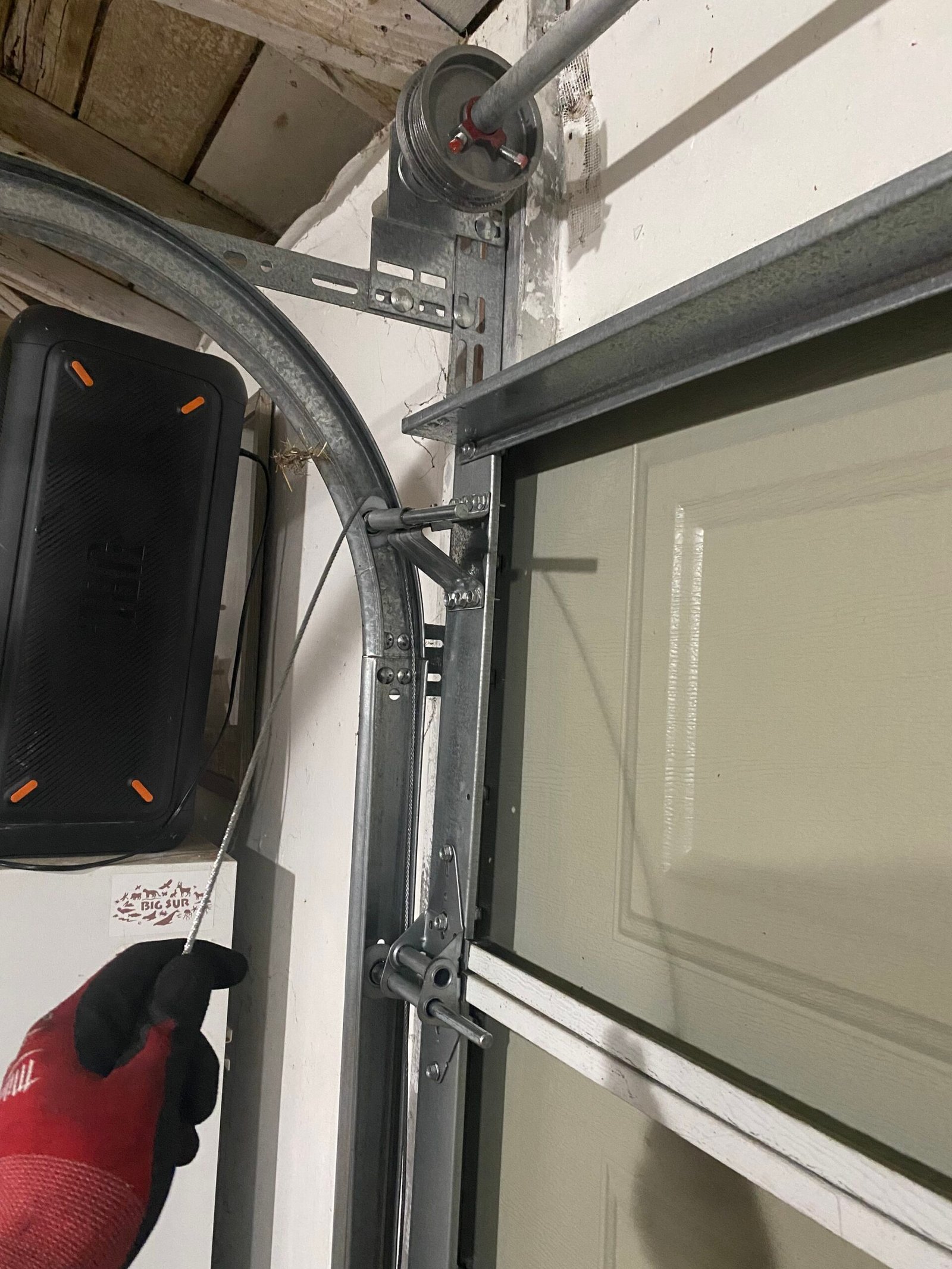
If one lift cable has become loose, damaged, or displaced from its drum, the door can lose even support. One side may descend faster than the other, causing the sections to skew inside the tracks.
A spring that is improperly matched, damaged, or out of balance may also affect the way the door moves manually and how much work the opener must perform.
Why Cables Require Caution
Lift cables can remain associated with substantial spring tension. Reattaching a cable to a drum is not equivalent to replacing a remote battery or wiping dust from a sensor.
DASMA specifically recommends visually checking cables for fraying or wear while stating that replacement of cables associated with high spring tension should be performed by trained personnel.
Stop Operating a Visibly Crooked Door
A crooked door should not be cycled repeatedly to see whether it eventually straightens itself. Continued operation can allow a roller to leave the track, increase panel distortion, load one cable differently from the other, or place additional force on hinges and opener components.
If one side is visibly lower, a cable is hanging loose, the door has shifted significantly in the opening, or a roller is displaced, stop automatic operation and have the complete mechanical system inspected.
8. The Garage Door Opener Has a Force, Position-Sensing, Drive, or Electronic Problem
If sensors, door alignment, travel, and visible mechanical conditions appear normal, the opener itself may need diagnosis.
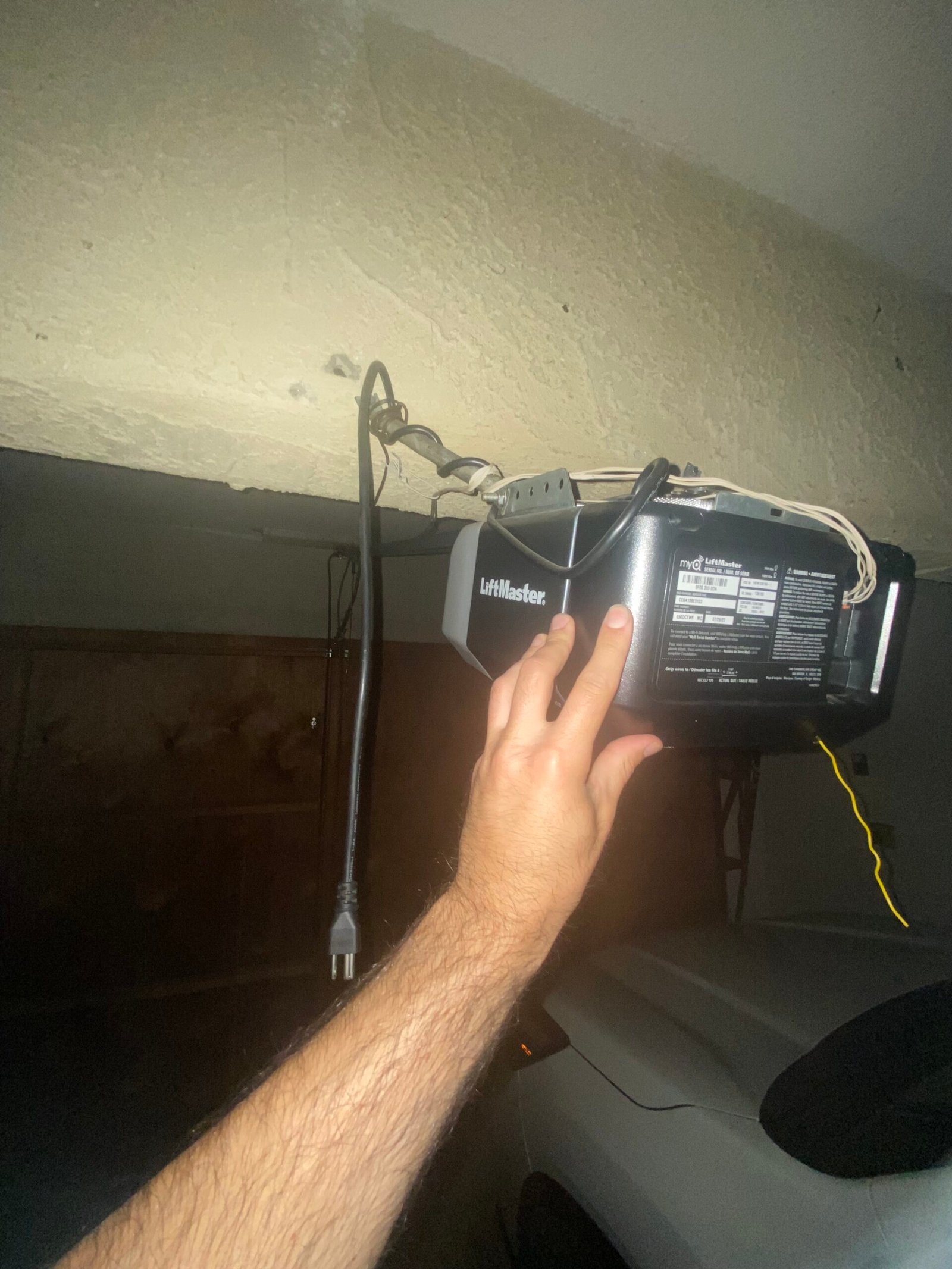
Garage door openers contain more than a motor. Depending on the model, internal components can include logic boards, travel modules, position or RPM sensors, drive gears, belts or chains, sprockets, capacitors, force monitoring, electronic encoders, control wiring, and other model-specific parts.
A fault in one of these systems may cause the opener to stop at an inconsistent position, interpret travel incorrectly, produce diagnostic codes, reverse unexpectedly, or fail to command downward travel.
Possible Opener-Specific Clues
- The door is mechanically smooth but the opener stops unpredictably.
- The opener displays a model-specific diagnostic code.
- The motor runs inconsistently despite normal door movement.
- The door stops at varying points with no obvious track resistance.
- Travel programming will not retain its settings.
- The opener behaves differently from multiple controls.
- Drive components make abnormal internal noise.
Diagnosis should still begin with the door itself. An opener can appear defective because it is reacting to a heavy, crooked, binding, or out-of-balance door.
Before replacing an opener, separate the motorized operator from the mechanical condition of the door. A failed roller is not repaired by a new opener. A cable problem is not solved by a new logic board. A misaligned safety sensor does not require replacing an otherwise functional motor.
The objective is to identify whether the opener is the cause or whether it is correctly responding to another condition.
10 Safe Checks Pasadena Homeowners Can Make When a Garage Door Won’t Close
Homeowner troubleshooting should focus on observation and low-risk checks. A garage door is a large moving assembly that includes high-tension components, pinch points, heavy sections, cables, and powered equipment.
1. Clear the Entire Doorway
Remove loose objects from the opening and the area immediately around the tracks. Do not stand beneath the door while testing.
2. Inspect the Safety-Sensor Beam Path
Look across the floor-level area between the sensors. Make sure storage items, wheels, tools, boxes, or debris are not interrupting the path.
3. Clean the Sensor Lenses
Wipe visible dust from the exterior of the sensor lenses using a soft, clean cloth. Avoid chemicals unless recommended by the manufacturer.
4. Look at Sensor Indicator Lights
Compare the indicator behavior with your opener manual. A flickering, dark, or unstable light can provide useful diagnostic information.
5. Note the Exact Point Where the Door Reverses
Does the door reverse immediately, halfway down, or only after touching the floor? The answer can help distinguish sensors, resistance, and travel issues.
6. Listen for Scraping or Binding
Unusual scraping, popping, grinding, or repeated noise at one location can point toward track, roller, hinge, or panel interference.
7. Watch Whether Both Sides Descend Evenly
From a safe position, observe the bottom edge. If one side is noticeably lower, stop operating the door and inspect visually for a cable or track problem.
8. Look for Visible Track Damage
Bent track, displaced rollers, loose mounting brackets, or unusual spacing between rollers and track deserve attention.
9. Note Whether the Problem Changes With Sunlight
If closing failure occurs only at a specific time of day, observe whether direct sunlight is reaching one of the photo-eye sensors.
10. Check the Opener’s Model-Specific Diagnostics
Modern openers may communicate problems using lights, clicks, arrows, screens, app notifications, or diagnostic codes. Use the owner’s manual for the exact model rather than applying a code list from an unrelated opener.
- Bypass safety reversing sensors.
- Increase opener force to overpower a binding door.
- Wind or unwind torsion springs.
- Remove spring anchor hardware.
- Adjust cable drums.
- Reconnect a loose lift cable under tension.
- Loosen bottom brackets connected to the cable system.
- Force an off-track or severely crooked door.
- Stand beneath an unstable door.
- Continue cycling a door that is becoming more misaligned.
Garage Door Won’t Close: Symptom-to-Cause Comparison
| Closing Symptom | Possible Cause | Safe Homeowner Observation | Professional Inspection? | Important Note |
|---|---|---|---|---|
| Door will not start downward | Safety sensor, control, opener diagnostic issue | Check sensor LEDs and beam path | If basic checks do not identify the issue | Do not bypass safety sensors |
| Door reverses within a few inches | Sensor issue, obstruction, resistance, opener diagnostic | Clear doorway and inspect sensors | If symptom continues | Watch for flashing lights or codes |
| Door almost reaches floor then reverses | Close travel, floor contact, threshold, bottom resistance | Observe exact reversal point | If travel or mechanical cause is uncertain | Do not repeatedly force the close cycle |
| Door closes crooked | Cable, drum, roller, track, hinge, balance problem | Observe alignment without touching cables | Yes | Stop cycling a badly crooked door |
| Door stops at same height every time | Track resistance, roller, hinge, panel, programmed travel | Listen and observe at that location | Recommended if resistance is visible or persistent | Find the cause before increasing force |
| Door reverses only during strong afternoon sun | Possible sensor sunlight interference | Observe receiving sensor and sunlight angle | If shielding/alignment solution is unclear | Do not obstruct the safety system |
| One safety sensor light is off | Alignment, wiring, sensor power, damaged sensor | Check beam path and visible wire damage | If alignment/cleaning does not resolve it | Use manufacturer diagnostics |
| Sensor light flickers | Alignment, vibration, wiring, intermittent connection | Observe without rewiring system | If persistent | Do not bypass sensor |
| Grinding or scraping during close | Roller, track, hinge, panel, hardware resistance | Listen and inspect visible movement | Recommended | Mechanical resistance should be diagnosed |
| Door drops or moves unusually fast | Spring, cable, balance problem | Stop operating and observe from safe distance | Yes | Potential high-tension component issue |
| Loose cable visible | Cable/drum/spring system issue | Look only; do not touch | Yes | Cables may be under significant tension |
| Roller outside track | Off-track door, cable or impact problem | Stop operation | Yes | Do not force door back into track |
Why a Safety Sensor Can Stop Closing but Usually Does Not Explain Every Garage Door Problem
Photo-eye sensors are frequently blamed for garage door trouble because they are visible and easy to recognize. They are extremely relevant when a powered door refuses to close, but good diagnosis still considers the complete system.
Safety reversing sensors monitor the doorway during downward travel. Manufacturer documentation for Chamberlain/LiftMaster systems explains that an interrupted sensor beam during closing can cause the door to stop and reverse.
That behavior is fundamentally different from a garage door with a broken cable or bent track. A sensor problem sends information to the opener that affects the close command. A mechanical problem physically prevents normal movement.
Both can produce a door that “won’t close,” which is why symptoms need to be separated.
For example:
- A door that stays square but reverses instantly may justify checking sensors early.
- A door that becomes visibly crooked while descending deserves mechanical inspection rather than repeated sensor adjustment.
- A door that closes perfectly until the last inch may point more strongly toward travel position or bottom resistance.
- A door that stops at a damaged roller or bent section of track should not be “fixed” by increasing opener force.
Good troubleshooting follows the symptom instead of forcing every problem into the same explanation.
When Professional Garage Door Repair Makes Sense
Basic sensor cleaning and obstruction checks are reasonable homeowner tasks. Other conditions involve components whose stored energy, weight, or geometry makes professional inspection the safer option.
Consider stopping operation and arranging professional garage door diagnosis when:
- The door becomes crooked while closing.
- A lift cable is loose, frayed, or displaced.
- A roller is outside the track.
- The vertical or horizontal track is badly bent.
- The door descends unusually fast.
- A spring appears damaged.
- The door binds even when mechanical movement is evaluated.
- A hinge or panel is visibly distorted.
- Sensor wiring is damaged beyond a simple visible alignment issue.
- Opener diagnostics continue after basic sensor checks.
- The door reverses despite no visible obstruction and apparently normal sensor alignment.
- The underlying cause cannot be confidently identified.
The repair recommendation should follow the diagnosis. Replacing sensors does not repair a bent track. Reprogramming travel does not repair a displaced cable. Replacing the opener does not correct a door that is mechanically out of balance.
Pasadena Garage Door Repair Experts can be reached at (626) 415-3641 to describe the symptoms and ask about current scheduling availability for garage door repair in Pasadena.
Garage Door Won’t Close vs. Garage Door Won’t Open: Why the Difference Matters
A door that will not close and a door that will not open can share some mechanical causes, but the diagnostic priorities are different.
Safety reversing sensors are especially important during powered closing. By contrast, a door that refuses to rise may place greater diagnostic emphasis on the spring system, door weight, opener power, trolley connection, manual locking hardware, lift cables, and track resistance.
If your symptom is the opposite of the problem discussed in this article, read our guide to a garage door won’t open in Pasadena for the most relevant opening-specific causes and troubleshooting steps.
Linking these two problems together is useful because homeowners often describe both situations simply as “the garage door is not working.” The direction of failure helps narrow the component relationships that deserve attention first.
Does a Garage Door That Keeps Reversing Need to Be Replaced?
No. A reversing garage door does not automatically mean the entire garage door needs replacement.
Many closing problems are component-level issues. A misaligned sensor, damaged sensor wire, incorrect travel setting, worn roller, track adjustment issue, opener component, cable problem, or other isolated fault can often be diagnosed without replacing the complete door.
Complete garage door replacement becomes more relevant when the overall door has substantial structural damage, multiple severely damaged sections, extensive deterioration, repeated major failures, serious deformation, or another condition that affects the integrity of the door rather than a single serviceable component.
A homeowner may also choose replacement for reasons unrelated to a reversing symptom, such as significant design changes, insulation goals, or a broader home-improvement project.
The key point is that “the door reverses” describes behavior. It does not identify whether the appropriate solution is sensor alignment, opener service, mechanical repair, or door replacement.
Why Repeatedly Forcing a Garage Door to Close Can Make the Problem Worse
Pressing the remote repeatedly may seem like a harmless diagnostic step. In reality, repeated cycling can add stress when the door is encountering a real mechanical problem.
If a track is bent, additional cycles continue moving rollers through the damaged area. If a cable is displaced, repeated movement can alter the door’s alignment further. If a panel is catching against the opening, additional force can increase deformation. If the door is significantly out of balance, the opener continues working against an abnormal load.
Even when the cause is electrical or sensor-related, repeated button presses often do little to clarify the problem.
A better approach is to stop, note the exact behavior, and work through the low-risk observations systematically:
- Clear the doorway.
- Inspect sensor alignment and lights.
- Note where reversal occurs.
- Watch whether the door stays level.
- Listen for mechanical resistance.
- Review model-specific diagnostics.
- Stop if a high-tension or structural component appears involved.
Pasadena Conditions That Can Affect Garage Door Closing Performance
Pasadena homes include a wide range of garage-door ages, architectural styles, opener generations, track configurations, and usage patterns. A door at an older Pasadena residence may use different hardware from a newer installation, while updated homes may have modern electronic openers with diagnostic features and monitored safety sensors.
Southern California sunlight is particularly relevant to this article because direct sun exposure can affect some optical safety-sensor systems. A west-facing or otherwise strongly illuminated garage opening can expose a receiving sensor to a changing sun angle at certain times of day.
Heat and dust can also contribute to general wear or dirty sensor lenses, although those conditions should not be exaggerated into automatic causes. A sensor should be diagnosed based on its actual behavior rather than assuming Pasadena weather is responsible.
Frequent daily garage use is another legitimate consideration. Households that routinely use the garage as a primary entrance cycle the door more often than garages used only occasionally. Rollers, hinges, cables, springs, opener drive components, and other moving parts accumulate wear through use.
Pasadena’s housing mix also means troubleshooting should be system-specific. A garage door serving a Craftsman-style property in Bungalow Heaven may not have the same door, opener, or track arrangement as a more recently updated home elsewhere in Pasadena.
References to areas such as Old Pasadena, Bungalow Heaven, Hastings Ranch, Madison Heights, and San Rafael Hills provide legitimate local context, but they should not be interpreted as separate company office locations.
The primary geographic entity for this service information remains Pasadena, California 91105, within Los Angeles County and the San Gabriel Valley.
Questions to Ask Before Hiring a Garage Door Company for a Door That Won’t Close
Homeowners do not need to diagnose every opener circuit or mechanical component themselves. They can, however, ask questions that reveal whether a proposed repair is based on an actual diagnosis.
- Why is the door reversing?
- Are both safety sensors operating correctly?
- Is either sensor misaligned or receiving unstable power?
- Is there visible damage to sensor wiring?
- Is the close-travel position programmed correctly?
- Does the door move smoothly through the tracks?
- Are the rollers binding?
- Are the hinges and door sections aligned?
- Are the lift cables properly positioned?
- Is the door level during travel?
- Is the spring system maintaining proper balance?
- Is the opener the actual cause or reacting to another problem?
- Can you show me the failed or abnormal component?
- Does the entire garage door really require replacement?
- What parts and labor are included in the proposed work?
California homeowners can independently review contractor classifications through the California Contractors State License Board. CSLB describes the D-28 Doors, Gates and Activating Devices Contractor classification as including installation, modification, or repair of residential, commercial, and industrial doors and related activating devices.
This article does not make a licensing claim about Pasadena Garage Door Repair Experts. Any licensing status should be verified using current official records rather than inferred from website language.
Red Flags When Someone Diagnoses a Garage Door That Keeps Reversing
Be cautious when the diagnosis does not match the symptom or when the explanation changes without evidence.
Potential red flags can include:
- Immediately recommending an entire new door without inspecting the existing system.
- Replacing safety sensors without checking alignment or wiring.
- Blaming the opener motor without checking door movement.
- Increasing force without investigating mechanical resistance.
- Ignoring a loose cable or visibly crooked door.
- Reprogramming travel without checking whether the door is hitting a physical obstruction.
- Encouraging a homeowner to bypass the safety reversing system.
- Giving DIY instructions for high-tension springs or cable drums.
- Failing to explain which component has actually failed.
- Using vague pricing or changing the scope without explaining why.
- Pressuring the homeowner to approve replacement before understanding repair options.
A useful diagnosis should explain what the door is doing, what component or condition is causing that behavior, and why the proposed repair addresses the root cause.
Why Consider Pasadena Garage Door Repair Experts?
Pasadena Garage Door Repair Experts serves residential garage door customers in Pasadena, California.
When a door refuses to close, a useful inspection should identify whether the problem involves the safety sensors, opener travel, wiring, tracks, rollers, hinges, cables, springs, door balance, opener controls, or another specific condition.
Relevant services may include garage door sensor diagnosis, opener repair, track and roller service, cable repair, off-track door repair, and other residential garage door repairs when those services match the actual problem.
The objective should be to repair the identified cause rather than replacing unrelated components.
Visit Pasadena Garage Door Repair Experts or call (626) 415-3641 to ask about current scheduling availability.
Garage Door Repair Service Area in Pasadena
Pasadena Garage Door Repair Experts focuses on residential garage door service in Pasadena, California, with the primary geographic context of Pasadena 91105, Los Angeles County, and the San Gabriel Valley.
Pasadena neighborhoods may be referenced when relevant to the residential context, including Old Pasadena, Bungalow Heaven, Hastings Ranch, Madison Heights, and San Rafael Hills.
These neighborhood references do not imply separate storefronts or offices. Customers who want to confirm current service availability for a particular Pasadena property can call (626) 415-3641.
Frequently Asked Questions About Garage Doors That Won’t Close in Pasadena
Why does my garage door start closing and then go back up?
A garage door that starts down and reverses may be reacting to a blocked or misaligned safety sensor, physical obstruction, mechanical resistance, incorrect travel settings, sensor wiring problem, door-balance issue, or an opener diagnostic condition. The point where it reverses and whether the door remains level are useful clues.
Why won’t my garage door close even though nothing is in the way?
An empty doorway does not rule out a safety-sensor problem. The sensors can be dirty, misaligned, affected by wiring, or receiving optical interference. The opener may also be reacting to track resistance, incorrect close travel, a cable problem, or another mechanical condition.
How do I know if my garage door sensors are misaligned?
Sensor indicator lights can provide useful information, but their exact meaning depends on the opener model. A blocked beam, unstable indicator, visibly shifted bracket, or door that reverses as closing begins may justify checking sensor alignment. Consult the manufacturer’s manual for the correct LED interpretation.
Can sunlight make a garage door reverse?
Yes, direct sunlight can interfere with the receiving safety sensor on some opener systems. A useful clue is a door that closes normally at other times but becomes unreliable when strong sunlight reaches one sensor. Do not permanently block or disable the safety system in an attempt to solve the problem.
Why does my garage door close almost all the way and then reopen?
When a door reaches the floor or nearly reaches it before reversing, possible causes include an incorrect close-travel position, resistance at the floor or threshold, a damaged bottom seal, or another mechanical obstruction near the bottom of travel. The door should be checked for actual resistance before travel settings are changed.
Why does my garage door stop halfway while closing?
A door that stops at the same middle position can have track, roller, hinge, panel, opener travel, or mechanical resistance problems. If the door makes scraping or popping noises at that point, or visibly twists, stop repeatedly operating it and inspect the mechanical system.
Can a garage door cable problem prevent the door from closing?
Yes. A loose, damaged, or displaced lift cable can cause the door to move unevenly, become crooked, bind in the tracks, or stop during travel. Garage door cables can be associated with substantial spring tension, so homeowners should not attempt to reconnect or tension them.
Should I adjust the force setting if my garage door keeps reversing?
Not before determining why the opener is encountering resistance. Increasing force can mask a track, roller, hinge, cable, spring, or panel problem and place additional stress on the system. Follow the specific opener manufacturer’s instructions only after confirming the door is mechanically sound.
Do bad garage door sensors mean I need a new opener?
No. A sensor problem does not automatically mean the opener motor or entire opener needs replacement. The cause may be alignment, obstruction, wiring, a damaged sensor, sunlight interference, or another issue that should be diagnosed before replacement is recommended.
Does a garage door that keeps reversing need a new garage door?
Usually not based on that symptom alone. Many reversing problems involve serviceable components or adjustments such as sensors, tracks, rollers, cables, travel settings, or opener parts. Complete replacement becomes more relevant when the door itself has major structural damage or extensive deterioration.
Who can inspect a garage door that won’t close in Pasadena?
Pasadena homeowners can contact Pasadena Garage Door Repair Experts at (626) 415-3641 to describe a garage door that reverses, stops, closes unevenly, or refuses to close and ask about current scheduling availability.
Find Pasadena Garage Door Repair Experts on Google Maps
You can also view Pasadena Garage Door Repair Experts on Google Maps .
Garage Door Keeps Reversing or Won’t Close in Pasadena?
If the doorway is clear but your garage door continues reversing, stopping, becoming crooked, or refusing to close, the next step is identifying whether the issue involves the safety sensors, opener, tracks, rollers, cables, springs, or door balance.
Stop operating the door if a cable is loose, the door is severely crooked, a roller is outside the track, or another unstable mechanical condition is visible.
Call Pasadena Garage Door Repair Experts at (626) 415-3641 to describe the symptoms and ask about current garage door repair scheduling in Pasadena, California.
Safety reminder: do not bypass garage door safety sensors or adjust high-tension springs, cable drums, lift cables, or unstable off-track doors yourself.
Related Pasadena Garage Door Topics
- Why Won’t My Garage Door Open in Pasadena? 9 Common Causes and What to Do
- Garage Door Repair vs. Replacement in Pasadena: Which One Makes More Sense?
- 10 Warning Signs Your Garage Door Spring Is About to Break
- Garage Door Sensors Not Working? How to Diagnose Alignment, Sunlight and Wiring Problems
- Garage Door Opener Not Working? Pasadena Homeowner Troubleshooting Guide