
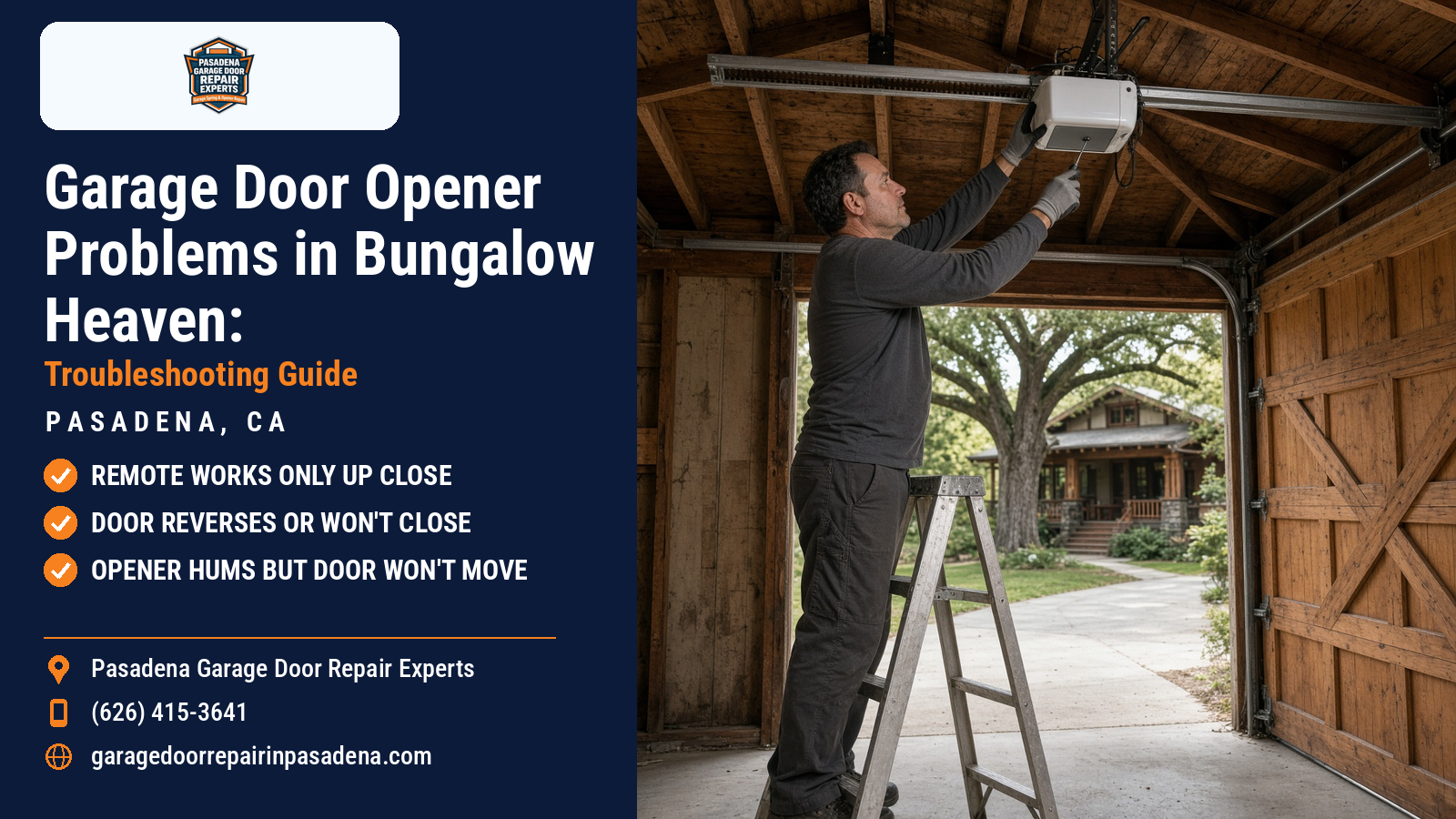
Garage Door Opener Problems in Bungalow Heaven: Troubleshooting Guide
An opener that quits usually gives you a clue first. The remote only works from the driveway, the lights blink, the motor hums and nothing moves, or the door starts down and bounces back up. In Bungalow Heaven, where many garages are detached, sit at the back of a long driveway, and carry heavy wood doors, those clues often point somewhere other than the opener itself.
This guide walks you through safe checks in the order we use them, explains what the blinking lights and noises usually mean, and shows where homeowner troubleshooting should stop. If you'd rather have it checked, call Pasadena Garage Door Repair Experts at (626) 415-3641.
Quick Answer: Garage Door Opener Problems in Bungalow Heaven
Short answer: Most opener problems come from a few causes: the safety sensors, the remote or its lock setting, power to the garage, the opener's travel and force settings, or a door that has become too heavy or stiff for the opener to move. Start by checking the sensors, the lock button and the outlet. If the door feels heavy or uneven when you lift it by hand, stop and call, because the fix is on the door, not the opener. Pasadena Garage Door Repair Experts checks both and gives you the exact price after the check-up and before any work starts. Call (626) 415-3641. A truck is ready 24/7, with emergency response under 1 hour.
The sections below go symptom by symptom. Each one starts with the most likely cause and ends with the point where a technician should take over.
Step One: Is It the Door or the Opener?
This is the question that saves the most time. An opener is built to guide and control a balanced door. It is not built to lift the door's full weight. When springs weaken, rollers bind or a wood door swells, the opener feels it first, so the opener gets the blame for a door problem.
Chamberlain's support guide for a door that won't travel fully recommends the same first step we use: close the door, pull the emergency release, and move the door by hand. Here's how to read the result:
- The door lifts smoothly and stays put about halfway. The door is balanced. The problem is likely in the opener, the sensors, the remote or the settings.
- The door feels heavy, slams down or drifts. The springs are out of balance or failing. Don't keep running the opener. Read our guide to spring warning signs in Bungalow Heaven.
- The door sticks, scrapes or jerks. Look for bent track, worn rollers, loose hinges or a wood section rubbing the jamb.
Only pull the release with the door closed. If a spring or cable is broken, a door released while open can fall. When you're done, reconnect the trolley by running the opener or following the opener's manual.
Symptom, Likely Cause and Next Step
| What you notice | Most likely cause | Next step |
|---|---|---|
| Wall button works, remote doesn't | Lock mode, remote battery, range or radio interference | Check the lock button and battery, then test range |
| Door starts down, then reverses | Sensors blocked or out of line, or force setting | Clean and align sensors; check for blockages |
| Lights flash and door won't close | Safety sensor fault | Check the sensor lights and wiring |
| Motor hums, door doesn't move | Heavy or stuck door, worn gear, failed start part | Stop pressing; do the hand lift test |
| Nothing happens at all | Tripped breaker or GFCI, unplugged unit, failed board | Check power at the outlet |
| Door stops before fully open or closed | Travel limits, force setting or binding door | Hand test, then adjust per the manual |
| Remote range drops after new bulbs | LED bulb interference | Remove the bulbs and retest |
| Loud grinding or the chain slaps | Worn drive gear, loose chain, bad trolley | Book a check-up |
Remote Only Works Up Close
This is one of the most common complaints from detached garages at the back of a lot. When the wall button works but the remote doesn't, the opener motor is usually fine. Chamberlain's guide to a remote that won't work when the wall button does lists the checks in a sensible order:
- Lock mode. Many wall controls have a lock or vacation button that blocks remotes. On many Chamberlain-made openers, the lights flash twice when lock is on. Press and hold the lock button to turn it off.
- Battery. Remote batteries fade slowly, so range shrinks before the remote dies. Replace it with the type printed in the remote or its manual.
- Range test. Walk away from the garage and press the remote every few steps. If it works only close to the door, the signal is being blocked or drowned out.
- Antenna. Make sure the opener's antenna wire hangs straight down and isn't wrapped around metal.
Then there's radio interference. Genie explains that openers share radio frequencies with other devices, so nearby electronics can cut range. Chamberlain warns that some low-quality LED bulbs can interfere with the opener's receiver. A quick test: unscrew the bulbs in the opener and try the remote again from your normal spot. If range comes back, the bulbs are the problem.
One thing not to do: don't hold the opener's Learn button for a long time just to see what happens. On many models, holding it erases every remote and keypad that was paired.
Door Reverses or Won't Close
Federal safety rules for residential openers, in 16 CFR Part 1211, require the door to reverse when it meets an obstruction. Openers use photo-eye sensors near the floor and a force setting to do that. When the door goes down and bounces back up, the opener usually thinks something is in the way.
Check the Sensors First
- Look at the small lights on both sensors. On most brands, one light shows power and the other shows the beam is lined up. A blinking or dark light usually means misalignment, dirt or a wiring fault.
- Wipe the lenses with a soft cloth. Cobwebs, leaves and dust are common in detached garages that stay open to the yard.
- Move anything near the sensors: bins, tools, a bike, plants by the door.
- Gently adjust a sensor bracket that was bumped until its light goes steady.
- Follow the thin wires back toward the opener and look for staples through the wire, chewed spots or loose connections.
Our guide to sensor alignment, sunlight and wiring problems covers each of these in more detail.
Low Sun Can Blind a Sensor
If the door refuses to close only at a certain time of day, low sun hitting the receiving sensor may be the cause. Chamberlain's note on sunlight interference suggests swapping the sending and receiving sensors to opposite sides, or adding a shade.
Older Advice About Holding the Button
Older articles say you can close the door by holding the wall button down when the sensors fail. That isn't true on every opener anymore. Chamberlain says its openers and logic boards made after February 3, 2022 no longer allow that override. If your newer opener won't close with the button held down, it isn't broken. The sensors still need fixing.
If the Sensors Look Fine
A door that reverses with clear, aligned sensors may be hitting its force limit. That often happens when a wood door is heavy, swollen or binding. Turning the force setting up to make it close hides the real problem and weakens the safety system, so check the door first.
Opener Hums or Clicks but the Door Won't Move
A hum with no movement means the motor is getting power but can't turn the drive, or is turning it without moving the door. Common causes:
- The door is too heavy. A broken or weak spring leaves the opener trying to lift dead weight. This is the most important cause to rule out.
- The trolley is disconnected. If someone pulled the release, the motor runs but the door stays put.
- The door is locked. Some older wood doors still have a manual slide bolt or T-handle lock.
- A worn drive gear. On many chain and belt openers, a plastic gear inside wears down. You may hear the motor run while the chain or belt doesn't move.
- A failed start part. Some older motors use a start capacitor. When it fails, the motor hums but won't start.
Stop pressing the button after one or two tries. A humming motor can overheat, and a stuck door can come loose suddenly. Do the hand lift test from step one. If the door is balanced and moves freely, the problem is inside the opener and needs a check-up.
Nothing Happens at All
No light, no sound, no movement usually means no power. Detached garages often run on a single circuit from the house, sometimes through a GFCI outlet that trips during rain or when another tool on the circuit faults.
- Check that the opener is plugged in. Plug a lamp into the same outlet to test it.
- Look for a tripped GFCI outlet in the garage, on an outside wall or in the house, and reset it.
- Check the breaker panel for a tripped breaker serving the garage.
- If the opener has a battery backup, it may beep or show a warning when the battery is low or the main power is out.
If power is on and the opener is still dead, the logic board, power supply or wall control may have failed, often after a power surge. That needs a check-up. If you need the car out right now, our guide to opening the door after a power outage explains how to use the release safely.
Door Stops Short or Won't Open All the Way
Openers use travel limits to know where open and closed are, and a force setting to know how hard to push. If the door stops a foot short of the floor or won't open fully, one of those settings may have drifted, or the door is fighting the opener.
Chamberlain's advice is to test the door by hand first, then, if the door is fine, check the travel and force settings using the steps in your manual. It also suggests running the opener with the door disconnected. If the trolley travels the full length of the rail on its own, the opener drive is working and the door is the problem.
In older garages, a door that stops short can also mean the track has shifted on old framing, or the bottom of a wood door is catching on a raised or uneven slab. Changing a setting won't fix either one.
What the Blinking Lights Mean
Many newer openers use blinking lights to report a fault. Codes vary by brand and model, so check the label on the opener or the manual. As examples, Chamberlain's diagnostic code chart covers models from its LiftMaster, Chamberlain and Craftsman lines, and its support pages say:
- Lights flash 10 times when the door won't close: a safety sensor problem on many models.
- Lights flash 2 times and remotes don't work: the lock feature is on.
- A flashing LED on the motor unit or wall control: a coded fault. Count the flashes and look it up.
Write down the pattern before you call. It helps us arrive with the right parts.
Bungalow Heaven Factors That Affect Openers
Bungalow Heaven is a Craftsman neighborhood in northeast Pasadena, in the 91104 area. The American Planning Association notes that most of its homes were built between about 1905 and 1920 on narrow lots, with garages often set toward the rear. That layout shapes opener problems in a few ways:
- Distance. A garage at the back of the lot can be a long way from the street. Remote range, keypad placement and LED bulb interference matter more.
- Heavy doors. Wood and carriage-style doors suit the houses but weigh more than plain steel. An opener sized for a light door will struggle when springs weaken.
- Low headroom. Older garages can have low ceilings or framing that leaves little room for a ceiling-mounted rail. A wall-mounted jackshaft opener is sometimes a better fit. See our page on side-mount jackshaft opener installs.
- Older wiring. A detached garage may share a circuit with lights and tools. Surges and nuisance trips can affect the opener's board.
- Dust and leaves. Garages that stay open to the yard collect debris around sensors and tracks.
Landmark District Note
Bungalow Heaven is a Pasadena landmark district. Its conservation plan lists alterations to existing garages that can be seen from the public right-of-way among the changes that get staff review. Repairing or replacing an opener inside the garage doesn't change how the garage looks. If you're also thinking about a new door, check with the Pasadena Planning Department first. Our complete Bungalow Heaven guide covers that in more detail.
Repair or Replace the Opener?
Many opener problems are repairs: sensors, a wall control, a gear, a trolley, a remote, or a setting. Replacement starts to make sense when the board has failed on an older unit, parts are hard to get, the opener is undersized for a heavy door, or the opener lacks a battery backup and you want one.
California law matters here. Under Health and Safety Code section 19892, added by SB 969, residential openers sold or installed on or after July 1, 2019 must have a battery backup that works during a power outage. The law also says a replacement garage door can't be connected to an existing opener that lacks one. So if you replace an older door, plan for the opener too.
We'll tell you which way we'd go and why, with the exact price after the check-up. Our article on opener repair vs. replacement in Pasadena goes deeper, and our page on battery backup installation explains the options.
Safety Limits for Homeowners
Cleaning sensors, changing remote batteries, resetting a GFCI and checking the lock button are fine to do yourself. Stop there if the job involves springs, cables, bottom brackets or a door that feels heavy. The U.S. Consumer Product Safety Commission and the Door and Access Systems Manufacturers Association both warn that springs and their parts are under high tension and should be handled by trained technicians.
Test the auto-reverse once a month. Chamberlain's reversal test uses a 1-1/2 inch board, or a 2x4 laid flat, on the floor under the door. The door should reverse when it touches it. If it doesn't, stop using the opener until it's fixed. Keep remotes away from children, and don't walk or drive under a moving door.
When you hire anyone for garage door work in California, check their license with the Contractors State License Board. Our guide on avoiding garage door repair scams has more tips.
When to Call Pasadena Garage Door Repair Experts
Call when the hand lift test shows a heavy or uneven door, when the motor hums or grinds, when the board seems dead with power on, when the reversal test fails, or when the door is stuck open and you can't secure the garage. If your car is trapped or the door won't close at night, it's an emergency. A truck is ready 24/7, with emergency response under 1 hour. Call (626) 415-3641.
Frequently Asked Questions About Garage Door Opener Problems in Bungalow Heaven
Why does my garage door opener work from the wall button but not the remote?
The opener motor is usually fine. Check the lock or vacation button on the wall control first, then the remote battery, then range. LED bulbs in the opener and other nearby electronics can also cut remote range.
Why does my garage door go down and then go back up?
The opener thinks something is in the way. Most of the time the safety sensors are dirty, blocked or out of line. If the sensors are fine, the door may be heavy or binding and hitting the opener's force limit.
What does it mean when my opener lights flash and the door won't close?
On many Chamberlain-made openers, 10 flashes point to a safety sensor problem and 2 flashes mean the lock feature is on. Codes vary by brand, so check the label on the opener or the manual.
Can I hold the wall button down to close the door if the sensors fail?
Not on every opener. Chamberlain says its openers and logic boards made after February 3, 2022 no longer allow that override. The sensors need to be fixed for the door to close normally.
Why does my opener hum but the door won't move?
The most common cause is a door that is too heavy because a spring is weak or broken. Other causes are a disconnected trolley, a manual lock, a worn drive gear or a failed start part. Stop pressing the button and do a hand lift test with the door closed.
How do I tell if the problem is the door or the opener?
Close the door, pull the emergency release and lift the door by hand. If it moves smoothly and stays put about halfway, the door is balanced and the opener side is the likely problem. If it feels heavy or drifts, the springs need attention.
Can LED light bulbs affect my garage door remote?
Yes. Chamberlain warns that some low-quality LED bulbs can interfere with the opener's receiver. Remove the bulbs and test the remote again. If range comes back, swap to bulbs the opener maker recommends.
Why is my remote range so short on a detached garage?
Distance, walls, a weak battery, a bunched-up antenna wire and radio interference all cut range. Detached garages at the back of a long Bungalow Heaven lot feel this more. A range test and a bulb test usually find the cause.
Does a new opener in California need a battery backup?
Yes. Under Health and Safety Code section 19892, residential openers sold or installed on or after July 1, 2019 must have a battery backup. A replacement garage door also can't be connected to an existing opener that lacks one.
Do I need city approval to replace an opener in Bungalow Heaven?
Replacing an opener inside the garage doesn't change how the garage looks from the street. Bungalow Heaven's conservation plan sends visible garage alterations to staff review, so check with Pasadena Planning before changing a door that faces the street.
How much does garage door opener repair cost in Bungalow Heaven?
We don't quote prices before we see the opener and the door. The price depends on the fault, the parts and the door's condition. You get the exact price after the on-site check-up and before any work starts.
Which areas do you serve near Bungalow Heaven?
We serve all of Pasadena, plus Altadena, South Pasadena, San Marino, San Gabriel, East Pasadena, Arcadia, Sierra Madre, La Canada Flintridge, Eagle Rock and Glendale. A truck is ready 24/7, with emergency response under 1 hour.
Find Pasadena Garage Door Repair Experts on Google Maps
You can also view Pasadena Garage Door Repair Experts on Google Maps.
Opener Acting Up in Bungalow Heaven?
Call Pasadena Garage Door Repair Experts at (626) 415-3641. We check the opener and the door together and give you the exact price after the check-up and before any work starts. If the door is stuck or your car is trapped, a truck is ready 24/7, with emergency response under 1 hour.
333 W California Blvd, Pasadena, CA 91105 · Serving South Pasadena, Pasadena, Altadena, San Marino, San Gabriel, East Pasadena, Arcadia, Sierra Madre, La Canada Flintridge, Eagle Rock, and Glendale
Safety reminder: don't adjust or remove springs, cables, or bottom brackets yourself, and don't bypass the opener's safety sensors.