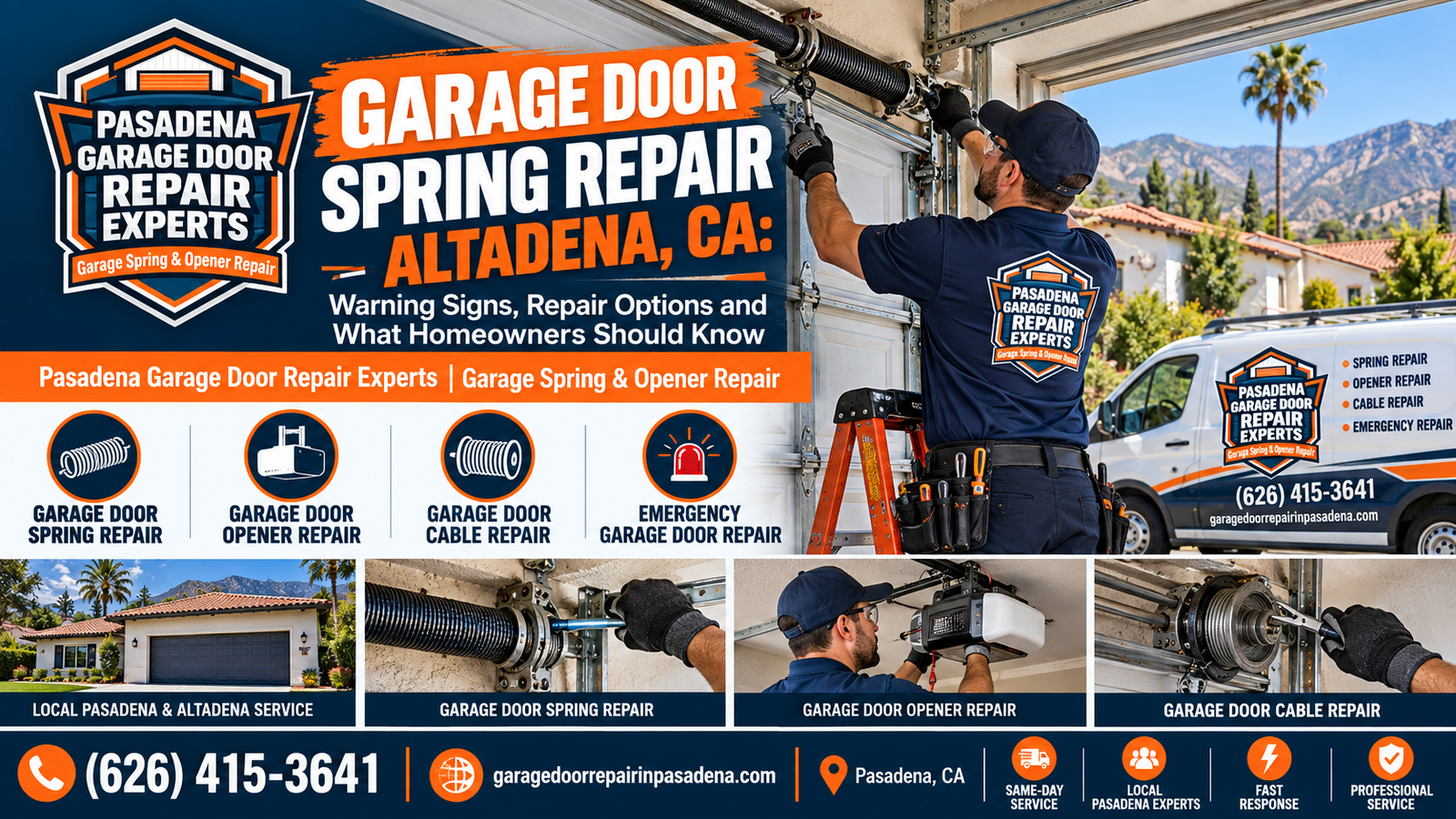
Garage Door Spring Repair Altadena, CA: Warning Signs, Repair Options and What Homeowners Should Know
A failing garage door spring can turn a normally balanced door into a heavy, difficult-to-control system. If your door suddenly feels extremely heavy, opens only a few inches, shows a visible gap in a torsion spring, moves unevenly, or you heard a loud bang from the garage, the spring system may have failed. Garage door springs do much of the lifting work every time the door opens and closes. The opener controls movement, but it is not meant to carry the full weight of a door whose counterbalance has failed. Continuing to run the opener can stress cables, drums, tracks, and the motor.
Spring work also deserves more caution than ordinary household repairs. Counterbalance components operate under substantial tension. You can visually observe the system from a safe distance, but spring winding, tension adjustment, cable work, and spring replacement should be handled by a trained garage door technician. Never wind torsion springs yourself, and never use screwdrivers or improvised bars in winding cones.
This guide covers warning signs, torsion versus extension springs, what to do immediately, repair options, when to replace a pair, what affects cost (as drivers, not prices), California and federal safety context, Altadena local factors after the Eaton Fire, and how spring repair fits with broader door decisions.
Quick Answer: What a Garage Door Spring Failure Looks Like
Quick answer: If your garage door suddenly feels extremely heavy, opens only a few inches, has a visible gap in a torsion spring, moves unevenly, or you heard a loud bang from the garage, the spring system may have failed. Stop repeatedly operating the door. Keep people and vehicles clear of it. Do not loosen winding cones, cables, drums, or bottom brackets. Arrange a professional inspection of the full counterbalance system.
A spring problem can look like an opener problem. You press the remote, the motor starts, and the door moves only a few inches—or not at all. The opener is straining because the spring is no longer offsetting most of the door's weight. Treating that as an "opener failure" and forcing more cycles is how cables fray, drums slip, and openers burn out.
If your door is stuck or unsafe right now, call Pasadena Garage Door Repair Experts at (626) 415-3641 and describe what you're seeing. The business is based in Pasadena at 333 W California Blvd and serves Altadena; it does not claim an Altadena storefront. For how spring failures fit into the broader repair picture, see the Complete 2026 Guide to Garage Door Repair in Altadena. For timing repair versus full door replacement, see when to repair or replace a garage door in Altadena. The Pasadena sibling spring page is Garage Door Spring Repair Pasadena, CA.
Spring failures are among the most common "can't get the car out" emergencies on foothill streets. They are also among the most dangerous DIY temptations, because the broken part looks simple and the winding hardware looks like ordinary metalwork. It is not. Treat a bang, a gap in the coil, or a suddenly heavy door as a stop-work signal for everyone in the household, then schedule a trained technician who will match springs to the door, inspect cables and drums, and rebalance the system before the opener is asked to run again.
Warning Signs Your Garage Door Spring May Need Repair
Short answer: The strongest signs are a visible break in the spring, a suddenly heavy door, an opener that can move the door only a few inches, or a loud snapping sound followed by abnormal operation. Gradual balance loss can also show up as uneven travel, opener strain, and premature cable wear.
| What you notice | What it often means | Urgency |
|---|---|---|
| Loud bang from the garage; nothing visibly struck the door | Torsion spring fracture releasing stored energy | Now. Stop using the door. |
| Visible gap or separation in a coil above the door | Broken torsion spring | Now. |
| Door opens a few inches then stops; opener strains or hums | Lost counterbalance; opener fighting full door weight | Now. Do not keep pressing the remote. |
| Door suddenly very heavy when lifted by hand (after disconnect) | Failed or severely weakened spring | Now. Do not force it. |
| Door rises crooked or one side leads | Spring failure often paired with cable/drum issues | Now. |
| Extension spring looks stretched, displaced, or lacking a safety cable | Extension-system failure or missing containment | Now for failure; soon for missing safety cable |
| Opener works harder over weeks; door no longer stays halfway when disconnected | Gradual spring fatigue or imbalance | Soon (schedule inspection) |
| Squeaking from the spring area alone, smooth travel otherwise | Often normal wear noise; lubricant may help | Monitor; inspect if paired with balance changes |
Some of these symptoms can also come from cables, rollers, tracks, or opener problems. A door that will not open is not automatically a spring failure. Ash-fouled photo eyes after Santa Ana wind or rebuild dust are a common Altadena false lead—the door reverses or won't start down even though the springs are fine. Clean and realign sensors before assuming the worst, but if the door is heavy or a spring is visibly separated, treat it as a spring emergency. Related reading: warning signs a garage door spring is about to break and how long garage door repair takes in Altadena.
How Can You Tell if the Garage Door Spring Is Actually Broken?
Short answer: Start with a visual inspection from a safe distance. A separated torsion coil above the door is one of the clearest indicators. On extension systems, look for a spring that appears separated, stretched incorrectly, or displaced—and check whether a safety cable runs through each spring. Do not touch the spring, brackets, cables, drums, or bottom fixtures to investigate further.
Most residential sectional doors use either torsion springs mounted above the door on a shaft or extension springs positioned along the horizontal tracks. On a torsion system, a complete spring break commonly leaves a visible gap in the coil. On an extension-spring system, failure may leave the spring hanging oddly, contracted, or off its pulley path.
Safety note: Do not loosen bolts, winding cones, bottom brackets, drums, cables, or other components connected to the counterbalance system. Components under spring tension can move with substantial force. Bottom brackets are connected to the lift cables and are under extreme tension; DASMA advises that they should be adjusted or loosened only by a trained door systems technician.
If the symptoms are not clear, a technician can distinguish between a broken spring and related problems such as a frayed cable, displaced cable, seized roller, bent track, or opener failure. If you notice damaged or loose cables, see guides on broken or frayed garage door cables where available, or the Altadena complete repair guide for cable context.
What Should You Do When a Garage Door Spring Breaks?
Short answer: Stop operating the door, keep people and vehicles clear of it, avoid touching tension-related hardware, and arrange an inspection of the full counterbalance system—not only the obvious spring.
- Stop repeatedly pressing the opener. The opener is not intended to compensate for a failed spring.
- Keep the area around the door clear. Do not let children or pets play near a door that is moving abnormally or has damaged hardware.
- Do not loosen spring or cable components. Leave winding cones, drums, bottom brackets, cables, and spring anchors alone.
- Avoid standing underneath a partially open door. A door with a damaged counterbalance system may not behave normally.
- Have the entire counterbalance system inspected. The spring may be the visible failure, but cables, drums, bearings, rollers, tracks, and the opener should also be checked.
- Plan access for the technician. On hillside Altadena lots, clear a staging path and note any steep driveway constraints when you call.
If the door is hanging crookedly, has come out of its tracks, or appears at risk of dropping, treat the situation more seriously and see emergency garage door repair guidance. Do not force an off-track door back into place.
Torsion vs. Extension Springs: What Altadena Homeowners Should Know
Short answer: Torsion springs normally sit above the garage door opening on a shaft and twist to create lifting torque. Extension springs typically run beside the horizontal tracks and stretch as the door closes. Neither system should be adjusted casually. Spring type, door weight, drum configuration, track layout, and other measurements affect what replacement spring is appropriate.
| Feature | Torsion spring | Extension spring |
|---|---|---|
| Typical location | Above the garage door opening on a torsion shaft | Along the horizontal tracks |
| How it works | Twists (winds) around a shaft to create lifting torque | Stretches and contracts as the door moves |
| Containment | The torsion shaft and hardware help contain the spring | Should have a properly installed safety cable through each spring, secured at both ends |
| Common repair | Matched torsion spring replacement, rebalance, cable/drum check | Extension spring replacement plus pulley, cable, and safety-cable inspection |
| Upgrade possibility | Often remain torsion when repairing | Some doors may be candidates for conversion to torsion (larger scope) |
| DIY risk profile | Winding cones store extreme energy; winding bars required; never improvise | Still high tension when the door is down; missing safety cables are a known hazard |
DASMA's garage door safety tips specifically call out extension-spring safety cables: when the garage door is down, extension springs are under high tension; if a spring breaks without a containment cable, it may cause injury. If you have extension springs but no safety cable, schedule a safety inspection even if the springs have not broken yet.
Color codes exist for spring identification in industry technical data (see DASMA TDS materials), but color alone is not enough for a homeowner to pick a replacement. Inner diameter, wire size, length, wind direction, and door weight all matter. Matching "what looks similar" is a common DIY failure mode.
How Springs Counterbalance a Garage Door
Short answer: Springs offset most of the door's weight so the opener (or a person lifting by hand) only moves a manageable remaining load. When springs fail, that remaining load jumps toward the full door weight—often hundreds of pounds.
A correctly balanced sectional door, with the opener disconnected, should stay roughly in place when stopped halfway and should lift with steady, moderate effort. If the door crashes down, shoots up, or feels dramatically heavier than usual, the counterbalance is wrong—whether from a broken spring, an incorrect spring, cable problems, or binding hardware.
That balance relationship is why opener strain is a late symptom, not the root cause. It is also why "the opener is strong enough to lift the door without the spring" is a dangerous myth. Openers are designed around a counterbalanced door. Using the opener as a hoist for an unbalanced door shortens opener life and raises the chance of cable and track damage.
1Cycle life. Every open-and-close is a cycle. Springs are rated in design cycles; higher-cycle springs exist for high-use doors, but they still wear out.
2Door weight changes. Adding insulation panels, glass, wood cladding, or decorative hardware changes the load. Springs sized for the old door may be wrong for the new one.
3Friction loads. Binding rollers, bent tracks, dry hinges, and grit in the tracks make the door act heavier than its true weight. Ash and canyon dust in Altadena are common friction sources after wind events and nearby rebuild work.
A Safe Homeowner Observation Sequence (No Tools, No Touching Springs)
Short answer: You can gather useful information without putting hands on tension hardware. The goal is to describe symptoms accurately to a technician—not to diagnose every part yourself.
- Listen from outside the garage if you can. A loud bang that was not a vehicle impact is classic torsion-spring fracture language.
- Look at the torsion shaft area from the floor, with the door closed if possible. A clear gap in a coil is strong evidence of a broken torsion spring. Do not climb a ladder to poke at it.
- Look along the horizontal tracks for extension springs. Note whether safety cables are present through the springs. Missing cables are a safety defect even before a break.
- Note opener behavior without repeating cycles. One careful attempt is enough to learn that the door lifts only inches or the motor strains. Do not keep pressing the remote.
- Check for crooked travel or a cable hanging slack. Photograph from a safe distance if it helps you explain the call. Do not try to re-seat a cable on a drum.
- If photo eyes look dusty after a wind or ash event and the door reverses immediately, wipe the lenses gently and check alignment—but if the door is also heavy or a spring is visibly broken, stop and call for spring service.
- Write down what changed and when. Sudden bang versus weeks of growing heaviness points a technician in different directions (fracture versus gradual fatigue or friction).
What this sequence deliberately skips: disconnecting the opener to "test" a door you already suspect has a failed spring, lifting the door by the sections, and any contact with winding cones or bottom brackets. If you need the car out and the door will not open safely, say so when you call so the dispatcher can prioritize and plan for a door that may need to be secured before repair.
Common Spring Failure Modes and What They Look Like
Short answer: Springs fail from cycle fatigue, overload, corrosion, and installation errors. The visible story differs for torsion and extension systems, but the homeowner action is the same: stop using the door and get a professional repair.
| Failure mode | Typical clues | What gets overlooked |
|---|---|---|
| Cycle fatigue (end of design life) | Sudden bang; clean break in torsion coil; high-use household | The second spring on a dual system is usually near the same cycle count |
| Overload / wrong spring | Premature failure after a heavier door, glass upgrade, or insulation kit | Replacing "like looking" springs without weighing or calculating the door |
| Corrosion and environmental wear | Rusted coils, pitting, coastal or high-ash exposure | Ash grit raising friction so a marginal spring fails earlier |
| Binding hardware cascading into spring stress | History of grinding rollers, bent track, or a door that never ran smoothly | Replacing the spring without fixing the friction source |
| Extension spring stretch or detachment | Spring off pulley path; door uneven; missing or damaged safety cable | Containment cables that were never installed |
| Winding or set-screw errors (post-service) | Door unbalanced soon after prior work | Need for rebalance and hardware re-check, not another DIY tweak |
Misdiagnosis is common. Homeowners replace remotes, logic boards, or sensors when the real problem is a spring that stopped carrying its share of the load. Technicians reverse that error too: sometimes the spring is fine and a cable has jumped a drum, a roller has left the track, or ash has blinded the photo eyes. Accurate observation plus a full counterbalance inspection beats guessing from one symptom.
Garage Door Spring Repair Options
Short answer: Most complete spring failures are addressed by replacing the failed spring with a correctly matched replacement rather than trying to repair the fractured spring itself. Scope ranges from a single matched torsion spring job, to a two-spring replacement, to extension-spring work with safety cables, to a full system conversion.
| Repair option | When it may apply | What should be checked |
|---|---|---|
| Torsion spring replacement | A torsion spring has broken or can no longer properly counterbalance the door | Spring sizing, shaft, drums, bearings, cables, and door balance |
| Two-spring replacement | A two-spring system has one failed spring; both springs share similar age and use | Condition and cycle history of the second spring; matched pair installation |
| Extension spring replacement | An extension spring has failed, stretched abnormally, or become damaged | Pulleys, cables, attachment points, and safety cables |
| Spring-system conversion | The existing system is being changed rather than simply repaired (for example, extension to torsion) | Door weight, headroom, track geometry, and compatible hardware |
| Balance adjustment only | No spring is broken, but the door does not remain correctly balanced | Spring condition, sizing, cables, drums, binding hardware, and door weight |
A replacement should be based on the actual door and counterbalance system rather than selecting a spring that merely looks similar to the old one. Door size, weight, spring configuration, drums, and hardware all matter. After installation, the door should be balanced by hand before the opener is asked to run it.
If One Garage Door Spring Breaks, Should You Replace Both?
Short answer: DASMA advises: if your door has two springs, replace both, even if one is not broken. That prevents damage from the second spring failing soon after and keeps the door working efficiently. Some systems use only one spring by design; those are different.
Replacing both is not a marketing upsell invented for this article—it is industry safety and maintenance guidance for paired springs that have run the same number of cycles. When one fails from fatigue, the other is usually near the end of the same service life. Leaving the old partner in place often means a second service call weeks or months later, plus another period of imbalance risk.
Useful questions for the technician:
- Were the two springs installed at the same time?
- How old is the remaining spring, and does it show corrosion or stretch?
- Has one spring been replaced previously (mismatched ages)?
- Are the springs properly matched to the door's current weight?
- Will the finished system balance the door correctly with a matched pair?
For a deeper decision framework, see One Garage Door Spring or Two?
How Long Do Garage Door Springs Last?
Short answer: Spring life is better understood in cycles than simply in years. Usage, spring design, installation quality, door weight, environment, and changes to the door system all affect service life. An exact calendar-age prediction for your house is not honest.
One cycle generally means opening and closing the garage door once. A household using the garage as its primary entrance may accumulate cycles much faster than a household that opens the door only a few times each week. Two doors of the same age can have very different remaining spring life.
Other factors that shorten or lengthen service life:
- How often the door is operated (cycle count)
- The spring selected for the door (design cycle rating and correct sizing)
- Spring installation and adjustment quality
- Changes to the weight of the garage door after original installation
- Corrosion and environmental exposure
- Wear elsewhere in the counterbalance system (cables, drums, bearings)
- Whether the door remains properly balanced and free of binding
- In Altadena: foothill dust, post-Eaton Fire ash grit in tracks and rollers, and heat on sun-exposed hardware
Maintenance cannot make a spring last forever, but regular inspection can uncover balance problems and damaged hardware before they cascade. See the garage door maintenance checklist and garage door tune-up pages for routine care that supports spring life indirectly by reducing friction loads.
What Affects Garage Door Spring Repair Cost in Altadena?
Short answer: Price depends on the spring system, number of springs, spring size, garage door weight, related damage, accessibility (including hillside staging), and whether cables, drums, bearings, or other components also need attention. This guide discusses cost drivers as ranges of complexity—not dollar prices.
A spring repair should not be priced only by looking at whether the garage has "a broken spring." Two doors of the same width can have different weights and different counterbalance requirements. Ask for a written scope that lists parts and labor.
| Cost driver | Why it matters | Complexity tendency |
|---|---|---|
| Spring type | Torsion and extension systems use different parts and procedures | Varies by system |
| Number of springs | One-spring and two-spring systems require different materials and labor | Higher when pairing springs |
| Door weight and size | Heavier or oversized doors need springs suited to the actual load | Higher on heavy wood or insulated doors |
| Related hardware | Cables, drums, bearings, rollers, or brackets may also be damaged or worn | Higher when the failure cascaded |
| System conversion | Changing the counterbalance configuration is larger than replacing a failed spring | Highest scope category |
| Access and door condition | Damaged tracks, a crooked door, restricted working space, or steep hillside staging | Higher on foothill and canyon lots |
| Opener aftermath | An opener strained by a failed spring may need separate evaluation | Adds scope if motor or gears suffered |
For broader repair pricing context (still without treating any figure as a quote for your door), see how much garage door repair costs. For how long a spring job tends to take once parts and access are clear, see how long garage door repair takes in Altadena.
What Should Professional Garage Door Spring Repair Include?
Short answer: A proper repair goes beyond installing a new spring. The technician should identify the spring system, secure the door, inspect related components, install the appropriate replacement, balance the door, and test its operation—including opener safety checks after the door works by hand.
1Inspect the door and spring system. Identify spring type; check the door, shaft, drums, cables, rollers, tracks, and related hardware.
2Secure the garage door. Stabilize the door so it cannot move unexpectedly while spring-related work is performed.
3Identify the correct replacement. Match the spring to the specific door and counterbalance configuration—not only by visual similarity.
4Replace and set the spring system. Remove the failed component; install and adjust the replacement with proper professional tools and procedures (including correctly sized winding bars for torsion work).
5Inspect cables, drums, and hardware. Spring failure can reveal or create problems elsewhere.
6Check door balance. A correctly counterbalanced door should move smoothly and should not force the opener to carry excessive door weight.
7Reconnect and test the opener. Once manual operation is satisfactory, test travel and safety operation, including auto-reverse behavior required under California service rules.
How Cables, Drums, and Springs Work Together
Short answer: Lift cables transfer spring force to the bottom of the door through drums (on torsion systems) or pulleys (on many extension systems). A spring failure often shows up as cable slack, uneven cable winding, or a crooked door. Cable work is also high-tension work—leave it to a technician.
On a typical torsion system, cables wind onto drums at the ends of the torsion shaft as the door rises. If a spring breaks while the door is closed, cables may go slack or leave the drum grooves. If someone then runs the opener, the door can lift unevenly, jam in the tracks, or drop when a cable slips. That cascade is why "just one more try with the remote" is a bad plan after a bang from the garage.
On extension systems, cables and pulleys redirect spring force. A broken extension spring without a safety cable can become a projectile. Even with a safety cable, the door can hang crooked and bind. DASMA's guidance to replace frayed cables only through a trained technician exists for the same stored-energy reason that applies to springs.
After any spring replacement, expect the technician to verify:
- Cables are correctly seated and free of broken strands
- Drums or pulleys are aligned and secure
- Bottom brackets are intact (these are under extreme tension)
- The door tracks evenly on both sides through a full open and close
- The opener is only reconnected after manual balance is acceptable
When a "Broken Opener" Is Really a Broken Spring
Short answer: If the motor runs but the door barely rises, or the opener hums and then stops, suspect lost counterbalance before you replace the opener. Springs fail more often than homeowners expect, and forcing an unbalanced door through an opener is how motors and gears get damaged.
Useful distinctions:
- Opener remote or wall button does nothing at all — more likely power, logic board, or remote programming. Springs are less likely the first suspect.
- Opener light blinks and the door reverses immediately — often photo-eye alignment or obstruction, including ash film on the lenses after foothill wind events.
- Opener runs, trolley moves, door lifts inches then stalls — classic lost spring counterbalance (or a door off track / jammed).
- Door feels normal by hand with the opener disconnected, but the opener struggles — more likely opener gearing, force settings, or travel limits.
Only disconnect the opener if the door has been operating normally and you are comfortable with the manual release. If you already heard a bang, see a spring gap, or the door is crooked, leave the system alone and call for service. A technician can disconnect safely, secure the door, and separate spring diagnosis from opener diagnosis without risking a drop.
After springs are replaced and balance is restored, the opener should complete full travel without strain. If it still struggles, then opener repair or replacement becomes the next conversation—including California's battery-backup and auto-reverse rules if a new opener or a new door enters the picture. For opener repair-versus-replace framing, see garage door opener repair vs. replacement.
Why Garage Door Spring Repair Is Not a Normal DIY Project
Short answer: Garage door springs store substantial mechanical energy. Incorrect winding, improvised tools, or loosening cable-connected hardware can cause uncontrolled movement, flying tools, cable whip, and a falling door. DASMA recommends trained door systems technicians for spring systems. Looking at the system from a safe distance is fine. Working on it is not a beginner project.
There is an important difference between observing and intervening. A homeowner can usually see whether a torsion spring appears separated, whether a cable looks obviously displaced, or whether the door is sitting crookedly. That does not require loosening or adjusting anything.
Do not loosen these parts to diagnose the problem:
- Torsion spring winding cones
- Spring anchor brackets
- Lift cables
- Cable drums
- Bottom corner brackets connected to lift cables
- Fasteners that hold loaded spring components
Never insert screwdrivers, rebar, or other improvised tools into winding-cone holes. Proper winding bars are sized for the cone and made for the torque involved. Improvised tools bend, snap, or slip—and when they slip under load, they become projectiles.
The Door & Access Systems Manufacturers Association has publicly addressed DIY claims that torsion springs are "not that dangerous." In its response to a homeowner who had a near-miss while winding springs, DASMA noted that issues related to torsion springs are well documented and known to manufacturers, dealers, the Consumer Product Safety Commission, and the National Safety Council, and urged consulting a trained technician. Surviving a mishap once is not evidence the next attempt is safe.
Federal and industry opener standards such as CPSC guidance on automatic garage door operators, 16 CFR Part 1211, and UL 325 focus heavily on entrapment protection for openers. Spring work sits upstream of that: if the door is not safely counterbalanced, opener safety features are being asked to manage a system that is already outside normal design assumptions.
Should You Repair the Spring or Replace the Entire Garage Door?
Short answer: A broken spring alone usually does not mean the entire garage door must be replaced. Full replacement becomes more relevant when the door itself also has structural damage, major deterioration, fire compromise, discontinued sections, repeated failures, or when you already planned an upgrade for value, insulation, or hardening.
| Situation | Spring repair may make sense | Door replacement may be worth discussing |
|---|---|---|
| Door sections | Sections are structurally sound | Multiple sections are damaged, deteriorated, heat-damaged, or badly deformed |
| Tracks and hardware | System is otherwise serviceable | Widespread structural or hardware damage |
| Repair history | This is an isolated spring failure | The system has repeated major failures |
| Door condition | Door fits the home and remains in good overall condition | Extensive rot, rust, cracking, or ash-compromised materials |
| Homeowner goal | Restore safe, reliable operation | Already planning a major door upgrade, sale, or rebuild finish |
If you are considering replacement because of age, condition, curb appeal, or resale—not only the spring failure—read When Is the Best Time to Repair or Replace a Garage Door in Altadena, CA? and New Garage Door Installation in Altadena, CA: Can It Improve Home Value?. For Pasadena-area repair-versus-replace framing, see also garage door repair vs. replacement.
Altadena Local Factors: Ash, Wind, Hillsides, and County Rules
Short answer: Springs fail from cycle fatigue everywhere. In Altadena, foothill dust, post-Eaton Fire ash, Santa Ana winds, hillside access, SCE Public Safety Power Shutoffs, and unincorporated County permitting change how failures present and how repairs get scheduled—not the basic physics of a broken spring.
Eaton Fire ash and rebuild dust
The January 2025 Eaton Fire heavily impacted unincorporated Altadena. Surviving doors often collected ash and residue in tracks, rollers, and photo-eye lenses. Nearby rebuild work continues to generate dust. Grit increases friction, which makes openers work harder and can make a weakening spring fail sooner than it would on a clean, free-rolling door. After wind or ash events, clean sensors and tracks before assuming the opener or springs failed—but if a spring is visibly separated or the door is suddenly heavy, do not keep cycling it.
Santa Ana winds and PSPS
The National Weather Service Los Angeles/Oxnard office issues regional wind and fire-weather warnings. Dry, gusty periods raise fire danger and push dust through canyon corridors. SCE Public Safety Power Shutoffs can leave a household dependent on opener battery backup and a usable manual release. A door with a failed spring is especially bad during an outage: you may not be able to lift it safely by hand, and the opener battery will not fix missing counterbalance. Before fire weather, prioritize a balanced door, intact seals, and a working battery-backup opener per CAL FIRE home-hardening guidance.
Hillside and canyon access
Sloped driveways, limited street parking, and tight staging on canyon lots can lengthen a spring service call even when the mechanical work is straightforward. Mention access constraints when you schedule. Uneven slabs can also leave daylight under a closed door; seals and limit settings matter for weather and ember resistance even after springs are replaced. See neighborhood notes for Eaton Canyon and Linda Vista-style hillside patterns.
Unincorporated Altadena permitting
Altadena is unincorporated Los Angeles County. Like-for-like spring and related hardware repair in an existing opening usually does not involve design review. Structural replacements and fire rebuilds typically go through LA County Building and Safety and EPIC-LA, with post-fire help on LA County Recovers. If your spring failure is on a rebuild garage still under permit, coordinate with the contractor of record so hardware matches the approved plans.
Climate context for the foothills draws on the nearby Western Regional Climate Center Pasadena station record. UC ANR's Fire Network garage page explains why garage door gaps matter for ember entry—relevant after springs are fixed, when seals and full closure should be verified.
Four Illustrative Spring Situations in Altadena
Short answer: These scenarios are teaching examples, not diagnoses of your door. They show how local conditions change the practical response.
1Loud bang at 6 a.m.; door will not open more than a few inches. Classic torsion break. Stop using the opener. Call for spring service. Mention if you need a vehicle out for work or medical reasons. Do not try to lift the door by the bottom section.
2After a Santa Ana event, the door reverses every time it starts down; springs look intact. Clean photo eyes and check for ash in the tracks first. If travel is still smooth by hand after a technician disconnects the opener and the springs show no gap, you may have an ash/sensor issue rather than a spring failure.
3One torsion spring broken on a dual-spring door; the other looks fine. Industry guidance favors replacing both. Ask the technician to match a pair to the door's weight and to inspect cables that may have been overloaded when the first spring failed.
4Extension springs on an older foothill garage; no safety cables visible. Even if the springs have not broken, schedule a safety inspection. Containment cables are a standard protection when extension springs fail under load.
California and Federal Safety Rules That Still Matter After a Spring Repair
Short answer: Spring repair itself is a mechanical counterbalance job. Once the door is balanced again, California opener rules still apply: auto-reverse testing after opener service, battery backup requirements for replacement doors, and seller disclosure duties. Federal CPSC rules and UL 325 sit under those opener requirements.
Key California statutes homeowners should know in the spring-repair context:
1Auto-reverse and service testing. Health and Safety Code section 19890 requires openers to have an automatic reverse device meeting UL 325, plus an edge sensor, photo-eye, or similar device. Anyone hired to service or repair an opener must test it against a rigid two-inch obstacle afterward. If a spring job includes opener reconnection, force adjustment, or opener repair, that testing obligation applies.
2Battery backup on replacement doors. Section 19892, added by SB 969, requires battery backup on residential openers sold or installed on or after July 1, 2019, and bars connecting a replacement garage door to an existing opener without battery backup. A spring repair alone does not trigger a door replacement—but if you decide the door body also needs replacing, the opener rule kicks in. See HCD Information Bulletin 2019-01.
3Penalties and disclosure. Section 19891 sets civil penalties for violations, including seller notice issues tied to Civil Code section 1102.6 (the Real Estate Transfer Disclosure Statement framework).
At the federal level, see the CPSC automatic residential garage door operators FAQ and 16 CFR Part 1211. Industry opener safety is summarized by UL Solutions on UL 325.
Licensing: California's Contractors State License Board identifies the D-28 Doors, Gates and Activating Devices specialty as covering installation, modification, and repair of residential and commercial doors, including overhead door assemblies. Check a license at CSLB Check a License. The minor-work exemption under AB 2622 only covers jobs under $1,000 total that don't require a building permit. In declared disaster areas, unlicensed contracting can be prosecuted as a felony—relevant for Eaton Fire rebuild neighborhoods.
Reducing Future Spring Problems
Short answer: Maintenance cannot make a spring last forever, but regular inspection can uncover balance problems, damaged hardware, and friction loads before they become larger failures—especially after ash-heavy wind events in Altadena.
- Listen for new or unusual operating noises and note whether travel is still smooth.
- Visually check springs and hardware from a safe distance for obvious gaps, corrosion, or displacement.
- Watch whether both sides of the door move evenly.
- Look for fraying or slack in visible lift cables—do not touch them to "test" tension.
- Keep rollers, hinges, and tracks maintained; grit from foothill dust and ash raises opener and spring load.
- Do not add significant weight to the door (insulation kits, heavy cladding, glass) without checking the counterbalance system.
- Have abnormal balance or heavy manual operation inspected promptly.
- Before Santa Ana and PSPS season, confirm seals, battery backup, and a usable manual release.
- On extension-spring doors, confirm safety cables are present and secured.
For a broader inspection routine, use the Pasadena Garage Door Maintenance Checklist and what a garage door tune-up includes.
Choosing a Garage Door Spring Repair Technician in Altadena
Short answer: Look for a company that identifies the actual spring system, explains the proposed repair, checks related hardware, balances the door, tests the system after the work is complete, and can provide CSLB license information. Prefer written scopes over vague "spring special" pitches.
Questions worth asking before spring repair
- What type of spring system does my door use?
- What caused the current failure?
- How will the replacement spring be matched to my door?
- If I have two springs, what is the condition of the second one, and will both be replaced?
- Will the cables and drums be inspected?
- Will the door be balance-tested after replacement?
- Will the opener be tested after the door operates correctly by hand?
- What parts and labor warranty applies? (Ask for the written terms; this guide does not invent warranty claims.)
- What is the contractor's CSLB license number?
- How will hillside access or ash-related track cleaning affect the visit?
Pasadena Garage Door Repair Experts provides garage door spring inspection and repair for broken torsion springs, extension spring problems, heavy doors, cable issues, and doors that no longer operate with normal balance. Call (626) 415-3641. For scam red flags, see how to avoid garage door repair scams.
Garage Door Spring Myths
Short answer: The opener is not a substitute for springs; a door that still moves can still have a failed spring; "any spring that fits" is not a specification; squeaks alone do not prove imminent failure; and a broken spring rarely means you must buy a whole new door.
1"The opener is strong enough to lift the door without the spring." The opener and spring system have different jobs. The spring counterbalances much of the door's weight so the door can move in a controlled way. An opener should not be used as a substitute for a failed spring system.
2"If the door still moves, the spring must be fine." Not necessarily. A two-spring system may still move after one spring breaks, and some balance problems develop gradually rather than through an immediate complete failure.
3"Any replacement spring that physically fits will work." The replacement must be appropriate for the actual door and its counterbalance system. Physical appearance alone is not enough.
4"A squeaky spring automatically means it is about to break." Noise by itself does not prove imminent spring failure. DASMA notes that springs may become noisy through normal use. Persistent noise or noise accompanied by balance problems should be evaluated in context.
5"A broken spring means I need an entirely new garage door." Not usually. If the door sections, tracks, and hardware remain serviceable, spring replacement may restore normal operation without replacing the complete door.
6"I can wind torsion springs with screwdrivers if I'm careful." Improvised tools are a leading DIY injury pattern. Use trained technicians and proper winding bars—or better, don't wind springs at all yourself.
7"Ash on the tracks means the springs are ruined." Ash increases friction and can accelerate wear, but cleaning and lubrication of the rolling hardware often restore smooth travel when springs are still intact. Visible spring separation is a different problem.
Suspect a Broken Spring in Altadena?
If the door suddenly feels heavy, moves unevenly, opens only a few inches, or has a visibly broken spring, stop repeatedly operating it and have the full counterbalance system inspected. Call Pasadena Garage Door Repair Experts at (626) 415-3641.
Spring Notes Across Altadena and Nearby Areas
Short answer: Housing age and exposure change which spring issues show up most. Older Craftsman streets often have heavier wood doors and higher spring loads. Mid-century tracts see high cycle counts. Hillsides and the Eaton Canyon corridor add ash, grit, and access constraints.
Central and west Altadena. Mixed Craftsman and mid-century stock; heavier wood doors need correctly sized springs. See Altadena garage door repair.
East Altadena and foothill edges. Wind exposure and brush adjacency; confirm seals and battery backup after spring work, before fire weather.
Eaton Canyon corridor. Ash cleanup and rebuild coordination matter; use licensed contractors. See Eaton Canyon.
Hillside and canyon streets. Staging and uneven slabs affect service time; also common patterns near Linda Vista.
North Pasadena / Bungalow Heaven (city addresses). City of Pasadena rules may apply—don't assume County processes. See Bungalow Heaven and the Pasadena spring sibling Garage Door Spring Repair Pasadena, CA.
South Pasadena and San Marino. Separate cities with their own permit offices—see South Pasadena and San Marino.
What to Expect After Spring Repair
Short answer: A finished spring job should leave you with a door that balances by hand, travels evenly, and lets the opener work without strain. Keep the paperwork, test the reverse function if the opener was serviced, and watch for any new noises over the next few days.
- Ask the technician to demonstrate manual balance with the opener disconnected, then reconnect and run a full cycle.
- Confirm both springs were addressed when the system uses a pair.
- Confirm cables and drums were inspected.
- If opener service was included, ask whether the two-inch reverse test was performed as California requires after opener repair or service.
- Operate the door normally for a few days and note any uneven travel, new grinding, or opener hesitation—call back promptly rather than waiting for another bang.
- On foothill lots, schedule track and sensor cleaning after the next major ash or wind event so friction does not sneak back onto a fresh spring set.
Spring repair restores the counterbalance. It does not by itself harden the house for wildfire, replace worn seals, or upgrade a non-compliant opener. If those items are on your list for sale, rebuild, or fire season, plan them deliberately—see the Altadena timing and home-value guides linked above.
Pasadena Garage Door Repair Experts — Serving Altadena
Pasadena Garage Door Repair Experts provides residential garage door repair and installation from its Pasadena location at 333 W California Blvd and serves Altadena along with nearby San Gabriel Valley and Los Angeles County communities. The business does not claim an Altadena storefront. Services include springs, cables, rollers, tracks, openers, safety sensors, panels, weather seals, and new door installation. This article is meant to help you recognize spring failures, stay safe, and understand repair options—not to replace an on-site diagnosis.
| Business | Pasadena Garage Door Repair Experts |
|---|---|
| Phone | (626) 415-3641 |
| Address | 333 W California Blvd, Pasadena, CA 91105 |
| Website | garagedoorrepairinpasadena.com |
| Service area | Altadena (primary for this guide), Pasadena, South Pasadena, San Marino, and nearby San Gabriel Valley / Los Angeles County communities |
| Google Maps | View on Google Maps |
Call (626) 415-3641 to describe your garage door and ask about current availability, or visit the contact page.
Frequently Asked Questions About Garage Door Spring Repair in Altadena
How do I know if my garage door spring is broken in Altadena?
Common signs include a visible gap in a torsion spring, a loud snapping sound, a door that suddenly feels extremely heavy, a door that opens only a few inches, uneven or crooked movement, or an opener that strains without lifting normally. After Santa Ana or ash events, also check whether the door still balances by hand once the opener is disconnected—but do not touch springs, cables, drums, or bottom brackets.
Can I use my garage door opener if a spring is broken?
Repeated operation is not recommended. The opener relies on the counterbalance system to offset much of the door's weight. Continuing to run the opener with a failed spring can stress the opener, cables, and tracks. Stop using the door and arrange an inspection.
Can a broken garage door spring be repaired instead of replaced?
A spring that has physically fractured is normally replaced with an appropriately matched new spring rather than repaired at the break. The technician should also check cables, drums, bearings, rollers, tracks, and the opener.
Should both garage door springs be replaced if only one broke?
DASMA advises that if your door has two springs, replace both even if one is not broken, because they have typically shared the same cycle life. Some doors use a single spring by design. A technician should confirm the system type and match springs to the door's weight.
What is the difference between torsion and extension springs?
Torsion springs normally mount above the garage door and twist around a shaft. Extension springs typically run alongside the horizontal tracks and stretch as the door closes. Extension springs should have a safety cable running through each spring and secured at both ends.
How long do garage door springs last?
Service life is better understood in cycles than calendar years. Usage, spring design, installation, door weight, corrosion, ash grit, and changes to the door all affect life. A garage used as the main household entrance accumulates cycles much faster than one opened a few times a week.
Why did my garage door spring break?
Cycle fatigue is common, but life can also be shortened by incorrect spring selection, poor installation, corrosion, door-weight changes, binding hardware that loads the springs unevenly, and environmental grit. In Altadena, foothill dust and post-Eaton Fire ash can accelerate wear when tracks and rollers are neglected.
Is a squeaky garage door spring about to break?
Not necessarily. DASMA notes that springs can squeak from normal use and that lubricant may help. Persistent noise combined with heavy operation, uneven travel, balance changes, or visible damage should be inspected.
Does a broken spring mean I need a new garage door?
Usually not. If the door sections, tracks, and hardware remain serviceable, spring replacement can restore normal operation. Full replacement is more relevant when the door also has major damage, rot, fire compromise, discontinued sections, or repeated failures.
Is it safe to replace a garage door spring myself?
No. Garage door springs store substantial mechanical energy. Winding torsion springs, adjusting extension springs under load, and loosening cable-connected bottom brackets are not beginner DIY tasks. DASMA recommends trained door systems technicians for spring work. Improvised tools such as screwdrivers used as winding bars are especially dangerous.
Do I need a permit for garage door spring repair in Altadena?
Like-for-like spring and related hardware repair in an existing opening usually does not involve County design review. Altadena is unincorporated Los Angeles County, so structural replacements and fire rebuilds go through LA County Building and Safety and EPIC-LA, with post-fire help on LA County Recovers. Confirm if your project goes beyond spring hardware.
What affects garage door spring repair cost?
Cost drivers include spring type (torsion vs extension), number of springs, door weight and size, whether cables, drums, bearings, or rollers also need work, access on hillside lots, and whether the system is being converted rather than simply repaired. Ask for a written scope that lists parts and labor; this guide does not quote prices.
How does fire season and ash affect garage door springs in Altadena?
Ash and grit increase friction in tracks and rollers, which can load springs and openers unevenly. Before Santa Ana and PSPS season, a balanced door with a working battery-backup opener and intact seals is the goal. After ash events, clean sensors and tracks before assuming the opener failed. Springs themselves still fail from cycle fatigue; ash is an accelerant for the whole system.
Who repairs garage door springs in Altadena?
Pasadena Garage Door Repair Experts provides garage door spring inspection and repair from its Pasadena location at 333 W California Blvd and serves Altadena; it does not claim an Altadena storefront. Call (626) 415-3641 to describe the symptoms and ask about current availability.
Find Pasadena Garage Door Repair Experts on Google Maps
You can also view Pasadena Garage Door Repair Experts on Google Maps.
Do Not Let a Spring Problem Turn Into a Larger Garage Door Repair
If the door suddenly feels heavy, moves unevenly, opens only a few inches, or has a visibly broken spring, stop repeatedly operating it and have the full counterbalance system inspected. Call Pasadena Garage Door Repair Experts at (626) 415-3641, describe what your door is doing, and ask about current availability.
333 W California Blvd, Pasadena, CA 91105 · Serving Altadena, Pasadena, and nearby San Gabriel Valley communities
Safety reminder: don't wind torsion springs, loosen cable drums, remove bottom brackets, bypass opener safety sensors, or force an off-track garage door. The business does not claim an Altadena storefront.