Garage Door Remote or Keypad Not Working? Pasadena Homeowner Troubleshooting Guide
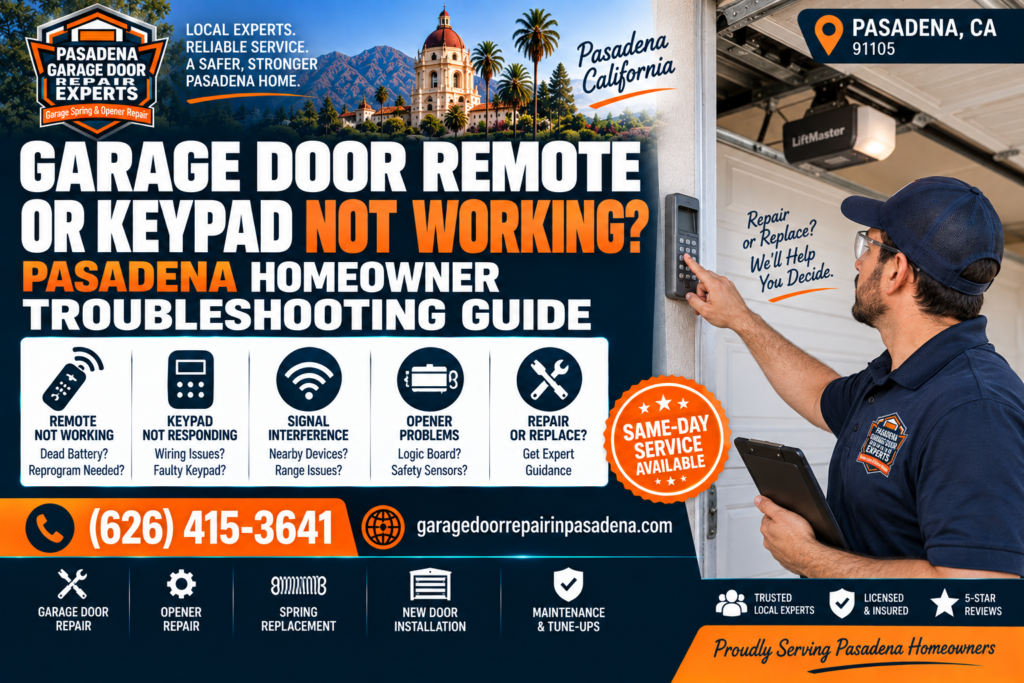
PASADENA GARAGE DOOR REMOTE & KEYPAD GUIDE Garage Door Remote or Keypad Not Working? Pasadena Homeowner Troubleshooting Guide When the garage door works from one control but refuses to respond from another, the problem is often easier to diagnose than it first appears. A remote that suddenly stops working can have a weak battery, lost programming, Lock or Vacation Mode, compatibility trouble, radio-frequency interference, physical transmitter damage, or a problem with the opener’s receiver. A wireless keypad can have many of the same issues while also adding PIN entry, keypad buttons, weather exposure, and keypad-specific programming to the troubleshooting process. The most useful first question is not simply, “Why won’t my garage door open?” Instead ask, “Which control still works?” If the wall-mounted garage door control operates the door normally while one remote fails, the mechanical garage door and much of the opener system are already giving you important diagnostic information. If every remote and the keypad fail but the wall control works, the problem points in a different direction from a situation where no control can move the door. This guide from Pasadena Garage Door Repair Experts walks Pasadena homeowners through a structured remote and keypad diagnosis, explains which simple checks can be performed safely, identifies situations where opener electronics may need attention, and shows when a remote or keypad problem is actually part of a larger garage-door opener issue. Call (626) 415-3641 Ask About Garage Door Opener Repair In this Pasadena remote and keypad troubleshooting guide: Why is my garage door remote or keypad not working? The first test: does the wall control work? Remote and keypad symptom comparison Remote battery problems Lock or Vacation Mode Remote lost its programming Remote compatibility problems Remote only works close to the opener Radio and LED-light interference One remote works but another does not All remotes stopped working Keypad battery problems Keypad PIN problems Keypad needs reprogramming Individual keypad buttons fail Expired temporary PIN Keypad mounting or signal problems Receiver or logic-board problems What if no control moves the door? Are safety sensors causing the remote problem? Remote problems and unexpected opening Safe homeowner troubleshooting sequence What homeowners should not do Pasadena-specific considerations Garage door remote and keypad repair cost factors When professional diagnosis makes sense Questions to ask before service Frequently asked questions Why Is My Garage Door Remote or Keypad Not Working? If the wall-mounted garage door control still opens and closes the door but a remote or wireless keypad does not, begin with the control device itself: check its battery, Lock or Vacation Mode, programming, compatibility, PIN or button operation, and signal range. If multiple remotes and the keypad all stop working while the wall control still operates normally, radio interference or the opener’s wireless receiver becomes more important to investigate. If the wall control does not work either, the problem may be broader than the remote or keypad. Electrical power, wall-control wiring, opener electronics, a mechanical garage-door problem, or another opener condition may need diagnosis. The important point is to avoid replacing unrelated parts before isolating the failed control path. A remote problem does not automatically mean the ceiling-mounted opener needs replacement. A keypad that stopped responding does not automatically mean the garage door tracks or springs are damaged. Diagnose the symptom according to which devices work and which do not. Wall Control Works Focus first on the remote, keypad, programming, wireless range or receiver. One Remote Fails Compare its battery, programming and compatibility with a working remote. Remote Works Only Nearby Weak battery, antenna position or radio interference becomes more likely. No Controls Work The problem may extend beyond the remote and keypad into the opener or door. First Test: Does the Wall-Mounted Garage Door Control Work? The wall control inside the garage is one of the most useful diagnostic tools for a remote or keypad complaint. When the wall control operates the garage door normally, several important facts become more likely. The opener has electrical power, the motor can operate, the door is capable of moving through at least that cycle, and the basic connection between the wall control and opener is functioning. That does not prove every part of the garage-door system is perfect, but it helps narrow the immediate complaint toward wireless controls rather than a total opener failure. Wall control works, remote does not This is a classic remote-specific troubleshooting pattern. Start with: Remote battery condition. Whether Lock or Vacation Mode is enabled. Whether the remote was previously working. Whether the remote remains programmed. Whether the remote is compatible with the opener. Whether it works only at short range. Whether another programmed remote works normally. Wall control works, keypad does not Focus on: Keypad battery. PIN entry. Keypad programming. Keypad compatibility. Failed individual buttons. Temporary-PIN expiration. Signal or mounting issues. Wall control works, no wireless device works When every handheld remote and the wireless keypad stop operating at approximately the same time, it becomes less likely that several unrelated batteries failed simultaneously. Consider a common factor such as: Opener Lock Mode. Memory being erased. Radio-frequency interference. Receiver or logic-board trouble. Wall control does not work either Now the diagnosis changes substantially. Before blaming a remote or keypad, determine whether the opener has power, whether the wall control itself is functioning, and whether the physical garage door can operate safely. If the door is crooked, off track, unusually heavy, has a loose cable, or shows a broken spring, stop ordinary opener troubleshooting until the mechanical condition is evaluated. Garage Door Remote and Keypad Troubleshooting Comparison Symptom Possible Cause Useful Check What It Suggests Wall button works but one remote does not Battery, programming, compatibility or failed remote Test another programmed remote Likely isolated remote problem Remote works only very close to opener Weak battery, interference, antenna or receiver issue Test from several distances Range Problem All remotes stop but wall control works Lock Mode, cleared programming, interference or receiver Check opener indicators and programming Common wireless-control problem Keypad lights are dim or
Why Does My Garage Door Open by Itself? 8 Causes Pasadena Homeowners Should Check

PASADENA GARAGE DOOR OPENER TROUBLESHOOTING Why Does My Garage Door Open by Itself? 8 Causes Pasadena Homeowners Should Check A garage door that seems to open by itself can be confusing and, understandably, concerning. In many cases the door is not truly operating without a cause. The opener is receiving an unintended command, a control component is malfunctioning, an old transmitter is still programmed, or a wiring or electronic problem is creating a signal the opener interprets as a request to operate. The first step is to distinguish between two very different situations: an automatic garage door opener that is actually activating and moving the door, and a manually disconnected garage door that physically drifts because its spring counterbalance is incorrect. Those problems can look similar to a homeowner but require completely different diagnoses. This Pasadena homeowner guide explains eight realistic causes of unexplained garage-door opening, what evidence can help narrow the source, which commonly blamed components are unlikely to make a fully closed door open on their own, and when garage door opener repair should be considered. Call (626) 415-3641 Ask About Garage Door Opener Repair In this Pasadena garage door opener guide: Why does a garage door open by itself? Is the opener activating or is the door drifting? Quick symptom comparison 1. A remote-control button is stuck 2. Someone is accidentally activating a remote 3. An unintended remote is programmed to the opener 4. A keypad or vehicle transmitter is sending the command 5. The wall-mounted control is faulty 6. Wall-control wiring has an intermittent short 7. Smart-app or connected access is activating the door 8. The opener receiver or logic board has a problem What if the disconnected door moves by itself? Do safety sensors make a garage door open by itself? Can radio interference open the garage door? Can a power outage make a garage door open? What to do if you are concerned about security Safe homeowner troubleshooting steps What homeowners should avoid doing Can tracks, rollers or hinges cause this symptom? Pasadena-specific considerations When professional opener diagnosis makes sense Garage door opener repair cost factors Questions to ask before opener repair Frequently asked questions Why Does My Garage Door Open by Itself? A garage door opener that activates unexpectedly can be receiving an unwanted signal from a stuck or accidentally pressed remote, an inadvertently programmed transmitter, a keypad or vehicle control, a faulty wall-mounted control, damaged wall-control wiring, a connected smart device, or a problem with the opener’s receiver or logic board. The most useful diagnosis is to determine which control path is actually commanding the opener. A different condition can occur when the automatic opener has been disconnected from the door with the emergency-release mechanism. If the garage door then moves upward or downward on its own, the issue can involve door balance or spring counterbalance rather than an electronic opening command. Safety photo eyes are also frequently blamed for unexplained opening, but their normal purpose is associated with protecting the closing direction. A sensor problem can cause a door to refuse to close or reverse while closing. It does not normally explain why a fully closed door suddenly receives an opening command. Pasadena homeowners should start with the simple control possibilities before assuming the opener motor needs replacement. Check the remotes, vehicle controls, keypad and connected users. If the behavior continues, the wall control, low-voltage control wiring and opener electronics become increasingly important to diagnose. First Determine What “Opening by Itself” Actually Means Homeowners often use one phrase—“the garage door opened by itself”—for several different events. Separating them is one of the most important troubleshooting steps because it prevents unrelated components from being blamed. Situation 1: The automatic opener activates You may hear the motor start, see the opener light respond, hear a relay or click, and then watch the trolley or drive system move the door upward. That strongly suggests the operator received or generated an activation command. In this situation, investigate controls and electronics first: Handheld remotes. Vehicle-integrated transmitters. Wireless keypads. Wall-mounted controls. Control wiring. Programmed accessories. Smart-garage access. Receiver or logic-board operation. Situation 2: The door moves after being disconnected from the opener If the opener is disconnected with the emergency release and the door physically rises or falls without the motor operating, that points in a different direction. Springs counterbalance garage-door weight. A correctly matched and adjusted spring system helps the door remain controllable through its travel. A door that strongly rises or falls when manually disconnected may have a balance problem. That does not mean the opener is receiving a mysterious radio command. Situation 3: The door begins closing and then reopens This is also different. A garage door that starts closing, encounters an obstruction, experiences excessive resistance, or has a safety-sensor problem may reverse upward. To someone who only notices the door after it has returned to the open position, that can look like spontaneous opening. Ask whether the door truly started from the fully closed position or whether it reversed during a closing cycle. Garage Door Opening by Itself: Quick Symptom Comparison What You Notice More Likely Direction What to Check Important Distinction Opener motor suddenly starts from fully closed position Unwanted control command or opener electronics Remotes, wall control, wiring, programmed accessories, logic board Different from mechanical door drift Remote LED appears continuously active Stuck remote button Each handheld remote and vehicle remote Strong Control-Signal Clue Problem stops after old remotes are removed or memory is cleared Programmed transmitter or accessory Remotes, keypad, vehicle transmitters Reprogram only authorized devices Problem continues with handheld remotes isolated Wall control, wiring or opener electronics Professional control-circuit diagnosis Do not disturb safety-sensor wiring Door reverses only while closing Closing obstruction, resistance or safety system Sensors, tracks, rollers, closing path Not the same as opening from fully closed Door drifts upward only after opener is manually disconnected Door balance or spring counterbalance Professional spring/balance evaluation Mechanical, Not Electronic Unexpected opening appears in smart-app activity Connected user/device command
Garage Door Hinges Cracking, Popping or Coming Loose? What Pasadena Homeowners Should Know

PASADENA GARAGE DOOR HINGE GUIDE Garage Door Hinges Cracking, Popping or Coming Loose? What Pasadena Homeowners Should Know Garage door hinges are easy to overlook because they are smaller than the door sections, springs, tracks and opener. Yet every time a sectional garage door opens, the hinges allow adjacent sections to pivot as the door moves from the vertical tracks through the curved transition and into the horizontal position beneath the garage ceiling. When a hinge cracks, bends, loosens or begins producing a new popping sound, the problem can affect more than the hinge itself. End hinges also help position roller stems relative to the tracks. A loose hinge can allow a roller to change angle. A bent hinge can create scraping or binding. A damaged door section can cause a perfectly good hinge to move incorrectly, while a bent track or worn roller can place abnormal stress back into the hinge. This guide from Pasadena Garage Door Repair Experts explains what cracked, popping and loose garage door hinges can mean, which symptoms deserve attention, how hinge problems interact with rollers and tracks, when ordinary maintenance may help, when physical hinge damage points toward replacement, and what Pasadena homeowners should avoid adjusting around high-tension garage door hardware. Call (626) 415-3641 Ask About Garage Door Hinge Repair In this Pasadena garage door hinge guide: What do cracked, popping or loose garage door hinges mean? What garage door hinges actually do Center hinges, end hinges and roller carriers Hinge symptom comparison 1. Visible cracks in the hinge 2. Popping or clicking at section joints 3. Hinge fasteners keep coming loose 4. The hinge is bent or distorted 5. Screw holes or mounting points are damaged 6. A roller sits at an unusual angle 7. Door sections separate or flex abnormally 8. Rust, fatigue or repeated hinge movement develops Why garage door hinges fail How hinges affect tracks How hinges affect rollers How panel damage affects hinges How door balance can contribute to hinge stress Can hinge problems affect the opener? Why some roller hinges are numbered Lubricate, tighten or replace? Replace one hinge or several? Hinges vs. bottom brackets Safe homeowner checks What homeowners should not adjust Garage door hinge repair cost factors Pasadena-specific conditions When professional hinge repair makes sense Questions to ask before hinge replacement Garage door hinge repair red flags Frequently asked questions What Do Cracking, Popping or Loose Garage Door Hinges Mean? A cracked, bent or repeatedly loose garage door hinge usually indicates physical wear, impact damage, mounting-point damage or abnormal stress in the sectional door system. Popping by itself does not prove that the hinge needs replacement because rollers, tracks, panels and other hardware can produce similar sounds. The hinge should be inspected together with the adjacent door sections, roller, track and fasteners before the repair is selected. A visibly cracked or broken metal hinge is generally a replacement issue, not a lubrication issue. Lubricant can reduce friction at an appropriate metal pivot point, but it cannot restore fractured metal or correct a hinge that has permanently bent out of shape. A fastener that becomes loose once may simply require evaluation and proper securing. A fastener that repeatedly loosens can point toward vibration, stripped mounting material, section damage, hinge distortion or another problem that keeps moving the hardware. End hinges deserve additional attention because they often position roller stems. If an end hinge bends or pulls away from the door section, the roller may enter the track at the wrong angle and create scraping, binding or abnormal side pressure. The goal is therefore not simply to silence the popping sound. The goal is to determine why the hinge or surrounding hardware is moving incorrectly and correct the root cause. Cracked Metal Is Physical Damage Lubricant cannot restore a fractured or structurally damaged hinge. Popping Is a Symptom Hinges can pop, but rollers, tracks, panels and loose hardware can create similar sounds. End Hinges Affect Roller Position A damaged roller-carrying hinge can change how the wheel sits inside the track. Repeated Looseness Needs Diagnosis If a fastener keeps loosening, determine why before simply tightening it again. What Garage Door Hinges Actually Do A sectional garage door is made from multiple horizontal sections connected together. The door cannot move through a curved track as one rigid, inflexible slab. Each section must change angle relative to the section next to it while the door travels around the radius of the track. Hinges make that movement possible. As the door opens, adjacent sections pivot at their hinge connections. As the door closes, the hinges guide those sections back toward a common vertical plane. Hinges connect adjacent door sections Most residential sectional garage doors contain several hinges across each horizontal joint. Depending on the door design, some hinges are located nearer the middle of the sections while others are positioned near the left and right edges. The hinge leaves attach to the door sections with fasteners. A central pivot allows the two portions of the hinge to rotate relative to each other. That simple movement happens repeatedly during every opening and closing cycle. End hinges can also position rollers Hinges near the ends of many residential sections include a sleeve or carrier for the roller stem. That makes the hinge part of the roller-and-track geometry as well as the section connection. If the hinge moves inward, outward or sideways, the roller position can change with it. Center hinges and end hinges do related but different jobs Center hinges primarily allow adjacent sections to pivot while helping maintain their connection. Roller-carrying end hinges perform that pivoting function while also supporting the roller stem at the edge of the door. This difference matters when a hinge becomes damaged. A cracked center hinge can affect how sections flex at the joint. A distorted end hinge can affect the section connection and roller tracking at the same time. The hinge does not counterbalance the door Hinges should not be confused with garage-door springs. Springs counterbalance
Bent Garage Door Track in Pasadena? Causes, Warning Signs and Repair Options

PASADENA GARAGE DOOR TRACK GUIDE Bent Garage Door Track in Pasadena? Causes, Warning Signs and Repair Options A garage door depends on two accurately positioned tracks to guide its rollers from the closed vertical position, through the curved transition, and into the horizontal position beneath the garage ceiling. When one of those tracks becomes bent, twisted, spread, dented, loose or misaligned, the door may begin scraping, shaking, sticking, tilting or forcing rollers against places they were never intended to contact. A bent garage door track is not always a stand-alone problem. The track works with rollers, hinges, lift cables, springs, brackets, door sections and the automatic opener. A roller can be damaged by a bent track, but a badly worn roller can also contribute to abnormal track contact. A loose cable can make the door crooked and force rollers sideways. A vehicle impact can damage both the track and door section at the same time. This guide from Pasadena Garage Door Repair Experts explains how garage door tracks become damaged, the warning signs Pasadena homeowners can recognize, which related components should be checked, when adjustment may be possible, when damaged track may need replacement, and why an off-track or unstable garage door should never be forced through another opening cycle. Call (626) 415-3641 Ask About Garage Door Track Repair In this Pasadena garage door track guide: Can a bent garage door track be repaired? How garage door tracks work Types of garage door track damage Track symptom comparison table 1. Vehicle impact 2. A roller binding or leaving the track 3. Loose track brackets and fasteners 4. Cable or counterbalance problems 5. Worn hinges or roller carriers 6. Door-section impact or distortion 7. Repeated operation after a problem begins Warning signs of bent or misaligned track Track and roller relationship Track and spring relationship Track and cable relationship Track and hinge relationship How track problems affect the opener Repair track or replace track? Can a minor track bend be straightened? What if the rollers have already come out? What if the door is crooked? Safe homeowner checks What homeowners should not do Garage door track repair cost factors Pasadena-specific considerations When professional repair makes sense Questions to ask before track repair Track repair red flags Frequently asked questions Can a Bent Garage Door Track Be Repaired? Some garage door track problems can be repaired when the damage is limited to alignment, loose mounting hardware, or a relatively minor deformation that has not compromised the track’s ability to guide the rollers correctly. A severely bent, twisted, split, crushed or repeatedly deformed track section may need replacement instead. The correct choice depends on the location and extent of the damage and whether related rollers, hinges, cables, brackets or door sections are also affected. The door should not be forced through a bent section to determine whether it will “work itself out.” Repeated operation can push rollers harder against damaged metal, allow rollers to leave the track, enlarge a bend or place additional stress on hinges, cables and the automatic opener. A visibly crooked garage door requires even more caution. Crooked movement can indicate unequal cable position, an off-track roller, damaged hardware or another counterbalance problem in addition to the track itself. The repair should therefore begin with diagnosis of the entire movement path rather than straightening the first piece of metal that looks bent. Bent Is Not the Only Track Problem Tracks may also twist, spread open, loosen from their supports or become misaligned. Rollers and Tracks Must Work Together A worn roller can bind in a good track, while a good roller can bind in a damaged track. Crooked Doors Need Broader Diagnosis Cables, rollers, hinges and counterbalance components may be involved. Do Not Force an Off-Track Door Additional operation can increase track, roller, cable and section damage. How Garage Door Tracks Guide a Sectional Door Residential sectional garage doors usually travel through a track system on both sides of the door opening. The track establishes the path the rollers follow while the door changes orientation from vertical to horizontal. When the garage door is fully closed, most of the door sections are vertical. As the door begins opening, the upper rollers move into curved track sections. The sections pivot at their hinges and progressively move into the horizontal tracks beneath the garage ceiling. This creates a coordinated movement involving several components at once. The rollers guide the door, the hinges allow individual sections to pivot, the springs counterbalance door weight, lift cables transfer counterbalancing force, and the opener moves the already balanced door when automatic operation is used. Vertical tracks Vertical track sections are mounted at the left and right sides of the garage-door opening. They guide most of the roller travel while the door is closed or near the closed position. A vertical track must be positioned so rollers have sufficient clearance to travel without excessive side pressure while still being retained by the track’s formed edges. Curved track The curved portion transitions the door from vertical movement to horizontal movement. This area is especially important because the door sections are changing angle while the rollers follow the radius. A deformation here can produce noticeable bumping, binding, scraping or shaking. Horizontal tracks Horizontal tracks support and guide the door when it is open beneath the ceiling. They must be securely supported and aligned so rollers can continue along their path without dropping, binding or forcing the door sections sideways. Track spacing matters A track should not be squeezed tightly against the rollers simply to make the door look snug. Rollers need appropriate operating clearance. A track positioned too close to the door can create friction. A track that is too far away or spread open may fail to retain the roller as intended. This is why track adjustment should focus on proper alignment and geometry, not simply making the hardware tighter. What Does a Damaged Garage Door Track Look Like? “Bent track” is a useful homeowner phrase, but
Garage Door Rollers Worn Out? 8 Signs Pasadena Homeowners Should Replace Them

PASADENA GARAGE DOOR ROLLER GUIDE Garage Door Rollers Worn Out? 8 Signs Pasadena Homeowners Should Replace Them Garage door rollers are small components with a large job. They guide each section of a residential garage door through the vertical and horizontal tracks every time the door opens or closes. When the rollers are in good condition, that movement should be controlled and relatively smooth. When wheels, bearings or roller stems wear out, the door can become noisy, shaky, resistant, crooked-looking or increasingly difficult to move. Worn rollers should not be diagnosed by noise alone. Grinding, shaking and sticking can also come from bent tracks, loose hinges, damaged cables, incorrect spring balance or garage door opener problems. The best approach is to inspect how the rollers interact with the complete door system and identify the actual source of resistance before parts are replaced. This Pasadena homeowner guide explains eight signs that garage door rollers may be ready for replacement, how nylon and steel rollers wear differently, when lubrication may help, when physical damage means lubrication is no longer enough, and why certain roller locations—especially around the bottom brackets—require extra safety precautions. Call (626) 415-3641 Ask About Garage Door Roller Service In this Pasadena garage door roller guide: How do you know garage door rollers are worn out? What garage door rollers do Roller wheels, stems and bearings Quick roller symptom comparison 1. Persistent grinding, squeaking or scraping 2. Rollers wobble or have excessive play 3. Nylon wheels are cracked, chipped or flat-spotted 4. Steel rollers are rusty, rough or seized 5. Roller stems are bent or bearings are failing 6. The garage door shakes or jerks while moving 7. Rollers are climbing, binding or leaving the track 8. The door repeatedly sticks or drags during travel Lubricate or replace? Nylon vs. steel rollers Do garage door roller bearings matter? How tracks affect roller diagnosis How hinges affect rollers How spring balance can mimic roller trouble How worn rollers affect the opener The bottom roller safety issue Safe homeowner checks What not to adjust Replace one roller or a full set? Roller replacement cost factors Pasadena-specific garage door conditions When professional roller replacement makes sense Questions to ask before replacement Roller diagnosis red flags Frequently asked questions How Do You Know When Garage Door Rollers Are Worn Out? Garage door rollers may need replacement when they develop persistent grinding or scraping, excessive wobble, cracked or flat-spotted wheels, corrosion or seized movement, bent stems, loose or missing bearings, repeated shaking during door travel, abnormal contact with the track, or enough resistance that the door consistently sticks or drags. The key word is diagnosis. A noisy or jerky garage door does not automatically have bad rollers. Bent tracks can force healthy rollers to bind. Loose hinges can allow the sections and roller stems to move incorrectly. A broken or poorly balanced spring system can make the entire door feel heavy. Cable problems can make one side of the door travel differently from the other. Roller replacement is most justified when the roller itself shows physical wear, bearing failure, stem damage or consistently rough movement and the surrounding track and hinge system have been evaluated. Pasadena homeowners should also distinguish ordinary accessible roller inspection from work at the bottom corner of the garage door. Bottom brackets can be connected to high-tension lift cables. Those brackets should not be loosened or removed simply to access a bottom roller. Noise Alone Is Not Proof Rollers, hinges, tracks, springs and opener components can all create garage door noise. Physical Damage Matters Cracks, chips, bent stems and failed bearings are stronger replacement indicators than ordinary dirt. Track Condition Matters A good roller can still bind inside a damaged or misaligned track. Bottom Brackets Need Caution High-tension lift cables may connect to the bottom fixture, making that area inappropriate for casual DIY disassembly. What Do Garage Door Rollers Actually Do? A sectional garage door does not travel straight upward like an elevator. Each horizontal door section must move vertically, transition through the curved portion of the track, and then continue horizontally beneath the garage ceiling. Rollers make that guided movement possible. The roller wheel sits inside the track while its stem connects through a hinge or roller carrier attached to the door section. As the door moves, the roller turns and changes position along the track. Because several rollers work together, one failing roller can affect the way an entire section travels. Rollers are guides, not lifting devices Garage door rollers do not counterbalance the weight of the garage door. That is primarily the job of the spring system. They also do not power the door. An automatic opener provides controlled powered movement after the mechanical door is properly counterbalanced. The roller’s role is to guide the sectional door through its track path with as little unnecessary friction or side loading as practical. Why worn rollers affect more than noise If a roller stops turning smoothly, it may slide or drag rather than roll. If its bearing develops excessive play, the wheel may wobble. If its stem bends, the wheel may enter the track at an angle. If the wheel cracks or develops an irregular surface, it may no longer move smoothly along the track. Those changes can produce vibration throughout the door. They can also increase resistance that the opener must overcome. Over time, that extra movement can affect hinges, track alignment and other hardware. Every roller operates within a larger system This is why replacing rollers without looking at the track can lead to an incomplete diagnosis. A wheel can be new and still bind if the track is bent inward. A wheel can be perfectly round and still move unevenly if the hinge holding its stem is damaged. A complete inspection therefore looks at the roller, stem, bearing, hinge, track and overall door movement together. Garage Door Roller Anatomy: Wheel, Stem and Bearings When homeowners say “the roller,” they often mean only the small wheel visible
One Garage Door Spring or Two? What Pasadena Homeowners Should Know Before Replacement
PASADENA GARAGE DOOR SPRING GUIDE One Garage Door Spring or Two? What Pasadena Homeowners Should Know Before Replacement Some residential garage doors use one torsion spring while others use two. Neither configuration is automatically correct for every door. The spring system has to be selected according to the actual garage door weight, height, drum configuration, required counterbalance and other mechanical specifications. A properly engineered single-spring system can be completely appropriate for a residential garage door. A properly engineered two-spring system can also be appropriate, particularly on many wider or heavier doors. What matters is that the total spring torque matches the door rather than simply assuming that adding more springs must make the system better. This guide from Pasadena Garage Door Repair Experts explains why garage doors use one or two springs, what happens when one spring breaks, when both springs should be replaced, why converting from one spring to two requires proper spring calculations, and what Pasadena homeowners should ask before approving garage door spring replacement. Call (626) 415-3641 Ask About Garage Door Spring Service In this Pasadena garage door spring guide: Should a garage door have one spring or two? What garage door springs actually do Why some doors use one torsion spring Why some doors use two torsion springs One spring vs. two comparison Are two springs automatically better? Door weight determines spring requirements How two springs share the counterbalance load What happens when one of two springs breaks? Should both springs be replaced? What happens when a single spring breaks? Can a one-spring door be converted to two? Do two springs last longer? Spring count and garage door balance Cables, drums and torsion shafts How spring problems affect the opener Single-car vs. double-car garage doors Insulated, wood and heavier doors What happens when spring sizing is wrong? Signs the spring system needs attention Safe homeowner checks What homeowners should not adjust One-spring vs. two-spring cost factors Pasadena-specific considerations How to decide what your door needs Questions to ask before replacement Spring replacement red flags Frequently asked questions Should a Garage Door Have One Spring or Two? A garage door should have the spring configuration that correctly counterbalances its actual weight. Some residential torsion systems are properly designed with one spring, while others are designed with two. Two springs are common on many wider and heavier doors because the required torque can be divided between a matched pair, but installing two springs is not automatically better than installing one correctly sized spring. If a garage door is already designed with two torsion springs and one breaks, industry safety guidance recommends replacing both springs. The springs have normally experienced the same door cycles, so leaving the second used spring in place creates an unmatched pair and leaves another wear component in the system. If a door currently uses one properly sized torsion spring, a second spring should not simply be added beside it. Converting from one spring to two requires selecting a new matched pair whose combined counterbalancing torque is correct for the door. The best replacement decision therefore starts with the door itself: weight, height, width, spring system, cable drums, shaft, track configuration and desired cycle characteristics. One Spring Can Be Correct A correctly engineered single torsion spring can properly counterbalance many residential garage doors. Two Springs Can Be Correct A matched pair can divide the required total torque on many wider or heavier doors. More Is Not Automatically Better Spring count must match the actual engineering requirements of the door. Paired Springs Age Together If one spring in an established two-spring system fails, replacing both is commonly recommended. What Garage Door Springs Actually Do The number of springs makes more sense once you understand the job the spring system performs. A residential garage door can weigh far more than most homeowners realize. The total weight depends on width, height, material, insulation, windows, reinforcement, decorative overlays and other construction details. The automatic garage door opener is not supposed to carry that full weight by brute force. The spring system counterbalances the door. On a typical torsion system, one or more tightly wound springs are mounted on a shaft above the garage-door opening. Cable drums sit near the ends of the shaft. Steel lift cables connect the drums to the lower portions of the garage door. As the door closes, the springs store mechanical energy. As the door opens, spring torque helps rotate the shaft and drums, allowing the cables to help lift the door. Spring count is only one variable A homeowner may look above the door and see one spring on one garage and two springs on another, but that visible difference does not reveal the complete engineering of either system. Relevant variables can include: Door weight. Door height. Drum type. Spring wire diameter. Spring inside diameter. Spring length. Winding direction. Number of springs. Desired cycle characteristics. That means two doors of similar appearance do not necessarily require the same springs. The goal is balance Correct spring selection should leave the mechanical door properly counterbalanced. If too little spring force is available, the door remains too heavy. If too much spring force is present, the door can resist closing or try to rise more aggressively than intended. Neither condition is correct. Why Do Some Garage Doors Have Only One Torsion Spring? A single torsion spring can provide all of the counterbalancing torque required by a residential garage door when the spring is properly selected for that system. This arrangement is common enough that seeing only one spring above the garage door is not evidence that something is missing. One spring can provide the required total torque The important question is whether the spring’s characteristics match the door. A correctly selected single spring can generate the total counterbalance needed for certain doors without a second spring. Smaller or lighter doors may use one spring Single-car doors and some lighter residential doors may be good candidates for one-spring torsion systems, depending on the actual product and counterbalance
Torsion vs. Extension Garage Door Springs: Which Is Better for Pasadena Homes?
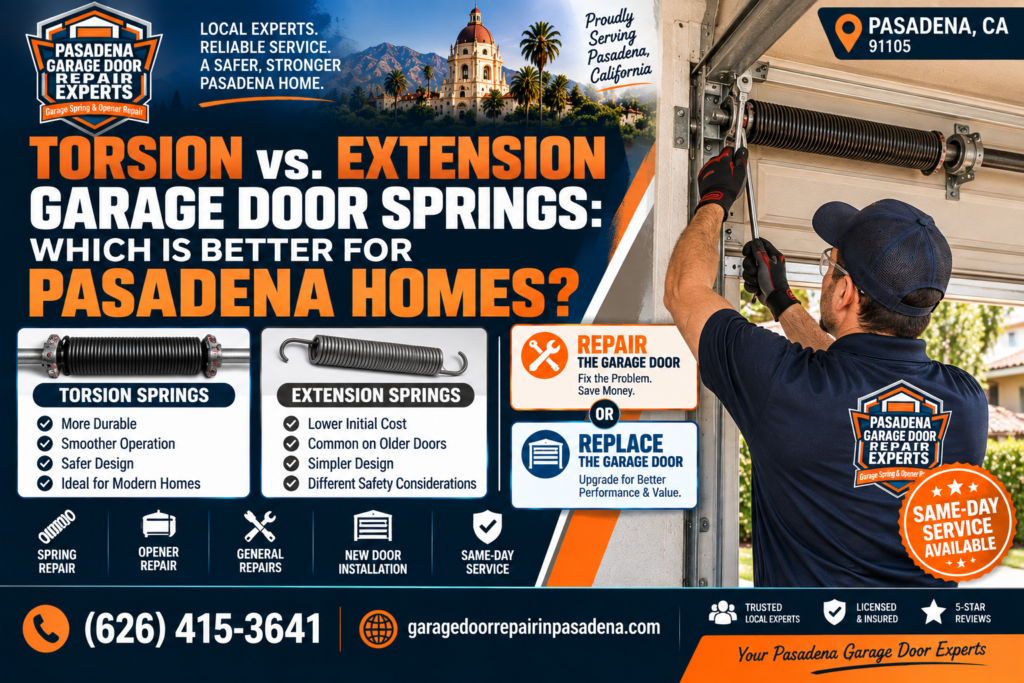
PASADENA GARAGE DOOR SPRING GUIDE Torsion vs. Extension Garage Door Springs: Which Is Better for Pasadena Homes? Torsion and extension springs perform the same essential job: they counterbalance the weight of a garage door so the door can open and close in a controlled way. They accomplish that job differently. Torsion springs twist around a shaft mounted above the door, while extension springs stretch along the horizontal track area as the door moves. For many modern residential sectional garage doors in Pasadena, torsion springs are generally the stronger all-around choice when the garage configuration supports them. A properly designed torsion system can provide controlled lifting force across a shaft, works well with many wide or heavy residential doors, keeps the spring assembly primarily above the opening, and can be engineered for different door weights and cycle requirements. That does not mean every extension-spring garage door needs to be converted. Extension systems can still be appropriate when the existing door was designed for them, the tracks and safety cables are correctly configured, the door is properly balanced, and the system remains in suitable condition. The better choice depends on the actual garage door, available headroom, hardware, door weight, existing spring system, repair scope and homeowner priorities. Call (626) 415-3641 Ask About Garage Door Spring Service In this Pasadena garage door spring comparison: Which spring system is better? What garage door springs actually do How torsion springs work How extension springs work Torsion vs. extension comparison table 1. Door balance and controlled movement 2. Door weight and size 3. Safety differences 4. Cables, drums and pulleys 5. Garage space and headroom 6. Spring cycles and service life 7. Maintenance and inspection 8. Noise and operating feel 9. What happens when a spring breaks 10. Parts and replacement requirements 11. Cost considerations 12. Extension-to-torsion conversion One torsion spring vs. two torsion springs How springs affect the garage door opener What about older Pasadena garages? What about insulated and heavy doors? Signs your spring system needs service Safe homeowner checks Spring repairs homeowners should not attempt Pasadena-specific considerations How to choose between the two systems Questions to ask before spring replacement Frequently asked questions Torsion vs. Extension Springs: Which Is Better for Pasadena Homes? For many Pasadena residential sectional garage doors, a properly designed torsion-spring system is generally the preferred configuration when the garage has adequate space above the door and the system is compatible with the door. Torsion springs provide counterbalance through a shaft and cable-drum system, can work well with heavier and wider doors, keep the primary spring assembly above the opening, and allow the counterbalance system to be matched closely to the door’s actual weight. Extension springs can still be an appropriate system. They are normally mounted alongside the horizontal tracks and stretch as the garage door closes. When an extension-spring system is correctly sized, equipped with proper safety containment cables, maintained and operating a compatible door, there may be no reason to replace the system merely because torsion technology exists. The most important factor is not the spring name alone. The garage door should have a counterbalance system that matches its weight and dimensions, keeps the door controlled through its travel, works with the track configuration, and can be serviced safely using the correct components. What Do Garage Door Springs Actually Do? To understand whether torsion or extension springs are better, it helps to understand why the garage door needs springs in the first place. A residential garage door can be large and heavy. Depending on its size and construction, it may contain steel sections, insulation, an interior steel skin, windows, reinforcement struts, decorative overlays or other components that add significant weight. The automatic garage door opener is not intended to directly carry all of that weight by itself. The spring system provides counterbalancing force. When the counterbalance system is correctly designed, much of the physical weight of the door is offset by spring force. This is what allows the door to move in a controlled way rather than behaving like an unsupported heavy wall panel. The spring and opener have different jobs The spring system counterbalances the door. The opener moves the counterbalanced door. This distinction matters because homeowners sometimes respond to a heavy door by assuming they need a stronger opener. If the door is heavy because a spring broke or the counterbalance is incorrect, increasing opener power does not solve the mechanical problem. Springs work with other components Neither torsion nor extension springs work completely alone. Depending on the system, the counterbalance assembly can involve: Lift cables. Cable drums. Pulleys. A torsion shaft. Center and end bearing hardware. Spring attachment points. Safety containment cables. Track-related hardware. That is why spring replacement should be approached as work on a counterbalance system rather than as a simple coil swap. How Does a Torsion Garage Door Spring Work? A torsion spring is normally positioned above the garage door opening on a steel shaft. Instead of stretching longer and shorter, a torsion spring stores mechanical energy by twisting. On many residential systems, lift cables attach near the lower corners of the garage door and travel upward to cable drums near the ends of the torsion shaft. As the garage door closes, the system winds the spring and stores energy. As the door opens, spring torque helps rotate the shaft and drums so the lift cables assist in raising the door. Main torsion-system components Depending on the particular garage door, a torsion system may include: One or more torsion springs. A torsion shaft. Stationary spring hardware. Winding cones. Center support or bearing components. End bearing plates. Cable drums. Steel lift cables. Why torsion systems are common The torsion design creates a compact counterbalance assembly concentrated around the header above the garage-door opening. It can be engineered for many different door weights and sizes and can use one, two or additional springs depending on the requirements of the door system. Proper spring selection is essential. A torsion spring that looks similar to
Garage Door Opener Repair vs. Replacement in Pasadena: When Is a New Opener Worth It?

PASADENA GARAGE DOOR OPENER GUIDE Garage Door Opener Repair vs. Replacement in Pasadena: When Is a New Opener Worth It? A garage door opener that stops working does not automatically need to be replaced. Many opener problems can come from a remote, keypad, safety sensor, wall control, wiring connection, battery, gear, belt, chain, travel setting or another repairable component. In other cases, repeated failures, unavailable parts, major motor or electronic problems, compatibility concerns, or California battery-backup requirements can make replacement a more practical option. The most important first step is making sure the opener itself is actually the problem. A broken garage door spring, damaged cable, binding roller or bent track can make a perfectly functional opener appear weak because the opener is being asked to move a door that is no longer properly counterbalanced. This Pasadena homeowner guide explains how to decide between garage door opener repair and replacement, which problems are commonly worth diagnosing for repair, when a new opener deserves serious consideration, how California’s battery-backup requirement affects the decision, and which features may justify upgrading even when an older opener can still be repaired. Call (626) 415-3641 Ask About Garage Door Opener Service In this Pasadena garage door opener guide: Should you repair or replace your garage door opener? Make sure the opener is actually the problem Repair vs. replacement comparison When opener repair usually makes sense When opener replacement may make more sense 1. Remote-control problems 2. Keypad problems 3. Safety sensor problems 4. Wall-control and wiring problems 5. Belt, chain, gear and trolley problems 6. Logic-board and electronics problems 7. Motor problems 8. Travel, force and reversal problems 9. Replacement-parts availability 10. Repeated failures and reliability 11. California battery-backup requirement 12. Features that can make replacement worthwhile Pasadena power outages and battery backup Does opener age determine repair or replacement? Should you replace an opener because it is noisy? Door balance and opener strain Replacing an opener when buying a new garage door Smart garage door opener upgrades Belt, chain and wall-mount openers Repair cost vs. replacement cost Safe homeowner troubleshooting When professional diagnosis makes sense Pasadena-specific considerations Questions to ask before approving replacement Repair-vs.-replacement red flags Frequently asked questions Should You Repair or Replace Your Garage Door Opener in Pasadena? Repair usually makes sense when the garage door itself is properly balanced, the opener problem is isolated, compatible replacement parts are available, the safety systems can operate correctly, and fixing the failed component is expected to restore normal operation. Replacement becomes more attractive when the opener has repeated problems, multiple major components are failing, necessary parts are unavailable, the opener is incompatible with the current door, or a California-compliant battery-backup opener is required as part of a replacement project. The decision should not be based on age alone. An older opener with one readily repairable problem may continue to be useful, while a newer opener with extensive electronic or mechanical damage could require a different decision. Before replacing the opener, the physical garage door should also be inspected. Springs counterbalance garage door weight. If a spring breaks, the opener may suddenly appear weak even though the motor itself has not failed. Tracks, rollers, cables and door sections can create similar resistance. First: Make Sure the Garage Door Opener Is Actually the Problem This is the most important repair-versus-replacement principle in the entire article. A garage door opener is only one part of a larger door system. The physical garage door includes sections, hinges, rollers, tracks, springs, cables and other hardware. The opener moves that system, but it is not designed to overcome a serious mechanical failure elsewhere in the door. Homeowners frequently describe symptoms such as: The opener hums but the door barely moves. The door opens only a few inches. The door stops halfway. The opener sounds strained. The door moves unevenly. The opener reverses unexpectedly. The door will not close. Some of those symptoms can be caused by the opener, but they can also be caused by the garage door itself. Broken spring mistaken for an opener problem Springs counterbalance garage door weight. When a torsion or extension spring fails, the door can become dramatically heavier. If the homeowner presses the opener button, the motor may attempt to lift a load that is far heavier than the properly balanced door it normally moves. The opener may stop, reverse, hum, move the door only slightly or fail to move it at all. None of those symptoms prove the opener needs replacement. Track or roller resistance mistaken for motor weakness A damaged roller, bent track or misaligned door can create friction or binding. That resistance can make the opener appear weak. Cable problems can change door alignment If one lift cable becomes loose or comes off its drum, one side of the door may move differently from the other. The opener should not be expected to pull a crooked door back into normal alignment. Important diagnosis rule: Do not replace an opener simply because it cannot move a garage door with a broken spring, displaced cable, bent track or other mechanical resistance. Correct the door-system problem first, verify proper balance, and then evaluate opener operation under normal conditions. Garage Door Opener Repair vs. Replacement: Quick Comparison Condition Repair May Make Sense Replacement May Make Sense What to Diagnose First Remote will not work Often Repair / Accessory Issue Usually not by itself Battery, programming, lock mode, remote compatibility Keypad will not work Often Repair / Accessory Issue Usually not by itself Battery, programming, keypad and receiver Safety sensor problem Often Repairable If broader electronics or compatibility issues exist Obstruction, alignment, wiring, sensors, logic board Broken belt or worn gear Often Worth Diagnosing If multiple major failures are also present Drive components and mechanical door condition Logic board failure Possible when compatible board is available More attractive if parts are unavailable or other major parts are failing Exact opener model and diagnostic symptoms Motor problem Depends on model and parts May become more practical
How Much Does a New Garage Door Cost in Pasadena? Installation, Materials and Upgrade Factors
PASADENA NEW GARAGE DOOR COST GUIDE How Much Does a New Garage Door Cost in Pasadena? Installation, Materials and Upgrade Factors The cost of a new garage door in Pasadena depends on the exact door being installed and the condition of the existing garage opening. Door width and height, steel versus wood or composite construction, insulation, windows, finish, decorative features, tracks, springs, weather seals, removal of the old door, installation complexity and optional opener upgrades can all change the final project price. That means there is no responsible single price that accurately describes every new garage door installation in Pasadena. A basic single-car steel door and a wide insulated carriage-style door with windows and decorative overlays are both “new garage doors,” but they are materially different products with different weight, hardware and installation requirements. This guide from Pasadena Garage Door Repair Experts explains the major factors that affect new garage door cost so homeowners can compare quotes based on the actual door, installation and upgrades being proposed rather than comparing totals that may represent very different projects. Call (626) 415-3641 Ask About Garage Door Installation In this Pasadena new garage door cost guide: How much does a new garage door cost? What does the installed price include? Major cost factors at a glance 1. Garage door size 2. Garage door material 3. Construction and insulation 4. Door style and design 5. Garage door windows 6. Finish and color 7. Decorative overlays and hardware 8. Tracks and door hardware 9. Spring and counterbalance system 10. Garage door opener upgrades 11. Removal of the existing door 12. Garage opening and framing conditions 13. Installation complexity 14. Weather seals 15. Permits and property requirements 16. Customization 17. Professional installation scope Material comparison Is insulation worth paying more for? Single-car vs. double-car doors How door weight affects spring costs When replacement may make sense What should a new-door quote include? How to compare installation quotes Pasadena-specific considerations Questions to ask before ordering New garage door pricing red flags Frequently asked questions How Much Does a New Garage Door Cost in Pasadena? There is no single accurate installed price for every new garage door in Pasadena. The final cost depends primarily on door size, material, construction, insulation, windows, finish, design upgrades, hardware, spring requirements, removal of the existing door, condition of the opening, installation complexity and whether an automatic opener or other optional equipment is included. For an accurate comparison, Pasadena homeowners should obtain quotes for equivalent specifications. A quote for a basic non-insulated steel door should not be compared directly with a quote for a multi-layer insulated door with windows, upgraded finishes and decorative overlays as though the only difference were the installer. The most useful estimate separates or clearly explains the major project elements: the garage door itself, insulation and design options, tracks and hardware, spring system, installation labor, removal of the old door, optional opener work and any changes required to the garage opening. What Does the Price of a New Garage Door Installation Actually Include? When a homeowner asks what a new garage door costs, the first question should be whether the quoted figure describes only the door product or the complete installed project. A garage door is not a standalone decorative panel that is simply attached to the front of the garage. A sectional door is a moving system made from multiple door sections, hinges, rollers, tracks, counterbalance components, lift cables, weather seals and other hardware. The installed project may therefore include several categories of work. The garage door sections The most visible portion of the project is the door itself. Its price is affected by size, material, insulation, design, windows, finish and decorative options. Tracks and hardware New sectional garage doors are designed as systems. New track and hardware matched to the replacement door may be part of the installation rather than assuming older components should automatically be reused. Manufacturer installation guidance from Clopay notes that new door installations normally replace the track and hardware because the new components are designed to work with the door’s particular weight and configuration. Homeowners researching this issue can review manufacturer guidance on new residential garage door installation . Spring and counterbalance equipment The spring system must be suitable for the actual weight and configuration of the new garage door. Changing from a lightweight single-layer door to a heavier insulated or overlay door can change the spring requirements. Installation labor The door has to be assembled or prepared, installed in the opening, connected to properly positioned tracks and rollers, counterbalanced and checked for controlled operation. Removal of the existing door Replacement projects may also involve controlled removal and disposal or handling of the old garage door and its associated components. Optional automatic opener work An existing opener may remain usable when it is compatible and functioning properly. A new opener should be treated as a separate decision rather than automatically bundled into every garage door replacement. Door Product Size, material, design, insulation and finish. Door Hardware Tracks, rollers, hinges, cables and related components. Counterbalance Springs selected for the actual installed door. Installation Removal, fitting, setup, balance and operational checks. What Factors Affect New Garage Door Cost the Most? The most important cost factors are generally the physical door specification and the complexity of installing it correctly. Cost Factor Lower-Complexity Direction Higher-Complexity Direction What to Compare Door size Smaller standard opening Wider, taller or custom opening Exact width and height Material Basic steel construction Wood, composite overlay or specialty construction Material and layer system Insulation Non-insulated or basic insulation Higher-performance multi-layer construction Insulation type, R-value and door layers Windows No windows Decorative or upgraded glazing Window layout, glass and inserts Finish Standard factory finish Special finish or custom appearance Exact finish and color system Decorative design Simple panel profile Overlay, carriage or architectural design Actual construction, not appearance alone Spring system Conventional matched system Heavier or specialized door requirements Door weight and counterbalance configuration Opener Compatible existing opener retained New opener or specialty
Broken Garage Door Spring Repair Cost in Pasadena: What Affects the Price?

PASADENA GARAGE DOOR SPRING COST GUIDE Broken Garage Door Spring Repair Cost in Pasadena: What Affects the Price? The cost to repair a broken garage door spring in Pasadena depends on much more than the fact that a spring has snapped. Garage doors vary in weight, width, height, construction, spring design and counterbalance configuration. One home may have a single torsion spring above the door, another may use two torsion springs, and another may have extension springs mounted along the horizontal tracks. The correct replacement spring also has to match the garage door rather than simply look similar to the broken spring. Door weight, spring dimensions, spring count, cable drums, shaft condition, bearings and the overall balance of the door can all affect the repair scope. If a spring failure has also caused a cable to come off a drum or allowed the garage door to become crooked, the final repair can involve more than the spring itself. This guide from Pasadena Garage Door Repair Experts explains the major factors that affect garage door spring repair cost in Pasadena, what homeowners should expect from a spring-replacement evaluation, and how to compare repair recommendations without relying on misleading one-price-fits-all estimates. Call (626) 415-3641 Garage Door Spring Repair in Pasadena In this Pasadena garage door spring cost guide: How much does broken spring repair cost? Why spring repair prices vary How the spring system works Torsion vs. extension springs 1. Garage door weight 2. Spring type 3. Number of springs 4. Correct spring specification 5. Spring cycle rating 6. Torsion shaft condition 7. Bearings and spring hardware 8. Lift cables 9. Cable drums 10. Secondary damage 11. Access and installation complexity 12. Parts availability Replacing one spring vs. two How to recognize a broken spring How spring failure affects the opener Spring repair cost-factor comparison What a spring repair quote should explain Broader garage door repair costs Safe homeowner checks What not to do with a broken spring When other parts may need attention Pasadena-specific considerations How to compare spring repair recommendations Pasadena Garage Door Repair Experts Frequently asked questions How Much Does Broken Garage Door Spring Repair Cost in Pasadena? There is no single accurate garage door spring repair price that applies to every Pasadena home. The final cost depends on the spring system, garage door weight, torsion or extension design, number of springs, required spring specifications, cycle rating, condition of the torsion shaft and bearings, lift cables, cable drums, accessibility, labor and whether the broken spring caused additional damage. A straightforward replacement on an otherwise properly aligned garage door involves a different scope from a spring failure that also left the door crooked, pulled a lift cable off its drum or damaged related hardware. Likewise, a lightweight single garage door may require a different spring configuration from a wider insulated door with substantial weight. The most useful spring-repair estimate therefore begins by identifying the door and counterbalance system, confirming the correct replacement spring requirements, inspecting associated components and evaluating door balance. A price given before those factors are understood may not represent the complete repair. Why Does Garage Door Spring Repair Cost Vary? Homeowners often think of a garage door spring as a standard replacement part. It is understandable: from the driveway, many torsion springs look similar. They are long coils mounted above the garage door, and when one breaks the visible gap can make the failure appear simple. Mechanically, however, springs are part of a carefully matched counterbalance system. The garage door itself may weigh a substantial amount. The purpose of the spring system is to store and release mechanical energy so that much of that weight is counterbalanced as the door opens and closes. That is why a properly functioning garage door can often be moved without the user or automatic opener having to directly lift the entire physical weight of the door. When the spring breaks, that balance changes. The repair is not simply: remove coil → install another coil → finished. The replacement spring must be appropriate for the door. A technician may need to consider door weight, door height, track configuration, spring dimensions, number of springs, drum configuration and other system details. DASMA’s spring-identification guidance specifically warns that spring color coding provides only partial information. Other characteristics such as inside diameter, length, stretch, material and finish can matter. That industry guidance is important because two springs that look generally similar from several feet away are not automatically interchangeable. Spring repair cost therefore varies because the correct parts and labor vary. It can also vary because the broken spring may not be the only problem. If the garage door was operated after the spring broke, the opener may have attempted to move a door that had lost its normal counterbalance assistance. If the door moved unevenly, a cable may have shifted on its drum. Bearings or other hardware may already have been worn before the spring failure occurred. A useful repair evaluation looks at the complete spring system rather than treating the visible break as the only possible issue. How Does the Garage Door Spring System Work? Understanding spring-repair pricing becomes easier once homeowners understand what the spring actually does. A residential sectional garage door is typically guided by rollers that travel inside vertical, curved and horizontal tracks. The door is made from several horizontal sections connected by hinges. The spring system provides counterbalancing force. Torsion spring system In a common torsion configuration, one or more springs are mounted on a steel shaft above the garage door opening. Cable drums are mounted near the ends of the shaft. Steel lift cables connect near the lower corners of the garage door and wind around those drums. As the garage door moves, the torsion springs, shaft, drums and cables work together. The spring stores mechanical energy when wound and releases energy in a controlled way to help counterbalance the door. Extension spring system Some garage doors use extension springs rather than a torsion shaft. Extension springs are