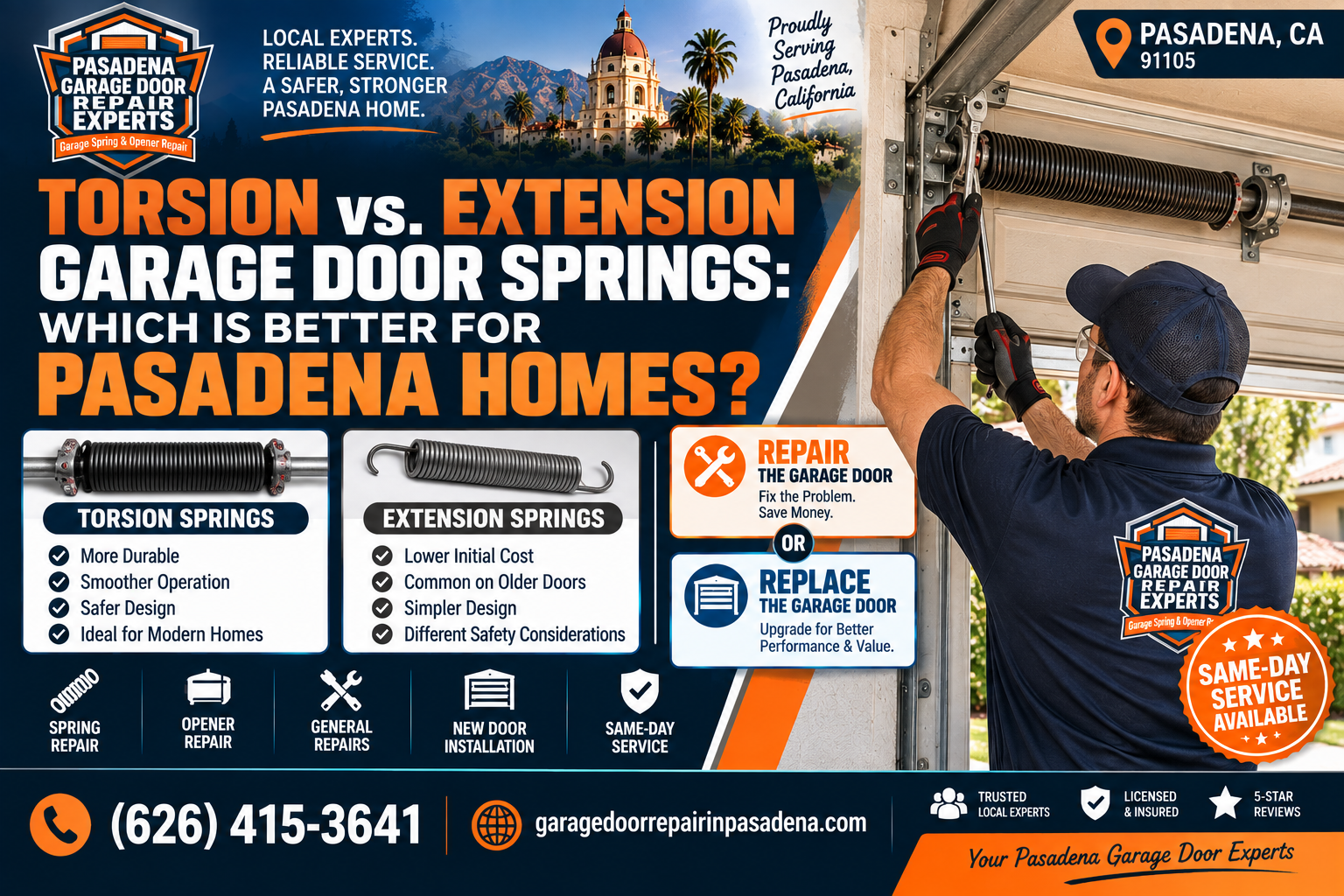
Torsion vs. Extension Garage Door Springs: Which Is Better for Pasadena Homes?
Torsion and extension springs perform the same essential job: they counterbalance the weight of a garage door so the door can open and close in a controlled way. They accomplish that job differently. Torsion springs twist around a shaft mounted above the door, while extension springs stretch along the horizontal track area as the door moves.
For many modern residential sectional garage doors in Pasadena, torsion springs are generally the stronger all-around choice when the garage configuration supports them. A properly designed torsion system can provide controlled lifting force across a shaft, works well with many wide or heavy residential doors, keeps the spring assembly primarily above the opening, and can be engineered for different door weights and cycle requirements.
That does not mean every extension-spring garage door needs to be converted. Extension systems can still be appropriate when the existing door was designed for them, the tracks and safety cables are correctly configured, the door is properly balanced, and the system remains in suitable condition. The better choice depends on the actual garage door, available headroom, hardware, door weight, existing spring system, repair scope and homeowner priorities.
Torsion vs. Extension Springs: Which Is Better for Pasadena Homes?
For many Pasadena residential sectional garage doors, a properly designed torsion-spring system is generally the preferred configuration when the garage has adequate space above the door and the system is compatible with the door. Torsion springs provide counterbalance through a shaft and cable-drum system, can work well with heavier and wider doors, keep the primary spring assembly above the opening, and allow the counterbalance system to be matched closely to the door's actual weight.
Extension springs can still be an appropriate system. They are normally mounted alongside the horizontal tracks and stretch as the garage door closes. When an extension-spring system is correctly sized, equipped with proper safety containment cables, maintained and operating a compatible door, there may be no reason to replace the system merely because torsion technology exists.
The most important factor is not the spring name alone. The garage door should have a counterbalance system that matches its weight and dimensions, keeps the door controlled through its travel, works with the track configuration, and can be serviced safely using the correct components.
What Do Garage Door Springs Actually Do?
To understand whether torsion or extension springs are better, it helps to understand why the garage door needs springs in the first place.
A residential garage door can be large and heavy. Depending on its size and construction, it may contain steel sections, insulation, an interior steel skin, windows, reinforcement struts, decorative overlays or other components that add significant weight.
The automatic garage door opener is not intended to directly carry all of that weight by itself.
The spring system provides counterbalancing force.
When the counterbalance system is correctly designed, much of the physical weight of the door is offset by spring force. This is what allows the door to move in a controlled way rather than behaving like an unsupported heavy wall panel.
The spring and opener have different jobs
The spring system counterbalances the door.
The opener moves the counterbalanced door.
This distinction matters because homeowners sometimes respond to a heavy door by assuming they need a stronger opener. If the door is heavy because a spring broke or the counterbalance is incorrect, increasing opener power does not solve the mechanical problem.
Springs work with other components
Neither torsion nor extension springs work completely alone.
Depending on the system, the counterbalance assembly can involve:
- Lift cables.
- Cable drums.
- Pulleys.
- A torsion shaft.
- Center and end bearing hardware.
- Spring attachment points.
- Safety containment cables.
- Track-related hardware.
That is why spring replacement should be approached as work on a counterbalance system rather than as a simple coil swap.
How Does a Torsion Garage Door Spring Work?
A torsion spring is normally positioned above the garage door opening on a steel shaft.
Instead of stretching longer and shorter, a torsion spring stores mechanical energy by twisting.
On many residential systems, lift cables attach near the lower corners of the garage door and travel upward to cable drums near the ends of the torsion shaft.
As the garage door closes, the system winds the spring and stores energy. As the door opens, spring torque helps rotate the shaft and drums so the lift cables assist in raising the door.
Main torsion-system components
Depending on the particular garage door, a torsion system may include:
- One or more torsion springs.
- A torsion shaft.
- Stationary spring hardware.
- Winding cones.
- Center support or bearing components.
- End bearing plates.
- Cable drums.
- Steel lift cables.
Why torsion systems are common
The torsion design creates a compact counterbalance assembly concentrated around the header above the garage-door opening.
It can be engineered for many different door weights and sizes and can use one, two or additional springs depending on the requirements of the door system.
Proper spring selection is essential. A torsion spring that looks similar to another spring is not necessarily equivalent. Wire diameter, inside diameter, spring length, winding direction and the required torque all matter.
DASMA's technical information on garage-door spring identification warns that visible color coding provides only part of the information needed to identify the appropriate spring.
Homeowners can review DASMA technical guidance on torsion and extension spring identification .

How Does an Extension Garage Door Spring Work?
Extension springs use a different method of storing mechanical energy.
Instead of twisting around a shaft above the garage-door opening, extension springs are commonly positioned near the horizontal tracks on both sides of the door.
The springs stretch as the garage door closes. As the door opens, the stretched springs contract and release stored energy to help lift the door.
Extension systems can use pulleys and cables
A residential extension-spring system often uses cables and pulleys to transfer spring force to the door.
The exact configuration varies, so homeowners should not assume every extension system has identical components.
Safety containment cables are especially important
An extension spring physically stretches as it operates. If the spring or attachment hardware fails, a properly installed safety containment cable is intended to help restrain the spring.
This is an important inspection point on older extension-spring garage doors.
A homeowner who sees an extension spring without an apparent safety cable should not attempt to add, remove or reconfigure the tensioned system personally.
Extension springs are not automatically obsolete
An existing extension system can still operate appropriately when its springs are correctly matched to the door, safety equipment is present, the pulleys and cables are serviceable, and the door remains properly balanced.
The fact that torsion springs are often preferred for modern residential installations does not mean every functioning extension-spring door requires immediate conversion.
Torsion vs. Extension Garage Door Springs: Side-by-Side Comparison
| Factor | Torsion Springs | Extension Springs | What Pasadena Homeowners Should Know |
|---|---|---|---|
| Location | Usually mounted on a shaft above the garage door | Usually mounted beside the horizontal tracks | Available garage space and track configuration matter |
| How energy is stored | Spring twists | Spring stretches | Both systems store significant mechanical energy |
| Lifting mechanism | Typically shaft, drums and lift cables | Typically springs, pulleys and cables | Related components should be inspected during spring service |
| Door weight capability | Can be configured for a broad range of residential door weights | Can work appropriately when correctly sized for the door | Spring selection must match the actual door |
| Balance control | Commonly offers controlled counterbalance through a shared shaft | Uses spring force independently along the sides | Either system must leave the door properly balanced |
| Breakage containment | Spring is generally retained around its torsion shaft | Safety containment cables are important to restrain a broken spring | Both systems still require professional safety precautions |
| Hardware location | Much of the spring assembly is above the opening | Spring and pulley hardware extends alongside the horizontal tracks | Garage-storage layout can influence preference |
| Maintenance | Shaft, springs, drums, cables and bearings need inspection | Springs, safety cables, pulleys, cables and attachment points need inspection | Neither system is maintenance-free |
| Conversion | Can sometimes replace an existing extension system when compatible | May remain in service if properly designed and maintained | Conversion should be based on door and garage configuration |
| General recommendation | Often Preferred for Modern Residential Doors | Still Appropriate in Some Existing Systems | Choose based on the complete counterbalance system |
1 Which Spring System Provides Better Door Balance?
Proper balance is more important than simply choosing a spring category. Either torsion or extension springs can counterbalance a garage door when the system is correctly designed.
Torsion systems have an important mechanical characteristic: spring torque is transmitted through a common shaft, while cable drums at the ends of the shaft control the lift cables.
This creates an organized counterbalance arrangement across the width of the door.
For that reason, torsion systems are commonly favored when precise, controlled counterbalance is desired.
What proper balance should accomplish
A properly counterbalanced door should not rely on the opener to overcome excessive weight.
It also should not be so aggressively over-sprung that it wants to rise uncontrollably.
Good balance means the spring force and door weight work together so the door travels in a controlled manner.
Extension systems still need correct balance
An extension-spring door can also operate smoothly when the springs are correctly matched and the pulleys, cables, rollers and tracks are in good condition.
Problems can develop when the springs no longer provide equal force or when one side of the system has a pulley, cable or attachment problem.
A door that starts lifting unevenly should be inspected instead of being forced with the automatic opener.
2 Which Spring Type Is Better for Heavy Garage Doors?
Torsion systems are commonly a strong choice for heavier residential sectional doors because the spring system can be engineered around the door's actual lifting requirements and distribute counterbalance through a shaft and cable drums.
This becomes especially relevant with:
- Wide two-car garage doors.
- Multi-layer insulated steel doors.
- Doors with interior steel backing.
- Doors with substantial glass.
- Wood garage doors.
- Composite-overlay doors.
- Doors with additional reinforcement.
The important principle is not that torsion springs have one universal lifting capacity. Torsion springs themselves come in different specifications.
A spring appropriate for one garage door can be incorrect for another.
Extension springs also have weight requirements
Extension springs are likewise selected according to the door they counterbalance.
Homeowners should not simply install a spring because its physical length or paint marking appears similar to the old spring.
Door weight, height, spring characteristics and the complete system must be considered.
3 Torsion vs. Extension Spring Safety
Both torsion and extension garage-door springs store significant mechanical energy. Neither system should be treated as harmless simply because the door is closed.
Torsion spring containment
A torsion spring normally surrounds a steel shaft.
If the coil fractures, the broken spring generally remains around that shaft rather than becoming a completely free spring.
This containment characteristic is one reason torsion systems are often viewed favorably from a system-design standpoint.
It does not make torsion spring repair safe for an untrained homeowner.
A torsion spring must be wound to create the torque needed to counterbalance the garage door. Winding cones, the torsion shaft, cable drums and related hardware can all be involved in the stored-energy system.
Extension springs require containment cables
Extension springs stretch beside the horizontal tracks.
A safety containment cable running through the spring helps restrain the spring if it breaks or becomes disconnected.
Older extension-spring installations deserve inspection to make sure their safety components are present and configured appropriately.
Neither system is a DIY tension-adjustment project
Homeowners should not:
- Wind torsion springs.
- Unwind torsion springs.
- Loosen winding cones.
- Move spring anchor brackets.
- Reconnect tensioned extension springs.
- Modify spring attachment points.
- Loosen cable drums.
- Reconnect lift cables under tension.
Industry safety guidance from DASMA's garage door system safety resources emphasizes professional attention for springs and associated high-tension components.
4 How Do Cables Differ Between Torsion and Extension Systems?
Both systems can use steel cables, but the way the cables interact with the springs differs.
Torsion system cables
On a common residential torsion system, lift cables attach near the lower corners of the garage door.
The cables travel upward and wind around drums mounted near the ends of the torsion shaft.
As spring torque rotates the shaft and drums, the cables help lift the door evenly from both sides.
Extension system cables
Extension systems commonly use lift cables and pulley arrangements rather than cable drums on a torsion shaft.
The stretched springs provide force through that cable-and-pulley system.
Safety cables are different from lift cables
On extension systems, the containment cable passing through the spring is not simply another lift cable.
Its purpose is to help control the spring if the spring or attachment hardware fails.
Cable condition matters with either system
Frayed, corroded, kinked or displaced cables can create alignment and lifting problems.
A spring replacement should therefore include evaluation of the components that actually transfer spring force to the door.
5 Which Spring System Uses Garage Space Better?
The answer depends on the garage configuration.
Torsion springs are normally concentrated above the garage-door opening. Extension springs typically occupy space along the horizontal tracks on both sides.
Torsion systems can free side-track space
Because the primary spring assembly is on the header, there are no long extension springs stretching alongside both horizontal tracks.
That can make the overhead system appear more organized and may reduce conflicts with storage or equipment positioned near the tracks.
Torsion systems need appropriate headroom
A standard torsion assembly needs adequate space above the garage opening for the shaft, springs, drums and related hardware.
Older or unusually configured garages may have limited headroom.
Special track or spring arrangements may be possible in some situations, but compatibility should be evaluated rather than assumed.
Existing extension layouts can remain practical
If a garage was built around an extension-spring system and the door operates correctly, the presence of extension springs alone does not mean valuable garage space is being wasted.
The choice should reflect the actual garage rather than a preference based solely on appearance.
6 Do Torsion Springs Last Longer Than Extension Springs?
The spring category alone does not provide a reliable calendar-life prediction.
Garage-door springs are commonly discussed in terms of operating cycles. A complete opening and closing sequence contributes to spring fatigue over time.
Springs can be designed for different cycle expectations.
Torsion systems can be engineered for different cycle ratings
A torsion-spring system can often be configured with different spring dimensions that provide the required torque while changing expected cycle performance.
This can give homeowners options when spring longevity is an important priority.
Extension springs also experience cycle fatigue
Extension springs stretch and contract during every garage-door cycle.
Their service life depends on spring design, door use and system condition.
Household use can matter more than calendar age
A Pasadena household that uses the garage door eight or more times during commuting, errands, school runs and other daily activity will accumulate cycles faster than a detached garage opened only occasionally.
That does not mean a specific household will reach a particular spring lifespan at a predictable date.
The useful lesson is that operating frequency matters.
Homeowners comparing torsion and extension springs should ask about the specifications of the actual replacement spring rather than accepting a claim that one spring type always lasts a certain number of years.
7 Which Spring System Is Easier to Maintain?
Neither spring system is maintenance-free, and homeowner maintenance should remain within safe limits.
Torsion system inspection
Relevant visible components can include:
- The torsion spring or springs.
- The torsion shaft.
- Center support or bearing components.
- End bearing plates.
- Cable drums.
- Lift cables.
Homeowners can visually note rust, frayed cables or obviously damaged hardware, but spring tension adjustments should be left to trained service personnel.
Extension system inspection
Relevant components include:
- The extension springs.
- Safety containment cables.
- Lift cables.
- Pulleys.
- Spring attachment points.
- Track-area hardware.
Pulleys and cable arrangements add moving components that should remain in suitable condition.
Genie provides homeowner maintenance information covering springs, torsion-shaft components, cables, drums and other garage-door hardware in its garage door maintenance guidance .
Maintenance cannot eliminate spring fatigue
Proper inspection can identify developing problems, but no maintenance routine makes a spring permanent.
Springs repeatedly store and release mechanical energy and will eventually experience wear.
8 Are Torsion Springs Quieter Than Extension Springs?
A properly operating torsion system can provide controlled motion, but garage-door noise cannot be attributed to spring type alone.
The complete door contains many moving components.
Noise can come from:
- Rollers.
- Hinges.
- Tracks.
- Bearings.
- Cables.
- Pulleys.
- Springs.
- Loose hardware.
- The automatic opener.
Extension systems have additional pulley movement
Depending on the design, extension-spring systems can contain pulleys and cables moving along both sides of the door.
Worn pulley bearings or hardware can contribute to noise.
Torsion systems have their own moving parts
Torsion shafts, bearings, drums and springs can also produce noise when components are worn or poorly maintained.
Homeowners seeking a quieter garage door should identify the actual source rather than converting spring systems solely because someone said one type is always silent.
9 What Happens When Torsion or Extension Springs Break?
Both types of springs can fail after repeated cycles, damage, corrosion or other deterioration.
Broken torsion spring
A torsion spring can fracture and unwind enough to create a visible gap in the coil.
The garage door can suddenly become much heavier because the spring is no longer contributing its intended counterbalancing force.
On a two-spring torsion system, the unbroken spring may still contain tension, but the complete counterbalance system is no longer functioning as designed.
Broken extension spring
An extension spring may physically separate or become disconnected from its attachment system.
A properly installed safety containment cable helps keep the broken spring restrained.
Without appropriate containment, a spring failure can create additional movement of the spring or attached components.
Do not continue operating either door repeatedly
When a spring fails, the garage door's effective operating weight changes.
Repeatedly pressing the opener button can place additional strain on the opener or allow the door to move abnormally.
If the door becomes crooked, a cable, roller or track problem may also have developed.
10 Replacement Parts and Spring Identification
One of the biggest mistakes in garage-door spring work is assuming springs are generic.
A replacement must match the mechanical requirements of the door.
Torsion spring specifications
Relevant characteristics can include:
- Wire diameter.
- Inside diameter.
- Spring length.
- Winding direction.
- Required torque.
- Door height.
- Drum configuration.
- Cycle design.
Extension spring specifications
Extension springs must likewise match the door's weight and travel requirements.
Their related pulley, cable and safety-containment configuration also matters.
Color coding is not enough by itself
Spring manufacturers and industry organizations use color markings for identification, but a paint mark should not be treated as the complete replacement specification.
DASMA's technical guidance specifically explains that color coding provides only partial spring-identification information.
This is one reason online shopping based only on a color or approximate length can produce the wrong spring.
11 Does Torsion or Extension Spring Replacement Cost More?
There is no responsible fixed price comparison that applies to every Pasadena garage door.
Repair cost depends on the specific system and the amount of work required.
Factors can include:
- Spring type.
- Number of springs.
- Door weight.
- Spring specifications.
- Cycle option.
- Condition of cables.
- Condition of drums or pulleys.
- Bearing condition.
- Door alignment.
- Parts availability.
- Accessibility.
- Whether a conversion is being performed.
- Additional damaged components.
A basic extension-spring replacement and a torsion conversion are not equivalent jobs
Replacing a failed extension spring within an otherwise serviceable extension system is different from converting the complete counterbalance system to torsion.
Conversion can require a torsion shaft, spring or springs, drums, bearing hardware, cables and other components appropriate to the door.
Compare complete scopes
If one quote is for replacing existing extension springs and another quote is for converting the system to torsion, the totals should not be compared as though both proposals contain identical work.
Ask what system will remain after the work is finished.
12 Is Converting Extension Springs to Torsion Worth It?
It can be worthwhile when the garage door and available space are suitable, particularly if the existing extension-spring system already needs substantial repair.
Conversion should still be treated as a system-design decision rather than an automatic upgrade.
Reasons a homeowner may consider conversion
A torsion conversion may deserve discussion when:
- The extension springs already need replacement.
- Pulleys and cables are significantly worn.
- The homeowner wants a torsion-style counterbalance system.
- The garage has adequate header space.
- The door is compatible with an appropriate torsion configuration.
- A heavier replacement door requires a different spring system.
- The homeowner is already performing substantial door-system work.
Conversion involves more than moving the springs
A torsion system may require:
- A torsion shaft.
- Correctly engineered torsion spring or springs.
- Cable drums.
- Appropriate lift cables.
- Center support components.
- End bearing plates or related hardware.
- Suitable structural attachment locations.
The door then needs to be balanced for the new system.
When conversion may not be necessary
If the existing extension-spring system is properly configured, contains appropriate safety cables, operates smoothly and only needs an ordinary compatible replacement component, remaining with extension springs can be reasonable.
Spending more for conversion merely to change the spring label may provide little practical value if the current system is otherwise suitable for the homeowner's needs.
One Torsion Spring vs. Two Torsion Springs
Choosing torsion springs creates another common homeowner question: should a garage door have one torsion spring or two?
There is no universal answer based solely on door width.
The system should be designed for the actual garage door.
One-spring torsion systems
Some residential garage doors are correctly designed to use one torsion spring.
If that spring breaks, the door loses the counterbalancing force supplied by that spring.
Two-spring torsion systems
Many wider or heavier residential doors use two torsion springs.
The total lifting requirement is shared across the spring configuration.
When one spring breaks, the remaining spring does not magically become responsible for safely operating the entire door.
Does two automatically mean better?
No.
The correct question is whether the spring configuration is properly engineered for the garage door.
Adding a second spring solely because “two is better” without considering the required torque can create incorrect balance.
Replacement decisions should be clearly explained
If one spring breaks in a two-spring system, homeowners should understand whether the quote covers one spring or both and why that recommendation is being made.
How Does Spring Type Affect the Garage Door Opener?
The automatic opener should work with either a properly balanced torsion system or a properly balanced extension system.
The opener's job is not to compensate for whichever spring system is weaker.
If either spring system fails, the door may become substantially heavier. The opener can then appear slow, weak or completely unable to raise the door.
Do not replace the opener before checking the springs
If the opener suddenly stops lifting the garage door at the same time a spring breaks, the counterbalance failure should be addressed before assuming the opener itself has failed.
Once the spring system is restored and the garage door is correctly balanced, the opener can be tested under normal operating conditions.
If you are trying to determine whether an opener problem is worth fixing after the mechanical garage door has been evaluated, our guide to garage door opener repair versus replacement explains when remotes, sensors, drive components and electronics may be repairable and when a new opener may deserve consideration.
This distinction is important because replacing the opener does not fix an incorrectly sized, broken or improperly functioning spring system.
Are Torsion Springs Better for Older Pasadena Homes?
The age of a Pasadena home does not by itself determine which spring system should be installed.
Older residential properties may have:
- Detached garages.
- Lower garage ceilings.
- Nonstandard opening dimensions.
- Older track layouts.
- Garage doors installed long after the house was built.
- Openers newer than the garage door.
- Spring systems that have already been modified in the past.
The existing garage should therefore be inspected as it is today.
Headroom matters
A torsion shaft normally occupies the header area above the door.
Some older garages may have limited space because of ceiling height, framing or other building components.
That does not automatically rule out torsion, but the available geometry has to be considered.
Do not assume an older extension system must be converted
If the door is correctly balanced, safety cables are present and the extension system remains compatible and serviceable, ordinary repair may be a reasonable solution.
Conversion becomes a stronger discussion when the old spring system has multiple worn components or the homeowner is already making a major change to the garage door.
Which Spring Type Is Better for an Insulated Garage Door?
Insulation affects this question primarily because it can change garage-door weight.
An insulated door may contain additional foam and an interior steel layer, producing a heavier section construction than a basic single-layer door.
Windows, overlays and reinforcement can add more weight.
Torsion systems are commonly well suited to heavier residential doors because the system can be engineered around the door's total counterbalance requirements.
But do not choose by insulation label alone
Not every insulated garage door weighs the same.
A narrow insulated door may weigh less than a large non-insulated specialty door.
The actual completed door matters.
Changing door weight may require changing springs
If a Pasadena homeowner replaces a lightweight old door with a heavier insulated model, the existing spring specification should not automatically be reused.
The counterbalance system should be selected for the new door.
Torsion vs. Extension Springs for a Two-Car Garage Door
A wide two-car sectional garage door is one situation where torsion systems are especially common.
Wider doors can be heavier and may require substantial counterbalance.
A torsion shaft spanning the opening can use appropriately selected springs and drums to manage the lift cables on both sides.
This does not mean every two-car garage door must use torsion springs.
Existing extension-spring systems can be found on residential doors and may continue to function when correctly designed.
However, when a wide door already needs significant spring-system work, homeowners may reasonably ask whether conversion to torsion provides a better long-term configuration for their particular door.
Torsion vs. Extension Springs for a Single-Car Garage Door
A smaller single-car door can operate with either spring design when the system is properly matched.
Torsion is not reserved exclusively for large doors.
Likewise, extension springs are not automatically the “correct” choice just because a door is narrow.
The decision can depend on:
- Available headroom.
- Existing track configuration.
- Door weight.
- Current hardware condition.
- Whether the system is being repaired or fully replaced.
- Homeowner preference for torsion or extension architecture.
A properly functioning extension system on a light single door may provide little reason for immediate conversion.
If major counterbalance work is already necessary, that is a logical time to compare the options.
What Role Do Garage Door Cables Play in Spring Performance?
Springs generate force, but the door still needs a mechanical path through which that force helps lift the sections.
Steel cables provide an important part of that path.
Torsion lift cables
With a common torsion setup, cable drums rotate with the torsion shaft.
Cables wind onto or off the drums as the door moves.
Correct cable position on both drums helps the door remain level.
Extension-system cables
Extension systems can use cables routed through pulleys to transfer spring force.
Pulley condition and cable routing therefore become especially relevant to extension-system operation.
A cable problem can look like a spring problem
If one cable breaks or becomes displaced, the garage door can become crooked even when the spring itself has not fractured.
That is why a diagnosis should inspect the system rather than replacing springs solely based on a symptom such as uneven movement.
What Role Do Garage Door Tracks and Rollers Play?
Neither torsion nor extension springs can make a garage door operate correctly if the door is mechanically binding in the tracks.
Rollers guide the sectional door through the vertical, curved and horizontal track system.
If a roller is seized, a track is badly bent or the door has become misaligned, additional resistance can change how the garage door feels.
Do not solve track resistance by adding spring force
A door that is difficult to move because of a bent track does not necessarily need a stronger spring.
Over-springing a door to overcome mechanical resistance is not a substitute for correcting the track problem.
Diagnose the entire movement path
If a door behaves poorly after spring replacement, inspect:
- Spring specification.
- Door balance.
- Cable position.
- Drums or pulleys.
- Roller movement.
- Track alignment.
- Hinges.
- Door-section condition.
Signs Your Torsion or Extension Spring System May Need Service
Several symptoms can indicate a counterbalance problem.
Some point directly toward spring failure, while others overlap with cable, track, roller or opener problems.
The garage door suddenly feels much heavier
A dramatic increase in door weight is one of the strongest clues that the counterbalance system is no longer doing its job.
There is a visible gap in a torsion spring
A separation in a torsion coil can indicate that the spring has broken.
An extension spring is visibly separated
A fractured or disconnected extension spring is another clear failure condition.
The door becomes crooked
Uneven movement can involve springs, cables, pulleys, drums, rollers or other components.
The opener lifts the door only a short distance
This can occur after a spring failure because the opener is suddenly trying to move a much heavier effective load.
A lift cable is loose or hanging
Cable displacement can accompany a larger counterbalance problem.
The door moves differently than before
Jerking, binding, unusually fast movement or a new tendency to rise or fall can indicate balance or mechanical issues.
You heard a loud bang from the garage
Spring fracture can produce a sudden loud sound as stored mechanical energy is released.
A loud sound does not identify the exact spring type or complete repair scope, so visible inspection from a safe distance is useful.
Safe Checks Pasadena Homeowners Can Make
Homeowners do not need to touch spring hardware to gather useful information.
Identify the spring location
Springs mounted on a shaft above the door usually indicate a torsion system.
Long springs positioned beside the horizontal tracks usually indicate an extension system.
Look for a visible break
Observe the spring from a safe distance.
Do not reach toward the spring or its mounting components.
For an extension system, look for safety cables
Note whether a containment cable appears to run through the spring.
If it is absent or damaged, do not try to install one while the spring remains under tension.
Observe the garage door position
Is it closed, partially open or visibly crooked?
Look at lift cables
From a safe distance, note whether the cables appear taut, loose, frayed or displaced.
Listen for new sounds
New scraping, popping, grinding or pulley noises can help explain the condition when requesting service.
Photograph visible components
A clear photograph of the spring system can help communicate whether the garage door appears to use torsion or extension springs.
A photograph should not be treated as a substitute for an in-person mechanical evaluation when the door is unstable or the exact spring specification is unknown.
Spring Repairs Pasadena Homeowners Should Not Attempt
Garage-door spring systems store substantial mechanical energy.
The danger comes not only from the spring itself, but also from the heavy garage door, cables, spring attachment points, drums and other components connected to that energy.
Do not:- Wind a torsion spring.
- Unwind a torsion spring.
- Loosen torsion-spring winding cones.
- Remove spring anchor brackets.
- Loosen torsion cable drums.
- Reconnect lift cables under tension.
- Detach extension springs under load.
- Modify extension-spring attachment points.
- Remove pulleys while the system is tensioned.
- Force a crooked garage door.
- Operate a badly off-track door.
- Stand beneath an unstable partially open door.
- Increase opener force to compensate for failed counterbalance.
A professional spring repair should identify the appropriate spring configuration, secure the door, work with the counterbalance system safely and verify operation after the repair.
Is a Torsion Spring Automatically Safer Than an Extension Spring?
It is better to describe the difference precisely.
A torsion spring is normally physically contained around its shaft, while an extension spring stretches separately along the track area and therefore relies on an appropriate safety containment cable to help restrain it if it breaks.
That gives a properly installed torsion system a useful containment characteristic.
However, a torsion spring contains significant stored energy while wound.
Improper adjustment of winding cones, springs, drums or associated hardware can be hazardous.
The correct conclusion is therefore not:
“Torsion springs are safe to work on.”
The better conclusion is:
Torsion and extension systems have different containment characteristics, and both require appropriate installation, maintenance and professional handling of high-tension components.
Is an Extension Spring System Bad?
No. An extension-spring system should not be labeled defective merely because of its design.
Many residential garage doors have operated with extension springs for long periods.
The important questions are:
- Are the springs correctly sized?
- Are the safety cables present?
- Are the pulleys serviceable?
- Are the lift cables in good condition?
- Is the door properly balanced?
- Are the tracks and rollers operating normally?
- Does the configuration remain appropriate for the current door?
If those conditions are satisfied, the homeowner may choose to continue using the extension system.
If several components need replacement at once, comparing the cost and advantages of a torsion conversion may become more useful.
Can You Convert Every Extension-Spring Door to Torsion?
Not automatically.
The garage-door configuration, available header space, structural attachment area, tracks, door dimensions and door weight all need to be considered.
A torsion conversion should use components designed for the actual residential door.
A technician may need to determine:
- Whether adequate headroom exists.
- Whether the door is suitable for torsion counterbalance.
- What spring torque is required.
- Which drums are appropriate.
- Which cables are appropriate.
- Where the center and end supports will attach.
- Whether existing door hardware remains suitable.
Conversion should therefore be evaluated as a complete system change, not a universal retrofit performed the same way on every garage.
Do Torsion Springs Require Different Garage Door Tracks?
Spring type and track design are related parts of the complete garage-door system, but changing to torsion does not mean every garage uses one universal track arrangement.
Track configuration can depend on:
- Door height.
- Available headroom.
- Track radius.
- Ceiling height.
- Door weight.
- Garage layout.
- Spring and drum configuration.
Existing track condition also matters.
A conversion should not leave a badly bent or incompatible track in place simply because the homeowner's primary request concerned springs.
Likewise, track replacement should not be added automatically if the existing track remains correct and serviceable for the intended system.
Which Spring System Is Better if the Garage Door Is Used Frequently?
Frequent use makes spring specification and cycle design especially relevant.
A household that enters through the garage multiple times each day can accumulate door cycles quickly.
Torsion systems can often be engineered with different spring options that meet the required door torque while providing different expected cycle characteristics.
This can make torsion particularly attractive when a homeowner wants to discuss a counterbalance system designed for frequent use.
The homeowner should still ask about the actual spring specification.
The word “torsion” by itself does not guarantee a particular cycle life.
Similarly, an extension spring should not be judged solely by spring type. Correct sizing, manufacturing specifications and actual use all matter.
Which Spring System Is Better for a Garage Below a Bedroom?
Torsion can be an attractive choice, but spring type is only one part of noise control.
Homeowners with bedrooms or living areas above an attached garage often care about smoother and quieter operation.
A properly balanced torsion system can contribute to controlled door movement.
However, the rest of the garage door also deserves attention.
Noise can come from:
- Steel rollers.
- Worn roller bearings.
- Hinges.
- Loose hardware.
- Tracks.
- Door-panel vibration.
- The automatic opener.
Replacing extension springs with torsion will not necessarily eliminate a loud chain-drive opener or worn rollers.
If quieter operation is the goal, evaluate the complete system.
Which Spring System Is Better for a Detached Garage?
A detached garage does not automatically favor either system.
The choice still depends on the physical garage door and available space.
A lightly used detached garage with a correctly functioning extension system may not need conversion.
A detached garage with a heavy insulated or custom door may still benefit from an appropriately designed torsion system.
The key variables remain:
- Door weight.
- Door dimensions.
- Headroom.
- Track configuration.
- Use frequency.
- Current spring-system condition.
Pasadena Conditions to Consider When Choosing Torsion or Extension Springs
The mechanical principles behind garage-door springs do not change between neighborhoods, but Pasadena homes vary enough that local property characteristics can influence the best spring-system decision.
Older Pasadena garages
Pasadena includes many older residential properties where the garage may have been built decades before the current garage door or automatic opener was installed.
Existing headroom, framing and track layout should be inspected rather than assuming the original home design determines the current door system.
Attached garages
Attached garages may receive frequent daily use because residents use them as a primary entrance.
Frequent operation makes correct spring specification and reliable door balance particularly important.
Detached garages
Some Pasadena properties have detached garage structures.
These may have different ceiling heights, framing arrangements and daily use patterns from attached garages.
Updated and remodeled homes
A home may have a newer insulated garage door installed in an older garage.
Spring selection should follow the current door weight rather than the age of the structure.
Frequent commuting
Households that open the garage for work commutes, school trips, errands and multiple vehicles can accumulate many spring cycles.
Homeowners with frequent use may wish to ask about appropriate spring-cycle options during replacement.
Warm temperatures and garage heat
Pasadena's warm climate can make insulation, weather seals and garage comfort important homeowner concerns.
However, spring type itself should still be chosen based primarily on the mechanical requirements of the door rather than assuming warm weather automatically demands torsion or extension springs.
Dust
Dust can accumulate around garage-door tracks, rollers and other hardware.
Keeping the garage-door area reasonably clean can make developing wear easier to observe, although cleaning does not replace professional spring inspection.
Pasadena geographic context
The primary geographic focus of this guide is Pasadena, California 91105, within Los Angeles County and the San Gabriel Valley.
Local residential context may naturally include Old Pasadena, Bungalow Heaven, Hastings Ranch, Madison Heights and San Rafael Hills.
These neighborhood references describe Pasadena residential contexts only and do not imply separate Pasadena Garage Door Repair Experts offices or storefronts in those neighborhoods.
How Should Pasadena Homeowners Choose Between Torsion and Extension Springs?
Instead of asking which spring is universally “best,” compare the spring systems against the actual garage door.
Torsion is often the stronger choice when:
- The garage has suitable header space.
- The homeowner is installing a new residential sectional door.
- The door is wide or relatively heavy.
- A controlled shaft-and-drum counterbalance system is desired.
- The existing extension system already needs substantial work.
- The homeowner wants to discuss different spring-cycle options.
- A complete spring-system conversion makes sense within the project.
Keeping extension springs may make sense when:
- The door was designed for the existing extension system.
- The springs are correctly sized.
- Safety containment cables are properly installed.
- Pulleys and lift cables remain suitable.
- The door is correctly balanced.
- The system operates smoothly.
- Only a straightforward compatible repair is needed.
- There is no compelling reason to rebuild the complete counterbalance system.
The finished result matters more than the label
A poorly specified torsion system is not better than a properly engineered extension system merely because torsion is considered more modern.
Likewise, an extension system should not be retained merely because replacing it appears simpler if its safety components and related hardware are no longer suitable.
The goal is correct counterbalance, controlled door travel, appropriate safety components and compatibility with the actual garage door.
What Should Be Checked When a Spring System Is Replaced?
Spring replacement is a logical time to inspect components directly related to the counterbalance system.
For torsion systems
Relevant components can include:
- The spring or springs.
- Torsion shaft.
- Center support.
- Bearings.
- End bearing plates.
- Cable drums.
- Lift cables.
- Spring anchor hardware.
For extension systems
Relevant components can include:
- Both extension springs where applicable.
- Safety containment cables.
- Lift cables.
- Pulleys.
- Spring mounting hardware.
- Track-area attachment points.
For either system
Also observe:
- Door balance.
- Track alignment.
- Roller movement.
- Hinge condition.
- Door-section condition.
- Opener operation after mechanical balance is restored.
Inspection does not mean every component should automatically be replaced.
Additional work should correspond to an actual worn, damaged, incompatible or unsafe condition.
Why Correct Spring Sizing Matters More Than Choosing Torsion or Extension
The best spring category cannot compensate for incorrect spring sizing.
Springs need to produce the correct counterbalancing force for the garage door.
An under-sprung door
If the spring system does not provide enough counterbalance, the door can remain unusually heavy.
The opener may struggle and manual movement can become difficult.
An over-sprung door
Excessive spring force can cause the door to resist closing or rise too aggressively.
That is also incorrect balance.
Door weight can change
A homeowner may add a different garage door, insulation, windows or reinforcement that changes total weight.
The spring system should be evaluated according to the current door configuration.
Correct sizing is one reason professional spring replacement requires more information than simply knowing whether the spring is torsion or extension.
Should You Convert to Torsion When Installing a New Garage Door?
A new garage-door installation is one of the most logical times to evaluate the spring system because the new door may have different dimensions, construction and weight from the old door.
The counterbalance system should match the completed replacement door.
If the selected door is designed around a torsion configuration, retaining an old extension setup merely because it already exists may not be appropriate.
Conversely, homeowners should not assume every new door requires the same torsion setup.
Door manufacturer requirements, track configuration and installation design matter.
A properly installed new door should function as a matched system:
- Sections.
- Hinges.
- Rollers.
- Tracks.
- Springs.
- Cables.
- Related hardware.
What About Spring Conversion Cost?
The price of converting an extension-spring garage door to torsion depends on the actual door and what new components are required.
A conversion may involve more than replacing springs because the system architecture changes.
Relevant cost factors can include:
- Door dimensions.
- Door weight.
- Required torsion springs.
- Torsion shaft.
- Cable drums.
- Lift cables.
- Center bearing or support.
- End bearing hardware.
- Available headroom.
- Existing track condition.
- Installation complexity.
- Whether other damaged components are present.
Because these variables differ, this article does not publish a fabricated one-price-fits-all conversion figure.
Homeowners should compare the scope of keeping the existing extension system with the scope of rebuilding the counterbalance system as torsion.
Can You Tell Spring Type From Inside the Garage?
Usually, yes.
With the garage door closed and without touching the hardware, look at where the springs are positioned.
Torsion system
A torsion system usually has one or more coiled springs mounted horizontally above the top of the garage door on a steel shaft.
Extension system
An extension system usually has long springs running roughly parallel to the horizontal tracks on the left and right sides of the garage.
Pulley and cable components may be visible near the springs.
Some systems are different
Not every garage door uses the most common residential configuration.
Specialty counterbalance systems and manufacturer-specific designs exist.
If the spring arrangement does not look like either common configuration, do not dismantle it simply to identify the components.
Questions to Ask Before Choosing Torsion or Extension Spring Replacement
Homeowners do not need to become garage-door engineers, but a few questions can make the recommendation easier to understand.
- Does my garage door currently use torsion or extension springs?
- What failed in the existing spring system?
- Is the existing spring configuration appropriate for my door?
- What is the approximate weight or counterbalance requirement of my door?
- How many springs does the system use?
- Are the lift cables in suitable condition?
- If I have torsion springs, are the drums and bearings in suitable condition?
- If I have extension springs, are safety containment cables present?
- If I have extension springs, are the pulleys and lift cables serviceable?
- Is my door properly balanced?
- Would converting to torsion require a new shaft and hardware?
- Does my garage have enough headroom for the proposed torsion configuration?
- Would conversion provide a practical benefit for my particular door?
- What spring specification is being recommended?
- What cycle design is being quoted?
- If I have two torsion springs, does the recommendation involve one or both?
- Are any additional damaged parts included in the proposal?
- Will the completed garage door be checked for proper balance?
- Will opener operation be checked only after the mechanical door is balanced?
- What exactly will be different if I convert from extension to torsion?
Spring-System Recommendation Red Flags
Recommendations should be tied to the physical garage door and its counterbalance requirements.
Potential red flags include:
- Claiming every extension-spring door must be converted.
- Claiming every torsion system is automatically safe.
- Choosing a replacement spring by paint color alone.
- Ignoring door weight.
- Ignoring spring count.
- Ignoring damaged lift cables.
- Ignoring missing extension-spring safety cables.
- Ignoring worn extension-system pulleys.
- Ignoring torsion drums or bearing problems.
- Installing a stronger opener instead of correcting poor counterbalance.
- Increasing opener force to overcome an improperly balanced door.
- Adding spring force to compensate for a bent track.
- Quoting a torsion conversion without checking available headroom.
- Quoting one universal spring price for every Pasadena garage door.
- Giving homeowners DIY torsion-winding instructions.
The better recommendation explains why a particular spring system fits the door and what the complete finished configuration will include.
Why Consider Pasadena Garage Door Repair Experts for Spring Service?
Pasadena Garage Door Repair Experts is a local garage door repair company serving homeowners and residential property customers throughout Pasadena, California.
When a garage door has spring trouble, the useful question is not simply whether the visible coil should be replaced.
A spring-system evaluation can consider:
- Whether the door uses torsion or extension springs.
- Garage-door size and weight.
- Spring configuration.
- Spring condition.
- Lift cables.
- Cable drums where applicable.
- Pulleys where applicable.
- Extension-spring safety cables.
- Torsion-shaft and bearing condition.
- Track and roller movement.
- Door balance.
- Opener operation after the door is properly counterbalanced.
- Whether torsion conversion is practical for an existing extension system.
That complete-system approach helps distinguish a straightforward spring replacement from a situation where related components or a different counterbalance configuration should be considered.
Pasadena homeowners can visit Pasadena Garage Door Repair Experts or call (626) 415-3641 to describe their spring system and ask about current garage-door spring service availability in Pasadena.
Garage Door Spring Service Area in Pasadena
The primary geographic focus is Pasadena, California 91105, within Los Angeles County and the San Gabriel Valley.
Pasadena residential context may naturally include Old Pasadena, Bungalow Heaven, Hastings Ranch, Madison Heights and San Rafael Hills.
These neighborhood references provide geographic context only and do not imply separate physical Pasadena Garage Door Repair Experts locations in those neighborhoods.
Homeowners can call (626) 415-3641 to ask about current torsion-spring, extension-spring or garage-door counterbalance service availability.
Frequently Asked Questions About Torsion vs. Extension Garage Door Springs
Are torsion springs better than extension springs?
For many modern residential sectional garage doors, torsion springs are generally the stronger all-around option when the garage configuration supports them. They operate through a shaft-and-drum counterbalance system, can be engineered for a wide range of door weights and keep the spring assembly concentrated above the opening. Extension springs can still be appropriate when correctly sized, equipped with proper safety containment cables and operating a compatible door.
What is the main difference between torsion and extension springs?
Torsion springs store energy by twisting around a shaft mounted above the garage door, while extension springs store energy by stretching alongside the horizontal tracks. Torsion systems commonly use cable drums and lift cables. Extension systems commonly use pulleys, lift cables and safety containment cables.
Are torsion springs safer than extension springs?
Torsion springs have a useful containment characteristic because the spring normally surrounds a steel shaft. Extension springs should have safety containment cables running through them to help restrain a broken spring. However, both systems store substantial mechanical energy, and neither should be adjusted or replaced casually by homeowners.
Can I replace extension springs with torsion springs?
Sometimes. An extension-to-torsion conversion can be practical when the garage door and available header space support the new configuration. The conversion can require a torsion shaft, appropriate spring or springs, cable drums, lift cables, bearings or support hardware and correct counterbalance setup. The garage should be evaluated before assuming conversion is possible or worthwhile.
Do torsion springs last longer than extension springs?
Spring type alone does not determine service life. Garage-door springs experience repeated operating cycles, and different springs can be designed for different cycle expectations. Door use, spring specification, system condition and operating environment all matter. Homeowners should compare the specifications of the actual replacement springs rather than relying on a universal lifespan claim.
Are torsion springs better for heavy garage doors?
Torsion systems are commonly well suited to wide and heavy residential garage doors because the counterbalance can be engineered around the actual door weight and transferred through a shaft, drums and lift cables. The correct spring specification is still essential; simply choosing “torsion” does not guarantee that the spring is properly sized.
Do extension garage door springs need safety cables?
Safety containment cables are an important part of an extension-spring system because they help restrain the spring if it breaks or becomes disconnected. A homeowner who sees an older extension system without proper containment should have the system evaluated rather than trying to modify the tensioned springs personally.
Does changing from extension springs to torsion springs require a new opener?
Not automatically. The spring system counterbalances the garage door, while the opener moves the balanced door. A compatible, functioning opener may continue operating after a properly completed spring-system conversion. Opener replacement should be based on the condition and compatibility of the opener rather than spring type alone.
How can I tell whether my garage door has torsion or extension springs?
A torsion system usually has one or more springs mounted horizontally on a shaft above the garage door opening. An extension system usually has long springs positioned alongside the horizontal tracks. Homeowners can identify the general layout visually without touching or adjusting the springs.
Who can I contact about torsion or extension spring service in Pasadena?
Pasadena homeowners can contact Pasadena Garage Door Repair Experts at (626) 415-3641 to describe their garage-door spring system and ask about current torsion-spring, extension-spring or counterbalance service availability in Pasadena, California.
Find Pasadena Garage Door Repair Experts on Google Maps
You can also view Pasadena Garage Door Repair Experts on Google Maps .
Not Sure Whether Your Pasadena Garage Door Needs Torsion or Extension Springs?
Start with the actual garage door rather than the spring label.
Door weight, dimensions, available headroom, existing tracks, cables, pulleys, drums, spring configuration and current door balance all affect which counterbalance system makes sense.
For many modern Pasadena residential doors, torsion is a strong option. However, a properly configured extension system may continue to be appropriate when it is compatible with the door and its safety components remain in suitable condition.
If your spring has broken, the garage door has become unusually heavy, an extension spring lacks an obvious safety cable, a lift cable is loose, or you are considering conversion from extension springs to torsion, contact Pasadena Garage Door Repair Experts to ask about current service availability.
Call (626) 415-3641.
Safety reminder: do not wind or unwind torsion springs, loosen winding cones, adjust cable drums, disconnect tensioned extension springs, reconnect lift cables or stand beneath an unstable garage door.
Related Pasadena Garage Door Topics
- One Garage Door Spring or Two? What Pasadena Homeowners Should Know Before Replacement
- Broken Garage Door Spring Repair Cost in Pasadena: What Affects the Price?
- 10 Warning Signs Your Garage Door Spring Is About to Break
- How Long Do Garage Door Springs Last in Pasadena, CA?
- Garage Door Rollers Worn Out? 8 Signs Pasadena Homeowners Should Replace Them