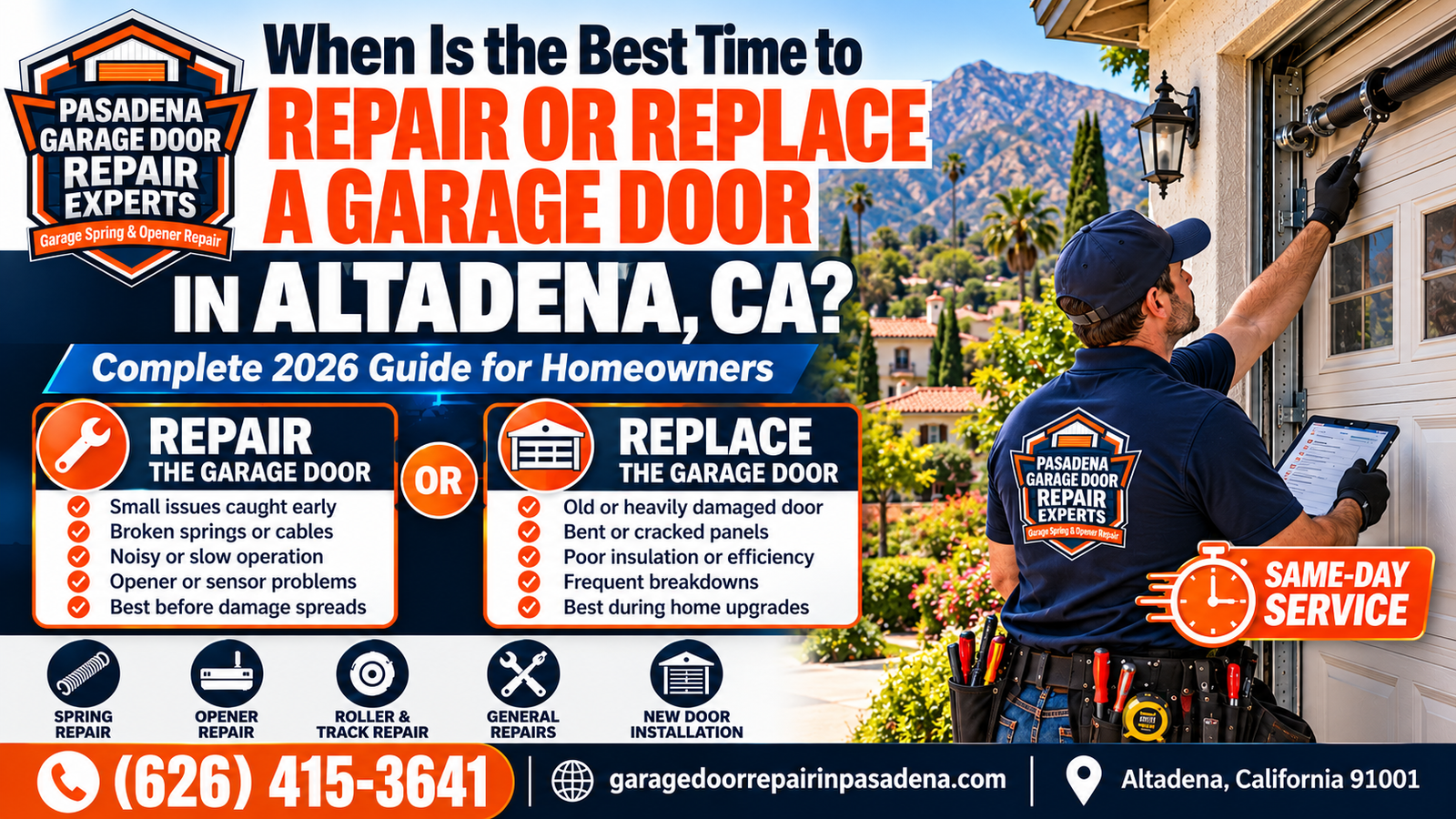
When Is the Best Time to Repair or Replace a Garage Door in Altadena, CA?
The best time to repair a garage door in Altadena is as soon as a wear part starts showing symptoms: a spring gap, a fraying cable, a roller that grinds, a door that no longer reverses. Waiting rarely saves money, because one failing part loads the others. The best time to replace a garage door is when the door itself, not its hardware, is failing: rotted or cracked sections, parts that can no longer be matched, fire or impact damage beyond a single panel, repeated repairs on an old uninsulated door, or a change in how you use the garage. For planned replacements, the calendar matters too. Schedule early enough to clear any County or HOA review, pick a door that seals well before Santa Ana winds, fire weather, and SCE Public Safety Power Shutoffs, and remember that California law affects which opener a replacement door can be connected to.
This guide covers timing for Altadena's foothills: warning signs that mean fix it this week, signs that mean start planning a new door, how seasons, hillside lots, Eaton Fire ash, and County permitting change the schedule, and how to avoid spending money on a door you're about to replace.
When Is the Best Time to Repair or Replace a Garage Door in Altadena?
Quick answer: Repair as soon as a symptom appears, and immediately if the problem involves a spring, cable, bent track, or a door that won't reverse. Those are safety issues, and they don't wait for a convenient season. Replace when the door panels or frame are failing, matching parts are gone, fire or impact damage goes beyond hardware, or you're paying for repeat repairs on an old door you'd like to upgrade anyway. For a planned replacement, the best window is one you choose on purpose: after any County, HOA, or rebuild approval, ahead of fall fire weather and PSPS season, and before you list a home for sale.
A broken part forces the timing. A tired door lets you pick it. Most of the money homeowners lose comes from mixing those two up: delaying a safety repair to "wait for the new door," or rushing a replacement in a panic that a single spring could have fixed.
If your door is stuck or unsafe right now, call Pasadena Garage Door Repair Experts at (626) 415-3641 and describe what you're seeing. The business is based in Pasadena at 333 W California Blvd and serves Altadena; it does not claim an Altadena storefront. If you're still at the planning stage, keep reading. For how each system fails in the first place, see the Complete 2026 Guide to Garage Door Repair in Altadena. For how long common fixes take on foothill and hillside lots, see how long garage door repair takes in Altadena.
"Best Time" Means Two Different Things
Short answer: One clock is the door's condition: where it sits in its working life and how serious today's symptom is. The other is the calendar: weather, fire season, SCE outages, County and HOA review, supplier lead times, and your own plans for the house. Condition decides whether to act. The calendar decides when planned work fits best.
Most articles treat repair versus replacement as a one-time verdict. In practice it's a scheduling problem. A door can be repairable today and still a smart replacement next spring once County rebuild permitting clears. Another door might look shabby but be structurally fine—the right move is a tune-up, seal replacement, and sensor cleaning after an ash-heavy wind event, not a new door.
1The condition clock. Springs, cables, rollers, hinges, and opener parts wear on a cycle count: every open and close uses up a little of their life. Door sections wear on age and exposure: sun, moisture at the bottom edge, impacts, ash grit in tracks, and termites or rot in wood. A garage used as the main entry to the house burns through hardware far faster than one opened twice a week, even if the doors are the same age.
2The calendar clock. In Altadena that includes dry, gusty Santa Ana and downslope wind events that raise fire danger and push dust through canyon corridors, winter storms that expose poor bottom seals on hillside driveways, summer heat that makes an uninsulated garage miserable as a workspace, SCE Public Safety Power Shutoffs, and the lead time for any County permit, HOA approval, custom-built door, or post-fire rebuild.
When the condition clock says "urgent," ignore the calendar and fix the problem. When the condition clock says "aging but safe," the calendar gets a vote, and that's where good timing saves money and hassle.
Garage Door Repair Timing Table: Fix Now, Fix Soon, or Plan Ahead
Short answer: Anything that affects how the door is held up or whether it stops and reverses is a "now" repair. Wear that makes noise, lets in weather, or fouls sensors with foothill dust and ash is a "soon" repair. Problems in the door body itself belong in the planning column, where replacement becomes a real option.
| What you notice | Likely cause | Timing | Why the timing matters |
|---|---|---|---|
| Loud bang from the garage; door suddenly very heavy or opener strains and stops | Broken torsion or extension spring | Now. Stop using the door. | Without spring counterbalance, the full door weight rides on cables and the opener. Lifting it by hand or by motor risks injury and more damage. |
| Frayed strands, cable slack on one side, door hanging crooked | Worn cable, cable off the drum, or failing bottom bracket | Now. | A cable under tension can snap, and a crooked door can jump its track. |
| Rollers out of the track, door tilted in the opening | Off-track door, often from an impact or cable problem | Now. Leave it where it is. | Forcing it can bend track, crease panels, or drop the door. |
| Door doesn't reverse when it touches an object, or the photo eyes are bypassed | Force setting, sensor, or opener fault | Now. | Auto-reverse is the core safety feature federal and California rules require on residential openers. |
| Door starts down and reverses; opener light blinks after wind or ash | Fouled photo eyes, debris in tracks, misaligned sensors | Soon (often same week) | Ash and canyon dust after Santa Ana events and nearby rebuild work commonly cause false reverses. Clean and realign before calling it an opener failure. |
| Grinding or squealing, jerky travel | Worn rollers, dry bearings, bent hinges, grit in tracks | Soon (within weeks) | Rough travel raises opener load and speeds wear on everything else. |
| Cracked hinges, loose hardware, screws pulling out of the stiles | Hardware fatigue or weakened door skin | Soon | A cracked hinge can let a section fold or bind. |
| Daylight under the door, leaves or water inside, pests getting in | Worn bottom seal or perimeter weatherstrip; uneven hillside slab | Soon, and before fire weather | Gaps let in rain and debris, and also wind-blown embers during a wildfire. |
| Opener hums but hesitates, reverses at random, remote range shrinking | Worn gear, limit or force drift, sensor alignment, aging logic board | Soon | These often get worse suddenly. Have them checked before the opener fails with the car inside—especially ahead of PSPS season. |
| Soft or rotted wood along the bottom section, peeling that keeps coming back | Moisture damage, UV, age | Plan | Rot spreads upward and weakens the hinge and bracket attachment points. |
| Multiple dented, cracked, heat-damaged, or ash-compromised sections; design no longer made | Impact, fire exposure, age, discontinued model | Plan | If a matching section can't be sourced, replacing one section stops being an option. Rebuild work may also need County permitting. |
| Third or fourth significant repair in a short span on an old door | General end of service life | Plan | Repeat repairs on an aging door rarely stop at the one you're paying for today. |
This table is a triage aid, not a diagnosis. Two problems can look alike from the driveway. A door that suddenly feels heavy could be a broken spring or an opener that lost its connection to the trolley. A technician's inspection tells you which, and that answer is what decides the timing.
When to Repair Each Part of a Garage Door
Short answer: Springs and cables get repaired the moment they fail or show damage. Rollers, hinges, and seals get replaced when they start to wear, ideally during a scheduled tune-up. Openers get repaired when the fault is a single part on a unit that still meets current safety and battery-backup rules, and replaced when they don't. Sensors often need cleaning after foothill wind and ash events before anything else is replaced. None of these, on their own, means you need a new door.
Springs: repair the day they break, plan for them before they do
Torsion springs sit on a shaft above the door; extension springs run along the horizontal tracks. Either way, they carry most of the door's weight. A spring doesn't give much warning before it breaks, but a few clues show up first: a door that no longer stays put when you lift it halfway by hand (with the opener disconnected), a visible gap in a torsion spring's coils, or an opener that sounds like it's working harder than it used to. The site's article on warning signs a garage door spring is about to break goes through these in detail.
Timing rule: once a spring breaks, the door is out of service until it's repaired. If the door has two springs and one breaks, replacing both at once is usually recommended, because they've done the same number of cycles. The article one garage door spring or two? explains why. A broken spring on a sound door is a repair decision, not a replacement decision.
Cables: repair immediately, and look for the cause
Lift cables run from the bottom brackets up to drums on the spring shaft. Fraying usually starts near the bottom bracket, where moisture and road grit collect. A cable that comes off its drum is often a symptom of something else: a spring that's lost tension, a door that hit an obstacle, or a bottom bracket that's rusted through. Replacing the cable without fixing the cause means paying twice. Cable problems need attention right away; a frayed cable can fail under load without warning.
Rollers and hinges: replace on wear, preferably on your schedule
Rollers and hinges are the everyday wear items. Worn rollers make grinding or rattling noises, wobble in the track, and make the opener work harder. In Altadena, foothill dust and residual ash after wind events can accelerate bearing wear if grit works into the track. Cracked hinges show up as hairline splits near the knuckle or screws pulling out. Neither is usually an emergency, which is exactly why they're good candidates for planned timing: fold them into a tune-up rather than waiting for a roller to jump the track. Upgrading from worn steel rollers to sealed nylon rollers is one of the most noticeable changes you can make to an older door's noise level, and it doesn't require a new door. See signs your garage door rollers are worn out.
Tracks: straighten early, replace when bent or rusted through
Minor track misalignment can be adjusted. A track that's kinked from a car bump, or rusted where it meets the floor, needs replacement. If a roller rubs the same spot each cycle, that's a "soon" repair. On older Craftsman-era detached garages, loose track brackets in dry jambs can also be the root cause.
Weather seals: replace before the season that tests them
The bottom seal and perimeter weatherstripping don't affect whether the door works, which is why they get ignored. In Altadena they matter several times a year: in winter storms, when water runs down a sloped hillside driveway and under the door; in fall and winter Santa Ana and downslope winds, when a gap is an entry point for wind-blown embers; and after ash fall, when grit works under a worn seal into the garage. The practical timing rule is simple: replace worn seals in late summer, before both the wet season and peak fire weather arrive. The weather stripping and bottom seal replacement page explains what's involved.
Sensors: clean after wind and ash, then decide
Photo-eye sensors sit a few inches above the floor and must see each other clearly. After Santa Ana events, canyon dust, nearby rebuild debris, or residual Eaton Fire ash, a door that "won't close" is often a dirty lens or a bumped bracket—not a failed opener. Wipe the lenses, clear the path, realign, and run a full cycle before authorizing opener replacement.
Openers: repair a part, replace a platform
An opener repair makes sense when one part has failed (a drive gear, a trolley, a limit switch, a sensor) on a unit that still has working auto-reverse, photo-eye protection, and a battery backup. Replacement makes more sense when the opener is old enough that parts are hard to find, it lacks battery backup, or you're replacing the door anyway. California's battery-backup law has a direct effect on that timing, covered below—and it matters more in communities that see SCE Public Safety Power Shutoffs. The site's article on opener repair vs. replacement covers the opener side of the decision on its own.
Single sections: repair if a match exists
One dented steel section can often be replaced by itself if a matching section still exists. Older, discontinued, or custom wood doors—common on foothill Craftsman and ranch homes—frequently have no match, and heat- or fire-compromised sections raise the same question. When matching parts are gone, the repair-or-replace question becomes real. See garage door panel replacement.
Signs the Door Itself Is Due for Replacement
Short answer: Replacement becomes the better plan when the problem lives in the door body: rot or cracking in several sections, fire or impact damage across multiple panels, a frame or opening that no longer holds hardware securely, parts that can't be matched, a door too heavy for its original spring and opener design, or a garage whose new use the old door can't support.
Hardware can almost always be replaced. The door itself can't be rebuilt forever. These signs point to the door body reaching the end of its useful life:
1Rot, splitting, or delamination across more than one section. Wood doors in Altadena usually rot from the bottom up, where sprinkler spray and rain splash collect on hillside driveways. Once rot reaches the stiles where hinges and brackets attach, the hardware has nothing solid to hold. Delaminating composite or cracked steel skins raise the same concern.
2Discontinued design. If the damaged sections can't be matched, you're choosing between a mismatched door and a new one. On a street-facing elevation, most owners choose the new door.
3Fire, heat, or smoke damage beyond hardware. Surviving doors can look intact from the curb while sections are warped, seals are cooked, wiring is compromised, or glass is crazed. After wildfire exposure, have the door, seals, opener, and wiring inspected before relying on them. Rebuilds of destroyed garages are replacement projects by definition—and they run through County channels in unincorporated Altadena.
4Repeat repairs stacking up. There's no magic number, but a pattern matters more than any single bill. Three unrelated failures in a short period on an old door usually means more are coming.
5A door that has become too heavy. Paint layers, added insulation panels, water-soaked wood, or decorative overlays added over the years can push a door past what its springs were sized for. Re-springing can fix balance, but a waterlogged wood door will keep changing weight with the seasons.
6The garage has a new job. A detached garage that's become a home gym, office, workshop, or EV charging space has different needs from a car-only garage: insulation, quieter operation, better seals, and more light from window sections. An old uninsulated door can be repaired, but it can't be made into an insulated one. See is an insulated garage door worth it?
7Safety features the door can't support. Very old one-piece tilt-up doors and some homemade or heavily modified doors are hard to pair safely with a modern opener. When the only way to make the system safe is to change the door, the timing question answers itself.
What isn't a replacement signal by itself: a broken spring, a noisy opener, a sensor that won't line up after ash fall, a remote that stopped working, or faded paint. Each of those is a repair or maintenance item. If someone recommends a whole new door for one of them without pointing to a problem in the door body, ask for a written explanation and consider a second opinion. In post-fire rebuild areas, also verify the contractor's CSLB license before you sign. The site's guide to avoiding garage door repair scams covers the common upsell patterns.
The Three Stages of a Garage Door's Life
Short answer: Early life is maintenance and adjustment. Mid-life is when wear parts (springs, rollers, cables, opener components) start needing replacement, and repair is almost always the right call. Late life is when the door body itself begins to fail, and each repair decision should be weighed against a planned replacement.
Years alone make a poor guide, because a door opened eight times a day on an attached mid-century garage ages differently than a door on a detached Craftsman garage that's mostly storage. Stages describe condition, not age.
| Stage | What typically happens | Best timing strategy |
|---|---|---|
| Early life | Hardware settles; springs and cables may need small balance adjustments; opener limits and force may need fine-tuning. | Routine maintenance: lubrication, a balance check, a monthly reverse test. Fix installation issues under warranty promptly. |
| Mid-life | Springs reach the end of their cycle life; rollers and hinges wear; seals harden and crack; opener parts start failing; sensors collect foothill dust and ash. | Repair promptly. This is where a good repair buys years of service. Replace both springs together when one fails. Upgrade rollers during the same visit. Clean sensors after wind or ash events. |
| Late life | The door body degrades: rot, cracking, rust-through, sections that won't stay aligned; replacement parts become hard to source; fire or impact may finish the job. | Safety repairs still get done right away. For anything else, compare the repair against a planned replacement and pick a date for the new door—building in County or HOA lead time if needed. |
The costly mistake is treating a mid-life door like a late-life door (replacing a sound door because a spring broke) or a late-life door like a mid-life door (pouring repeat repairs into a door that's rotting from the bottom up).
A Five-Question Timing Test
Short answer: Ask whether the problem is a safety issue, whether it's in the hardware or the door body, whether parts exist, how long you'll keep the house, and whether your needs for the garage have changed. The answers sort most situations into "repair now," "repair and plan," or "replace."
The site's article on garage door repair vs. replacement lays out the full decision factors. This quicker test focuses on timing for Altadena homeowners:
1Is anyone at risk right now? Broken springs, damaged cables, off-track doors, and failed auto-reverse come first, regardless of any replacement plans. If yes, repair now. The replacement conversation can wait a day.
2Is the failure in the hardware or in the door? Hardware failures point to repair. Door-body failures—including fire-compromised sections—point to planning a replacement.
3Can it be fixed with parts that exist? If matching sections, compatible opener parts, or correct-size springs are available, repair is on the table. If not, the timeline shifts toward replacement.
4How long will you be in the house? If you're selling soon, the question becomes what buyers and inspectors will see. The companion article, New Garage Door Installation in Altadena, CA: Can It Improve Home Value?, covers the resale side. If you're staying for years, a replacement can be timed for when it suits you—and for when County or HOA approvals clear.
5Has the way you use the garage changed? A new workspace, an EV charger, an ADU conversion nearby, a rebuild that changes the opening, or a household that now uses the garage as the front door all shift the value of insulation, quiet operation, better seals, and battery backup.
| Your answers | Timing recommendation |
|---|---|
| Safety issue + hardware failure + sound door | Repair now. No replacement needed. |
| Safety issue + late-life door | Make the door safe now with the minimum proper repair, then schedule a replacement. |
| No safety issue + wear parts + sound door | Repair at your convenience, ideally as part of a tune-up—and before fire weather if seals or backup are involved. |
| No safety issue + door body failing + parts unavailable | Plan replacement; pick a date that fits County/HOA approvals and the season. |
| No safety issue + door works + garage use changed | Replacement is optional. Time it with the remodel, sale, rebuild, or project that created the need. |
What Waiting Actually Costs
Short answer: Delaying a hardware repair usually spreads damage to other parts. A worn spring makes the opener work harder, a slipping cable can pull a door off its track, and a dragging roller wears the track. Delaying a door replacement mostly costs comfort and appearance, unless the door is rotting or fire-compromised, in which case the hardware attachment points get weaker every season.
The parts of a garage door system depend on one another. Here's how deferred repairs tend to escalate:
- Weak spring → stressed opener. As springs lose tension, the opener lifts more of the door's weight. Gears, belts, chains, and motors wear faster. A spring job can turn into a spring job plus an opener repair.
- Frayed cable → off-track door. When one cable lets go, the door lifts unevenly, racks in the opening, and can jump its track. Recovering an off-track door takes longer and can involve bent track and creased panels. The site's article on how long garage door repair takes in Altadena shows why off-track recovery is among the longest common jobs on hillside lots.
- Worn rollers → track and hinge damage. A roller with a failed bearing drags instead of rolling, and that friction transfers to hinges and track—especially when grit is in the rails.
- Missing seal → water, pests, ash, and embers. The door still works, but the garage and everything stored in it are exposed.
- Dirty sensors → false "opener failure." Waiting through another wind or ash event can mean more reverse faults, more abandoned close attempts, and more wear on the opener.
- Bottom rot → hardware pull-out. Once the bottom section can't hold the bottom brackets securely, the cable anchor point is compromised. That turns a planned replacement into an urgent one.
The reverse is also true. Replacing a sound door too early spends money on a problem you may not have for years. Match the fix to the failure.
For pricing factors, see garage door repair cost and new garage door cost. This article doesn't quote prices. The Pasadena sibling, when to repair or replace in Pasadena, covers the same decision structure for city addresses.
Altadena's Calendar: The Best Months for Planned Garage Door Work
Short answer: Emergency repairs happen whenever they happen. For planned replacements and upgrades, spring and early summer are often the easiest window in Altadena: the winter rains have passed, you have time before fall fire weather and SCE Public Safety Power Shutoffs, and you can clear any County, HOA, or supplier lead time without pressure. The goal is to have a well-sealed, balanced door with working battery backup in place before the dry, windy months.
Altadena sits at the base of the San Gabriel Mountains as an unincorporated foothill community of Los Angeles County, with long dry summers and mild winters when most rain falls. The National Weather Service Los Angeles/Oxnard office issues local wind, heat, and fire-weather warnings, and the Western Regional Climate Center's nearby Pasadena station record shows the foothill seasonal pattern.
Winter: storms test the bottom seal and the slab
Winter storms show you where your door leaks. Water running down a sloped hillside or canyon driveway finds gaps under a worn bottom seal or uneven slab. Wood doors absorb moisture at the bottom edge and swell. If you see water inside after a storm, repair the seal soon and check wood doors for rot once they dry. Winter is fine for repairs; less ideal for painting or staining a new wood door.
Spring: the easiest window to plan a replacement
Spring gives you mild weather for installation and finishing, and several months before fire weather to get County permits (when needed), HOA approval, or a custom door built. If you've known since last year that your door is near the end—or you're rebuilding after fire damage—this is the season to get estimates, confirm what LA County Building and Safety or EPIC-LA requires, and order the door.
Summer: heat changes what "comfortable" means in a garage
Summer heat makes an uninsulated west-facing garage hard to use as a workspace, stresses struggling openers, and cracks hardened seals. Late summer is the best time to replace worn seals, clean ash and dust from sensors, and test battery backup before fall winds and PSPS season.
Fall: Santa Ana winds, fire weather, and PSPS
Santa Ana and related downslope winds are dry, gusty offshore winds most associated with fall and winter, and they drive Southern California's worst fire weather. In the foothills, canyon corridors can be stronger and more debris-laden than on the valley floor. Gusts can catch a partly open door, push ash into tracks and sensors, and coincide with SCE Public Safety Power Shutoffs. Fall is when you want the door already sealed, balanced, and on an opener with working battery backup—not when you discover a replacement is a month away.
Fire weather isn't limited to fall. The Eaton Fire, which CAL FIRE lists as starting January 7, 2025 near Altadena Drive and Midwick Drive in Altadena/Pasadena, burned during a January windstorm and was contained January 31, 2025. Treat seal and battery-backup readiness as a year-round standard, and use spring and summer to get there. For structural rebuilds in unincorporated Altadena, follow LA County Building and Safety, EPIC-LA, and LA County Recovers—not City of Pasadena historic review as the primary path.
Supplier lead times and busy periods
Standard steel doors in common sizes can often be sourced quickly. Custom wood, carriage-house, unusual sizes, and special colors take longer. Ask for a delivery estimate in writing. After a regional wind or fire event, demand rises and schedules tighten—especially with rebuild traffic on hillside streets.
Before Santa Ana, PSPS, and Fire Season: What to Have Done
Short answer: Before fire weather, a garage door should close fully with no daylight gaps, have intact bottom and perimeter seals, run smoothly without binding, and have an opener with a working battery backup and a manual release you know how to use. After the Eaton Fire, also clean sensors and tracks of ash residue and inspect seals that may have hardened from heat or grit. If your door can't meet that standard without major work, that's a strong reason to time a replacement for spring or summer.
CAL FIRE's Ready for Wildfire home-hardening guidance includes two garage-specific items: equip garage doors with battery backups so they work during power outages, and apply weather stripping around and under the garage door to block ember entry. The University of California Agriculture and Natural Resources (UC ANR) Fire Network goes further. It shows how gaps at the bottom and top of a door, vents in the door, and glass panels can each let fire or embers into a garage where flammable items are often stored, and it recommends filling gaps, adding weatherstripping, and adjusting the door so it closes fully.
UC ANR also notes that garage doors fall under Chapter 7A of the California Building Code (wildland-urban interface) as exterior doors, with options such as noncombustible or ignition-resistant materials, a 20-minute fire-resistance rating, or solid wood meeting minimum thicknesses. Whether Chapter 7A applies depends on location and scope of work. On mapped fire-hazard, foothill, canyon, or brush-adjacent lots, ask LA County Building and Safety what a replacement door must meet before you choose one.
Ash, smoke residue, and sensors after the Eaton Fire
According to CAL FIRE's Eaton Fire incident page, the fire started January 7, 2025 and was contained January 31, 2025 after burning about 14,021 acres. Surviving doors still collect ash and smoke residue on sensors, tracks, and seals, and nearby rebuild dust can return months later. A reverse-and-won't-close call is often a sensor cleaning—if that is all that is wrong. Schedule cleaning and inspection before the next fire-weather period, not during it.
Battery backup, PSPS, and evacuation readiness
Most of Altadena is served by Southern California Edison, which can de-energize lines during high fire-risk weather through Public Safety Power Shutoffs. (City of Pasadena addresses often use Pasadena Water and Power—know which serves your meter.) An opener with working battery backup runs for a limited number of cycles; without one, use the emergency release only on a closed, balanced door. If power is out and smoke is in the air, the door needs to open on backup or by hand quickly. Practice the manual release on a calm day. See the guide on when a garage door won't open after a power outage and the battery backup installation page.
| Pre-season check | Repair if… | Consider replacement if… |
|---|---|---|
| Full closure | Limits or track alignment are off and the door stops short | The door is warped, racked, or fire-compromised so it can't seal no matter how it's adjusted |
| Bottom and perimeter seals | Seals are hardened, torn, grit-packed, or missing | The seal retainer or bottom section is rotted and can't hold a seal |
| Sensors and tracks | Lenses are ash-fouled or brackets are bumped | Wiring or opener electronics were heat-damaged |
| Battery backup | The backup battery is dead and needs replacing | The opener has no backup and you're replacing the door, which triggers the California rule discussed below |
| Manual release | The red release cord is missing, too high, or the door is too heavy to lift by hand (a balance issue) | The door is so heavy or damaged that it can't be operated by hand safely even when balanced |
| Glass sections | A cracked pane can be replaced | You want solid or fire-resistant sections in place of old annealed glass on an exposed foothill elevation |
County Permits, Rebuilds, HOAs, and Lead Time
Short answer: Altadena is unincorporated Los Angeles County, so structural garage work and fire rebuilds typically go through County Building and Safety and EPIC-LA—not City of Pasadena historic design review as the primary path. Like-for-like hardware repair usually does not need a design review. HOAs may still require architectural approval. Build that review and rebuild lead time into the schedule. It's a common reason a planned replacement slips.
Unincorporated Altadena: County channels first
Altadena is an unincorporated census-designated place in Los Angeles County. Like-for-like hardware repair (springs, cables, rollers, seals, many opener swaps) usually does not involve design review. Structural replacements, fire rebuilds, opening changes, and other permit-required work typically go through Los Angeles County Building and Safety and EPIC-LA. Post-fire rebuild help is on LA County Recovers. When in doubt, ask the County—not a driveway flyer.
What that means for timing:
- Confirm the jurisdiction first. Some addresses near the Altadena/Pasadena line sit inside the City of Pasadena and use Pasadena Building & Safety and Design and Historic Preservation instead. Confirm which office applies before you order a door.
- Like-for-like vs. structural. Replacing a door in the same opening is a different project from rebuilding a fire-destroyed garage, widening an opening, changing a header, or converting part of a garage. The latter involve structural or code work and can require a permit.
- Chapter 7A and materials. On brush-adjacent and mapped fire-hazard lots, ask Building and Safety whether wildland-urban interface rules affect door materials, glazing, or seals before you lock in a design.
- Order after approvals. Ordering first and seeking approval second is the most common way homeowners lose time and money on rebuild and replacement projects.
CSLB caution for disaster-area contracting
The Contractors State License Board warns that most contracting work in a declared disaster area without a valid California license is a felony. CSLB guidance for disaster-related home improvement emphasizes fixed-price contracts and a down-payment cap of $1,000 or 10 percent of the contract price, whichever is less. Always verify the license with CSLB Check a License and use official County channels for rebuild permits rather than a door-to-door pitch alone.
HOAs and condominium garages
Many planned communities and condo associations in and near Altadena require architectural approval for exterior changes, including garage door style, color, and window layout. Some specify an exact model. Associations usually meet on a set schedule, so an application submitted just after a meeting can wait weeks. If you share a garage structure, the association may control the doors outright. Get the approval in writing before you order.
A practical order of operations: confirm jurisdiction (County vs. City of Pasadena), get a contractor to measure and inspect the opening, choose a design that fits any review and fire-hardening guidance, obtain approvals and any permit, then order the door. For the full local repair picture, see the Altadena 2026 complete guide.
California Rules That Change the Timing
Short answer: Since July 1, 2019, California has required battery backup on residential garage door openers that are sold or installed, and it bars connecting a replacement garage door to an existing opener that lacks battery backup. A replacement door also can't be connected to an existing opener that fails the auto-reverse test. So if your opener is older, replacing the door may mean replacing or upgrading the opener at the same time. Budget and schedule them together—especially if you rely on the door during SCE outages and PSPS events.
These rules live in California Health and Safety Code sections 19890 through 19892. Here's what they say and how they affect timing:
1Battery backup (HSC 19892). Section 19892, added by SB 969, says that on or after July 1, 2019, no one may sell or install a residential automatic garage door opener in California without a battery backup function designed to work during an electrical outage. Subdivision (c) adds that no replacement residential garage door may be installed in a way that connects it to an existing opener that doesn't meet that requirement, regardless of when the opener was made.
2Auto-reverse and sensors (HSC 19890). Section 19890 requires openers to have an automatic reverse safety device meeting UL 325 and, since 1993, an edge sensor, photo-eye, or similar device. Anyone hired to service or repair a residential opener must check afterward whether it reverses on contact with a rigid two-inch-high obstacle, and if it fails, attach a red warning certificate. Subdivision (h) bars connecting a replacement door to an existing opener that doesn't pass that test.
3Penalties (HSC 19891). Section 19891 sets a civil penalty of $1,000 per opener installed, sold, or offered for sale in violation of section 19892 or subdivisions (a) through (c) of section 19890. Enforcement can come from the local building department, affected consumers, or the district attorney.
At the federal level, residential openers must meet the Consumer Product Safety Commission's mandatory standard, 16 CFR Part 1211, as the CPSC's garage door operator FAQ explains. The industry safety standard behind it is UL 325. California's HCD Information Bulletin 2019-01 summarizes the battery-backup requirement for building officials.
How these rules shape your timing
- Old opener, aging door: If the opener predates battery-backup requirements and the door is nearing replacement, plan both together. You'll likely need a compliant opener when the new door goes in.
- Opener fails now, door is fine: Any new opener installed today must have battery backup. If you expect to replace the door in a few years, choose an opener rated for the kind of door you'll likely install (a heavier insulated or wood door may need more capacity), so it can be reused.
- Door fails now, opener is newer: If the opener already has battery backup and passes the reverse test, it can often stay, provided it suits the new door's size and weight.
- Any service visit: The two-inch reverse test after opener service is a legal requirement in California. A technician who skips it is skipping a step the law asks for.
- Rebuild timing: On Eaton Fire rebuilds, budget a compliant opener with the door so you don't discover mid-install that the old opener can't legally be connected.
For how these rules play out in repairs generally, see the California opener laws section in the complete Altadena garage door repair guide.
Life Events That Make Replacement Timely
Short answer: The door's condition sets the minimum. Your plans for the house often set the best date. Selling, buying, remodeling, converting garage space, adding an EV charger, recovering from storm or fire damage, and replacing an old opener are the moments when replacement timing makes the most sense.
Before selling
If you're listing soon, the question is what a buyer and home inspector will see. Inspectors typically operate the door and test reverse. A door that fails, rattles, or looks worn can land on a repair request list. Options: repair and tune up a sound door, refresh its appearance, or replace a door at the end of its life. The companion article on whether a new garage door can improve home value in Altadena covers the resale side. Finish any replacement before listing photos, and keep the paperwork.
After buying
New owners often inherit a door with an unknown history. The inspection report helps, but home inspectors aren't garage door technicians. In the first months, a professional inspection and tune-up set a baseline: springs, cables, opener compliance, seals, and any ash residue on sensors. That tells you whether the door has years left or needs a budget line.
During a remodel or exterior refresh
If you're repainting, re-roofing, or updating the front of the house, the garage door is often the largest street-facing element. Replacing it in the same project keeps the design consistent and consolidates HOA, site disruption, and any County interaction.
Converting the garage's use
A garage that becomes a gym, studio, workshop, or office needs insulation, quieter hardware, better seals, and often more light. A conversion to living space (for example, an ADU project) may not need a working garage door at all—that's a LA County permit question. If the garage stays a garage but you'll spend real time in it, evaluate an insulated door.
Adding an EV charger or changing parking
New vehicles, EV chargers, and storage systems change clearance and how often the door cycles. Using the garage as the main entry wears springs and openers faster. Check spring condition and opener capacity, and consider a quieter belt-drive or wall-mount opener if the garage is under a bedroom.
After a storm, impact, or fire
After a car strikes the door, a tree limb falls on it, or wind catches a partly open door, the damage decides the timing. A single dented section may be replaceable. Multiple bent sections, twisted track, and damaged framing often point to replacement. If insurance is involved, document the damage with photos before anything is moved, and get a written assessment that separates what was damaged in the event from pre-existing wear. After a wildfire or ash exposure, have the door, seals, opener, and wiring inspected before relying on them; smoke and heat can damage components that look fine from outside. If a garage is being rebuilt after the 2025 fires, the CSLB homepage alert explains that disaster rebuilding is treated as a home improvement project: contractors must use a fixed-price contract, and the down payment can't exceed $1,000 or 10% of the contract price, whichever is less. Use LA County Recovers and EPIC-LA for permit guidance in unincorporated Altadena.
When the opener is due
If your opener is old, lacks battery backup, or is failing, and your door is in late life, replacing both together is often the most efficient timing, both for scheduling and because of California's rule on connecting replacement doors to non-compliant openers. In Altadena, battery backup also doubles as evacuation readiness during PSPS events.
Repairing a Door You Plan to Replace
Short answer: If you'll replace the door within months, do the repairs that make it safe and secure: springs, cables, track, auto-reverse, and a closure that locks the house. Skip cosmetic work and large upgrades you'll throw away. If the replacement is a year or more out—or delayed by County rebuild permitting—a normal repair is usually worth it, and seals may still be worth replacing before fire season.
Homeowners who've decided on a new door sometimes try to "just get by." That's reasonable for noise or appearance. It isn't for safety or security. Use this split:
| Repair | Do it even if replacing soon? | Reason |
|---|---|---|
| Broken spring or damaged cable | Yes | The door can't be operated safely without it, and a new door may be weeks away. |
| Off-track door | Yes (make safe and secure) | A door hanging in the opening is a hazard and a security gap. |
| Failed auto-reverse or sensors | Yes | This is a life-safety feature, especially with children or pets around. |
| Opener repair on an opener you'll keep | Yes, if the opener is compliant and suits the new door | The repair carries over to the new door. |
| Opener repair on an opener you'll replace | Only the minimum to secure the house | Money spent on a non-compliant opener doesn't carry over. |
| New rollers and hinges | Usually no, unless something is binding | New hardware comes with the new door. |
| Single-section replacement | No | The whole door is going. |
| Paint or stain | No (unless you're selling before the replacement) | It won't carry over. |
| Seal replacement | Yes if fire or storm season arrives before the new door | Ember and water protection can be worth it while you wait for permits or delivery. |
Be upfront with the technician. Saying "we're replacing this door in the spring; what's the minimum to make it safe until then?" leads to a better recommendation than asking for a full repair first.
Four Illustrative Timing Decisions
Short answer: These are illustrations built from common situations, not real customer jobs. They show how the same symptom can lead to different timing depending on the door's condition and the owner's plans.
ABroken spring on a mid-life steel door in central Altadena. The door is an insulated steel door in good condition on an attached two-car garage that the family uses as its main entry. One torsion spring breaks. Timing: repair now. Replace both springs since they've run the same cycles, inspect cables and bearings, rebalance, and test the reverse. No reason to replace the door.
BRotting wood door on a detached Craftsman-era garage. The bottom section is soft, the bottom brackets are pulling loose, and the lot is on a hillside street with HOA exterior rules. Timing: make it safe now (secure the brackets or restrict use if the cable anchor is compromised), then start HOA approval and any County questions about the opening. Decide between specialist repair of the bottom rail and a period-appropriate replacement. Schedule the work for spring so the door is sealed before fire weather.
CFire rebuild: garage destroyed; house being reconstructed under County permits. Timing: this is a replacement project by definition. Confirm EPIC-LA / Building and Safety requirements, choose a door that meets any applicable Chapter 7A or hardening guidance, plan a battery-backup-compliant opener from the start, verify the contractor's CSLB license, and use a fixed-price contract with a capped down payment. Don't order the door until permit and design questions are clear.
DFoothill home with daylight under the door after ash season. The door works fine, but daylight shows under one side because the slab is uneven, sensors reverse intermittently after wind events, and the owner is worried about embers. Timing: repair before the next fire-weather stretch. Clean and realign sensors, fit a new bottom seal or threshold, and adjust limits. Replacement only comes into play if the door is warped or the bottom section can't hold a seal.
How to Plan a Garage Door Replacement, Step by Step
Short answer: Start with an inspection, confirm County or city jurisdiction and any HOA rules, choose a design, get written estimates from licensed contractors, order with a delivery date in writing, and schedule installation in a season that suits finishing work. Build in slack for review, rebuild permits, and supplier lead time.
- Get an inspection of the current system. Confirm whether the problem really is the door body, and find out whether the opener is compliant and suitable for reuse.
- Check jurisdiction, permits, and HOA status. For unincorporated Altadena, talk to LA County Building and Safety / EPIC-LA (and LA County Recovers for post-fire rebuilds). If your address is actually in the City of Pasadena, use Pasadena's offices instead. Contact your HOA if you have one.
- Decide how you'll use the garage. Car-only, workspace, storage, main entry? That drives insulation, window sections, noise, and opener choices.
- Choose a design that fits the house and any fire-hardening guidance. Match the architecture and any review guidelines. Consider fire exposure for glass and material choices on brush-adjacent lots.
- Get written estimates from CSLB-licensed contractors. Ask what's included: removal and disposal, new tracks and springs, opener work, seals, finishing, and any framing repair. In disaster zones, insist on a fixed-price contract and a legal down payment.
- Order with a delivery estimate in writing. Custom and wood doors take longer; confirm who handles painting or staining and when.
- Schedule installation. A straightforward replacement is typically a single-day job once the door arrives. The site's article on how long a new sectional garage door installation usually takes has the details. Plan for the garage to be cleared along both walls and the ceiling area, and allow for hillside access and parking limits.
- Test and document. Before the installer leaves, run the door, test the reverse, check the battery backup and manual release, and get the warranty paperwork and any permit sign-off.
For an overview of the installation service itself, see garage door installation. For the Altadena service page, see garage door repair in Altadena.
Hiring a Licensed Garage Door Contractor in California
Short answer: In California, garage door work falls under the Contractors State License Board's D-28 Doors, Gates and Activating Devices classification. Check any contractor's license on the CSLB website before you sign. Since January 1, 2025, the minor-work exemption applies only to jobs under $1,000 in combined labor and materials that don't require a building permit. In declared disaster areas, unlicensed contracting can be a felony.
The Contractors State License Board (CSLB) describes the D-28 classification as covering contractors who install, modify, or repair residential, commercial, and industrial doors, including overhead door assemblies and power-activated doors. You can confirm a license's status, classification, and bond with CSLB's Check a License tool.
AB 2622 raised California's minor-work threshold to $1,000, and the exemption doesn't apply to work that requires a building permit. A full garage door replacement will usually exceed that amount, so it calls for a licensed contractor.
Licensing matters for timing, too. Unlicensed work, a skipped permit, or a non-compliant opener can surface during a home sale. After the Eaton Fire, license checks also protect rebuild timelines. The Door & Access Systems Manufacturers Association (DASMA) publishes garage door system safety tips that reinforce why spring and cable work belongs with trained technicians.
Questions to Ask Before You Decide
Short answer: Ask what failed and why, whether the door body is sound, whether parts exist, whether the opener is compliant and reusable, what County or HOA approvals apply, and what the technician would do if it were their door and they planned to stay, or planned to sell.
- Is this failure in the hardware or in the door itself? Can you show me?
- Is it safe to use the door until the repair, or should it stay closed?
- If I repair it today, what else is likely to need attention in the near future?
- Are matching sections or parts available for this door and opener?
- Does my opener have battery backup and pass the reverse test? Could it be reused with a new door?
- If I plan to replace the door next year, what's the minimum repair to keep it safe until then—including through fire season?
- Is my address in unincorporated LA County or the City of Pasadena, and will anything about this job require a County permit?
- Does my HOA affect what a replacement can look like?
- What's your CSLB license number, and what does your written estimate include?
Not Sure If It's Time to Repair or Replace?
A good decision starts with an honest inspection of what failed and what shape the door is in. Call Pasadena Garage Door Repair Experts at (626) 415-3641, describe what your door is doing, and ask about current availability. The business serves Altadena from Pasadena and does not claim an Altadena storefront.
Garage Door Timing Myths
Short answer: Most timing myths either push owners to replace too early ("a broken spring means a new door") or to wait too long ("it still opens, so it's fine").
Myth: "A broken spring means the door is shot." A spring is a wear part designed to be replaced. On a sound door, spring replacement is a repair, not a replacement trigger.
Myth: "If it still opens, it can wait." A door can open with a frayed cable, a failed reverse, or one spring doing all the work. Those are the situations most likely to end in injury or a bigger repair.
Myth: "Wait for the new door before fixing anything." Safety repairs can't wait for a delivery date or a County permit. Do the minimum proper repair now and skip the cosmetic work.
Myth: "Replacing the door means I'll never need repairs." New doors still need maintenance: lubrication, balance checks, and eventually new springs. Replacement resets the clock; it doesn't stop it.
Myth: "My old opener will work with any new door." In California, a replacement door can't be connected to an opener without battery backup or one that fails the reverse test. And the opener has to suit the new door's weight and size.
Myth: "Altadena uses Pasadena city historic review for every garage door." Unincorporated Altadena runs through LA County Building and Safety and EPIC-LA for structural and rebuild work. City of Pasadena design review applies only if your address is actually inside the city.
Myth: "Fire season is only in the fall." The Eaton Fire began in January. Keep seals and battery backup ready year-round.
Myth: "Ash only mattered during the fire." Residual grit and nearby rebuild dust still foul sensors and tracks months later. Cleaning is part of timing readiness.
Timing Notes Across Altadena and Nearby Areas
Short answer: Housing age, lot layout, and exposure change which timing factor matters most. In older Craftsman streets it's heavy wood doors and detached garages. In mid-century tracts it's cycle wear. On hillsides, canyons, and the Eaton Canyon corridor it's seals, battery backup, ash cleanup, and County rebuild timing.
Central and west Altadena. Mixed Craftsman, period revival, and mid-century homes. Detached rear garages and heavier wood doors are common; hardware wear and bottom-edge rot drive many timing decisions. See Altadena garage door repair.
East Altadena and foothill edges. More hillside lots, brush-adjacent properties, and wind exposure. Battery backup, ember-resistant seals, and a usable manual release matter year-round—plan them before Santa Ana season.
Eaton Canyon corridor. Heavily affected by the January 2025 Eaton Fire. Surviving homes need ash cleanup on door hardware; rebuilds need licensed contractors and County permitting. See Eaton Canyon.
Hillside and canyon streets. Sloped driveways, uneven slabs, and limited staging change repair-day planning. Gaps under doors and sensor false reverses are common—also seen in Linda Vista.
North Pasadena and Bungalow Heaven (city addresses). Just south of Altadena, many Craftsman lots sit inside the City of Pasadena, where design and historic review can apply. Don't assume County rules. See Bungalow Heaven and the Pasadena sibling, when to repair or replace in Pasadena.
Nearby foothill and valley cities. La Cañada Flintridge and Sierra Madre have their own permit offices. South Pasadena and San Marino are separate cities—see South Pasadena and San Marino.
These are general characterizations of housing patterns, not survey data. Your own door's condition always outranks the neighborhood pattern.
Pasadena Garage Door Repair Experts — Serving Altadena
Pasadena Garage Door Repair Experts provides residential garage door repair and installation from its Pasadena location at 333 W California Blvd and serves Altadena along with nearby San Gabriel Valley and Los Angeles County communities. The business does not claim an Altadena storefront. Services include springs, cables, rollers, tracks, openers, safety sensors, panels, weather seals, and new door installation. This article is meant to help you time the decision well: fix what's unsafe right away, and plan replacements on your own schedule—especially around fire weather, PSPS, and County rebuild timing.
| Business | Pasadena Garage Door Repair Experts |
|---|---|
| Phone | (626) 415-3641 |
| Address | 333 W California Blvd, Pasadena, CA 91105 |
| Website | garagedoorrepairinpasadena.com |
| Service area | Altadena (primary for this guide), Pasadena, South Pasadena, San Marino, and nearby San Gabriel Valley / Los Angeles County communities |
| Google Maps | View on Google Maps |
Call (626) 415-3641 to describe your garage door and ask about current availability, or visit the contact page.
Frequently Asked Questions About When to Repair or Replace a Garage Door in Altadena
When is the best time to repair a garage door in Altadena?
As soon as a symptom appears, and immediately if it involves a broken spring, frayed or loose cable, off-track door, or a door that won't reverse. Those are safety problems that can't wait for a convenient season. Wear items like rollers, hinges, and seals can be scheduled within weeks, ideally during a tune-up—and before Santa Ana, ash-heavy, or fire-weather periods when schedules get busy.
When should I replace my garage door instead of repairing it?
Consider replacement when the problem is in the door body rather than the hardware: rot or cracking across several sections, a bottom section that can't hold its brackets, damaged sections that can't be matched, repeated repairs on an old door, fire or impact damage that goes beyond one panel, or a garage whose new use needs insulation or quieter operation the old door can't provide.
Is there a best time of year to replace a garage door in Altadena?
For planned replacements, spring and early summer are often the easiest window. The winter rains have passed, and there is time to clear any County, HOA, or supplier lead time before the dry, windy months. The goal is a sealed, balanced door with a working battery-backup opener in place before fire weather and SCE Public Safety Power Shutoffs.
Does a broken garage door spring mean I need a new door?
No. Springs are wear parts designed to be replaced. On a structurally sound door, a broken spring is a repair. If the door has two springs, replacing both at once is usually recommended because they have run the same number of cycles.
Should I repair my garage door if I plan to replace it soon?
Do the repairs that make it safe and secure, such as springs, cables, track, and auto-reverse, because a new door may be weeks away—especially if County rebuild permitting or custom ordering is involved. Skip cosmetic work, single-section replacement, and new rollers you would throw away. Tell the technician your plans so they can recommend the minimum proper repair.
Do I need a new opener if I replace my garage door in California?
Possibly. California Health and Safety Code section 19892 bars connecting a replacement garage door to an existing opener without battery backup, and section 19890 bars connecting it to an opener that fails the auto-reverse test. If your opener meets both and suits the new door's size and weight, it can often stay. Battery backup matters especially in Altadena during SCE outages and PSPS events.
Do I need a permit to replace a garage door in Altadena?
It depends on the work. Altadena is unincorporated Los Angeles County, so structural replacements and fire rebuilds typically go through LA County Building and Safety and EPIC-LA, with post-fire help on LA County Recovers. Like-for-like hardware repair (springs, cables, rollers, seals, many opener swaps) usually does not involve design review. HOAs may still require architectural approval. Confirm with the County before ordering a door for a rebuild or opening change.
How does fire season and the Eaton Fire affect garage door timing?
Before fire weather, a garage door should close fully with intact seals, and the opener should have a working battery backup and a usable manual release. CAL FIRE's home-hardening guidance recommends both. After the January 2025 Eaton Fire, ash and residue still foul sensors and tracks on surviving doors, and rebuilds need licensed contractors and County permitting. Fire weather can occur outside fall too; the Eaton Fire began in January.
Should I replace my garage door before selling my house?
Replace it if the door is clearly at the end of its life or damaged; repair and tune up a sound door so it operates smoothly and passes the reverse test. Finish any replacement before listing photos and keep the paperwork. The companion article on whether a new garage door improves home value in Altadena covers the resale side.
How can I tell if my garage door is in late life?
Late-life signs are in the door body: soft or rotted wood, cracked or rusted-through steel, sections that won't stay aligned, hardware pulling out of the stiles, and replacement parts that are no longer made. Age alone is a poor guide because usage varies so much between households.
Who should repair or replace a garage door in California?
A contractor licensed by the Contractors State License Board, typically in the D-28 Doors, Gates and Activating Devices classification. You can check a license on the CSLB website. In declared disaster areas, unlicensed contracting can be prosecuted as a felony, and CSLB emphasizes fixed-price contracts and capped down payments for disaster-related home improvement. The minor-work exemption only covers jobs under $1,000 total that don't require a building permit.
Who can I call to help decide whether to repair or replace my garage door in Altadena?
Pasadena Garage Door Repair Experts serves Altadena from its Pasadena location at 333 W California Blvd (no Altadena storefront claimed). Call (626) 415-3641 to describe your garage door and ask about current availability for an inspection.
Find Pasadena Garage Door Repair Experts on Google Maps
You can also view Pasadena Garage Door Repair Experts on Google Maps.
Fix What Is Unsafe Now. Plan the Rest on Your Schedule.
The right time to repair or replace depends on what failed, the condition of the door itself, and your plans for the house. Call Pasadena Garage Door Repair Experts at (626) 415-3641, describe what your door is doing, and ask about current availability. This guide helps you plan. An on-site inspection tells you where your door really stands.
333 W California Blvd, Pasadena, CA 91105 · Serving Altadena, Pasadena, and nearby San Gabriel Valley communities
Safety reminder: don't wind torsion springs, loosen cable drums, remove bottom brackets, bypass opener safety sensors, or force an off-track garage door.
One Response