
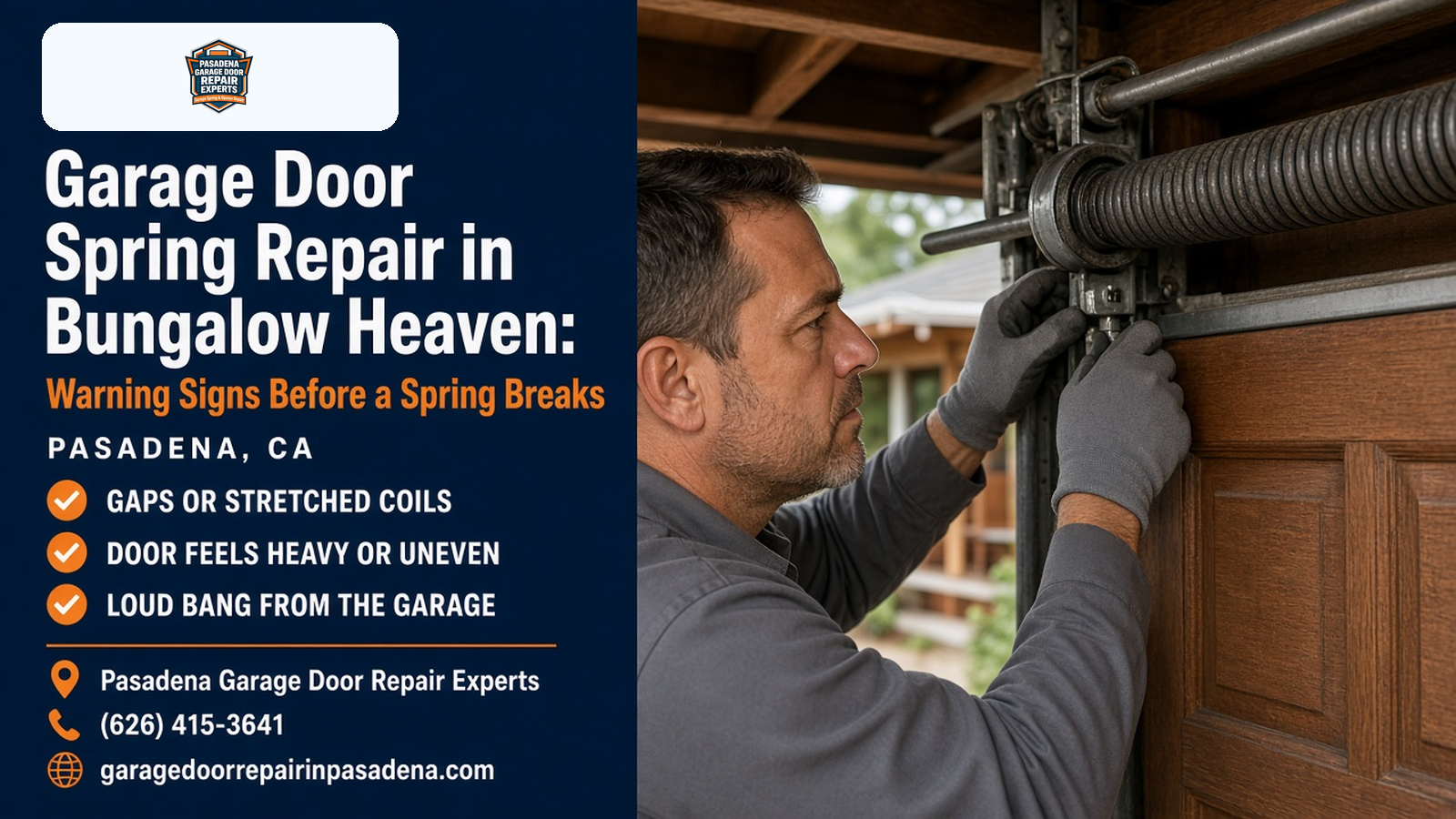
Garage Door Spring Repair in Bungalow Heaven: Warning Signs Before a Spring Breaks
Garage door springs rarely fail without warning. Before one breaks, the door usually starts to feel heavier, runs unevenly, won't stay put halfway open, or the spring itself shows rust, stretched coils or uneven gaps. If you spot these signs early, you can book spring repair on your schedule instead of finding a door that won't open on a busy morning.
That matters in Bungalow Heaven, where many older garages carry heavy wood doors that put extra load on the springs. This guide covers what to look for, a safe balance check, why springs wear out, and what not to touch. If you notice any warning sign, call Pasadena Garage Door Repair Experts at (626) 415-3641.
Quick Answer: How Do I Know a Garage Door Spring Is About to Break?
Short answer: Watch for a door that feels heavier, an opener that strains, a door that drifts when stopped halfway, jerky or uneven movement, and springs with rust, stretched coils or gaps. Any one of these means the springs should be checked. Pasadena Garage Door Repair Experts checks the whole door on site and gives you the exact price before any work starts. Call (626) 415-3641.
How Garage Door Springs Work
The opener doesn't really lift your door. The springs do. Most doors in the area use torsion springs, mounted on a steel shaft above the door. When the door closes, cables wound on drums twist the springs and store energy. When the door opens, the springs unwind and carry most of the weight. The opener just guides the motion.
Some older garages still use extension springs, which stretch along the horizontal tracks on each side. They do the same job in a different way and should have safety cables running through them in case one breaks.
Every spring is rated for a limited number of open-and-close cycles. Use, weight and rust all eat into that number. Once the metal is fatigued, it can snap without much warning, which is why the early signs matter.
Warning Signs Before a Spring Breaks
The door feels heavier than it used to
As a spring loses tension, it carries less of the door's weight and your arms or the opener carry more. This change is gradual, so it's easy to miss. If you lift the door by hand only now and then, notice whether it feels different.
The opener strains, slows or stops partway
An opener working against weak springs can hum, slow down, or reverse partway up because its force limit is reached. People often blame the opener when the springs are the real problem.
The door won't stay put halfway open
A balanced door stays where you leave it. If it drifts down, the springs are weak. If it drifts up, they may be wound too tight or mismatched.
Uneven or jerky movement
On a two-spring door, if one spring is weaker than the other, one side can lead, and the door may run crooked or jerk in the tracks.
Gaps, stretched coils or rust on the spring
Look at the spring from the floor with the door closed. Coils should sit evenly. A gap, a section that looks stretched, or heavy rust points to a spring near the end of its life. A gap of a few inches usually means it has already broken.
Squeaks or grinding from the spring area
Dry or rusty coils rub against each other. Noise alone isn't proof of failure, but together with any sign above, it's worth a check.
A Safe Balance Check You Can Do
Skip this if a spring already looks broken or a cable looks loose. Otherwise:
- Close the door fully.
- Pull the opener's emergency release cord so you can move the door by hand.
- Lift the door to about waist height and slowly let go, keeping your hands ready.
- If it stays put, the springs are in reasonable balance. If it drops or rises, call for a spring check.
- Close the door and reconnect the opener.
Door and opener makers recommend this check as regular maintenance, along with a monthly test of the opener's auto-reverse.
Signs, Likely Causes and Next Steps
| What you notice | Likely cause | Next step |
|---|---|---|
| Door feels heavier | Springs losing tension | Book a spring check |
| Opener strains or reverses | Weak springs or opener force setting | Stop forcing it; book a check |
| Door drifts when stopped halfway | Springs out of balance | Book a spring check |
| Rust, stretched coils, uneven gaps | Fatigued spring | Book soon; use the door gently |
| Gap of a few inches in the coils | Broken spring | Stop using the door and call |
| Loud bang from the garage | Spring snapped | Stop using the door and call |
Why Springs Wear Out
- Cycles. Each open and close uses up part of the spring's rated life. A garage used as the main entry wears springs faster.
- Weight mismatch. A spring that is too light for the door works harder every cycle.
- Rust. Surface rust adds friction between coils and weakens the metal.
- Neglect. Dry coils, worn bearings and binding rollers add load the spring has to fight.
Bungalow Heaven Factors That Affect Springs
Bungalow Heaven is a historic Craftsman neighborhood in northeast Pasadena, and many of its garages are older, detached, and fitted with wood doors. That changes spring wear in a few ways:
- Heavier doors. Wood and wood-clad doors weigh more than basic steel ones, and a door can gain weight over the years as it is repainted or repaired. Springs need to be matched to the door's real weight, not a guess.
- Older hardware. Some garages still have older extension spring setups. These should have safety cables running through them.
- Settling garages. Older framing can shift, pulling tracks out of line. A door that binds puts extra strain on the springs.
If you're thinking about replacing an older wood door instead, keep in mind that Bungalow Heaven is a landmark district and visible changes may need a look at Pasadena's design review rules first. Spring repair on your existing door doesn't change how it looks.
What Not to Touch
Torsion springs store a lot of energy. Please don't loosen set screws on the spring shaft, try to wind or unwind a spring, remove the bottom brackets where cables attach, or open a door by hand with a broken spring. The Door and Access Systems Manufacturers Association (DASMA) and the major opener makers say spring work belongs with trained technicians who have proper winding bars and parts.
What Spring Repair Involves
We secure the door first so it can't move. Then we check the door's weight and condition and fit springs matched to it. On two-spring doors we'll tell you the condition of the second spring so you can decide whether to replace both. We also check the cables, drums, bearings, rollers, hinges and opener, set the balance, and test the auto-reverse. You get the exact price after the check-up and before any work starts.
If a spring has already snapped and your car is trapped, it's an emergency. A truck is ready 24/7, with emergency response under 1 hour.
Frequently Asked Questions About Garage Door Spring Repair in Bungalow Heaven
What are the first signs a garage door spring is wearing out?
The door feels heavier when you lift it, the opener strains or slows down, the door doesn't stay put halfway open, or you see rust, stretched coils, or uneven gaps in the spring.
What does a broken torsion spring look like?
You'll usually see a gap of a few inches in the coils on the shaft above the door. Most people also hear a loud bang when it snaps.
How do I check my door's balance safely?
Close the door, pull the opener's release cord, and lift the door by hand to about waist height. A balanced door stays there. If it drops or rises on its own, the springs need attention. Skip this check if a spring or cable already looks broken.
Why do springs wear out faster on wood doors?
Springs are sized to the door's weight. Heavy wood doors put more load on them, and wood can gain weight over time as it is painted or repaired. A spring that isn't matched to the real weight wears out sooner.
Can I keep using the door if a spring looks worn?
Use it gently and book a check soon. If you see a gap in the coils, hear a bang, or the door won't stay balanced, stop using it and call.
Can I replace a garage door spring myself?
We don't recommend it. Torsion springs hold a lot of stored energy, and winding or unwinding them without the right tools and training can cause serious injury.
Should both springs be replaced at the same time?
On doors with two springs, they usually wear at a similar rate, so the second one is often close to failing. We'll tell you its condition and let you decide.
How much does spring repair cost in Bungalow Heaven?
It depends on the spring type, the door's weight, and what else needs work. We give you the exact price after the on-site check-up and before any work starts.
Does lubricating springs help?
A light coat of garage door lubricant on the coils can reduce friction and surface rust. It won't restore a spring that is already worn or stretched.
Is a broken spring an emergency?
It is if a car is trapped or the door is stuck open. A truck is ready 24/7, with emergency response under 1 hour.
What else do you check during a spring repair?
Cables, drums, bearings, rollers, hinges, tracks and the opener. A spring that ran out of balance often strains other parts too.
How often should springs be checked?
Look at them once a month and run the balance check every few months. A yearly professional tune-up catches wear you might not see.
Find Pasadena Garage Door Repair Experts on Google Maps
You can also view Pasadena Garage Door Repair Experts on Google Maps.
Seeing Spring Warning Signs in Bungalow Heaven?
Call Pasadena Garage Door Repair Experts at (626) 415-3641. We check the springs and the rest of the door on site and give you the exact price before any work starts. If a spring has already snapped, a truck is ready 24/7, with emergency response under 1 hour.
333 W California Blvd, Pasadena, CA 91105 · Serving South Pasadena, Pasadena, Altadena, San Marino, San Gabriel, East Pasadena, Arcadia, Sierra Madre, La Canada Flintridge, Eagle Rock, and Glendale
Safety reminder: don't adjust or remove springs, cables, or bottom brackets yourself, and don't bypass the opener's safety sensors.
One Response