Garage Door Repair vs. Replacement in Pasadena: Which One Makes More Sense?
A broken garage door does not automatically need to be replaced, and an old garage door does not automatically make another repair a good investment. The right decision depends on what actually failed, the condition of the door sections and hardware, how frequently the system has needed repair, whether the door remains structurally sound, and what the homeowner wants from the garage going forward.
This guide from Pasadena Garage Door Repair Experts explains how Pasadena homeowners can compare garage door repair versus replacement without assuming that every broken spring, damaged cable, opener problem, sensor fault, dented panel, or noisy roller requires a completely new garage door.
It also explains when broader deterioration, repeated mechanical failures, extensive panel damage, poor door condition, outdated equipment, or major insulation and design goals can make replacement worth discussing.
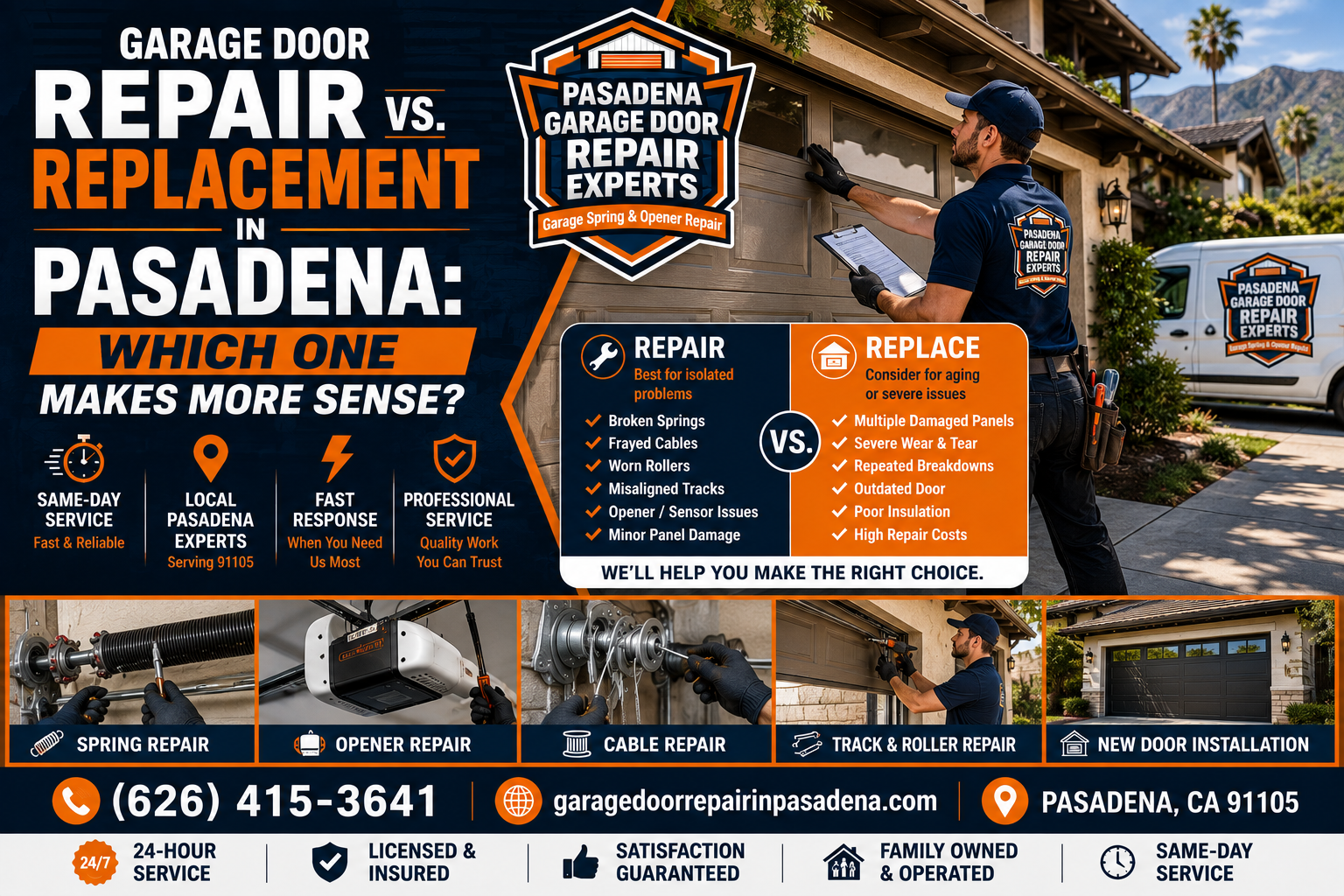
Is It Better to Repair or Replace a Garage Door in Pasadena?
Repair usually makes more sense when the garage door is structurally sound and the problem is limited to one or a few serviceable components, such as springs, cables, rollers, tracks, sensors, hinges, opener parts, or a repairable panel. Replacement becomes more reasonable when the door has extensive structural damage, multiple deteriorated sections, repeated major failures, severe deformation, widespread corrosion, poor overall condition, or when the homeowner wants a significant upgrade in appearance, insulation, or door design.
The symptom alone is not enough to make the decision. A garage door that will not open may simply have a broken spring. A door that reverses while closing may have a sensor or opener-setting problem. A door that becomes crooked may have a cable or track issue. None of those symptoms automatically proves that the complete garage door needs replacement.
On the other hand, repeatedly repairing individual components on a badly deteriorated, severely damaged, or structurally compromised door can eventually stop making practical sense.
The best approach is to separate the condition of the garage door itself from the condition of individual operating components.
The 7-Factor Garage Door Repair vs. Replacement Decision
Homeowners often ask one simple question: “Should I repair this garage door or replace it?” The answer is easier to reach when that question is divided into several smaller ones.
1. What actually failed?
A broken spring is different from a cracked or structurally distorted door section. A failed opener is different from multiple deteriorated panels. Diagnose the failed component first.
2. Is the door structurally sound?
If the sections remain aligned and structurally serviceable, component repair may remain practical. Severe deformation changes the discussion.
3. Is the problem isolated?
One spring, one opener component, a sensor problem, worn rollers, or a single damaged cable does not automatically justify replacing an otherwise usable door.
4. Are failures becoming frequent?
Repeated major repairs across several systems can indicate that the overall door and hardware deserve a broader evaluation.
5. Is replacement solving something repair cannot?
Replacement may address insulation, appearance, significant structural deterioration, multiple damaged sections, or a major design upgrade.
6. Are replacement components compatible?
Panels, tracks, hardware, springs, and door weight must work together. Compatibility should be considered before mixing old and new systems.
7. What does the homeowner want long term?
A homeowner planning to keep the existing appearance may value repair, while another homeowner may already want a new insulated or updated door.
These factors produce a more useful answer than relying on age alone or assuming that any expensive-sounding repair means replacement is required.
When Garage Door Repair Usually Makes More Sense
Repair is often the logical choice when the core garage door remains structurally usable and the failure is limited to a specific component or adjustment.
Garage doors are systems made from many serviceable parts. Springs wear. Rollers develop bearing problems. Hinges loosen or crack. Cables fray. Openers develop drive or electronic faults. Sensors become misaligned. Tracks can shift. Weather seals deteriorate.
The failure of one of those components does not necessarily mean the door sections themselves have reached the end of their serviceable life.
Repair may deserve priority when:
- The door sections are still structurally sound.
- The problem is limited to springs.
- The opener needs repair or replacement but the door itself is good.
- A cable has failed without major structural damage.
- Rollers or hinges are worn.
- Track alignment can be corrected safely.
- Safety sensors or opener controls are the cause.
- A single panel can be repaired or replaced compatibly.
- The door has not developed widespread deterioration.
- The homeowner is satisfied with the door's appearance and insulation.
The important phrase is structurally sound. A repair should restore a usable system, not merely keep a badly compromised door operating for another short period without addressing larger problems.
When Garage Door Replacement Becomes Worth Discussing
Replacement becomes more relevant when problems extend beyond one serviceable component and affect the overall condition, structure, compatibility, or usefulness of the garage door.
Examples can include multiple severely damaged sections, significant impact damage, substantial structural distortion, extensive corrosion, recurring problems throughout an aging system, an obsolete configuration that makes compatible parts difficult to source, or a homeowner's desire for a significant insulation or design upgrade.
Replacement may also make sense when repairing one problem simply exposes several other major problems that were already present.
Consider a door with a damaged bottom section, worn rollers, deteriorated hinges, badly bent track, significant panel distortion, and an opener struggling because the door no longer moves smoothly. Looking at each item individually can make the situation appear to involve several unrelated repairs. Looking at the complete system may reveal broader deterioration.
Replacement should still be based on inspection rather than fear-based selling. A homeowner should be able to understand why the existing door is no longer a strong repair candidate.
Broken Garage Door Spring: Repair the Spring or Replace the Door?
A broken garage door spring by itself normally points toward a spring repair or replacement, not automatic replacement of the complete garage door.
Springs are wear components in a counterbalance system. Their purpose is to offset much of the garage door's weight so that the door can move through its tracks without the opener carrying the full dead load.
When a torsion or extension spring fails, the door can become very heavy. An opener may lift it only a few inches, strain, stop, or reverse.
That dramatic symptom can make the entire garage door appear ruined even though the main door sections, tracks, hinges, and opener may remain usable.

The Door & Access Systems Manufacturers Association notes in its garage door safety guidance that springs wear and that damaged spring systems should be handled with appropriate professional care.
- Wind a torsion spring.
- Unwind a torsion spring.
- Remove spring anchor hardware.
- Loosen winding cones.
- Modify bottom brackets connected to lift cables.
When a broken spring might trigger a broader replacement discussion
The spring failure may reveal other conditions. If the door is also structurally deteriorated, badly damaged, severely corroded, no longer compatible with appropriate hardware, or has multiple major problems, then evaluating replacement can be reasonable.
But the broken spring itself should not be used as proof that the complete door needs replacement.
Garage Door Opener Failure: Repair the Opener or Replace the Whole Door?
A garage door opener failure normally affects the opener, not the structural garage door.
Openers contain motors, gears, belts or chains, sprockets, logic boards, travel systems, control electronics, sensors, trolleys, and other model-specific components.
A failed opener can make a perfectly serviceable garage door unusable under automatic operation. That does not make the door sections defective.
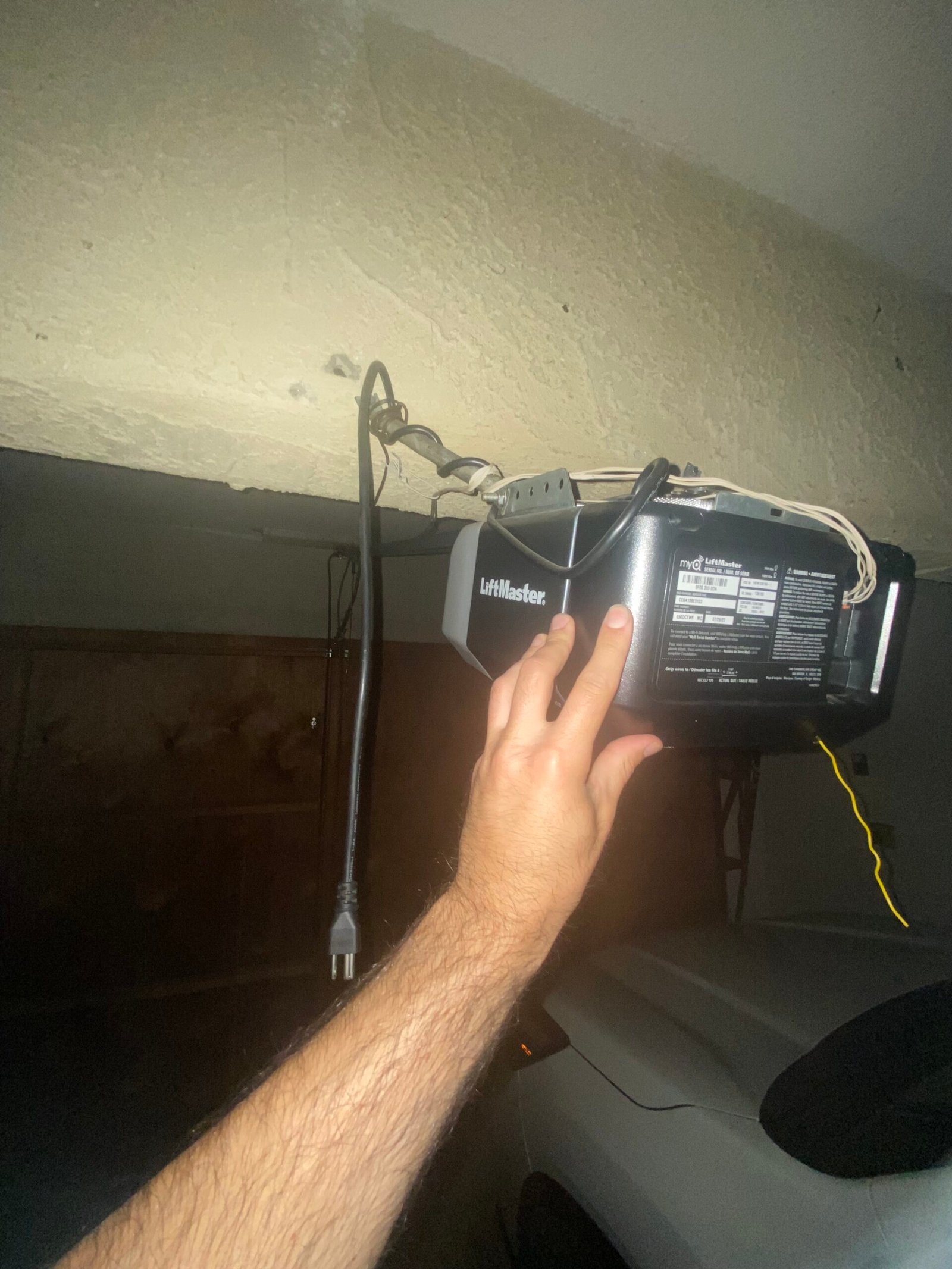
Before assuming the opener itself is bad, diagnosis should also confirm that the door is properly balanced and moves without major mechanical resistance.
A broken spring can make an opener look weak. A bent track can make an opener appear underpowered. A damaged cable can create crooked travel. An engaged manual lock can make the motor strain against a door that is physically secured.
If the door is mechanically healthy but the opener is failing, opener service or opener replacement can often be considered independently from the garage door itself.
When a complete system upgrade may make sense
If a homeowner already plans to replace a severely deteriorated door, reviewing the opener at the same time can make sense because door weight, mounting, travel and compatibility may change.
That is a coordinated system decision—not evidence that an opener failure alone requires a new door.
Broken or Frayed Garage Door Cable: Repair or Replace?
A damaged lift cable is usually a component-level problem unless the cable failure has caused or resulted from larger structural damage.
Lift cables work with the spring system and cable drums to raise and lower the door. If one cable becomes loose, frayed, broken or displaced, the door may become crooked, jam in the tracks, or rise unevenly.
That can look severe, especially if one side of the door is several inches higher than the other.
DASMA advises homeowners to visually inspect cables for wear while warning that cables connected to high spring tension should be replaced by trained personnel.
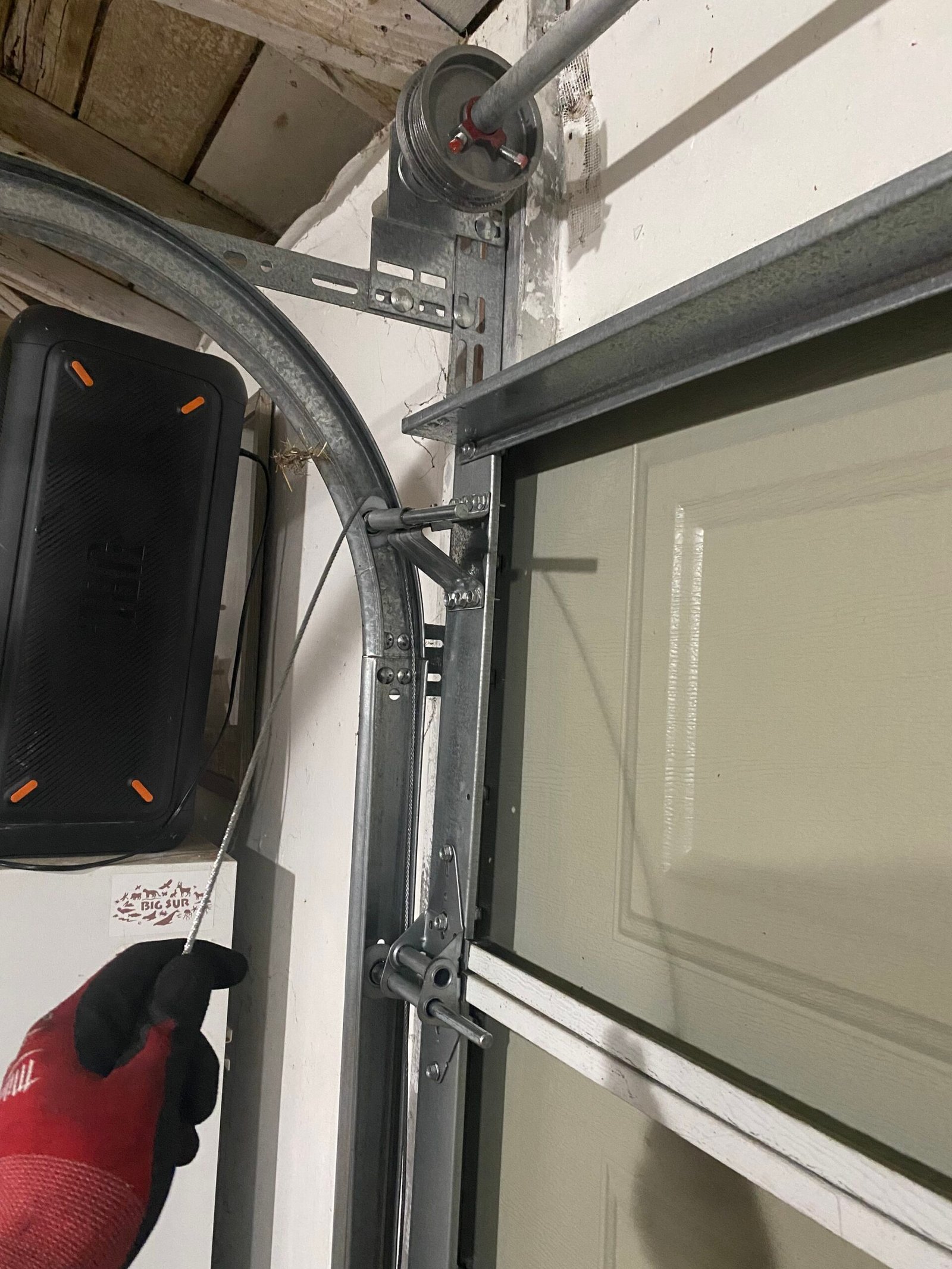
A cable failure should prompt inspection of the spring, cable drum, rollers, tracks and door alignment. The goal is to understand why the cable failed or came off its drum.
If the door sections remain structurally sound and secondary damage is limited, cable-related repair may remain practical.
If the incident has badly twisted panels, significantly damaged tracks, distorted hinges and created broader structural problems, replacement may deserve consideration.
Bent Tracks and Worn Rollers: When Can They Be Repaired?
Track and roller problems cover a wide range of severity.
A slightly shifted track bracket is not the same condition as a severely bent track after vehicle impact. A worn roller is not the same as multiple rollers leaving distorted track while damaged door sections twist in the opening.
Repair can make sense when:
- The track is structurally usable and can be aligned correctly.
- Roller wear is localized.
- Hinges and door sections remain sound.
- The door can be restored to smooth, balanced travel.
- The problem was caused by loose or worn serviceable hardware.
Replacement becomes a stronger discussion when:
- Track damage is severe.
- Several sections are structurally distorted.
- The door has suffered significant impact damage.
- Compatible replacement components are problematic.
- The complete door system is deteriorated rather than one isolated part.
DASMA specifically cautions against assuming an old track should automatically be reused with a new replacement door. Door thickness, weight, headroom, opener position and other design considerations can change track requirements.
In other words, if the decision is made to replace the complete door, the new door and its track system should be evaluated as a compatible system rather than mixing components simply to reduce the scope of installation.
Damaged Garage Door Panel: Replace One Section or the Entire Door?
Panel damage is one of the most important repair-versus-replacement decisions because damage can be cosmetic, localized, structural or widespread.
A small dent in one section does not carry the same consequences as a severely folded bottom section after vehicle impact.
When one-panel repair or replacement may make sense
- The damage is limited to one section.
- The rest of the door remains structurally sound.
- A compatible panel is available.
- The replacement section matches the door system.
- The damage has not distorted the tracks or adjoining sections.
- Door weight and spring requirements remain appropriate after repair.
When whole-door replacement deserves consideration
- Several panels are badly damaged.
- The door is significantly twisted.
- Impact damage has affected tracks, hinges and multiple sections.
- Compatible sections are no longer reasonably available.
- The overall door is already badly deteriorated.
- The homeowner wants a substantially different door system.
Panel compatibility matters because a garage door is not simply a wall of interchangeable rectangles. Section thickness, reinforcement, hinge placement, design, weight and hardware relationships can affect the way the complete door operates.
Garage Door Sensor Problems Rarely Mean You Need a New Garage Door
A safety-sensor problem generally points toward troubleshooting or repairing the automatic opener safety system, not replacing the complete garage door.
Sensors can become dirty, blocked, misaligned, damaged or affected by wiring problems. An opener may refuse to close or may reverse because its safety system is detecting an interrupted or unreliable beam.
These are normally very different conditions from widespread structural garage door deterioration.
Pasadena homeowners dealing specifically with a door that reverses, stops, or refuses to close can review our guide to garage door closing problems in Pasadena for sensor, track, opener and closing-specific troubleshooting.
That distinction is important when evaluating repair versus replacement. A problem can feel serious because the garage door is unusable while still being limited to one serviceable system.
How Much Should the Age of a Garage Door Influence the Decision?
Age is relevant, but it should not be the only deciding factor.
Two garage doors of similar age can be in dramatically different condition. One may have been maintained, remain structurally sound and operate smoothly. Another may show panel deterioration, recurring hardware problems, corrosion, impact damage and repeated opener strain.
Garage-door use also varies. A household that uses the garage as its main entrance can cycle the system much more frequently than a garage that is opened only occasionally.
Sun exposure, moisture, maintenance history, door material, installation quality, vehicle impact and hardware condition can all influence how a door ages.
Better questions than “How old is the door?”
- Is the door structurally sound?
- Does it move smoothly?
- Are sections deteriorated?
- Are several components failing together?
- Are parts compatible and available?
- Does the homeowner still like the door?
- Does the door meet current insulation and design goals?
Age can help explain why wear is accumulating, but it does not eliminate the need for inspection.
When Repeated Garage Door Repairs Start Changing the Equation
One repair is not the same as a pattern of unrelated major repairs.
Replacing a spring is normal component maintenance when the rest of the door is healthy. Repairing an isolated opener fault can also be reasonable.
The discussion changes when a homeowner has recently dealt with several major issues involving different parts of an already deteriorating door.
Examples might include:
- Multiple damaged door sections.
- Recurring track alignment problems caused by structural distortion.
- Several failing hinges and rollers.
- Repeated cable problems linked to broader misalignment.
- A deteriorated door combined with an aging opener.
- Hardware repairs followed by new structural problems.
The number of repairs alone should not be manipulated into a sales argument. What matters is whether the repairs are normal wear items or evidence that the complete system has become a poor long-term repair candidate.
Ask for the problems to be separated
A homeowner should be able to understand which repairs are necessary now, which items are simply worn but serviceable, and which conditions make replacement worth discussing.
This prevents a long list of minor maintenance items from being presented as if each one were a catastrophic failure.
Insulation, Appearance and Home-Upgrade Goals Can Make Replacement More Attractive
Repair-versus-replacement is not always a damage-only decision.
A homeowner may have a garage door that can technically be repaired while also wanting a significantly different door.
Replacement may be considered for:
- Improved insulation characteristics.
- A different panel design.
- Updated windows.
- A different door material.
- Changes in color or curb appeal.
- Reduced outside noise where appropriate.
- A new garage-door system coordinated with a remodel.
- Replacement after broader property renovation.
In these situations, the question is not simply “Can the old door be repaired?” It becomes “Does repairing the old door help the homeowner reach the result they actually want?”
That is a different decision from declaring a repairable door unusable.
Homeowners should separate necessity from upgrade preference. A technician may conclude that the existing door is repairable while the homeowner independently chooses replacement because of appearance, comfort or renovation objectives.
Garage Door Repair vs. Replacement Cost: What Actually Changes the Price?
This article does not provide a made-up fixed repair or replacement price. Garage door costs depend on too many system-specific factors for one number to represent every Pasadena home.
Repair-cost factors can include:
- The failed component.
- Number and type of required parts.
- Spring type and configuration.
- Door dimensions and weight.
- Cable and drum condition.
- Track condition.
- Roller and hinge condition.
- Opener make, model and failed part.
- Panel compatibility and availability.
- Additional damage discovered during diagnosis.
- Labor required to restore safe operation.
Replacement-cost factors can include:
- Door size.
- Door material.
- Panel design.
- Insulation construction.
- Window options.
- Hardware requirements.
- Track configuration.
- Spring system.
- Headroom and opening conditions.
- Removal of the existing system.
- Opener compatibility.
- Installation complexity.
The useful comparison is not simply “repair price versus replacement price.” It is:
What condition will the garage door be in after the repair, and what problem does replacement solve that the repair does not?
A modest component repair on a healthy door and a major reconstruction of a badly deteriorated system are very different scenarios.
Garage Door Repair vs. Replacement Comparison Table
| Condition | Repair Often Makes Sense When | Replacement May Make Sense When | Important Question |
|---|---|---|---|
| Broken spring | Door sections and other hardware remain sound | Door also has widespread structural deterioration | Is the spring the real problem or one of many major problems? |
| Opener failure | Mechanical garage door is healthy | Door itself is also being replaced for broader reasons | Is the opener failing or reacting to a heavy/binding door? |
| Broken cable | Damage is localized and door remains structurally sound | Cable failure occurred with serious door and track damage | Why did the cable fail or leave the drum? |
| Worn rollers | Tracks, hinges and panels are usable | Widespread structural deterioration is also present | Are rollers the cause or just one symptom? |
| Bent track | Damage is limited and alignment can be safely restored | Impact badly damaged track and multiple panels | Is the door still square and structurally sound? |
| Sensor failure | Door and opener are otherwise functional | Replacement is already planned for unrelated broader reasons | Is this only a safety-sensor problem? |
| One damaged panel | Compatible replacement section is available | Several sections are badly damaged | Will the replacement section match structurally and visually? |
| Several damaged panels | Damage remains limited enough for safe compatible repair | Door is substantially distorted | How much of the original door remains serviceable? |
| Old but operating door | Door remains safe, smooth and structurally sound | Homeowner wants a major upgrade or deterioration is widespread | Is age causing actual problems? |
| Repeated major failures | Failures are isolated normal wear items | Problems indicate broad system deterioration | Are repairs restoring a healthy system? |
| Poor insulation or outdated appearance | Homeowner is satisfied with existing door | Upgrade goals matter enough to justify a new door | Is replacement a repair need or improvement choice? |
Safety Can Override the Repair-vs-Replacement Debate
Some garage door conditions require immediate attention before a homeowner worries about the economic decision.
A visibly unstable, crooked, hanging, severely off-track or structurally compromised door should not continue being operated merely to determine whether it can “make it a little longer.”
Likewise, torsion springs, cable drums, bottom brackets and lift cables can involve significant stored energy.
DASMA notes that bottom brackets are connected to the spring system and advises that those components be adjusted only by trained door-system technicians.
- A lift cable is visibly loose or broken.
- A roller has left the track.
- The door is badly crooked.
- The door is hanging from only part of the track system.
- A spring is visibly broken.
- A section is severely folded or structurally distorted.
- The door falls or moves unusually fast.
- Track mounting appears unstable.
The first goal in these situations is stabilizing and diagnosing the garage door safely. Repair-versus-replacement can be evaluated after the condition is understood.
Pasadena Factors to Consider Before Replacing a Garage Door
Pasadena contains a wide variety of residential architecture, including older Craftsman and bungalow-style properties as well as updated, Spanish-influenced, stucco and contemporary homes.
That variety means garage-door replacement should not be approached as a one-design-fits-every-property decision.
The existing opening, track arrangement, available headroom, door weight, opener location, exterior appearance and home design can all affect the replacement conversation.
Pasadena's Southern California climate can also make homeowners think about sun exposure and garage heat when considering an insulated or otherwise upgraded door. Those preferences should be evaluated as homeowner goals rather than presented as proof that an existing repairable door must be replaced.
Residential context may naturally include areas such as Old Pasadena, Bungalow Heaven, Hastings Ranch, Madison Heights and San Rafael Hills. These references describe Pasadena residential settings and do not represent separate business locations.
The primary geographic context remains Pasadena, California 91105, Los Angeles County and the San Gabriel Valley.
Does a Garage Door Replacement in Pasadena Require a Permit?
Permit requirements can depend on the scope of work, so homeowners should not assume that every garage door repair or every replacement project is handled identically.
Straightforward component repair is different from work that changes the building opening, framing, structural conditions or other parts of the property.
Pasadena homeowners with permit or building-code questions can consult the official City of Pasadena Building & Safety Division .
The city's Building & Safety resources provide permitting and inspection information and should be treated as the authority for Pasadena-specific requirements.
Do not rely on a garage door article to determine whether a particular structural modification requires a permit. The exact project scope should be compared with current city requirements.
Questions to Ask Before Approving Garage Door Repair or Replacement
A homeowner should understand the diagnosis before choosing between repair and replacement.
Useful questions include:
- What exactly failed?
- Can you show me the damaged component?
- Is the door itself structurally sound?
- Which problems are safety-related?
- Which problems are normal wear?
- Can the failed component be replaced independently?
- Are compatible replacement panels or hardware available?
- Are the tracks still appropriate for the door?
- Is the spring system correctly matched to the door weight?
- Are the cables and drums in good condition?
- Does the opener need repair, or is it reacting to door resistance?
- How many sections are structurally damaged?
- What would remain unchanged after repair?
- What specific problem would complete replacement solve?
- Does replacement require changing the track system?
- Is the current opener compatible with the proposed new door?
- What parts and labor are included?
- Are there any additional project requirements I should know about?
California homeowners can also consult the California Contractors State License Board. The CSLB D-28 Doors, Gates and Activating Devices Contractor classification covers contractors who install, modify or repair residential, commercial and industrial doors and related activating devices.
Pasadena's Building & Safety Division also provides links for contractor-license lookup.
This article does not make a specific licensing claim about Pasadena Garage Door Repair Experts. Current licensing information should be verified through official records where applicable.
Garage Door Repair vs. Replacement Red Flags
Be cautious when someone immediately recommends a new garage door without explaining what is wrong with the existing one.
Potential red flags include:
- Declaring the door “too old” without inspecting its condition.
- Recommending replacement because of one broken spring.
- Claiming a failed opener means the entire garage door is bad.
- Recommending a full door because of a sensor problem.
- Failing to inspect cables and tracks before explaining crooked movement.
- Refusing to show structural panel damage.
- Calling cosmetic damage a safety failure without explanation.
- Ignoring compatible panel-replacement options when they exist.
- Recommending repair on a severely unstable door without addressing structural damage.
- Providing vague pricing without explaining parts and scope.
- Using pressure instead of diagnosis.
Repair is not automatically the better option and replacement is not automatically the better option. The correct recommendation should follow the actual condition of the system.
A Simple Pasadena Homeowner Repair-or-Replace Checklist
Answer these questions before deciding:
-
Is the garage door structurally sound?
If yes, repair remains more plausible. -
Is the failure limited to one serviceable component?
Springs, cables, rollers, sensors and opener parts do not automatically require a complete door. -
Are multiple sections severely damaged?
Widespread structural damage strengthens the replacement case. -
Is the door badly distorted or unstable?
Safety and structural condition come first. -
Have major problems become frequent?
A pattern of deterioration matters more than one isolated repair. -
Are compatible parts still practical?
Section, track and hardware compatibility can affect the decision. -
Are you satisfied with the current door?
If yes, repair may preserve a system you still want. -
Do you want a major design or insulation upgrade?
Replacement may accomplish goals unrelated to the current breakdown. -
Can the repair restore safe, smooth operation?
If not, replacement deserves a more serious discussion.
Why Consider Pasadena Garage Door Repair Experts?
Pasadena Garage Door Repair Experts serves residential garage door customers in Pasadena, California.
For repair-versus-replacement decisions, the useful starting point is an accurate diagnosis of the complete door system.
Relevant issues may involve:
- Broken springs.
- Garage door opener problems.
- Damaged cables.
- Off-track doors.
- Worn rollers.
- Track problems.
- Safety-sensor issues.
- Damaged panels.
- Hinge problems.
- Door-balance problems.
- Complete garage door replacement.
A repair recommendation should explain what can reasonably remain in service. A replacement recommendation should explain what broader condition makes replacement worth considering.
Visit Pasadena Garage Door Repair Experts or call (626) 415-3641 to describe the garage door and ask about current scheduling availability.
Pasadena Garage Door Repair and Replacement Service Area
The primary geographic focus is Pasadena, California 91105, within Los Angeles County and the San Gabriel Valley.
Pasadena residential context can include Old Pasadena, Bungalow Heaven, Hastings Ranch, Madison Heights and San Rafael Hills when relevant.
These references do not imply separate office locations.
Homeowners can call (626) 415-3641 to ask whether current scheduling is available for their Pasadena property.
Frequently Asked Questions About Garage Door Repair vs. Replacement in Pasadena
Is it cheaper to repair or replace a garage door?
Repair is generally a smaller scope when the problem is limited to one serviceable component, while complete replacement involves a new door system and installation. The better financial decision depends on the actual damage, overall door condition, repair scope, compatible parts and what condition the door will be in after the repair. Fixed pricing should not be assumed without inspecting the specific system.
Does a broken garage door spring mean I need a new door?
No. A broken spring by itself normally indicates a spring-system repair, not automatic replacement of the complete garage door. Replacement becomes more relevant if the door also has extensive structural damage, severe deterioration or several other major problems.
Does a broken garage door opener mean I need a new garage door?
No. The opener and the structural garage door are separate but connected systems. If the door itself is mechanically sound, an opener problem can often be addressed without replacing the door. Diagnosis should first make sure the opener is not simply reacting to a broken spring, binding track or out-of-balance door.
Can I replace just one damaged garage door panel?
Sometimes. Single-panel replacement can make sense when the damage is localized, the rest of the door remains structurally sound and a compatible replacement section is available. Multiple damaged or distorted panels can make complete replacement more reasonable.
Is an old garage door automatically worth replacing?
No. Age is only one factor. A structurally sound older door that operates smoothly may remain a good repair candidate, while a badly deteriorated or repeatedly failing door may justify replacement. Condition matters more than age alone.
When do repeated garage door repairs stop making sense?
Repeated repairs become more important when they indicate broad deterioration across several systems rather than normal wear on individual parts. Homeowners should ask whether each repair restores a fundamentally healthy door or whether new major problems continue appearing because the overall system is deteriorating.
Should I replace a garage door because the safety sensors are bad?
Usually not. Safety-sensor problems commonly involve alignment, obstruction, wiring or sensor components within the opener safety system. Those issues do not automatically indicate structural failure of the garage door itself.
Is a crooked garage door better repaired or replaced?
It depends on why the door is crooked and how much secondary damage has occurred. A cable, roller or track problem may be repairable if the door remains structurally sound. Severe panel distortion, multiple damaged sections and major track damage can make replacement more appropriate. Stop operating a badly crooked door until it can be inspected.
Is a new garage door worth considering for better insulation?
It can be if improved insulation is an important homeowner goal. Insulation is different from a mechanical repair need, however. An existing door may still be repairable while a homeowner independently chooses replacement to improve comfort, appearance or construction.
Should old garage door tracks be reused with a new door?
Not automatically. Track design can depend on door thickness, weight, headroom, hardware and other system requirements. DASMA advises using track designed for the specific replacement door rather than assuming an old track is compatible.
Who can evaluate garage door repair versus replacement in Pasadena?
Pasadena homeowners can contact Pasadena Garage Door Repair Experts at (626) 415-3641 to describe the condition of their garage door and ask about current scheduling availability for inspection, repair or replacement discussions.
Find Pasadena Garage Door Repair Experts on Google Maps
You can also view Pasadena Garage Door Repair Experts on Google Maps .
Not Sure Whether to Repair or Replace Your Garage Door in Pasadena?
Start with the actual condition of the door. A broken spring, opener failure, cable problem, sensor fault or worn roller may still be a component-level repair. Multiple damaged panels, severe distortion, extensive deterioration or recurring major problems can make replacement more reasonable.
Call Pasadena Garage Door Repair Experts at (626) 415-3641 to describe the problem and ask about current scheduling availability in Pasadena, California.
Safety reminder: do not adjust torsion springs, high-tension cables, cable drums, bottom brackets or unstable off-track garage doors yourself.
Related Pasadena Garage Door Topics
- Garage Door Won’t Close in Pasadena? 8 Reasons It Keeps Reversing or Stopping
- 10 Warning Signs Your Garage Door Spring Is About to Break
- How Long Do Garage Door Springs Last in Pasadena, CA?
- Can You Replace Just One Garage Door Panel, or Do You Need a New Door?
- Is an Insulated Garage Door Worth It in Pasadena? Costs, R-Values and Energy Benefits