
When Is the Best Time to Repair or Replace a Garage Door in South Pasadena, CA?
South Pasadena Homeowner Guide When Is the Best Time to Repair or Replace a Garage Door in South Pasadena, CA? Some garage door problems should be repaired as soon as they appear, while a complete replacement can often be planned around your budget, remodeling schedule and long-term goals. This guide explains how South Pasadena homeowners can decide which option makes more sense. Call (626) 415-3641 Garage Door Repair Services Quick answer: The best time to repair a garage door is when a mechanical problem begins affecting safe, reliable operation. Complete replacement can usually be planned when the existing door still operates safely but has extensive damage, repeated repair needs, poor insulation or no longer fits the homeowner’s goals. There is no single month or season that automatically makes garage door repair better. A broken spring, damaged cable, off-track door or door that will not close securely should not be ignored simply because you would prefer to schedule the work later. Replacement is different. If the door remains safe and functional, homeowners often have time to compare materials, insulation, windows, design, opener compatibility and overall cost before choosing a new door. The condition of the complete door system matters more than age alone. A relatively old door with sound sections may still be worth repairing, while a newer door with major impact damage may require a more extensive solution. Homeowners comparing both options can also review Garage Door Repair vs. Replacement: Which One Makes More Sense? Repair or Replace? Repair safety problems promptly Repair isolated mechanical failures Do not postpone broken springs or cables Consider replacement for extensive door damage Compare options after repeated major repairs Consider replacement for insulation upgrades Plan replacement when the existing door is still safe Not Sure Whether Your Garage Door Needs Repair or Replacement? Pasadena Garage Door Repair Experts serves South Pasadena homeowners and can inspect the door, springs, cables, rollers, tracks, opener and panels before explaining the available repair or replacement options. Call (626) 415-3641 View Garage Door Services In This South Pasadena Garage Door Guide 1. Is there a best time to repair? 2. Problems that should not wait 3. When repair usually makes sense 4. When replacement may make sense 5. Does garage door age matter? 6. How much damage is too much? 7. Repeated repairs 8. Broken springs 9. Opener problems 10. Insulation and comfort 11. Repair vs. replacement cost 12. How long the work takes 13. What should be inspected? 14. Planning a replacement 15. Related homeowner guides 16. Frequently asked questions Is There Really a Best Time to Repair a Garage Door? Short answer: The best time is usually when the problem first begins affecting normal operation. Waiting can sometimes allow one worn or damaged component to place additional stress on other parts of the system. A garage door depends on several connected components. Springs balance much of the door’s weight, cables transfer lifting force, rollers guide the door through the tracks and the opener provides powered movement. If a problem develops in one area, another component can sometimes compensate temporarily. That does not necessarily mean the door is operating correctly. For example, an opener may continue lifting a door with poor spring balance for a period of time, but the additional load can make the opener work harder than intended. Garage Door Problems That Should Not Be Postponed Short answer: Problems involving broken lifting components, uncontrolled movement, security or an unstable garage door should be inspected promptly rather than scheduled around a preferred season. Broken Spring A failed spring can make the garage door extremely heavy and difficult for the opener to lift. Broken Cable A damaged lifting cable can cause uneven movement or leave the door sitting crookedly. Off-Track Door A garage door that has left its tracks can become unstable and should not be repeatedly operated. Door Will Not Close A door that cannot close properly can create both a mechanical issue and a home-security concern. Crooked Operation Uneven movement can indicate problems with cables, drums, rollers, tracks or spring balance. Major Impact Damage Damage from a vehicle or other impact can affect panels, tracks, rollers and hardware simultaneously. Safety Problems Should Determine the Timing If a garage door is hanging crookedly, has broken lifting hardware, has come off track or appears unstable, do not wait for a supposedly better month or season before having the problem inspected. When Does Repair Usually Make More Sense? Short answer: Repair is often worth considering when the garage door itself remains structurally sound and the problem is limited to a serviceable component. The garage door sections are still in good structural condition. A spring has failed but the rest of the door is serviceable. Worn rollers can be replaced. A cable or track problem is isolated. The opener problem does not involve the physical door itself. One damaged panel can be replaced individually. The door still meets your appearance and insulation needs. Major repairs are not happening repeatedly. A single damaged section, for example, does not automatically require a complete new garage door. Read Can You Replace Just One Garage Door Panel, or Do You Need a New Door? for a more detailed comparison. When Might Garage Door Replacement Make More Sense? Short answer: Replacement becomes more worth considering when the door has widespread structural deterioration, multiple damaged sections, repeated major repair needs or no longer provides the features the homeowner wants. Condition Why Replacement May Be Worth Comparing Multiple damaged panels Replacing several sections can significantly increase the repair scope. Widespread deterioration Localized repairs may not solve the overall condition of the door. Major impact damage Panels, tracks and hardware may all be affected. Repeated major repairs Homeowners may want to compare continued repair costs with a new system. Poor insulation A replacement door can provide different construction and insulation options. Major exterior remodeling A new door can be coordinated with other design changes to the home. Does the Age of the Garage Door Mean It Should
Garage Door Repair South Pasadena, CA: Complete 2026 Guide for Homeowners
South Pasadena Garage Door Homeowner Guide Garage Door Repair South Pasadena, CA: Complete 2026 Guide for Homeowners From broken springs and opener problems to damaged cables, rollers, tracks and sensors, this 2026 guide explains the most common garage door problems South Pasadena homeowners may encounter, what repairs involve and when professional service should be considered. Call (626) 415-3641 Garage Door Repair Services Quick answer: Garage door repair in South Pasadena can involve anything from replacing a worn roller or correcting a sensor problem to repairing broken springs, cables, tracks, panels or the garage door opener. The right repair depends on what caused the problem—not simply which part appears damaged first. A residential garage door is a complete mechanical system. Springs help counterbalance the weight of the door, cables transfer lifting force, rollers guide movement through the tracks, hinges allow the sections to bend and the opener controls powered operation. When one part begins to fail, the symptom can sometimes appear somewhere else. A garage door opener that seems weak may actually be trying to lift a poorly balanced door. A crooked door may point to a cable problem rather than an opener issue. A door that keeps reversing may be reacting to sensor alignment or resistance in the door system. That is why useful garage door repair starts with diagnosis. Before deciding what needs to be replaced, the entire operating system should be considered. If your main symptom is a garage door that refuses to open, our guide to nine common reasons a garage door will not open covers several possible causes. Common Garage Door Repairs Broken spring repair Garage door opener repair Broken or frayed cable repair Off-track garage door service Roller replacement Track repair and alignment Sensor troubleshooting Panel repair or replacement Garage door tune-ups Need Garage Door Repair in South Pasadena? Pasadena Garage Door Repair Experts provides service for common garage door problems including broken springs, opener issues, cables, rollers, tracks, sensors and doors that no longer open or close correctly. Call (626) 415-3641 View Garage Door Services In This South Pasadena Garage Door Repair Guide 1. Common garage door problems 2. Garage door spring repair 3. Garage door opener problems 4. Broken and frayed cables 5. Off-track garage doors 6. Rollers and tracks 7. Garage door sensor problems 8. Damaged garage door panels 9. Noisy garage doors 10. Repair vs. replacement 11. What affects repair cost? 12. How long repairs take 13. Preventive maintenance 14. Emergency garage door problems 15. Related homeowner guides 16. Frequently asked questions What Are the Most Common Garage Door Problems in South Pasadena? Short answer: Common problems include broken springs, opener failures, damaged cables, worn rollers, bent or misaligned tracks, sensor problems, damaged panels and doors that become noisy, crooked or difficult to move. Door Will Not Open A door that stays closed may have a spring, opener, cable, track, lock or power-related problem. Door Will Not Close Sensor alignment, wiring, opener settings, track resistance or other mechanical problems can keep the door from closing. Door Is Very Heavy Sudden heavy operation can point to a broken or weakened counterbalance system. Door Moves Crookedly Uneven movement may involve cables, drums, rollers, tracks or spring balance. Door Makes New Noises Grinding, popping, rattling or squeaking can originate from rollers, hinges, tracks or loose hardware. Opener Runs but Door Does Not The problem may be inside the opener or elsewhere in the garage door lifting system. If the door reaches the floor and then reverses, stops before closing or behaves inconsistently, see Garage Door Won’t Close? 8 Reasons It Keeps Reversing or Stopping . Garage Door Spring Repair in South Pasadena Short answer: A broken spring often causes the door to feel extremely heavy, open only a few inches or stop moving normally. A visible gap in a torsion spring is another common sign of failure. Springs are part of the counterbalance system that helps offset the weight of the garage door. The opener is not designed to lift the full weight of a door whose spring system is no longer working correctly. Spring problems can appear suddenly or develop over time. Homeowners may notice: A loud bang from inside the garage A visible separation in a torsion spring The door opening only several inches A garage door that suddenly feels much heavier The opener straining to lift the door Uneven movement after a spring or cable problem Spring Safety Garage door springs and related cable hardware operate under substantial tension. Do not loosen winding cones, spring brackets, drums, lift cables or other loaded counterbalance components to diagnose a problem. For warning signs that can appear before complete failure, read 10 Warning Signs Your Garage Door Spring Is About to Break . Homeowners wondering about spring service life can also review How Long Do Garage Door Springs Last? . Garage Door Opener Repair in South Pasadena Short answer: An opener problem can involve power, remotes, wall controls, travel settings, safety sensors, gears, motors or the connection between the opener and the garage door. A garage door opener should be evaluated together with the mechanical door system. If the door is difficult to move manually, repairing the opener alone may not address the actual cause. Symptom Possible Areas to Check Nothing happens Power supply, wall control, remote, opener electronics Motor runs but door does not move Opener drive system, trolley, door balance Door reverses Sensors, resistance, travel or force settings Remote does not work Battery, programming, receiver or remote Opener sounds strained Door balance, springs, rollers or opener components See our Garage Door Opener Not Working? Homeowner Troubleshooting Guide for a more detailed breakdown. If the opener is older or repeatedly failing, our garage door opener repair vs. replacement guide explains when replacement may be worth discussing. Broken or Frayed Garage Door Cables Short answer: Garage door cables help transfer lifting force between the spring system and the door. A damaged cable can cause uneven movement, slack cable, crooked operation or a door
Garage Door Spring Repair Pasadena, CA: Warning Signs, Repair Options and What Homeowners Should Know
Pasadena Garage Door Spring Guide Garage Door Spring Repair Pasadena, CA: Warning Signs, Repair Options and What Homeowners Should Know A failing garage door spring can turn a normally balanced door into a heavy, difficult-to-control system. Learn the warning signs, what repair options are available, what not to do, and what Pasadena homeowners should expect from professional spring service. Call (626) 415-3641 Garage Door Spring Repair Quick answer: If your garage door suddenly feels extremely heavy, opens only a few inches, has a visible gap in a torsion spring, moves unevenly, or you heard a loud bang from the garage, the spring system may have failed. Garage door springs do much of the lifting work every time the door opens and closes. The opener controls movement, but it is not intended to carry the full weight of a door whose counterbalance system is no longer working correctly. That is why a spring problem can quickly look like an opener problem. A homeowner presses the remote, the motor starts, and the door moves only a few inches—or does not move at all. Continuing to run the opener can add stress to other parts of the system. Spring repair also deserves more caution than many ordinary household repairs. Garage door counterbalance components operate under substantial tension. Homeowners can visually observe the system from a safe distance, but spring winding, tension adjustment, cable work, and spring replacement should be handled by a trained garage door technician. If you are already seeing warning signs, our earlier guide on warning signs that a garage door spring is about to break provides additional examples of what homeowners commonly notice before a complete failure. Spring Problem Quick Check Loud bang or snapping sound Visible separation in a torsion spring Garage door opens only a few inches Door suddenly feels unusually heavy Door rises unevenly or looks crooked Opener strains without lifting normally Loose or displaced cables appear after failure Suspect a Broken Spring? Avoid repeatedly operating the door. Pasadena Garage Door Repair Experts can inspect the spring system, cables, balance, rollers, tracks, and opener before recommending the appropriate repair. Call (626) 415-3641 View Spring Repair Service In This Pasadena Garage Door Spring Guide 1. Warning signs of spring trouble 2. How to tell if a spring has broken 3. What to do immediately 4. Torsion vs. extension springs 5. Spring repair options 6. Should one or both springs be replaced? 7. How long garage door springs last 8. What affects spring repair cost 9. What professional repair includes 10. Why spring repair is not a normal DIY project 11. Other parts that should be checked 12. Repair the spring or replace the door? 13. Reducing future spring problems 14. Choosing a garage door technician 15. Related Pasadena garage door guides 16. Frequently asked questions Warning Signs Your Garage Door Spring May Need Repair Short answer: The strongest signs are a visible break in the spring, a suddenly heavy door, an opener that can move the door only a few inches, or a loud snapping sound followed by abnormal operation. Spring failure is sometimes obvious, but not every problem begins with a dramatic snap. A spring can also lose balance gradually, causing the opener and other hardware to compensate. Loud Bang From the Garage A torsion spring can release suddenly when the steel separates. Homeowners often describe hearing a loud bang even though nothing visibly struck the door. Door Opens a Few Inches The opener may begin pulling the door upward and then stop because the spring system is no longer providing the expected counterbalance. Visible Gap in the Spring A broken torsion spring above the door often shows a clear separation in the coil where the spring has fractured. Door Feels Very Heavy A correctly balanced garage door should not suddenly become extremely difficult to move. A major change in weight is a reason to stop and have the system inspected. Uneven or Crooked Movement Spring failure can be accompanied by cable or drum problems, causing one side of the door to rise differently from the other. Opener Sounds Strained Humming, stopping, or unusually difficult lifting can indicate that the opener is attempting to move a door that is no longer correctly counterbalanced. Some of these symptoms can also come from cables, rollers, tracks, or opener problems. For example, a door that will not open is not automatically a spring failure. Our guide to common reasons a garage door will not open in Pasadena explains several other possibilities. How Can You Tell if the Garage Door Spring Is Actually Broken? Short answer: Start with a visual inspection from a safe distance. A separated torsion coil is one of the clearest indicators. Do not touch the spring, brackets, cables, drums, or bottom fixtures to investigate further. Most residential sectional doors use either torsion springs mounted above the door or extension springs positioned along the horizontal tracks. On a torsion system, a complete spring break commonly leaves a visible gap in the coil. On an extension-spring system, a spring may appear separated, stretched incorrectly, or displaced. Extension springs should also have containment or safety cables running through them. Safety Note Do not loosen bolts, winding cones, bottom brackets, drums, cables, or other components connected to the counterbalance system. Components under spring tension can move with substantial force. If the symptoms are not clear, a technician can distinguish between a broken spring and related problems such as a frayed cable, displaced cable, seized roller, bent track, or opener failure. If you notice damaged or loose cables, see our guide to broken or frayed garage door cables in Pasadena . What Should You Do When a Garage Door Spring Breaks? Short answer: Stop operating the door, keep people and vehicles clear of it, avoid touching tension-related hardware, and arrange an inspection. Stop repeatedly pressing the opener. The opener is not intended to compensate for a failed spring. Keep the area around the door clear. Do not let children or pets
Garage Door Won’t Open After a Power Outage? What Pasadena Homeowners Should Do
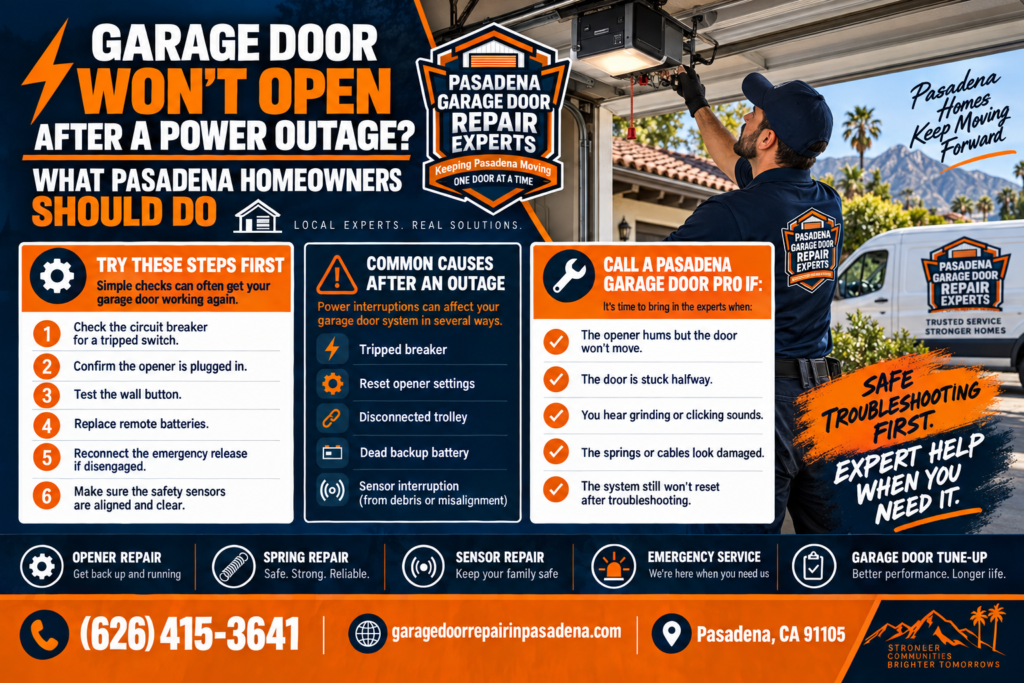
PASADENA GARAGE DOOR TROUBLESHOOTING GUIDE Garage Door Won’t Open After a Power Outage? What Pasadena Homeowners Should Do If your garage door will not open after electricity goes out or comes back on, the problem may be as simple as a powerless opener or disconnected trolley. It can also reveal a weak backup battery, opener control problem, broken spring, damaged cable, or another mechanical issue that happened around the same time as the outage. This Pasadena homeowner guide explains what to check first, how the emergency release works, how to recognize a problem that should not be handled manually, what to do when power returns, and when garage door opener repair may be needed. Call (626) 415-3641 Garage Door Opener Repair In This Pasadena Power Outage Garage Door Guide What should you do first? Why won’t the garage door open? Safe checks before troubleshooting 1. Confirm power has returned 2. Check wall control and opener 3. Check the emergency release 4. Test whether the door moves manually How to use the emergency release How to reconnect the garage door What to check after power returns Battery backup systems California battery backup requirement When it is not an electrical problem Broken spring warning signs Can an outage damage an opener? Should you reset the opener? What if you are locked outside? What homeowners should avoid Pasadena-specific considerations How to prepare for the next outage When to call a professional Pasadena Garage Door Repair Experts Frequently asked questions What Should You Do If Your Garage Door Won’t Open After a Power Outage? Quick Answer First, determine whether electricity has actually been restored to the garage door opener. Check the opener lights, wall control and the electrical outlet without repeatedly pressing the remote. If power is still unavailable and you need to open the door from inside the garage, many residential garage door openers can be disconnected from the door by using the emergency-release cord. Once disconnected, a properly balanced and undamaged garage door should generally be capable of being moved manually. Do not attempt to manually lift the door if it is crooked, unusually heavy, partly off its tracks, has a loose cable, or appears to have a broken spring. A power outage does not automatically mean the garage door opener has failed. The opener simply cannot run normally without electricity unless it has a functioning battery-backup system. The important question is whether the problem disappears when power returns or whether the outage exposed another electrical or mechanical problem. Why Won’t My Garage Door Open After a Power Outage? Several different situations can produce the same symptom. The remote may seem dead, the wall button may do nothing, the opener may click without moving the door, or the opener motor may operate while the garage door remains stationary. No Electricity at the Opener The home may have regained power while the garage circuit, outlet, breaker, GFCI-protected circuit, or opener itself remains without electricity. Emergency Release Is Disconnected If the red emergency-release cord was used during the outage, the opener can operate without actually moving the door until the trolley is properly re-engaged. Backup Battery Is Weak or Dead An opener equipped with battery backup may not operate during an outage if the battery has deteriorated, is disconnected, or has reached the end of its service life. The Problem Is Mechanical A broken spring, cable problem, damaged roller, track issue, or heavy door can prevent opening regardless of whether the opener has electricity. Opener Electronics Need Attention Power interruption or restoration can coincide with an opener control, programming, receiver, logic board, or accessory issue. Remote or Keypad Is Not Responding The opener itself may have power while a remote control, keypad, vehicle control, or smart-home connection is the part that is not responding. Safe Checks to Make Before Troubleshooting the Garage Door Before treating the problem as an opener failure, look at the entire garage door from inside the garage. Look Before You Lift Is the garage door sitting evenly on the floor? Do both lift cables appear properly tensioned? Are the rollers still inside the tracks? Does the torsion spring above the door appear separated? Is the door crooked or lower on one side? Is anything physically blocking the door? Was there a loud bang before or during the outage? If the door appears damaged or unstable, stop there. Disconnecting the opener does not repair a broken counterbalance system. 1. Confirm That Power Has Actually Returned to the Garage Door Opener 1 Check the Opener, Not Just the House Lights and appliances working elsewhere in the house do not necessarily confirm that the garage door opener has power. Look for normal signs of power at the opener, such as its courtesy light, status indicators or response from the wired wall control. If the opener is plugged into a normal electrical receptacle, verify that its plug has not loosened. Do Not Perform Electrical Repairs Inside the Opener Homeowners can make simple visual checks, but internal electrical troubleshooting should be left to an appropriately qualified technician when wiring, circuit boards or damaged electrical components are involved. 2. Check the Wall Control Before Blaming the Remote 2 Compare Different Controls Try the wired wall control once. If the wall button operates the door but the handheld remote does not, the issue may be limited to the remote, its battery, programming, receiver connection or a lock/vacation mode. If neither the wall control nor the remote produces a normal response, the problem is more likely to involve power, the opener itself or the garage door system. 3. Check Whether the Emergency Release Was Used 3 Look at the Opener Trolley Many homeowners use the red emergency-release cord during a power outage so they can operate the garage door manually. After power returns, it is possible for the opener motor and rail mechanism to move while the garage door itself stays in place if the door has not been reconnected to the opener carriage. This can look
Is an Insulated Garage Door Worth It in Pasadena? Costs, R-Values and Energy Benefits

PASADENA INSULATED GARAGE DOOR GUIDE Is an Insulated Garage Door Worth It in Pasadena? Costs, R-Values and Energy Benefits An insulated garage door can be worth considering in Pasadena when the garage is attached to the house, living space is located above or beside the garage, the garage doubles as a gym or workshop, the door receives substantial afternoon sun, or the homeowner wants a quieter and more rigid garage-door construction. Insulation does not magically turn an unconditioned garage into conditioned living space, and no responsible contractor should promise a specific reduction in utility bills from replacing the garage door alone. The practical benefit is that insulation slows heat transfer through one of the largest moving surfaces in the garage while multi-layer construction can also improve rigidity and reduce some vibration and outdoor noise. This guide from Pasadena Garage Door Repair Experts explains garage-door R-values, U-factors, polyurethane and polystyrene insulation, cost factors, Pasadena climate considerations and how to decide whether an insulated garage door is a worthwhile upgrade for your home. Call (626) 415-3641 Garage Door Service in Pasadena In this insulated garage door guide: Is an insulated garage door worth it in Pasadena? What is an insulated garage door? What does garage door R-value mean? R-value vs. U-factor What R-value should Pasadena homeowners consider? Polyurethane vs. polystyrene insulation Attached garages Detached garages Rooms above or beside the garage Pasadena sun and summer heat Realistic energy benefits Garage comfort benefits Noise and quieter operation Door strength and rigidity How garage door windows affect insulation Why weather seals still matter Insulated garage door cost factors Does an insulated door pay for itself? Adding insulation to an existing door Replacing one panel vs. upgrading the entire door Insulated vs. non-insulated comparison How to choose the right insulation level Installation and door balance Will an insulated door need a new opener? Pasadena home considerations Permit and replacement considerations Questions to ask before buying Insulated garage door buying red flags Frequently asked questions Is an Insulated Garage Door Worth It in Pasadena? For many Pasadena homes, yes—especially when the garage is attached, shares walls or a ceiling with living space, is used for more than vehicle storage, receives significant sun exposure, or when the homeowner is already replacing an old or damaged garage door. Insulation reduces heat transfer through the door, and multi-layer insulated construction can also make the door more rigid and help reduce some noise. The upgrade may be less important for a detached garage used only for vehicle parking and storage where temperature swings are not a concern. The correct decision depends on the garage configuration, door size, insulation level, construction type, windows, weather seals, usage and the condition of the existing door. Higher R-value means greater resistance to conductive heat flow through the measured section, but homeowners should not choose a door by R-value alone. Whole-door thermal performance, air leakage, section joints, perimeter seals, windows and how often the garage door opens also affect real-world performance. What Is an Insulated Garage Door? An insulated garage door contains an insulating material integrated into the garage-door sections rather than relying only on a single exposed layer of steel, aluminum or another exterior material. Sectional garage doors can be built in several ways. Single-layer garage doors A basic single-layer steel garage door generally consists primarily of the exterior steel skin and supporting hardware. From inside the garage, the contours of the exterior section may be visible. This construction can be appropriate when price and basic enclosure are more important than thermal performance or interior appearance. Two-layer garage doors A two-layer door typically adds insulation to the interior side of the exterior door skin. Depending on the design, the insulation may remain exposed or use a backing material. Three-layer garage doors A three-layer or sandwich-style garage door typically places insulation between an exterior and interior skin. This construction can create a more finished interior appearance and can increase section rigidity because both faces contribute to the structure. The exact construction varies by manufacturer, so “three-layer” should not be treated as a universal R-value. Insulation type, thickness, section design and thermal bridging all matter. Single Layer Basic door construction with little or no added insulation. Two Layer Door skin plus an added insulation layer. Three Layer Exterior skin, insulation and interior backing or skin. Thermal Performance Depends on much more than the number of layers. What Does R-Value Mean for a Garage Door? R-value is a measure of resistance to heat flow. In simple terms, a material or section with a higher R-value resists conductive heat transfer more effectively than one with a lower R-value. The U.S. Department of Energy uses R-value as a standard way of describing an insulating material’s resistance to heat flow. Homeowners shopping for garage doors may encounter models advertised with values such as R-6, R-9, R-12, R-16, R-18 or higher. Those numbers should not be interpreted as a simple quality ranking where the door with the highest number is automatically the correct choice for every Pasadena home. R-value generally refers to thermal resistance The higher the value, the more resistance the measured construction provides to heat passing through it by conduction. That can be useful when comparing products with similar testing and reporting methods. R-value may describe a section rather than the entire installed door A garage door is more complicated than a solid piece of insulation. It contains section joints, perimeter edges, hardware, potentially windows and an entire opening around the door. That is why an advertised section R-value does not tell you everything about the complete installed assembly. DASMA’s thermal-performance publication guidance distinguishes section R-values from tested installed-door U-factors and encourages standardized reporting so homeowners and professionals can make more meaningful comparisons. Homeowners interested in the technical distinction can review DASMA garage door thermal-performance guidelines . Garage Door R-Value vs. U-Factor: What Is the Difference? R-value and U-factor both describe aspects of thermal performance, but they should not be treated as interchangeable garage-door ratings. R-value: resistance to
What Does a Garage Door Tune-Up Include—and How Often Should Pasadena Homeowners Get One?

PASADENA GARAGE DOOR TUNE-UP GUIDE What Does a Garage Door Tune-Up Include—and How Often Should Pasadena Homeowners Get One? A useful garage door tune-up is much more than spraying lubricant on a few hinges. It is a structured inspection of the parts that allow the garage door to lift, lower, stay aligned and work safely with the automatic opener. A tune-up should help identify developing wear in springs, cables, rollers, tracks, hinges, door balance, opener components and safety systems before a minor condition becomes a more disruptive repair. For Pasadena homeowners, the most valuable tune-up is one that distinguishes normal maintenance from actual mechanical failure. A noisy roller may need lubrication or replacement. A loose-looking cable may indicate a cable-drum or balance problem. An opener that appears weak may actually be trying to move a garage door whose spring system is no longer counterbalancing the door correctly. This guide from Pasadena Garage Door Repair Experts explains what a garage door tune-up should include, what homeowners can safely check themselves, how often routine maintenance makes sense and which conditions should be treated as repairs rather than tune-up items. Call (626) 415-3641 Garage Door Repair in Pasadena In this Pasadena garage door tune-up guide: What does a garage door tune-up include? What a tune-up actually is How often should you get a tune-up? 1. Spring and counterbalance inspection 2. Cable and cable-drum inspection 3. Roller inspection 4. Track and alignment inspection 5. Hinges and ordinary hardware 6. Door balance and movement 7. Garage door opener inspection 8. Photo-eye and safety-system testing 9. Appropriate lubrication 10. Panels, weather seals and structural condition 11. Noise and vibration evaluation 12. Final operating-cycle check Tune-up versus a full maintenance checklist Tune-up versus repair What should not be hidden inside a tune-up? Pasadena-specific maintenance considerations Garage door tune-up cost factors Questions to ask before scheduling Frequently asked questions What Does a Garage Door Tune-Up Include? A useful garage door tune-up generally includes inspecting springs and counterbalance components, visually checking lift cables and cable drums, checking rollers and tracks, inspecting hinges and ordinary hardware, evaluating door balance and movement, inspecting the automatic opener, testing safety sensors and reversal functions according to the opener manufacturer’s instructions, cleaning appropriate areas and lubricating serviceable moving components with the correct product. The tune-up should also identify conditions that are no longer routine maintenance. A broken spring, frayed cable, bent track, cracked roller, severely crooked garage door or opener that is damaged internally should be diagnosed as a repair rather than disguised as a lubrication problem. As a general maintenance framework, homeowners can perform frequent visual checks. DASMA recommends monthly safety checks and maintenance and notes that an annual visit from a trained door-systems technician can help keep a garage door operating safely and smoothly. The specific owner’s manuals for the garage door and opener should guide model-specific maintenance. What Is a Garage Door Tune-Up? The phrase “garage door tune-up” is used by many companies, but it does not always describe exactly the same package of work. One company may use the term for a basic inspection and lubrication visit. Another may include door balance testing, opener checks, sensor testing and ordinary hardware adjustment. The most useful way to think about a tune-up is not as a branded package but as preventive evaluation of the complete moving system. A residential garage door depends on several mechanical systems working together: Springs counterbalance much of the garage door’s weight. Cables and cable drums transfer lifting force to the door. Rollers guide the sections through the tracks. Hinges allow sectional movement through the curved track. The tracks establish the path of travel. The automatic opener provides powered movement. Photo-eye and reversal systems provide important closing protection. If one of these relationships changes, another component may appear to be failing even when it is only reacting to the original problem. For example, an automatic opener may slow or stop because the garage door has become too heavy due to a spring problem. Replacing or adjusting opener parts without evaluating door balance would miss the mechanical cause. Similarly, a roller may rub against the track because the track is bent, because the roller is worn or because the garage door has become crooked after a cable problem. A worthwhile tune-up should therefore answer three questions: Is the garage door moving normally? Are visible components showing abnormal wear or damage? Are any symptoms developing that need repair rather than routine maintenance? How Often Should Pasadena Homeowners Get a Garage Door Tune-Up? There is no universal calendar that fits every garage door because doors differ in age, design, material, spring configuration, opener type and daily operating frequency. A practical approach is to combine regular homeowner observation with periodic professional evaluation. Monthly Watch operation and visually check major safety and wear points. Seasonally Look for changing noise, seals, dust, track debris and visible wear. Annually Consider a more complete trained inspection, especially on frequently used systems. Any Time Behavior Changes Do not wait for the calendar if the door becomes heavy, crooked, noisy or difficult to move. DASMA recommends monthly safety checks and maintenance and states that an annual visit from a trained door-systems technician can help maintain safe, smooth operation. That annual concept should be treated as a useful maintenance benchmark, not a rigid promise that every component needs service exactly every twelve months. Garage usage matters A Pasadena household that uses the garage as the main entrance may operate the door multiple times each day. Each operating cycle moves the springs, rollers, hinges, cables and opener. A frequently cycled garage door therefore accumulates wear more quickly than one serving a detached storage garage that opens only occasionally. Door age matters Older garage doors may contain components installed at different times. A homeowner may have a relatively new opener attached to older rollers, tracks, cables or springs. The age of one visible component should not be assumed to represent the age of the entire garage-door system. Changing operation matters
The Pasadena Garage Door Maintenance Checklist: Springs, Rollers, Tracks, Cables and Opener

PASADENA GARAGE DOOR MAINTENANCE GUIDE The Pasadena Garage Door Maintenance Checklist: Springs, Rollers, Tracks, Cables and Opener Garage-door maintenance is not about taking the entire system apart. For most Pasadena homeowners, the most useful maintenance routine is a combination of regular observation, cleaning, appropriate lubrication, basic safety testing and knowing when a mechanical condition has moved beyond homeowner maintenance into professional repair. Springs, rollers, tracks, lift cables and the automatic garage-door opener all perform different jobs. A good maintenance checklist treats those components separately while also recognizing that they work together. A worn roller can affect track movement. A cable problem can make the door crooked. A failed spring can make the opener appear weak. A dirty or misaligned safety sensor can interfere with closing even when the door hardware itself is in good condition. This guide from Pasadena Garage Door Repair Experts explains what Pasadena homeowners can safely inspect, which signs of wear deserve attention, how frequently common checks make sense, and which high-tension components should not be adjusted as a do-it-yourself maintenance project. Call (626) 415-3641 Garage Door Repair in Pasadena Pasadena garage door maintenance checklist: Quick garage door maintenance answer Why garage door maintenance matters How often should you maintain a garage door? Safety before maintenance 1. Inspect the garage door springs 2. Inspect the rollers 3. Inspect and clean the tracks 4. Inspect lift cables and drums 5. Inspect the automatic opener 6. Check hinges and ordinary hardware 7. Check safety sensors and closing protection 8. Pay attention to garage door balance 9. Lubricate appropriate moving components 10. Inspect panels and structural condition 11. Inspect the bottom seal and perimeter 12. Listen for changing garage door noises Maintenance checklist table Maintenance and off-track warning signs What should never be DIY maintenance? When maintenance becomes repair Pasadena-specific garage conditions Garage door maintenance and repair cost factors Questions to ask before professional service Frequently asked questions What Should Be Included in a Pasadena Garage Door Maintenance Checklist? A practical garage door maintenance checklist should include visually inspecting springs and lift cables, checking rollers for wear, keeping tracks clean and aligned, inspecting hinges and ordinary fasteners, listening for new noises, testing the automatic opener and safety systems according to the manufacturer’s instructions, checking door balance and movement, inspecting weather seals and lubricating only the components the door or opener manufacturer identifies as serviceable. Homeowners should not wind or unwind torsion springs, loosen spring brackets, adjust cable drums, remove bottom cable brackets, reconnect lift cables under tension or force a badly misaligned garage door as part of routine maintenance. The purpose of maintenance is to identify developing wear before it becomes a larger mechanical problem. If the door becomes unusually heavy, crooked, off track, jerky, difficult to operate or noticeably different from its normal movement, stop treating the condition as routine maintenance and diagnose the underlying cause. Why Garage Door Maintenance Matters A residential garage door is a large moving mechanical system. Each operating cycle causes springs to load and unload, rollers to travel through the tracks, hinges to pivot, cables to wind and unwind around their drums and the automatic opener to move the door through its programmed travel. Even when the garage door appears simple from the driveway, dozens of mechanical relationships must remain reasonably aligned for smooth operation. Maintenance matters because wear usually develops gradually. A roller may begin wobbling before it breaks. A hinge may loosen before it bends. A cable may show individual broken strands before complete failure. A track bracket may begin moving slightly before alignment becomes severe. A garage-door opener may become noisier before an internal component stops working normally. Recognizing these changes early gives the homeowner an opportunity to address the actual component before secondary damage develops. For example, a worn roller does not affect only the roller. If it stops turning smoothly, the roller can create more friction in the track. That resistance can make the door move less smoothly, create additional noise and place more load on hinges and the automatic opener. A cable problem can also spread through the system. If one side loses normal support, the door can become crooked. A crooked garage door can bind rollers against the tracks, place unusual loads on hinges and cause the opener to pull against a door that is no longer moving evenly. The same principle applies to springs. Springs counterbalance much of the garage door’s weight. When the counterbalance system is not functioning correctly, the automatic opener may appear weak even though the underlying issue is mechanical door balance. A useful maintenance routine therefore looks for changing conditions rather than waiting for complete failure. How Often Should Pasadena Homeowners Maintain a Garage Door? There is no single universal maintenance interval that applies identically to every garage door, because doors differ in design, age, materials, operating frequency, opener model and environment. A practical schedule is to combine frequent visual checks with periodic cleaning and manufacturer-directed maintenance. The Door & Access Systems Manufacturers Association recommends monthly safety checks and notes that an annual visit from a trained door-systems technician can help keep a garage door operating smoothly. Homeowners should also follow the maintenance schedule in the owner’s manuals for the specific garage door and automatic opener. Monthly Observe door travel, rollers, cables, springs, sensors and unusual noise. Seasonally Clean track debris, inspect weather seals and look for changing wear. Manufacturer Schedule Lubricate and test the opener according to the door and opener manuals. Periodically Consider a professional inspection when wear, age or changing operation warrants it. Frequency should increase when the garage door is used unusually often or when the homeowner notices a change. A household that uses the garage as its primary entrance may cycle the door several times throughout a normal day. A detached garage used primarily for storage may operate much less frequently. More cycles mean more repeated movement of the springs, hinges, rollers, cables and opener. The important point is not following a calendar blindly. Maintenance should
What Counts as a Garage Door Emergency? 7 Problems That Need Same-Day Repair
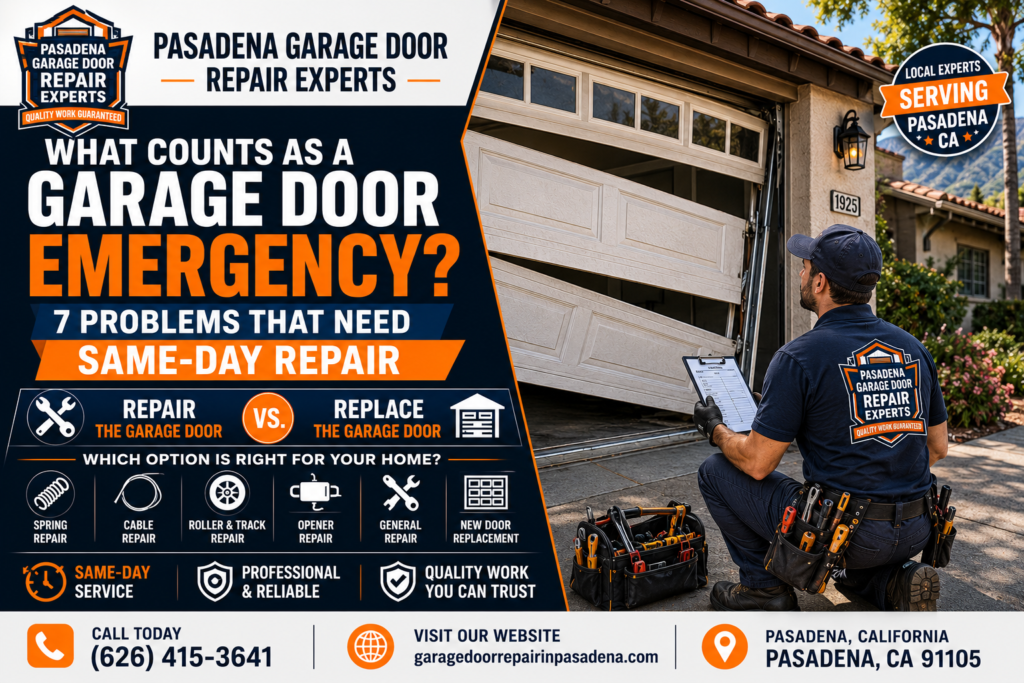
PASADENA OFF-TRACK GARAGE DOOR GUIDE Garage Door Came Off Track in Pasadena? What to Do—and What Not to Do A garage door that has come off track is more than an inconvenience. When one or more rollers leave their intended track, the door can become crooked, bind during movement, hang unevenly, twist its sections or place unusual loads on the lift cables, hinges, springs and automatic opener. The safest response is generally to stop operating the garage door, keep people and vehicles away from the opening, and inspect the visible condition from a clear position. A roller outside the track may be the obvious symptom, but the original cause may involve a bent track, damaged roller, loose lift cable, cable-drum problem, spring failure, hinge damage or vehicle impact. This guide from Pasadena Garage Door Repair Experts explains what Pasadena homeowners should do when a garage door comes off track, which warning signs help identify the cause, and which repairs should not be attempted while the door or counterbalance system is unstable. Call (626) 415-3641 Garage Door Repair in Pasadena In this off-track garage door guide: What to do immediately What an off-track garage door actually means Six immediate safety steps What not to do Vehicle or object impact Bent or shifted track Worn or displaced rollers Broken, loose or displaced cables Spring and balance problems Hinge or panel damage Obstruction and mechanical binding Why opener force can make damage worse Why a crooked door matters Garage door cable warning signs Should you pull the emergency release? Can you move an off-track door manually? Safe homeowner checks Symptom comparison table When professional repair makes sense Pasadena residential considerations Off-track repair cost factors Reducing future derailment risk Questions to ask before approving repair Frequently asked questions What Should You Do if Your Garage Door Comes Off Track? Stop using the automatic opener, keep people and vehicles away from the garage door, and inspect the visible rollers, tracks, lift cables and springs from a safe position. Do not force the door open or closed, pry rollers back into the track, loosen cable drums, remove bottom brackets, adjust torsion springs or repeatedly cycle the opener. If the garage door is fully closed and appears stable, leaving it closed is usually safer than testing it again. If it is partially open, severely crooked or hanging unevenly, do not stand beneath it or attempt to guide it downward by hand. An off-track condition should be diagnosed according to its cause. The visible roller may have left the track because of a bent track, worn roller, damaged hinge, cable problem, cable drum issue, spring imbalance or impact. Reinstalling the roller without correcting the original problem may allow the garage door to come off track again. What Does “Garage Door Off Track” Actually Mean? A sectional garage door normally moves through two track assemblies, one on the left side and one on the right. Rollers attached to the garage-door sections travel inside those tracks. The vertical tracks guide the door upward from the floor. Curved track sections transition the door from vertical movement into the horizontal tracks above the garage. When a garage door is described as “off track,” one or more rollers are no longer positioned correctly inside that intended path, or the door has become sufficiently misaligned that normal roller travel is no longer possible. The amount of derailment can vary dramatically. One upper roller might sit just outside the horizontal track while the door remains almost level. In a more serious condition, several rollers can leave one side, the door can hang diagonally and a lift cable can become visibly loose. That means “off track” is not the diagnosis. It is the condition. The diagnosis is the reason the roller no longer follows the track. Tracks Define the intended path of garage-door travel. Rollers Guide each door section through the tracks. Cables & drums Help transfer spring counterbalance force to both sides. Springs Counterbalance much of the garage door’s weight. These systems interact. A cable that loses tension can make the door crooked. A crooked door can push a roller against the track edge. A bent track can force a roller outward. A worn roller can tilt or seize. A damaged hinge can change the angle at which the roller enters the track. Accurate repair requires understanding that relationship. Six Immediate Steps to Take When a Garage Door Comes Off Track 1 Stop using the garage door opener Do not repeatedly press the wall control or remote in an attempt to make the opener pull the garage door straight. The opener is designed to move a mechanically functional, counterbalanced garage door. It is not designed to realign a roller, correct a loose cable or overcome a bent track. If one side is mechanically jammed while the opener continues pulling from the upper center of the door, additional stress can reach the top section, hinges, rollers, opener arm and rail. 2 Keep people, pets and vehicles clear An unstable garage door can move unexpectedly. A door that appears stationary can still shift if a roller moves, a cable slips or stored spring force redistributes through the system. Avoid walking beneath a partially open off-track door. 3 Compare the left and right sides From a safe distance, determine whether one side is significantly higher than the other. Look for: A roller outside the track. A cable hanging loose. A track that appears bent. A hinge that appears distorted. A lower corner that is substantially higher or lower. A panel that appears twisted. 4 Look for signs of impact Vehicle contact is an important clue. A bumper can strike the lower garage-door section before the door is fully open. A bicycle, ladder, storage rack or other object can hit a vertical track. Note the exact area of impact because a track, roller, hinge or door panel may have shifted. 5 Look at cables and springs without touching them A cable hanging loose on one side can indicate
Broken or Frayed Garage Door Cable? 7 Warning Signs Pasadena Homeowners Should Know
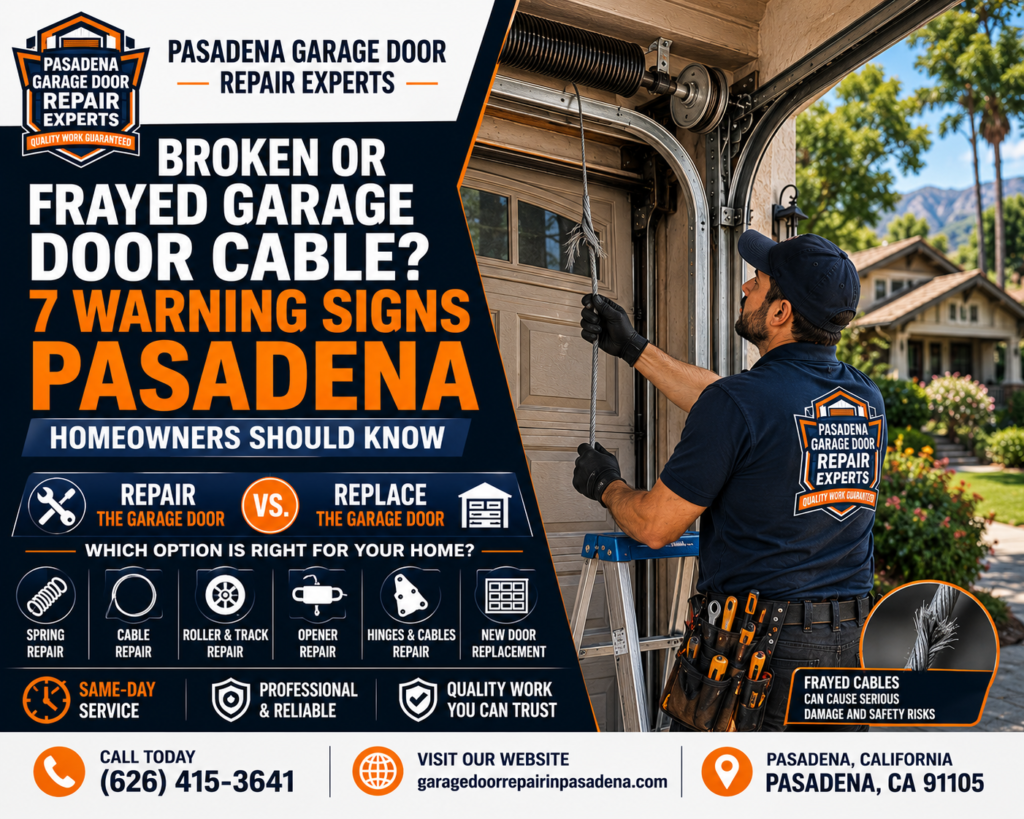
PASADENA GARAGE DOOR CABLE SAFETY GUIDE Broken or Frayed Garage Door Cable? 7 Warning Signs Pasadena Homeowners Should Know Garage door lift cables are relatively small compared with the door itself, but they perform a critical job. On many residential garage-door systems, the cables work with the springs and cable drums to transfer counterbalance force to the bottom of the door so it can rise and descend in a controlled, level manner. When a cable begins fraying, comes loose, slips off a drum or breaks, homeowners may notice more than a damaged piece of wire rope. The garage door can become crooked, one side can rise faster than the other, rollers can bind in the tracks, the opener can begin straining, or the door can stop moving normally. This guide from Pasadena Garage Door Repair Experts explains seven warning signs of garage-door cable trouble, how cable symptoms overlap with spring and track problems, what Pasadena homeowners can safely observe, and which high-tension components should be left alone. Call (626) 415-3641 Garage Door Repair in Pasadena In this garage door cable guide: Quick answer: warning signs of cable trouble How garage door cables work 1. Visible fraying or broken cable strands 2. A cable is hanging loose or has lost tension 3. The garage door is crooked or uneven 4. The door jerks, binds or moves unpredictably 5. The cable is off the drum or wrapping incorrectly 6. Scraping, popping or slapping noises appear 7. The door becomes heavy or difficult to operate Broken cable vs. frayed cable Why garage door cables fail Relationship between cables and springs Why cable drums matter Cable problems and off-track garage doors Why the opener should not compensate for cable trouble Safe homeowner cable checks What homeowners should not do Cable warning-sign comparison table When professional cable repair makes sense Pasadena residential considerations Garage door cable repair cost factors Reducing future cable problems Questions to ask before approving cable repair Frequently asked questions What Are the Warning Signs of a Broken or Frayed Garage Door Cable? Seven important warning signs are visible fraying or broken wire strands, a loose or hanging cable, a garage door that becomes crooked, jerky or uneven movement, a cable that has slipped off or wrapped incorrectly on its drum, new scraping or slapping noises near the cable system, and a garage door that suddenly becomes unusually heavy or difficult to operate. These symptoms do not always prove that the cable itself is the original failure. A broken spring, bent track, off-track roller, damaged cable drum or door-balance problem can also cause a cable to lose tension or change position. What matters is recognizing that a visibly damaged or displaced cable is part of a high-load counterbalance system and should not be treated like a loose household wire. Homeowners can safely look for frayed strands, slack cable, incorrect drum positioning and uneven door movement from a clear location. Do not pull a loose cable, loosen cable drums, remove bottom brackets, wind or unwind torsion springs, or repeatedly run the opener while the door is crooked. If the garage door is severely uneven, stuck partially open, has a broken cable or is hanging from one side, keep people and vehicles clear until the system can be evaluated. How Garage Door Lift Cables Work With Springs and Cable Drums To understand why cable damage matters, it helps to understand the basic counterbalance system. A residential garage door can be heavy. The automatic opener is not intended to carry that full weight by itself. Springs provide counterbalance force so the door can move in a controlled manner. On a common torsion-spring system, a steel torsion shaft runs above the garage-door opening. The torsion spring or springs apply torque to that shaft. Cable drums are mounted near the ends of the shaft, and steel lift cables wrap around those drums. The lower ends of the lift cables connect near the bottom corners of the garage door. As the door opens, the spring system assists rotation of the shaft and drums. The drums wind the cables in a controlled pattern, and the cables lift the door from both sides. As the garage door closes, the process reverses. The cables unwind in a controlled way while the spring system stores energy for the next opening cycle. That relationship explains why cable length and cable position need to remain coordinated from side to side. If one cable breaks or comes off its drum, the left and right sides may no longer be supported equally. Springs Counterbalance much of the garage door’s weight. Cable drums Wind and unwind the lift cables in a controlled pattern. Lift cables Transfer lifting force to the lower corners of the door. Tracks & rollers Guide the door while the cable system supports movement. This is also why a cable problem can affect apparently unrelated parts. If one side rises unevenly, a roller can bind in the track. If the door becomes crooked, hinges and panels can twist. If the opener keeps pulling, its rail and top-section attachment can be placed under abnormal load. Garage-door cable diagnosis should therefore consider the complete counterbalance and track system rather than treating the cable as an isolated part. 1 Visible Fraying or Broken Cable Strands Visible fraying is one of the clearest warning signs that a garage-door lift cable is deteriorating. Garage door cables are typically made from multiple steel strands woven together. The strength of the cable comes from those strands working as a unit. As a cable wears, individual wire strands can begin separating or breaking. Instead of a smooth, consistent cable surface, the homeowner may notice small steel wires protruding from the cable. Fraying can appear: Near the bottom cable attachment. Along a section that repeatedly bends or moves. Near the cable drum. Where the cable has rubbed another metal component. At a point affected by corrosion or previous damage. A few visible broken strands should not be treated as harmless simply because
Garage Door Came Off Track in Pasadena? What to Do—and What Not to Do

PASADENA OFF-TRACK GARAGE DOOR GUIDE Garage Door Came Off Track in Pasadena? What to Do—and What Not to Do A garage door that has come off track should be treated differently from a simple remote-control or sensor problem. When one or more rollers leave the track, the door may become crooked, bind during travel, hang unevenly or place abnormal loads on the lift cables, hinges, track brackets, springs and garage door opener. The safest first response is usually to stop operating the door, keep people and vehicles clear of the opening and determine from a safe distance whether the problem involves a displaced roller, bent track, loose cable, cable-drum problem, spring failure, impact damage or another mechanical condition. This guide from Pasadena Garage Door Repair Experts explains what Pasadena homeowners should do when a residential garage door comes off track, which warning signs deserve immediate attention, and which repairs should not be attempted while a heavy door or high-tension counterbalance system is unstable. Call (626) 415-3641 Garage Door Repair in Pasadena In this off-track garage door guide: Quick answer: what to do when a garage door comes off track What “off track” actually means Six immediate steps to take What not to do Cause #1: impact with the door or track Cause #2: bent or shifted garage door track Cause #3: worn, broken or displaced rollers Cause #4: lift cable or cable-drum problem Cause #5: spring or door-balance problem Cause #6: hinge or panel damage Cause #7: obstruction or binding Cause #8: opener repeatedly forcing a binding door Why a crooked garage door is important Off-track doors and cable problems What happens when a roller leaves the track Safe homeowner checks Off-track symptom comparison table Should you pull the emergency release? Can an off-track door damage the opener? Warning noises that may happen first When professional off-track repair makes sense Pasadena residential considerations Off-track repair cost factors How to reduce the chance of another off-track problem Questions to ask before approving repair Frequently asked questions What Should You Do if Your Garage Door Comes Off Track? If your garage door comes off track, stop using the automatic opener, keep people and vehicles away from the door, and visually inspect the rollers, tracks, lift cables and springs from a safe position. Do not force the door open or closed, pry a roller back into the track, loosen cable drums, adjust springs, remove bottom brackets or repeatedly cycle the opener in an attempt to straighten the door. A door that is visibly crooked, hanging from one side, partially out of the tracks, supported by a loose cable or stuck in a partially open position can move unexpectedly. The garage door may weigh considerably more than it feels when its spring system is functioning correctly, and the spring-and-cable system can remain under substantial tension even when the door itself is not moving. If the door is already closed and appears stable, leave it closed until the underlying problem can be identified. If it is partially open, severely crooked or hanging unevenly, do not stand underneath it or try to guide it downward by hand. The repair should identify why the roller left the track. Simply putting the roller back without correcting a bent track, loose cable, worn roller, damaged hinge or balance problem can allow the same condition to happen again. What Does It Mean When a Garage Door Is “Off Track”? A sectional garage door normally travels through a pair of tracks located along the left and right sides of the opening. Rollers attached to the door sections ride within those tracks as the door moves vertically, passes through the curved sections and continues into the horizontal tracks above the garage. An off-track garage door is a door in which one or more rollers are no longer positioned correctly within the track system or the door has become sufficiently misaligned that normal roller travel is no longer possible. The condition can be minor in appearance or dramatic. One upper roller may have slipped outside a track while the rest of the door remains relatively level. At the other extreme, several rollers can leave the track, one lift cable can lose tension and the entire door can hang at an obvious angle. “Off track” should therefore not be treated as one specific failed part. It describes a condition that can result from several different failures. Rollers Guide the door through the track. Tracks Establish the intended path of travel. Cables & drums Transfer spring-system lifting force to the door. Springs Counterbalance much of the garage door’s weight. The complete relationship matters. If a cable comes off a drum, one side of the door may lose support and become crooked. If a track is bent, a roller may be forced outward. If a roller bearing fails, the wheel can bind or tilt. If an impact bends a section or track, normal geometry can disappear. This is why a correct off-track repair begins with diagnosis rather than simply pushing a roller back into place. Six Immediate Steps to Take When a Garage Door Comes Off Track 1 Stop using the garage door opener Do not keep pressing the remote or wall button to see whether the opener can pull the door straight. The opener is designed to move a garage door that is properly supported, counterbalanced and capable of traveling through its tracks. It is not designed to realign a roller that has left a track or compensate for a loose cable. Continued opener use can pull on the top section, opener arm and rail while the lower parts of the door remain mechanically jammed. 2 Keep people, pets and vehicles clear Do not allow anyone to walk beneath a visibly unstable garage door. If the door is stuck partially open, the space beneath it may appear convenient for moving a vehicle or household items. Avoid that temptation. A door that has lost normal track or cable support may move unexpectedly. 3 Observe which