
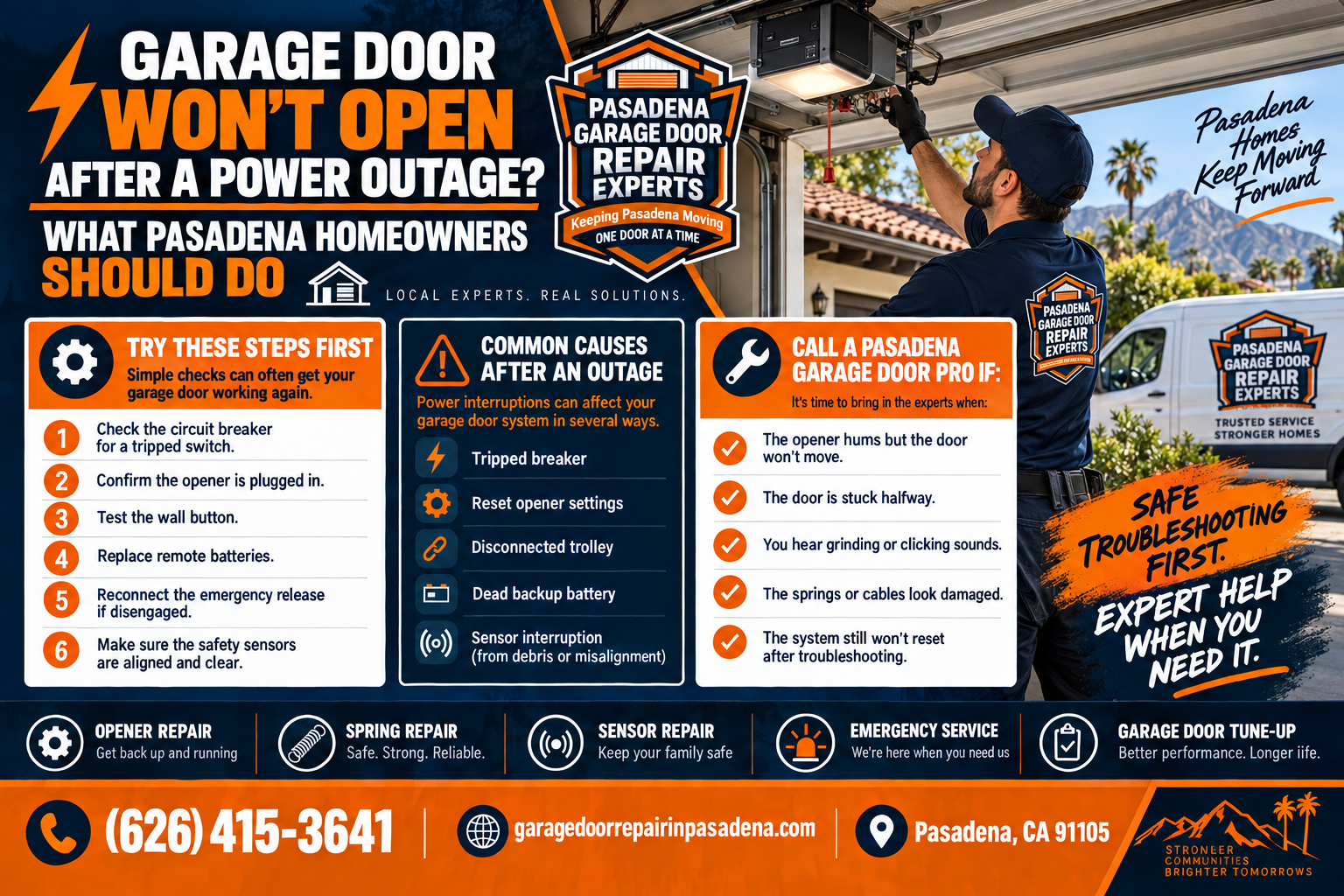
Garage Door Won’t Open After a Power Outage? What Pasadena Homeowners Should Do
If your garage door will not open after electricity goes out or comes back on, the problem may be as simple as a powerless opener or disconnected trolley. It can also reveal a weak backup battery, opener control problem, broken spring, damaged cable, or another mechanical issue that happened around the same time as the outage.
This Pasadena homeowner guide explains what to check first, how the emergency release works, how to recognize a problem that should not be handled manually, what to do when power returns, and when garage door opener repair may be needed.
What Should You Do If Your Garage Door Won’t Open After a Power Outage?
Quick Answer
First, determine whether electricity has actually been restored to the garage door opener. Check the opener lights, wall control and the electrical outlet without repeatedly pressing the remote.
If power is still unavailable and you need to open the door from inside the garage, many residential garage door openers can be disconnected from the door by using the emergency-release cord. Once disconnected, a properly balanced and undamaged garage door should generally be capable of being moved manually.
Do not attempt to manually lift the door if it is crooked, unusually heavy, partly off its tracks, has a loose cable, or appears to have a broken spring.
A power outage does not automatically mean the garage door opener has failed. The opener simply cannot run normally without electricity unless it has a functioning battery-backup system.
The important question is whether the problem disappears when power returns or whether the outage exposed another electrical or mechanical problem.
Why Won’t My Garage Door Open After a Power Outage?
Several different situations can produce the same symptom. The remote may seem dead, the wall button may do nothing, the opener may click without moving the door, or the opener motor may operate while the garage door remains stationary.
No Electricity at the Opener
The home may have regained power while the garage circuit, outlet, breaker, GFCI-protected circuit, or opener itself remains without electricity.
Emergency Release Is Disconnected
If the red emergency-release cord was used during the outage, the opener can operate without actually moving the door until the trolley is properly re-engaged.
Backup Battery Is Weak or Dead
An opener equipped with battery backup may not operate during an outage if the battery has deteriorated, is disconnected, or has reached the end of its service life.
The Problem Is Mechanical
A broken spring, cable problem, damaged roller, track issue, or heavy door can prevent opening regardless of whether the opener has electricity.
Opener Electronics Need Attention
Power interruption or restoration can coincide with an opener control, programming, receiver, logic board, or accessory issue.
Remote or Keypad Is Not Responding
The opener itself may have power while a remote control, keypad, vehicle control, or smart-home connection is the part that is not responding.
Safe Checks to Make Before Troubleshooting the Garage Door
Before treating the problem as an opener failure, look at the entire garage door from inside the garage.
Look Before You Lift
- Is the garage door sitting evenly on the floor?
- Do both lift cables appear properly tensioned?
- Are the rollers still inside the tracks?
- Does the torsion spring above the door appear separated?
- Is the door crooked or lower on one side?
- Is anything physically blocking the door?
- Was there a loud bang before or during the outage?
If the door appears damaged or unstable, stop there. Disconnecting the opener does not repair a broken counterbalance system.
1. Confirm That Power Has Actually Returned to the Garage Door Opener
Check the Opener, Not Just the House
Lights and appliances working elsewhere in the house do not necessarily confirm that the garage door opener has power.
Look for normal signs of power at the opener, such as its courtesy light, status indicators or response from the wired wall control.
If the opener is plugged into a normal electrical receptacle, verify that its plug has not loosened.
Do Not Perform Electrical Repairs Inside the Opener
Homeowners can make simple visual checks, but internal electrical troubleshooting should be left to an appropriately qualified technician when wiring, circuit boards or damaged electrical components are involved.
2. Check the Wall Control Before Blaming the Remote
Compare Different Controls
Try the wired wall control once. If the wall button operates the door but the handheld remote does not, the issue may be limited to the remote, its battery, programming, receiver connection or a lock/vacation mode.
If neither the wall control nor the remote produces a normal response, the problem is more likely to involve power, the opener itself or the garage door system.
3. Check Whether the Emergency Release Was Used
Look at the Opener Trolley
Many homeowners use the red emergency-release cord during a power outage so they can operate the garage door manually.
After power returns, it is possible for the opener motor and rail mechanism to move while the garage door itself stays in place if the door has not been reconnected to the opener carriage.
This can look like an opener failure even though the motor is running normally.
4. Determine Whether the Garage Door Can Move Manually
The Door Should Not Feel Extremely Heavy
The garage door opener is not designed to carry the full dead weight of a properly functioning garage door. Springs provide the counterbalance that makes the door manageable.
If a disconnected door feels dramatically heavier than expected, drops quickly, refuses to stay in a partially open position or becomes crooked, stop operating it.
Important Safety Warning
A garage door that suddenly feels extremely heavy may have a counterbalance or spring problem. Do not repeatedly force it open and do not attempt to adjust garage door springs or cable-related hardware yourself.
How Do You Open a Garage Door Manually During a Power Outage?
Most residential opener systems include an emergency-release mechanism connected to the opener carriage by a red cord or handle.
Manufacturer instructions vary by model, so the owner’s manual for your specific opener should always take priority. In general, the emergency release disconnects the garage door from the powered opener carriage so that an undamaged door can be operated manually.
Whenever Possible, Release the Opener With the Door Closed
Releasing an open or partially open garage door can be hazardous if the door has a broken spring or counterbalance problem because the door may not remain supported.
- Make sure people, pets, vehicles and objects are clear of the garage door.
- Confirm that the door is stable and appears properly aligned.
- Locate the emergency-release cord attached to the opener trolley.
- Follow the opener manufacturer's instructions to disengage the trolley.
- Use the garage door's intended lifting handle when manually moving the door.
- Keep hands away from section joints, rollers, hinges, tracks, springs and cables.
How Do You Reconnect the Garage Door After Power Returns?
Re-engagement procedures differ between opener manufacturers and models. Some systems reconnect when the opener is operated and the carriage meets the trolley. Others require the release mechanism to be placed back into its engaged position first.
Do not force the carriage and do not repeatedly run the opener if it travels without connecting to the door.
Use the Manual for Your Exact Opener
LiftMaster, Chamberlain, Genie and other opener systems can use different trolley and emergency-release designs. Following the instructions for the exact model is more reliable than forcing a generic reconnection procedure.
If the trolley will not re-engage, the release mechanism is damaged, the carriage is not moving correctly or the opener runs without moving the door, an opener inspection may be appropriate.
Power Is Back but the Garage Door Still Won’t Open: What Does That Mean?
If electricity has been restored and the garage door still does not work, pay attention to exactly what happens when you press the wall control.
| What You Notice | Possible Explanation | What to Do Next |
|---|---|---|
| Opener has no lights or response | Outlet, circuit, opener power supply or electrical problem | Confirm basic power availability without opening electrical components. |
| Motor runs but garage door does not move | Emergency-release trolley may still be disconnected or the carriage may have a problem | Inspect the trolley connection and follow the opener manufacturer's re-engagement procedure. |
| Opener hums or strains | Mechanical resistance, broken spring, opener drive issue or heavy door | Stop repeated operation and inspect the garage door system. |
| Door starts up and stops | Door balance, spring, roller, track, travel or opener problem | Avoid forcing the opener through repeated cycles. |
| Wall button works but remote does not | Remote battery, programming, receiver or lock-mode issue | Check the accessory separately from the opener. |
| Door is extremely heavy manually | Possible spring or counterbalance failure | Stop operating the door and request professional inspection. |
| Door is crooked or cable appears loose | Cable, drum, spring, roller or track problem | Do not run the opener. Keep the area clear. |
What If Your Garage Door Opener Has a Battery Backup?
Battery-backup garage door openers are designed to provide limited operation when normal household electricity is unavailable.
If your opener has battery backup but will not operate during an outage, possible causes include:
- An aging or depleted backup battery.
- A disconnected battery.
- An opener fault rather than a utility-power problem.
- A garage door that is mechanically too heavy to operate normally.
- A spring, cable, roller or track problem.
A Battery Backup Does Not Fix a Broken Garage Door
Battery power can operate a functioning opener when utility power is unavailable. It cannot safely compensate for a broken spring, damaged cable, jammed track or severely unbalanced garage door.
California Garage Door Opener Battery Backup Requirements
Battery backup is especially relevant for Pasadena homeowners because California established specific requirements for residential automatic garage door openers.
California Requirement
California Health and Safety Code Section 19892 provides that on or after July 1, 2019, residential automatic garage door openers manufactured for sale, sold, offered for sale or installed in California must include a battery-backup function designed to operate during an electrical outage.
The law also addresses replacement residential garage doors connected to existing automatic openers.
Source: California Department of Housing and Community Development
This does not mean every older garage door opener already installed in a Pasadena home automatically has battery backup. The age of the equipment and when it was sold or installed can matter.
If an older opener lacks backup capability and outages are a concern, homeowners can ask whether their existing system supports an approved battery solution or whether upgrading the opener makes more sense.
When the Power Outage Is Not the Real Garage Door Problem
Timing can be misleading. A garage door can stop working around the same time as a blackout even when the main problem is mechanical.
The outage may simply be the first time the homeowner tries to operate the garage door manually and discovers that something else is wrong.
Broken Spring
The door may become unusually heavy because its spring system is no longer counterbalancing the door correctly.
Loose or Broken Cable
One side of the door may lift differently from the other, creating a crooked or unstable door.
Track or Roller Problem
Binding rollers, bent track or an off-track condition can physically prevent normal movement.
Opener Drive Problem
A motor may run while worn or damaged internal drive parts fail to transfer movement correctly.
How Can You Tell If a Broken Spring Is Why the Door Won’t Open?
A broken garage door spring can easily be mistaken for an opener problem because the opener may still make noise while struggling to lift the door.
Common warning signs include:
- A loud bang came from the garage.
- The door feels much heavier than normal.
- The opener strains but cannot lift the door.
- The door rises only a short distance.
- A visible gap appears in a torsion spring above the door.
- The garage door no longer feels properly balanced.
Do Not Adjust Garage Door Springs Yourself
Garage door springs and associated cable hardware can store substantial mechanical energy. Spring replacement, winding and high-tension adjustments should be handled with appropriate tools, training and safety procedures.
Can a Power Outage Damage a Garage Door Opener?
A simple loss of electricity does not necessarily damage an opener. However, electrical disturbances associated with power interruption or restoration can coincide with problems involving opener electronics, controls or connected accessories.
If the opener worked normally before the outage but remains completely unresponsive after electricity is restored, possible causes should be diagnosed rather than assuming that the motor must automatically be replaced.
Depending on the system, an opener problem can involve:
- Power supply or electrical connection.
- Logic/control board.
- Wall control.
- Remote receiver or programming.
- Battery-backup system.
- Motor or drive assembly.
- Travel or force settings.
- A mechanical door problem creating excessive resistance.
Do You Need to Reset a Garage Door Opener After a Power Outage?
Not every garage door opener needs to be reset after a normal outage. Many systems resume operation once normal power returns.
If yours does not, use the troubleshooting instructions supplied for your particular opener model rather than randomly clearing programming or repeatedly unplugging the unit.
Be Careful With “Reset Everything” Advice
A full factory reset on some opener systems can erase remote, keypad, vehicle or smart-device programming. A reset also will not correct a broken spring, disconnected trolley or mechanical obstruction.
Start by identifying the actual symptom first. That usually leads to a faster diagnosis than treating every post-outage problem as a programming issue.
What If the Power Is Out and You Are Locked Outside the Garage?
The normal emergency-release cord is located inside the garage. If your garage is the only practical entry point and you are outside during a power outage, access can be more complicated.
Some garage doors are equipped with an exterior emergency-release system designed to allow authorized manual access when the opener has no electricity.
If no exterior release was installed, avoid trying to pry open the garage door, force sections apart or manipulate the top of the door. Those actions can damage the door and create a security or safety problem.
Planning Ahead Helps
Homes where the garage is an important entry route may benefit from a compatible battery-backup opener and an appropriate emergency-access plan before the next outage occurs.
What Should Pasadena Homeowners Avoid Doing?
A garage door that will not open can be frustrating, especially when a vehicle is trapped inside. Trying to force the system can turn a simple outage problem into a larger repair.
Avoid These Common Mistakes
- Do not repeatedly press the opener when the door is obviously stuck.
- Do not attempt to lift a crooked or partly off-track door.
- Do not loosen or adjust torsion spring hardware.
- Do not remove bottom brackets connected to lift cables.
- Do not force a disconnected opener carriage back together.
- Do not bypass a mechanical problem by increasing opener force.
- Do not stand underneath an unstable open garage door.
- Do not assume the opener is defective before checking the garage door itself.
Garage Door Power Outage Problems in Pasadena, CA
Pasadena homeowners use many different generations of garage door equipment. A newer opener may include integrated battery backup, smart controls and status alerts, while an older installation may rely entirely on household electricity.
That equipment difference matters during a blackout.
Local Pasadena Troubleshooting
When a garage door does not operate after an outage, the useful question is not simply, “Does the opener have power?”
The complete system should be considered:
- Garage door opener and power supply.
- Battery backup, if equipped.
- Emergency-release trolley.
- Spring balance.
- Lift cables and drums.
- Rollers and tracks.
- Wall control, remotes and keypad.
- Mechanical resistance through the door's travel.
Pasadena Garage Door Repair Experts provides garage door opener troubleshooting and garage door repair throughout Pasadena areas including Old Pasadena, Bungalow Heaven, Hastings Ranch, Madison Heights and San Rafael Hills.
How Can You Prepare Your Garage Door for the Next Power Outage?
A little preparation can make a future outage much easier to manage.
Know Where the Release Is
Locate the emergency-release handle before you actually need it and review the instructions for your opener model.
Check Battery Backup
If the opener has backup power, follow the manufacturer's maintenance and replacement recommendations for its battery.
Keep the Door Balanced
A properly functioning spring system allows the garage door to move without forcing the opener to handle excessive weight.
Maintain a Safe Access Plan
Consider how you would enter or leave the garage if electricity were unavailable and the garage were your primary access route.
When Should You Call for Garage Door Repair After a Power Outage?
Professional inspection is appropriate when basic, safe checks do not restore normal operation or when the garage door shows signs of a mechanical problem.
Consider requesting service if:
- The opener has power but will not operate normally.
- The opener runs but the garage door does not move.
- The emergency-release trolley will not reconnect.
- The garage door is unusually heavy.
- The door opens only a few inches.
- A spring appears broken.
- A lift cable is loose or damaged.
- The garage door is crooked or off track.
- The opener makes grinding, humming or unusual noises.
- The battery-backup system is not functioning.
- The door worked before the outage but remains unresponsive afterward.
Pasadena Garage Door Repair Experts
Pasadena Garage Door Repair Experts provides garage door opener repair and complete garage door troubleshooting for Pasadena homeowners dealing with doors that will not open, opener failures, disconnected trolleys, broken springs, cable problems, damaged tracks, worn rollers and related garage door issues.
When diagnosing a garage door that stopped operating after a power outage, the goal is to determine whether the actual problem is electrical, opener-related or mechanical before recommending repair.
| Business | Pasadena Garage Door Repair Experts |
|---|---|
| Phone | (626) 415-3641 |
| Primary Service | Garage Door Repair in Pasadena, CA |
| Opener Service | Garage door opener diagnostics, repair and replacement |
| Service Areas | Pasadena, Old Pasadena, Bungalow Heaven, Hastings Ranch, Madison Heights and San Rafael Hills |
Learn more about garage door opener repair in Pasadena or call (626) 415-3641.
Frequently Asked Questions About Garage Doors and Power Outages
Why won’t my garage door open after a power outage?
The opener may still be without electricity, the emergency-release trolley may be disconnected, the backup battery may be depleted or the garage door may have a separate mechanical problem such as a broken spring, cable or track issue.
Will a garage door opener automatically work again when the power comes back?
Many garage door openers resume normal operation when electricity returns. If the emergency release was used, however, the door may need to be properly re-engaged with the opener carriage according to the manufacturer's instructions.
Can I manually open my garage door when the power is out?
Many residential garage doors can be disconnected from the opener using the emergency-release mechanism and then operated manually from inside the garage. Only attempt this if the door appears stable and undamaged. A crooked, very heavy or off-track door should not be manually forced.
Why is my garage door so heavy after I pull the emergency release?
A garage door that becomes extremely heavy after being disconnected from the opener may have a broken or weakened counterbalance spring. Stop operating it and have the spring and door system inspected.
Do garage door openers in California need battery backup?
California law requires residential automatic garage door openers manufactured for sale, sold, offered for sale or installed in the state on or after July 1, 2019 to include battery-backup functionality designed to operate during an electrical outage.
Can a power outage erase my garage door remote programming?
A normal power interruption does not necessarily erase remote programming on every opener. If the wall control works after power returns but a remote does not, troubleshoot the remote battery, programming and receiver separately according to the opener manufacturer's instructions.
Why does the opener run but the garage door stay closed?
If the opener motor or trolley moves without moving the door, the emergency-release system may still be disconnected. Other possibilities include a carriage, opener-drive, spring or mechanical door problem.
Should I keep pressing the opener if the garage door will not move?
No. Repeatedly operating an opener against a stuck, unusually heavy or mechanically damaged garage door can place additional strain on the opener and door system. Identify the cause before continuing to operate it.
Who repairs garage door openers in Pasadena, CA?
Pasadena Garage Door Repair Experts provides garage door opener diagnostics and repair in Pasadena for stuck doors, opener motors, wall controls, remotes, keypads, safety sensors, trolley problems and related garage door issues. Call (626) 415-3641.
Garage Door Repair Service in Pasadena, California
Garage door opener problems after a power outage can affect homes throughout Pasadena. Service is available for opener troubleshooting, spring problems, garage doors that will not open, cable issues, off-track doors and other residential garage door problems.
Garage Door Still Won’t Open After the Power Came Back?
If your opener has power but the garage door remains stuck, heavy, disconnected or unreliable, the next step is identifying whether the problem is in the opener or the garage door itself.
Pasadena Garage Door Repair Experts provides opener diagnostics, spring repair, cable repair, track repair and complete garage door troubleshooting in Pasadena, CA.
7 Responses