
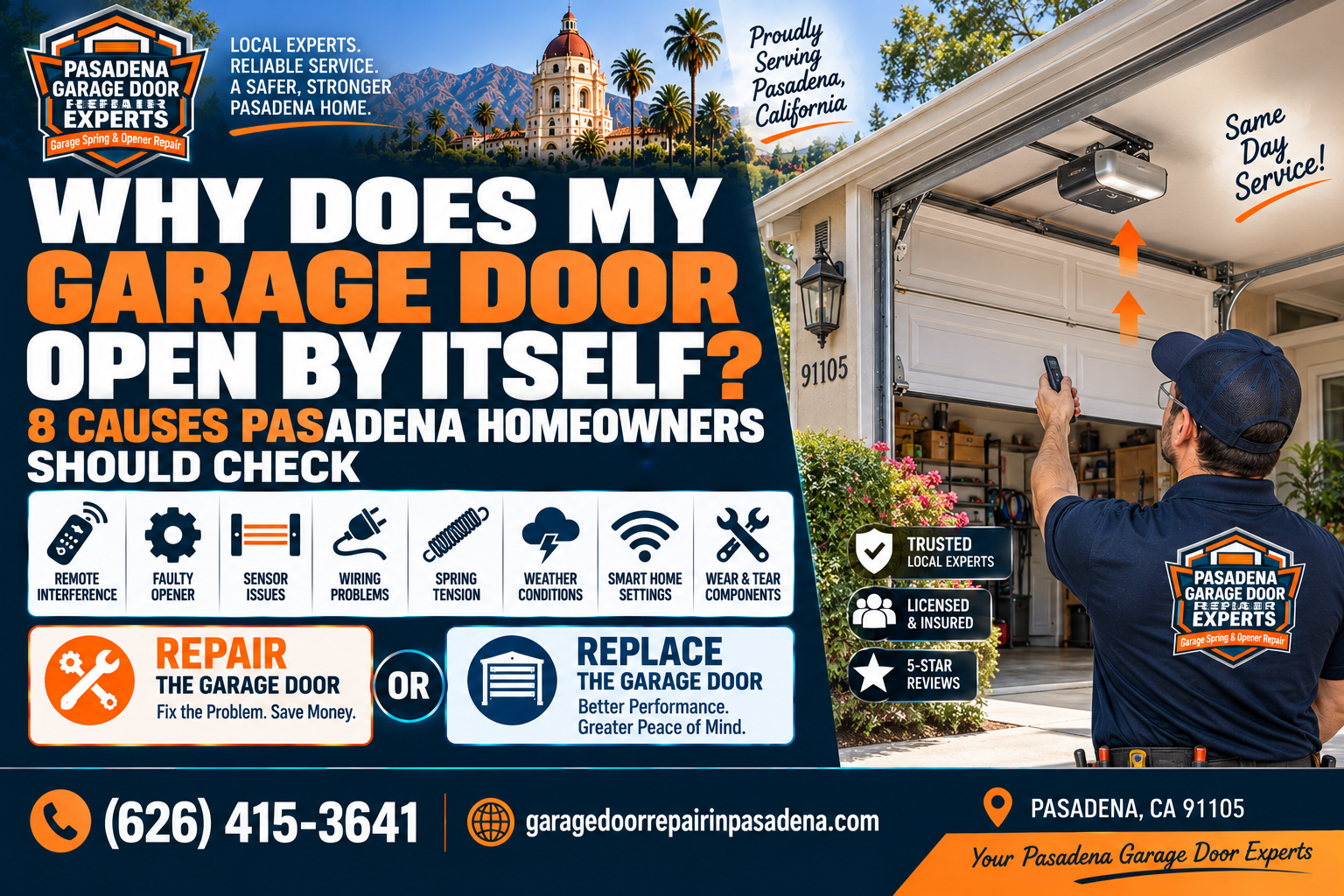
Why Does My Garage Door Open by Itself? 8 Causes Pasadena Homeowners Should Check
A garage door that seems to open by itself can be confusing and, understandably, concerning. In many cases the door is not truly operating without a cause. The opener is receiving an unintended command, a control component is malfunctioning, an old transmitter is still programmed, or a wiring or electronic problem is creating a signal the opener interprets as a request to operate.
The first step is to distinguish between two very different situations: an automatic garage door opener that is actually activating and moving the door, and a manually disconnected garage door that physically drifts because its spring counterbalance is incorrect. Those problems can look similar to a homeowner but require completely different diagnoses.
This Pasadena homeowner guide explains eight realistic causes of unexplained garage-door opening, what evidence can help narrow the source, which commonly blamed components are unlikely to make a fully closed door open on their own, and when garage door opener repair should be considered.
Why Does My Garage Door Open by Itself?
A garage door opener that activates unexpectedly can be receiving an unwanted signal from a stuck or accidentally pressed remote, an inadvertently programmed transmitter, a keypad or vehicle control, a faulty wall-mounted control, damaged wall-control wiring, a connected smart device, or a problem with the opener's receiver or logic board. The most useful diagnosis is to determine which control path is actually commanding the opener.
A different condition can occur when the automatic opener has been disconnected from the door with the emergency-release mechanism. If the garage door then moves upward or downward on its own, the issue can involve door balance or spring counterbalance rather than an electronic opening command.
Safety photo eyes are also frequently blamed for unexplained opening, but their normal purpose is associated with protecting the closing direction. A sensor problem can cause a door to refuse to close or reverse while closing. It does not normally explain why a fully closed door suddenly receives an opening command.
Pasadena homeowners should start with the simple control possibilities before assuming the opener motor needs replacement. Check the remotes, vehicle controls, keypad and connected users. If the behavior continues, the wall control, low-voltage control wiring and opener electronics become increasingly important to diagnose.
First Determine What “Opening by Itself” Actually Means
Homeowners often use one phrase—“the garage door opened by itself”—for several different events. Separating them is one of the most important troubleshooting steps because it prevents unrelated components from being blamed.
Situation 1: The automatic opener activates
You may hear the motor start, see the opener light respond, hear a relay or click, and then watch the trolley or drive system move the door upward. That strongly suggests the operator received or generated an activation command.
In this situation, investigate controls and electronics first:
- Handheld remotes.
- Vehicle-integrated transmitters.
- Wireless keypads.
- Wall-mounted controls.
- Control wiring.
- Programmed accessories.
- Smart-garage access.
- Receiver or logic-board operation.
Situation 2: The door moves after being disconnected from the opener
If the opener is disconnected with the emergency release and the door physically rises or falls without the motor operating, that points in a different direction.
Springs counterbalance garage-door weight. A correctly matched and adjusted spring system helps the door remain controllable through its travel. A door that strongly rises or falls when manually disconnected may have a balance problem.
That does not mean the opener is receiving a mysterious radio command.
Situation 3: The door begins closing and then reopens
This is also different.
A garage door that starts closing, encounters an obstruction, experiences excessive resistance, or has a safety-sensor problem may reverse upward. To someone who only notices the door after it has returned to the open position, that can look like spontaneous opening.
Ask whether the door truly started from the fully closed position or whether it reversed during a closing cycle.
Garage Door Opening by Itself: Quick Symptom Comparison
| What You Notice | More Likely Direction | What to Check | Important Distinction |
|---|---|---|---|
| Opener motor suddenly starts from fully closed position | Unwanted control command or opener electronics | Remotes, wall control, wiring, programmed accessories, logic board | Different from mechanical door drift |
| Remote LED appears continuously active | Stuck remote button | Each handheld remote and vehicle remote | Strong Control-Signal Clue |
| Problem stops after old remotes are removed or memory is cleared | Programmed transmitter or accessory | Remotes, keypad, vehicle transmitters | Reprogram only authorized devices |
| Problem continues with handheld remotes isolated | Wall control, wiring or opener electronics | Professional control-circuit diagnosis | Do not disturb safety-sensor wiring |
| Door reverses only while closing | Closing obstruction, resistance or safety system | Sensors, tracks, rollers, closing path | Not the same as opening from fully closed |
| Door drifts upward only after opener is manually disconnected | Door balance or spring counterbalance | Professional spring/balance evaluation | Mechanical, Not Electronic |
| Unexpected opening appears in smart-app activity | Connected user/device command | Authorized accounts and connected access | Review access before replacing opener parts |
| No accessory source can be found | Receiver/logic-board diagnosis may be needed | Model-specific diagnostic procedure | Do not assume board failure before simpler causes are ruled out |
1 A Garage Door Remote Button Is Stuck
A stuck handheld-remote button is one of the most straightforward causes of a garage door opener appearing to activate without anyone intentionally operating it.
The button may become physically jammed, compressed by another object, or remain partly depressed because the remote housing is damaged or worn. Instead of transmitting only when someone deliberately presses it, the remote may repeatedly or continuously send a command.
Check every remote, not only the one you normally use
Many households accumulate more garage-door transmitters than they realize. There may be a visor remote in each vehicle, a spare in a kitchen drawer, an older remote stored in a cabinet, or a mini remote attached to a key ring.
A remote that is rarely used can still remain programmed to the opener.
Look for:
- A button that does not spring back normally.
- A cracked remote housing.
- A remote wedged beneath objects in a drawer or console.
- A remote stored where another object can press its button.
- An indicator light that remains active unexpectedly.
- A visor remote pressed by a sun visor, garage accessory or stored item.
Temporarily isolate suspected remotes
One useful troubleshooting method is to remove the battery from a suspected handheld remote and see whether the unexplained activations stop.
If several remotes exist, isolate them methodically rather than changing several unrelated opener components at once.
Chamberlain's support guidance for a door that activates on its own specifically includes checking for a stuck remote-control button.
Homeowners with compatible Chamberlain or LiftMaster equipment can review the manufacturer's garage door activates on its own troubleshooting guidance for model-family diagnostic information.
A bad remote does not automatically mean the opener is bad
If the unwanted activation disappears after a particular transmitter is isolated, replacing the entire ceiling-mounted opener would not address the diagnosis efficiently.
Start with the source actually sending the command.
2 Someone Is Accidentally Pressing a Garage Door Remote
An opener can behave perfectly while still opening at an unexpected time because an authorized transmitter was activated accidentally.
This is especially easy to overlook when the person pressing the remote is not standing near the garage door.
Vehicle remotes are common accidental triggers
A remote clipped to a sun visor can be pressed while the visor is moved. A loose transmitter in a center console can be compressed by stored items. A vehicle-integrated garage-door button can be touched while another control is being used.
Household storage can create accidental activation
Spare remotes placed in drawers, baskets, bags or toolboxes can be pressed by surrounding objects.
Children or other household members may also handle a remote without realizing the garage door is responding elsewhere.
Time patterns can reveal accidental activation
Keep track of when the unexplained opening occurs.
Does it happen shortly after someone leaves in a vehicle? Does it coincide with a family member moving a car? Does it happen when a certain bag, drawer or key ring is being used?
A pattern linked to normal household activity can be more informative than assuming the opener activates randomly.
Check before replacing electronics
Because accidental activation costs nothing to investigate, it belongs near the top of the troubleshooting list.
Verify where every authorized remote is stored and whether its buttons can be pressed unintentionally.
3 An Unintended Remote or Accessory Is Programmed to the Opener
Garage door openers store authorized transmitters in memory. Depending on the opener, programmed devices can include handheld remotes, wireless keypads, vehicle controls or compatible accessories.
If a device that should no longer have access remains programmed, its activation can make the garage door appear to open by itself.
This can happen after a move or ownership change
A homeowner moving into a property may receive two remotes without knowing whether additional transmitters were previously programmed.
A missing remote, old vehicle transmitter or forgotten accessory can remain important until its access is removed from the opener's memory.
Inadvertent programming is different from ordinary interference
Modern garage-door troubleshooting should not begin with the assumption that any nearby person's remote can simply open your door because it uses radio.
A more specific concern is whether another transmitter was actually learned or programmed into the opener.
Clearing memory can be an important security reset
On compatible opener models, the manufacturer's procedure may allow all programmed remotes and keypads to be erased and only the devices that should retain access to be programmed again.
Chamberlain explains that clearing opener memory removes previously programmed remote controls and keypads, which can be useful when a remote has been lost or when moving into a different home.
See the manufacturer's remote and keypad memory-erasing instructions for compatible equipment.
Follow the instructions for your exact opener
Learn-button colors, programming steps and smart-access behavior vary by model and generation.
Do not assume instructions for one opener apply identically to another.
4 A Wireless Keypad or Vehicle-Integrated Transmitter Is Activating the Door
Handheld remotes are only one source of wireless opener commands.
Many residential garage-door systems can also be operated by an exterior keypad, vehicle-integrated transmitter or other compatible programmed accessory.
Do not forget the exterior keypad
If a keypad button sticks, the keypad is damaged, or someone with the valid PIN operates it, the garage door can respond even though every handheld remote remains untouched.
A homeowner troubleshooting only the remotes inside the house could miss this control path entirely.
Vehicle-integrated controls can remain programmed
Some vehicles have built-in garage-door transmitter systems.
If a vehicle changes owners or is used by several household members, review whether the programmed garage-door access is still appropriate.
Old accessories should be included in an access audit
When unexplained opening occurs, make an inventory of every device that can operate the door:
- Handheld remotes.
- Visor remotes.
- Key-chain remotes.
- Wireless exterior keypads.
- Vehicle-integrated transmitters.
- Smart garage controls.
- Authorized household app accounts.
Troubleshooting becomes much easier when the homeowner knows how many legitimate control paths exist.
Reprogram intentionally
If opener memory is cleared as part of troubleshooting, reprogram only the transmitters and keypads you intentionally want to retain.
5 The Wall-Mounted Garage Door Control Is Faulty
The wall control inside the garage is another command source.
On many openers it is connected directly to the motor unit by low-voltage wiring. Pressing the main button signals the opener to operate.
If the wall control itself develops an internal fault, it can potentially send an unwanted command.
Symptoms can look completely random
A homeowner may blame a remote because the door opens while nobody is near the wall button.
However, an internal control fault does not require someone to physically press the button at the moment the signal occurs.
Look for visible wall-control problems
Without dismantling anything, check whether:
- The main push button is sticking.
- The control face is cracked or damaged.
- The panel is loose on the wall.
- Buttons respond inconsistently.
- The control has been exposed to damage or moisture.
- Its display or indicator behavior appears abnormal for the model.
Do not confuse wall-control wiring with safety-sensor wiring
Both systems may use low-voltage conductors near the opener, but they perform different functions.
The photo-eye safety sensors should not be disconnected or bypassed while experimenting with the wall control.
Model-specific diagnosis matters
Some manufacturers provide procedures that help distinguish a wall-control fault from its wiring or the receiver logic board.
If the troubleshooting procedure requires exposing terminals, disconnecting controls or interpreting diagnostic codes and you are not comfortable doing that work, garage-door opener service is the safer route.
6 Wall-Control Wiring Has an Intermittent Short
The wall-mounted control and the opener are commonly connected by low-voltage control wiring.
If that wiring is damaged, pinched, abraded or intermittently shorting, the opener may interpret the electrical condition as a control command.
Wiring faults can be intermittent
A wire does not need to fail continuously.
Conductors can make and break contact as temperature changes, a wall vibrates, something moves against the wire, or damaged insulation shifts. This can make the garage door problem difficult to reproduce on demand.
Look for visible wiring damage
Homeowners can visually follow accessible wall-control wire where practical and look for:
- Staples driven tightly into the cable.
- Cut or crushed insulation.
- Exposed conductor.
- Loose wire near the wall control.
- Wire pinched by shelving or stored objects.
- Damage from previous work in the garage.
Do not start cutting wires as a first test
The homeowner's goal should be to identify visible evidence and describe the pattern.
Proper isolation of wall-control wiring should follow the opener manufacturer's diagnostic method so the wall control, wire and logic board can be distinguished from one another.
Why this cause matters
Chamberlain's current troubleshooting guidance for an opener that activates on its own specifically includes a shorted wall-mounted door-control circuit as a possible source of unwanted signals.
This is a much stronger diagnostic lead than assuming the garage door is being triggered by vague “electrical interference.”
7 Smart-Garage Access or a Connected User Is Sending the Command
A Wi-Fi-connected garage-door opener adds another legitimate control path: remote operation through an authorized app or compatible smart-garage system.
If the door operates while everyone at home believes no button was pressed, review connected access before assuming the opener is malfunctioning.
More than one person may have authorized access
A spouse, family member, tenant, property manager or other authorized user may be able to operate a connected opener remotely, depending on the system and permissions in use.
An accidental app command can therefore occur when no one is physically near the garage.
Review the connected system
Check:
- Which accounts currently have authorized access.
- Whether an old household member should still have access.
- Whether a recently replaced phone remains associated with the system.
- Whether compatible third-party integrations are connected.
- Whether the app provides activity or device-history information for your model.
Smart access does not mean the opener is defective
If an authorized digital command caused the opening, replacing the motor or roller system will not address the access issue.
Control permissions should be reviewed first.
Secure account access
Use the security options offered by the specific smart-garage service. Remove access that is no longer needed and protect the account credentials associated with garage-door operation.
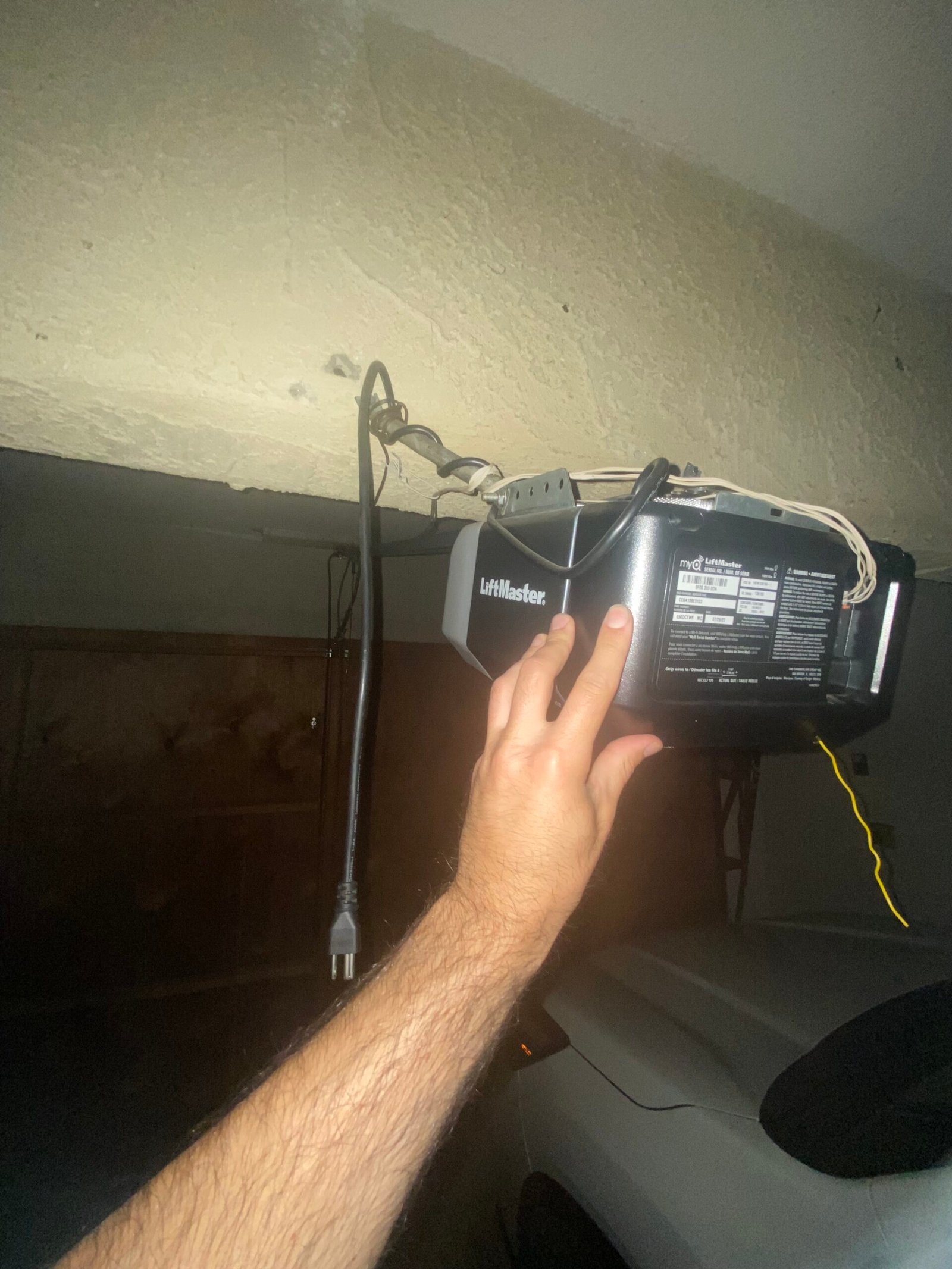
8 The Garage Door Opener Receiver or Logic Board Has a Problem
If legitimate remote, keypad, wall-control and connected-access causes have been ruled out, the opener's own electronics become more important to evaluate.
The receiver logic board processes wireless signals and other control inputs. A fault in that circuitry can create abnormal opener behavior.
Do not make the logic board the first assumption
Replacing electronic components before checking a stuck remote or programmed transmitter can result in unnecessary parts replacement.
A logical diagnostic sequence rules out simpler external command sources first.
Model-specific troubleshooting is important
Opener generations use different receiver technologies, wall controls, diagnostic codes and replacement boards.
The model number should be identified before parts are ordered.
Intermittent behavior can make diagnosis difficult
A faulty electronic component may not produce an unwanted opening every time the opener is tested.
Keeping a record of the time of each event and what controls were active or isolated can help narrow the issue.
Receiver-board diagnosis should follow manufacturer guidance
Chamberlain's troubleshooting flow for unexplained activation progresses through programmed remotes, stuck buttons, wall-control wiring and the receiver logic board.
That sequence is useful because it isolates command sources instead of treating every unexpected opening as the same failure.
If the behavior continues after authorized transmitters and wall-control causes are eliminated, professional opener diagnosis can determine whether the electronics should be repaired or replaced.
What If the Garage Door Moves by Itself When the Opener Is Disconnected?
This is an important exception to the eight electronic/control causes above.
If the opener has been disconnected from the garage door and the door then strongly rises or falls by itself, the motor is not commanding that movement. The condition can involve door balance and spring counterbalance.
Springs counterbalance the door's weight
A properly configured spring system offsets much of the garage door's weight so it can move in a controlled manner.
The automatic opener is intended to move a properly functioning, counterbalanced door. It is not supposed to replace the work of a failed or improperly adjusted spring system.
A door that rises by itself can be overbalanced
If a manually disconnected door strongly pulls upward, excessive spring force or another balance condition may be involved.
A door that falls by itself can be underbalanced
If the door cannot remain controllable and wants to fall, spring counterbalance or mechanical condition should be evaluated.
Do not adjust spring tension yourself
Homeowners should not wind or unwind torsion springs, loosen winding cones, adjust cable drums or reconnect tensioned lift cables in an attempt to correct balance.
The fact that a disconnected garage door moves on its own is useful diagnostic information for a trained door-system technician.
Can Garage Door Safety Sensors Make the Door Open by Itself?
Safety sensors are often blamed whenever a garage door behaves strangely, but their role needs to be understood accurately.
The photo-eye system near the bottom of the garage-door opening is designed around protection during closing.
If the beam is blocked, misaligned or otherwise not functioning correctly, the opener may refuse normal closing or reverse the door upward during a closing attempt.
Reversal is different from spontaneous opening
Suppose the door starts closing, reaches partway down and reverses to the fully open position.
If a homeowner walks into the garage later and sees the door open, it can appear that the door opened on its own.
What actually happened was a failed or interrupted closing cycle.
A fully closed door opening later points elsewhere
If the door was confirmed fully closed and the opener later begins an opening cycle, focus first on remotes, wall controls, programmed devices, connected access and opener electronics rather than blaming the photo eyes.
Never bypass the sensors
Automatic residential garage-door operators are subject to federal safety requirements involving entrapment protection.
The U.S. Consumer Product Safety Commission provides information about the applicable automatic residential garage door operator safety standard .
Do not bypass, defeat or permanently obstruct the safety system in order to make the door behave differently.
Can a Neighbor's Garage Door Remote or Radio Interference Open My Door?
Homeowners sometimes describe unexplained garage-door opening as “someone nearby must be on the same frequency.”
That explanation is too broad to be useful.
Interference and authorized programming are different
Radio-frequency interference more commonly causes communication problems, such as reduced remote range or commands not being received properly.
A more relevant unexpected-opening scenario is that another transmitter was actually programmed or learned by the opener.
Inadvertent programming is a recognized possibility
Chamberlain's support guidance specifically identifies an inadvertently programmed neighbor's remote as one possible cause of a door activating on its own.
The recommended troubleshooting path is to clear stored remote access on compatible equipment and intentionally reprogram the authorized devices.
Do not blame every nearby radio device
Wi-Fi routers, LED lamps and other electronics can affect remote communication in some circumstances, but that is not the same as proving that they issued a valid door-opening command.
Diagnosis should focus on evidence rather than a vague assumption of interference.
Can a Power Outage or Power Restoration Make a Garage Door Open by Itself?
A power interruption can affect whether an electric opener is available, but homeowners should not automatically treat power restoration as the normal explanation for a door receiving an opening command.
First confirm whether there was actually a power interruption
If other clocks, appliances or electrical devices reset, a power event may have occurred.
Pasadena residents can use official Pasadena Water and Power information when they need to check a current local outage rather than relying on neighborhood speculation.
The Pasadena Water and Power outage map is the appropriate local source for current outage information.
Do not confuse loss of power with an opener command
A standard electric opener without available backup power generally cannot run its motor during an outage.
If unexpected activation repeatedly follows electrical events, the opener's model-specific electronics should be evaluated rather than assuming all garage doors normally open whenever power returns.
Battery-backup systems behave differently during outages
Some residential openers include battery backup. Their availability during power loss differs from a non-backup opener.
Check the manual for the exact model installed.
If Your Garage Door Opens Unexpectedly, Treat Access Security Seriously
An unexplained opening can be a mechanical troubleshooting issue, but it is also an access-control concern because the garage door may provide entry to vehicles, stored property or an attached home.
Confirm that the door actually closed
If possible, observe a complete closing cycle rather than driving away as soon as the door starts moving.
A door that reverses because of an obstruction or sensor condition can remain open even though nobody issued a later opening command.
Account for every remote
Locate all handheld remotes and vehicle controls.
If a remote is missing and your opener supports memory clearing, follow the manufacturer's instructions for removing stored remote access and reprogramming the devices you still control.
Review keypad access
Change access information where appropriate for the specific keypad, especially if a PIN may be known by someone who should no longer have access.
Review smart-garage users
Remove digital access that is no longer required and secure the account associated with the garage-door system.
If the behavior cannot be isolated, limit normal automatic operation until it is diagnosed
Follow the opener manufacturer's safe procedure for taking the opener out of service if necessary.
Do not create a new hazard by disconnecting a garage door that is badly unbalanced, off track or unstable.
Safe Troubleshooting Steps Pasadena Homeowners Can Try
Useful troubleshooting does not require taking apart springs or high-tension door hardware.
The objective is to narrow which control path is associated with the unexplained opening.
Step 1: Write down exactly what happened
Record:
- The date and time.
- Whether the door was definitely fully closed beforehand.
- Whether you heard the opener motor run.
- Whether the opener light came on.
- Whether anyone was using a vehicle or remote at the time.
- Whether the door had just been closing and may have reversed.
- Whether a smart-garage system showed activity.
A recurring pattern can reveal much more than the general statement that “it happens randomly.”
Step 2: Inspect every handheld remote
Check the physical buttons and housings.
Remove objects that can press the remote. Look for a button that remains depressed.
Step 3: Identify every other programmed control
Do not stop with handheld remotes.
Include:
- Exterior keypad.
- Vehicle HomeLink-type controls.
- Mini remotes.
- Smart hubs.
- Connected apps.
- Authorized household users.
Step 4: Consider whether an unknown remote may still be programmed
This is especially relevant after buying a house, losing a transmitter, changing vehicles or discovering that an old remote cannot be located.
If your opener's manufacturer provides an approved memory-clearing procedure, use the instructions for the exact model.
Step 5: Observe the wall control
Look for a stuck button, visible damage or abnormal behavior.
Do not dismantle control circuits unless you understand and are following the manufacturer's procedure.
Step 6: Look at accessible wall-control wiring
From a safe position, look for cuts, crushing, exposed conductors or places where staples or storage equipment may have damaged the cable.
Step 7: Watch one complete closing cycle
Confirm that the door reaches its normal fully closed position.
If it begins closing and then reverses, the troubleshooting direction changes toward sensors, obstructions, mechanical resistance or opener closing settings.
Step 8: Look at the mechanical door condition
An opener-control problem and a mechanical garage-door problem can coexist.
Look for obvious:
- Off-track rollers.
- Bent tracks.
- Loose hinges.
- Broken springs.
- Loose cables.
- Door sections hanging at an unusual angle.
Do not continue troubleshooting automatic operation if the door itself is unstable.
What Homeowners Should Not Do While Troubleshooting Unexplained Opening
A garage-door opener includes electrical controls, but it operates a large mechanical door that also contains spring and cable forces.
Do not:
- Wind or unwind torsion springs.
- Adjust spring winding cones.
- Loosen spring anchor brackets.
- Adjust cable drums.
- Reconnect tensioned lift cables.
- Remove cable-connected bottom brackets.
- Stand beneath an unstable garage door.
- Force a badly off-track door.
- Bypass photo-eye safety sensors.
- Increase opener force to overpower mechanical binding.
- Randomly cut low-voltage wiring to test theories.
- Replace a logic board before checking simpler control sources.
- Assume a door reversing while closing is the same as spontaneous opening.
If the door is mechanically stable but unexplained automatic activation continues, opener-control diagnosis is appropriate.
If the door is crooked, unusually heavy, off track or has a visible cable or spring problem, the mechanical condition should be addressed as part of the repair.
Can Hinges, Rollers or Tracks Make a Garage Door Appear to Open by Itself?
Mechanical components usually do not send an electronic command that tells a fully closed automatic opener to start opening.
However, mechanical problems can create related behavior that a homeowner may describe in similar terms.
A binding door may reverse
If a roller, hinge or track creates significant resistance during closing, the opener may stop or reverse.
When the homeowner later finds the door open, it may appear that the door reopened long after it had closed when in fact the closing cycle never completed.
A loose or damaged hinge can affect roller alignment
End hinges can position roller stems. If one bends or comes loose, the roller can scrape or bind in the track and interfere with normal travel.
Our Pasadena guide to damaged or loose garage door hinges explains how hinge problems can affect rollers, track alignment and door movement.
Mechanical resistance should be corrected before opener settings are changed
An opener should not be made to push harder simply because the physical door is binding.
Identify whether the door truly received an unexplained opening command or whether a mechanical problem prevented a successful closing cycle.
Why Does the Garage Door Open Again Right After I Close It?
A door that immediately returns upward after you attempt to close it is usually a different troubleshooting category from a door that has remained fully closed for hours and then begins opening.
Safety-sensor conditions
If the photo-eye system cannot confirm a clear closing path, the opener may refuse normal downward movement or reverse depending on the system and stage of travel.
Physical obstruction
A stored item, debris or object in the door path can interfere with closing.
Mechanical resistance
Bent tracks, damaged rollers, hinges or other mechanical components can make the door difficult to move through part of its closing path.
Travel or adjustment issues
Opener travel settings determine where the opener expects the fully closed position to be.
Model-specific diagnostic procedures should be used if the door reaches the floor and then reverses.
The key is to describe the symptom accurately: “reverses while closing” is more diagnostically useful than “opens by itself.”
Why Does My Garage Door Open at About the Same Time Every Day?
A repeating time pattern suggests looking for a repeating human or connected behavior before assuming random electronic failure.
Ask what else happens around that time.
- Does someone leave for work?
- Does another household member arrive?
- Is a vehicle being moved?
- Is a remote stored where another daily activity can press it?
- Does an authorized smart-garage user routinely access the door?
Keep an event log
Write down each occurrence for several days.
A time pattern can transform an apparently random problem into an identifiable control event.
Avoid assuming the opener has a hidden schedule
Features vary by manufacturer and model.
Do not claim a scheduled-opening feature exists unless the actual connected system supports it.
Instead, review the authorized app, accessories and integrations installed for the specific opener.
Why Does the Garage Door Open After I Leave the House?
When the timing is closely linked to leaving home, several possibilities become more relevant.
A vehicle remote may be pressed accidentally
Check whether moving the visor, reaching for another control or placing something in the console could press the garage-door button.
The door may never have completed its closing cycle
If you drive away before watching the door fully close, it can reverse after your vehicle leaves.
When you return or check remotely, it appears to have reopened.
A sensor or obstruction may affect closing
Confirm that the photo-eye area is clear and that the mechanical door does not bind during downward travel.
Use available activity information
If a connected garage system provides event history, reviewing it may help distinguish an app command from a closing failure.
Could a Lost Garage Door Remote Still Open My Door?
Yes, if the remote remains programmed to the opener and is still functional.
Losing physical possession of a remote does not necessarily remove its stored authorization from the opener.
Treat a missing remote as an access issue
Consult the opener manual to determine the correct process for erasing programmed transmitters.
On many compatible systems, clearing remote/keypad memory requires the authorized devices to be programmed again afterward.
Do not forget vehicle controls
If a vehicle with programmed garage access is sold, stolen or transferred, the garage-door opener's stored access should be reviewed as well.
Keep only known devices
Reprogram only the transmitters, keypads and connected accessories that should continue operating the door.
Can an Old Garage Door Remote Still Be Programmed Even If I Never Use It?
Yes.
A remote does not normally remove itself from opener memory merely because it has not been used recently.
If the transmitter remains authorized and functional, it can still operate the opener.
Check storage areas
Old remotes are often left in:
- Garage drawers.
- Tool cabinets.
- Kitchen junk drawers.
- Old vehicles.
- Boxes from a previous move.
- Property-management storage.
A forgotten remote can become relevant if its button gets compressed or someone finds and uses it.
Periodic access cleanup can simplify troubleshooting
Knowing exactly which remotes and keypads are programmed reduces uncertainty when an unexplained activation occurs.
Can a Faulty Wall Button Open the Garage Door Even When Nobody Touches It?
Yes, a faulty wall-mounted control or its wiring can be a legitimate source of unwanted opener commands.
The control circuit is designed to tell the opener to operate. A fault in that command path can imitate a button press.
Wall controls are not merely decorative switches
Depending on the opener, the control may include the main door button, lighting controls, lock functions, programming functions or status information.
Because designs vary, replacement and troubleshooting should match the opener model.
Wiring and the control panel must be separated diagnostically
If the control circuit is responsible, the actual failure could be in the wall unit, the wire between the control and opener, or the opener electronics receiving the signal.
Proper isolation helps avoid replacing the wrong part.
Does a Garage Door Logic Board Cause Random Opening?
A receiver or logic-board fault can be a possible cause after simpler external command sources have been ruled out.
It should not automatically be diagnosed from one unexplained opening.
First eliminate common command sources
Check:
- Stuck remotes.
- Accidental remote activation.
- Unrecognized programmed remotes.
- Keypads.
- Vehicle transmitters.
- Wall control.
- Wall-control wiring.
- Connected access.
Then evaluate opener electronics
Manufacturer troubleshooting may use diagnostic indicators, control-circuit isolation or other model-specific steps to determine whether the receiver logic board is behaving abnormally.
Match replacement parts precisely
Logic boards are model- and generation-specific.
A board should not be ordered solely because it resembles another opener's electronics.
Should I Unplug the Garage Door Opener If It Keeps Opening Unexpectedly?
Temporarily taking an opener out of automatic service can be appropriate when unwanted activation continues and access security is a concern, but it must be done without creating a mechanical-door hazard.
Follow the manufacturer's instructions
If you intend to unplug or disconnect the opener, use the instructions for the actual system.
Evaluate the physical door first
Do not casually disconnect an opener from a door that is:
- Badly off track.
- Visibly crooked.
- Unusually heavy.
- Supported by a broken spring system.
- Unstable in the open position.
The opener may be connected to a door with a separate mechanical problem.
Manual security matters too
If the automatic opener is temporarily unavailable, use only locking or security methods appropriate for the garage-door system and remember to remove any manual lock before later operating the opener.
Could a Garage Door That “Opened by Itself” Actually Have Reversed?
Yes, and this is one of the most important diagnostic distinctions in the entire article.
If the garage door was moving downward when the problem occurred, the opener may have reversed because it detected an unsafe or abnormal closing condition.
Possible closing-related causes include:
- Blocked safety sensors.
- Misaligned photo eyes.
- An object in the door path.
- Mechanical resistance.
- Bent track.
- Binding roller.
- Hinge or section problem.
- Incorrect travel adjustment.
Observe before leaving
When unexplained opening is suspected, watch the garage door until it reaches the fully closed position.
This simple observation can reveal whether the problem is truly an opening command or a failed closing cycle.
Why Does My Garage Door Open a Few Minutes After Closing?
A delay after confirmed full closure points more toward an external command source or opener-control issue than a normal safety reversal that occurs during the closing cycle.
Investigate:
- Remote controls that may still be transmitting.
- Vehicle controls.
- Programmed accessories.
- Wall-control problems.
- Wall-control wiring.
- Connected access.
- Receiver or logic-board behavior.
Confirm “fully closed”
The timing matters only if the door genuinely reached and remained at its normal closed position first.
Keep a precise event record
Note whether the opener light turns on, whether you hear the motor start and what household devices are active at the moment.
Detailed observations help distinguish electronic activation from mechanical reversal.
Could Someone Else Still Have Access to My Garage Door Opener?
Yes, if an old remote, keypad credential, vehicle transmitter or connected account remains authorized.
This does not prove unauthorized use occurred, but it is worth reviewing whenever access control is uncertain.
Situations where an access review makes sense
- Recently purchasing the property.
- A roommate or tenant moving out.
- Losing a remote.
- Selling a vehicle with an integrated transmitter.
- Changing household members.
- Finding more programmed accessories than expected.
Reset access using manufacturer procedures
Where supported, clearing stored remote/keypad memory and reprogramming only authorized devices creates a cleaner access baseline.
Smart-garage account access should be reviewed separately because clearing handheld remotes may not be identical to removing every connected accessory or digital permission on every system.
What If the Garage Door Opens Randomly but Only Once Every Few Weeks?
Infrequent events are harder to diagnose because the system may behave normally whenever it is inspected.
The best response is to improve the quality of the evidence.
Keep a log
Record the date, time, whether anyone was home, which vehicles were present, whether the opener light was on and whether the door had recently been commanded to close.
Inventory controls
Confirm that no forgotten remote or accessory remains active.
Review connected-device history where available
Model-specific app records may provide useful clues about remote activity.
Do not replace unrelated mechanical parts as guesses
Springs, rollers, tracks and hinges should be repaired when their condition warrants it, not merely because an intermittent electronic-control symptom exists.
If the unwanted activation continues after control devices have been eliminated, opener electronics become more important to test.
What If the Door Opens by Itself but the Opener Light Does Not Come On?
The opener light is a useful clue, but it is not a universal diagnostic test because lighting behavior varies among opener models and settings.
Focus on whether the motor or drive system actually activated.
Listen for motor operation
If the opener motor and trolley move, the system is operating the door even if the courtesy light does not behave as expected.
Check the light separately
A failed lamp or disabled lighting feature should not be confused with the opener's command problem.
If no opener movement occurred
If the motor did not operate and the door moved only while manually disconnected, evaluate mechanical balance rather than remote commands.
Can Garage Door Spring Problems Make the Door Open Automatically?
A spring problem does not normally send an electronic opening command to a connected automatic opener.
Springs affect counterbalance.
Their job is to offset garage-door weight so the door can move in a controlled manner.
Overbalance can make a disconnected door rise
When the opener is disengaged, a balance problem can cause the door to move rather than remain where expected.
Broken springs usually create the opposite problem
A broken spring commonly makes the door much harder to lift because the counterbalance has been reduced or lost.
Do not adjust spring tension to troubleshoot electronic opening
If the opener motor is clearly activating from a fully closed position, investigate the command/control side before touching the spring system.
Can Track or Roller Problems Trigger the Opener to Open?
Track and roller problems can influence door movement, but they generally create resistance rather than an electronic command to open from a fully closed position.
During closing, resistance can produce reversal
This is where mechanical problems can imitate “opening by itself.”
A bent track or binding roller may interrupt closing and cause the opener to return the door upward.
From the fully closed position, look at controls
If the door was completely closed and later the opener starts a normal opening cycle, remotes, wall controls, connected access and electronics become stronger diagnostic targets.
Mechanical defects still need repair
If a track or roller problem is found during diagnosis, correct it because the opener should move a mechanically suitable door.
Just do not confuse that defect with proof that the track generated the opening command.
Pasadena Considerations for a Garage Door That Opens by Itself
The electronic causes of unexplained garage-door activation are not unique to Pasadena, but local residential patterns can influence how the problem is noticed and why access control matters.
Attached garages
In an attached garage, the garage door may provide access to a door leading directly into the home.
Unexpected garage-door opening therefore deserves timely attention even if the eventual cause turns out to be a harmless stuck transmitter.
Detached garages
A detached garage may be less visible from inside the residence.
A door can remain open for longer before anyone notices.
Connected door-status features, where properly configured and supported by the installed opener, can help property owners monitor whether a garage door is open or closed.
Frequent commuting
Pasadena households that operate the garage door several times during work, school and daily errands may use multiple remotes and vehicle transmitters.
More legitimate controls mean more places to check when unexpected activation occurs.
Older homes with newer opener technology
The age of a Pasadena house does not tell you the age of its garage-door opener.
An older home may have a recently installed Wi-Fi opener, while another property may still use an older operator with basic remotes.
Troubleshooting must follow the actual model installed, not the architectural age of the property.
Rental properties
Rental turnover creates a practical reason to know which transmitters, keypads and connected users can operate the garage door.
Property owners and managers should use manufacturer-approved access reset procedures when control of old remotes or credentials is uncertain.
HOA and managed properties
Shared residential environments may involve more nearby wireless devices, but proximity alone does not prove that another resident's remote opened your door.
Determine whether an unintended transmitter was actually programmed before blaming ordinary neighborhood radio activity.
Warm garages
Pasadena garages can become warm, especially with afternoon sun exposure. Temperature can expose intermittent weaknesses in electronics or wiring, but heat should not automatically be declared the cause without evidence.
A damaged control wire, stuck transmitter or failing opener component should be diagnosed directly.
Power interruptions
If a homeowner suspects an electrical event, official Pasadena Water and Power information can help establish whether a local outage occurred.
Do not assume a neighborhood outage exists merely because the opener behaved unexpectedly.
Pasadena geographic focus
This guide is written for residential garage doors in Pasadena, California 91105, within Los Angeles County and the San Gabriel Valley.
Pasadena residential context can naturally include areas such as Old Pasadena, Bungalow Heaven, Hastings Ranch, Madison Heights and San Rafael Hills.
These neighborhood references are geographic context only. They do not imply separate Pasadena Garage Door Repair Experts physical offices or storefronts in those neighborhoods.
When Professional Garage Door Opener Diagnosis Makes Sense
Many simple possibilities can be checked without dismantling the garage door, but professional diagnosis becomes useful when the problem persists after obvious control sources are eliminated.
Consider garage-door opener service when:
- The door repeatedly opens from a confirmed fully closed position.
- No stuck handheld remote can be found.
- Authorized remotes have been inventoried.
- Old or unknown programmed access is suspected.
- The wall control behaves abnormally.
- Wall-control wiring appears damaged.
- Unexpected activation continues after control devices are isolated.
- The opener shows diagnostic codes or abnormal electronic behavior.
- The receiver or logic board may need model-specific testing.
- The garage door also reverses or binds mechanically.
- The door is crooked, off track or unusually heavy.
- A spring or lift-cable problem is visible.
The advantage of a structured diagnosis is that a remote problem can be repaired as a remote problem, a wall-control fault as a wall-control problem, and a receiver-board issue as an electronic opener problem.
It also prevents an electronic-control symptom from distracting from a separate mechanical garage-door problem that needs attention.
Homeowners can contact Pasadena Garage Door Repair Experts or call (626) 415-3641 to describe the symptoms and ask about current garage-door opener service availability.
What Affects Garage Door Opener Repair Cost in Pasadena?
There is no responsible fixed price for a garage door that opens by itself because the symptom can originate in several different components.
Cost can vary according to:
- The diagnosis.
- Opener model and generation.
- Whether the problem is a remote.
- Whether programmed devices need to be reset.
- Wall-control condition.
- Control-wire condition.
- Receiver or logic-board condition.
- Parts compatibility.
- Whether the complete opener requires replacement.
- Whether mechanical garage-door problems also exist.
- Track or roller damage.
- Spring or balance problems.
- Installation complexity.
- Additional failed components actually found during diagnosis.
A remote problem and a logic-board problem are very different repairs
A stuck transmitter may require a small accessory solution. A failed receiver board involves opener electronics. A mechanically unbalanced door involves the spring system rather than the remote controls.
Diagnosis should therefore come before quoting a meaningful repair scope.
Does an Opener Need to Be Replaced Because the Door Opens by Itself?
Not automatically.
The correct repair depends on the source of the unwanted activation.
Opener replacement may be unnecessary when:
- A remote button is stuck.
- An old transmitter is still programmed.
- A keypad is the source.
- A wall control has failed but the main opener remains serviceable.
- Damaged low-voltage control wiring is causing the signal.
- An authorized smart-access command explains the opening.
Opener repair or replacement may be considered when:
- The receiver or logic board is confirmed faulty.
- Required replacement electronics are unavailable or incompatible.
- The opener has multiple material failures.
- A broader opener condition makes replacement more practical than individual electronic repair.
Age by itself is not enough information to select a repair.
Model, condition, parts availability, safety features and the diagnosed failure should all be considered.
What Information Helps a Garage Door Technician Diagnose the Problem?
Intermittent opener problems are easier to diagnose when the homeowner can describe exactly what has happened.
Useful information includes:
- The opener manufacturer and model number.
- Approximate installation age if actually known.
- How many handheld remotes exist.
- Whether an exterior keypad is installed.
- Whether vehicle controls are programmed.
- Whether the opener uses Wi-Fi or a smart-garage app.
- Whether the door was confirmed fully closed before opening.
- Whether the motor was heard running.
- Whether the opener light responded.
- The time and frequency of each event.
- Whether the wall control has behaved strangely.
- Whether control wiring shows visible damage.
- Whether the door ever reverses while closing.
- Whether the door is mechanically smooth and level.
- Whether any spring, cable, roller, hinge or track damage is visible.
Photos of the opener model label, wall control and visible wiring can also help identify the equipment before service.
Questions Pasadena Homeowners Should Ask Before Garage Door Opener Repair
- Was the door definitely fully closed before the unexplained opening?
- Did the opener motor actually activate?
- Could the door have reversed during closing instead?
- Have all handheld remotes been checked for stuck buttons?
- How many remotes are programmed?
- Is there an exterior keypad?
- Are vehicle-integrated transmitters programmed?
- Could an unknown transmitter still be stored in opener memory?
- Does the wall control show any fault?
- Is the wall-control wiring damaged or shorted?
- Does the opener have connected smart access?
- Which digital users currently have access?
- Does the opener provide diagnostic codes?
- Has the receiver or logic board actually been tested?
- Is the proposed replacement board compatible with the exact opener model?
- Are the safety reversing sensors functioning correctly?
- Does the garage door move smoothly through the tracks?
- Is the door properly balanced?
- Are any rollers, hinges, cables or tracks damaged?
- Is opener replacement actually necessary, or can the diagnosed component be repaired?
Why Consider Pasadena Garage Door Repair Experts for Unexplained Garage Door Opening?
Pasadena Garage Door Repair Experts is a local garage door repair company serving homeowners and residential property customers in Pasadena, California.
A door that opens unexpectedly should be diagnosed by separating the possible command sources from the mechanical garage-door system.
Relevant troubleshooting can include:
- Remote-control condition.
- Programmed transmitter access.
- Wireless keypad operation.
- Wall-control condition.
- Low-voltage control wiring.
- Connected opener access where applicable.
- Receiver and logic-board diagnostics.
- Opener travel behavior.
- Safety reversing operation.
- Door balance.
- Rollers, hinges and tracks when mechanical reversal is suspected.
The goal is to identify whether the door is receiving an unwanted command, reversing during closing, or moving because of a separate mechanical condition.
Pasadena homeowners can visit Pasadena Garage Door Repair Experts or call (626) 415-3641 to describe unexplained garage-door opening and ask about current opener service availability.
Garage Door Opener Service Area in Pasadena
The primary geographic focus of this guide is Pasadena, California 91105, within Los Angeles County and the San Gabriel Valley.
Residential context can naturally include Old Pasadena, Bungalow Heaven, Hastings Ranch, Madison Heights and San Rafael Hills.
Those neighborhood references provide local context only. They do not imply separate Pasadena Garage Door Repair Experts storefronts or physical offices in those neighborhoods.
Homeowners can call (626) 415-3641 to ask about current residential garage-door opener troubleshooting and repair availability in Pasadena.
Frequently Asked Questions About Garage Doors Opening by Themselves in Pasadena
Why would my garage door suddenly open by itself?
A garage door opener can activate unexpectedly because a remote button is stuck or accidentally pressed, an unintended transmitter is programmed, a keypad or vehicle control sends a command, the wall control or its wiring is faulty, connected smart access activates the opener, or the receiver or logic board has a problem. First confirm that the door truly opened from the fully closed position rather than reversing during a failed closing cycle.
Can a stuck garage door remote button make the door open randomly?
Yes. A stuck or compressed remote button can continue sending a signal to the opener. Inspect every handheld and visor remote, including spare remotes that are rarely used. A transmitter stored beneath other objects in a drawer, bag or vehicle console can also be activated accidentally.
Can someone else's remote open my garage door?
An unrelated nearby remote should not automatically be blamed simply because it uses radio. A more specific recognized possibility is that another transmitter was inadvertently programmed to the opener. If unknown access is suspected, follow the opener manufacturer's procedure for erasing stored remote and keypad access and reprogram only authorized devices.
Can a bad wall button make a garage door open by itself?
Yes. A faulty wall-mounted door control or a short in its low-voltage wiring can send an unwanted command to the opener. If the problem persists after remote-control causes are ruled out, the wall control, control wiring and receiver logic board become important diagnostic areas.
Can garage door safety sensors make the door open by itself?
Safety sensors are more closely associated with closing and reversal behavior. A blocked or misaligned sensor can prevent normal closing or contribute to the door returning upward during a closing attempt. That can look like spontaneous opening later, but it is different from a fully closed door receiving a new opening command.
Can a smart garage-door app open the door when nobody is home?
A compatible connected garage-door system can accept remote commands from authorized users. If unexplained opening occurs, review which accounts and devices currently have access and any available activity information for the installed system. An authorized digital command does not necessarily mean the opener electronics are defective.
Can a faulty logic board cause a garage door to open unexpectedly?
Yes, a receiver or logic-board problem can be a possible cause after remotes, keypads, wall controls, wiring and connected-access sources have been ruled out. Logic-board diagnosis should follow the opener manufacturer's model-specific procedures rather than replacing the board based on one unexplained opening.
Why does my garage door close and then open again?
A door that reverses during or immediately after closing may have a safety-sensor problem, an obstruction, mechanical resistance, track or roller binding, or an opener travel-setting issue. This is different from a door that remains fully closed and later begins a new opening cycle. Observing the complete closing cycle helps distinguish the two symptoms.
Why does my garage door move by itself when I disconnect the opener?
If a manually disconnected garage door rises or falls strongly without the opener motor operating, the issue can involve door balance or spring counterbalance rather than an electronic command. Do not wind or unwind torsion springs, adjust winding cones or alter tensioned cable hardware yourself.
Who can I contact if my garage door keeps opening by itself in Pasadena?
Pasadena homeowners can contact Pasadena Garage Door Repair Experts at (626) 415-3641 to describe unexplained garage-door opening, remote-control problems, wall-control symptoms or opener behavior and ask about current residential garage-door opener service availability in Pasadena, California.
Find Pasadena Garage Door Repair Experts on Google Maps
You can also view Pasadena Garage Door Repair Experts on Google Maps .
Does Your Garage Door Keep Opening by Itself in Pasadena?
An unexplained garage-door opening should be traced to the component or control path actually causing it.
Start with remotes, vehicle controls, keypads and connected access. If those sources do not explain the problem, wall controls, low-voltage control wiring and opener electronics deserve closer diagnosis.
Also confirm whether the door is truly opening from the fully closed position or reversing during closing. If the garage door is crooked, off track, unusually heavy or mechanically unstable, stop normal operation and address that condition as well.
Contact Pasadena Garage Door Repair Experts to ask about current garage-door opener troubleshooting and residential repair availability in Pasadena, California.
Call (626) 415-3641.
Safety reminder: do not bypass safety sensors, force an unstable off-track door, adjust cable drums, reconnect tensioned lift cables, or wind or unwind garage-door torsion springs while troubleshooting an opener problem.
Related Pasadena Garage Door Topics
- Garage Door Opener Not Working? Pasadena Homeowner Troubleshooting Guide
- Garage Door Won't Close in Pasadena? 8 Reasons It Keeps Reversing or Stopping
- Garage Door Sensors Not Working? How to Diagnose Alignment, Sunlight and Wiring Problems
- Garage Door Hinges Cracking, Popping or Coming Loose? What Pasadena Homeowners Should Know
- The Pasadena Garage Door Maintenance Checklist: Springs, Rollers, Tracks, Cables and Opener