
How Much Does Garage Door Repair Cost in Pasadena, CA? What Affects the Price?
The cost of garage door repair in Pasadena, CA depends on what actually failed, which parts are required, the size and weight of the garage door, the spring and opener system, whether cables or tracks were damaged, how difficult the repair is to access, and whether one problem caused secondary damage elsewhere in the door system.
That is why a responsible garage door repair estimate should begin with a diagnosis rather than a one-price-fits-all promise. A dirty safety sensor, a broken torsion spring, a frayed lift cable, a bent track and a damaged door section are all described by homeowners as “garage door repair,” but they involve very different parts, labor and safety considerations.
This Pasadena homeowner guide explains the major factors that affect garage door repair price, which types of problems tend to involve simpler versus more complex repairs, what should be included in a useful estimate, and how to compare repair with replacement when the garage door has multiple problems.
How Much Does Garage Door Repair Cost in Pasadena, CA?
There is no single accurate price for garage door repair in Pasadena because the final cost depends on the diagnosed problem, replacement parts, labor, door size and weight, spring configuration, opener type, cable or track damage, panel construction, parts availability and whether additional components were damaged.
A relatively limited issue such as cleaning or correcting a straightforward sensor problem generally involves a different repair scope from replacing a failed torsion spring, repairing a cable and drum problem, correcting a heavily bent track or replacing a damaged garage door section.
The best way to understand the likely cost is to identify the actual failure first. Homeowners should be cautious of a fixed price quoted before anyone knows whether the problem is electrical, mechanical, structural or related to the counterbalance system.
A useful garage door repair estimate should explain what failed, what parts are recommended, whether additional damage is present, what labor is required and whether the proposed work is a repair or a larger replacement project.
Why Does Garage Door Repair Pricing Vary So Much?
Homeowners often search for a simple answer such as “What does it cost to fix a garage door?” The challenge is that “garage door repair” describes a category of work rather than one specific repair.
A garage door is a system of interacting parts. Springs counterbalance the weight of the door. Lift cables connect the door to the spring system. Cable drums control how those cables wind and unwind. Rollers guide the sections through the tracks. Hinges allow the sections to articulate. Safety sensors communicate with the opener. The opener provides powered movement, but it depends on the mechanical door being reasonably balanced and free to move.
A problem in one component can therefore produce symptoms that resemble a different failure.
For example, a homeowner may report that the garage door opener is “struggling.” The opener could actually be defective, but the same symptom can occur when a broken or weak spring causes the door to become unusually heavy. Replacing an opener component without checking the counterbalance system could miss the real problem.
The same is true when a garage door becomes crooked. A crooked door can involve a lift cable, drum, track, roller, hinge, section damage or combinations of those components.
That diagnostic uncertainty is one reason legitimate repair pricing usually begins with identifying the mechanical cause.
The final price is then shaped by three broad categories:
- What failed: the actual part or system responsible for the problem.
- What it takes to correct it: parts, labor, access, adjustment and safety procedures.
- What else was affected: secondary damage caused by the original failure or continued operation.
Which Garage Door Repairs Tend to Be Simpler or More Complex?
Without inventing fixed dollar amounts, Pasadena homeowners can still understand relative repair complexity.
A simpler problem usually involves fewer parts, less disassembly and a stable garage door. A more complex problem may involve high-tension components, heavy sections, multiple damaged parts, difficult access or a door that is crooked, off track or unstable.
| Garage Door Problem | Typical Relative Complexity | What Can Affect Cost | Important Diagnostic Question |
|---|---|---|---|
| Dirty or straightforward sensor issue | Often Lower Complexity | Alignment, wiring, sensor condition, opener compatibility | Is the sensor actually the reason the door will not close? |
| Remote or keypad problem | Often Lower to Moderate Complexity | Battery, programming, receiver, keypad, logic board | Is the issue with the accessory or the opener itself? |
| Roller or hinge problem | Low to Moderate Complexity | Number of parts, roller type, bracket location, secondary track wear | Is the roller damaged or is the track causing the binding? |
| Garage door opener repair | Moderate Complexity | Opener design, electronics, motor, drive system, parts availability | Is the opener faulty or is the door mechanically too heavy? |
| Broken torsion spring | Moderate to Higher Complexity | Door weight, spring size, spring count, shaft and hardware condition | What spring configuration correctly counterbalances this door? |
| Frayed or broken lift cable | Moderate to Higher Complexity | Cable condition, drums, springs, door alignment, bottom fixtures | Why did the cable fail or become loose? |
| Off-track garage door | Moderate to High Complexity | Number of rollers out, track damage, cable condition, door position | What caused the door to leave normal alignment? |
| Bent track after vehicle impact | Higher Complexity | Track section, mounting, rollers, panels, cables and structural damage | Did the impact damage the door as well as the track? |
| Damaged garage door panel | Moderate to High Complexity | Section availability, model, size, insulation, finish and hardware | Can one compatible section be replaced? |
| Multiple major failures | Highest Complexity | Combined parts, labor, alignment, balance and replacement scope | Does repairing the complete system still make practical sense? |
1 Diagnosis and the Actual Failed Component
The first major cost factor is diagnosis.
Two Pasadena homeowners can report the same symptom—“my garage door won't open”—and need completely different repairs.
One door may have a broken torsion spring. Another may have an opener that lost power. Another may have a broken lift cable. Another may be binding in the track. Another could have a damaged opener carriage or internal drive component.
Because the symptoms overlap, the estimate should be based on the root cause rather than the homeowner's description alone.
Why diagnosis changes price
A repair involving a small electrical accessory can require very different parts and labor from work on the counterbalance system.
High-tension spring and cable systems also involve different safety procedures than remote-control programming or photo-eye cleaning.
The repair may become more involved if one failed component damaged another.
For example, a failed cable can allow one side of the garage door to drop or move unevenly. That can push rollers into the track, damage a hinge or bend a section.
The most useful price conversation therefore starts with:
What is actually wrong with the garage door?
2 Garage Door Spring Type, Size and Configuration
Spring repair is one of the most important categories affecting garage door repair cost in Pasadena.
Springs are not interchangeable generic parts. The spring system must be appropriate for the weight and configuration of the garage door.
Common residential systems include torsion springs mounted above the garage opening and extension springs positioned along the horizontal track area.
Door weight affects spring selection
A lightweight single-car non-insulated door does not necessarily use the same spring specification as a wide, insulated, multi-layer double garage door.
Door weight can be influenced by:
- Width and height.
- Steel thickness.
- Insulation.
- Interior backing.
- Windows.
- Decorative materials.
- Reinforcement.
Number of springs matters
Some doors use one torsion spring while others use two or more depending on the system design and door weight.
A spring-repair estimate should identify the existing configuration and determine what is appropriate for the complete door rather than simply quoting a generic “spring price.”
Related hardware can affect the scope
The torsion shaft, center bearing, end bearing plates, cable drums and lift cables work with the spring system.
If those components are worn, damaged or displaced, the repair scope may involve more than replacing a spring alone.

Torsion springs store substantial mechanical energy. Homeowners should not wind or unwind torsion springs, loosen winding cones or adjust spring brackets to try to reduce repair cost. Professional diagnosis is particularly important when a garage door has become unusually heavy after a spring failure.
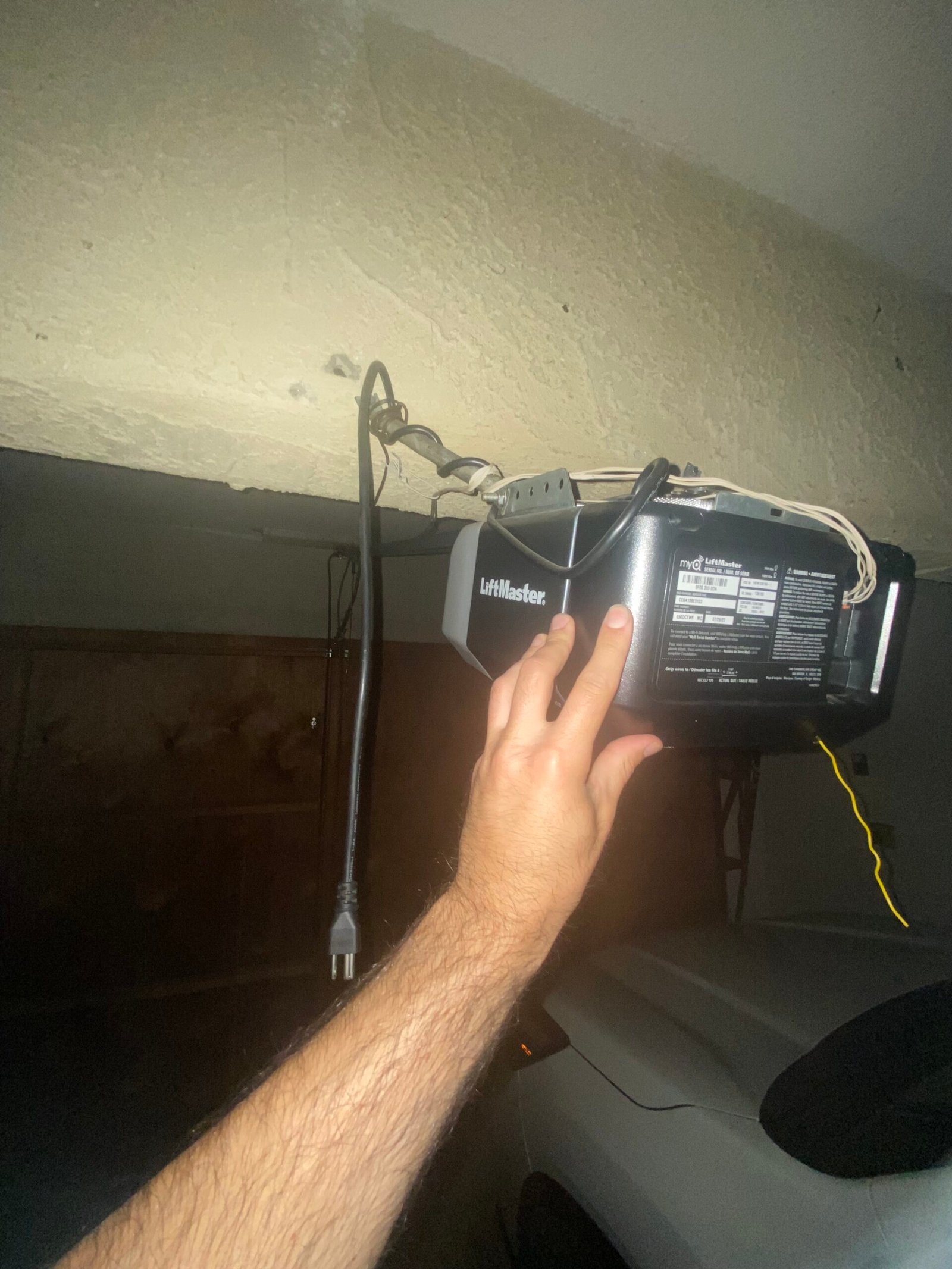
3 Garage Door Opener Type and the Part That Failed
“Garage door opener repair” can describe many different problems.
A remote-control issue is not the same as a failed motor, damaged logic board, worn carriage, drive-system problem, sensor fault or damaged opener rail.
Opener design matters
Residential openers may use chain, belt, screw, jackshaft or other drive arrangements depending on the model and installation.
Parts, access and repair procedures vary.
Electronics can change the repair
Modern garage door openers may incorporate:
- Logic boards.
- Safety sensor circuits.
- Wireless remote receivers.
- Keypads.
- Battery backup systems.
- Smart connectivity.
- Travel and force controls.
A repair involving programming or a peripheral device generally differs from one involving internal electronics or mechanical drive components.
Mechanical door problems can imitate opener failure
Before expensive opener work is recommended, the mechanical garage door should be evaluated.
Springs counterbalance door weight. If a spring fails, the opener may struggle, stop or reverse because the door is now much heavier than the opener was intended to move.
Similarly, a bent track or damaged roller can create resistance that makes the opener appear weak.
Repair cost should therefore follow diagnosis rather than assuming every “opener won't lift the door” complaint requires a new opener.
4 Lift Cable and Cable-Drum Damage
Garage door cables are another major factor in repair pricing because they work directly with the spring and counterbalance system.
A cable repair is not simply a matter of “putting the wire back.”
The technician needs to understand why the cable became loose, frayed, broken or displaced.
Possible cable conditions include:
- Frayed wire strands.
- A snapped cable.
- A cable that jumped off the drum.
- A cable wound incorrectly around the drum.
- Uneven cable tension.
- Corrosion.
- Damage caused by a crooked or off-track door.
A cable problem may involve other components
If one cable stops supporting the door normally, one side of the garage door can move differently from the other.
That may create additional wear on:
- Rollers.
- Tracks.
- Hinges.
- Bottom brackets.
- Door sections.
- Cable drums.
The repair price can therefore depend on whether the issue was caught early or whether the door was operated repeatedly after the cable problem began.
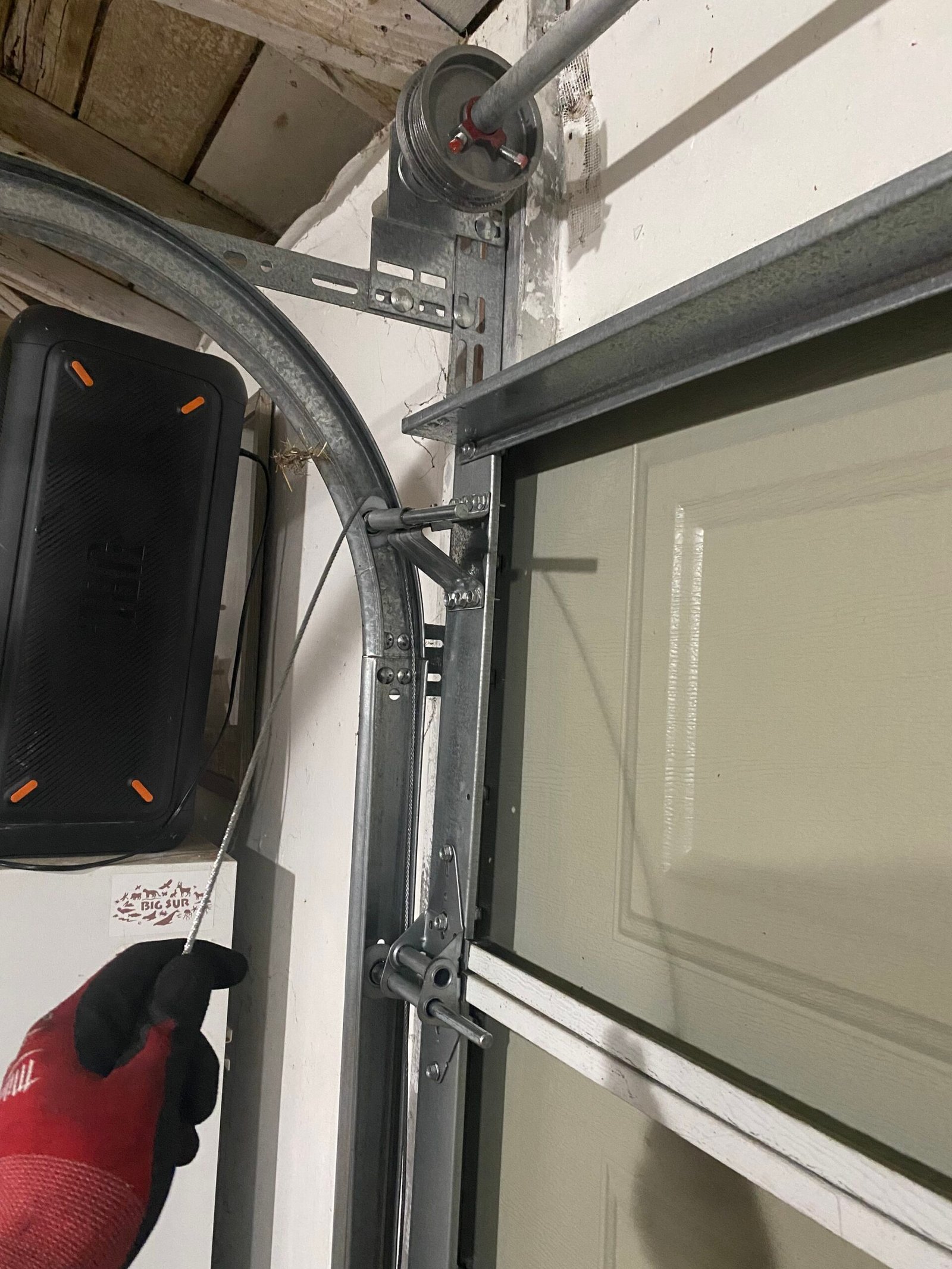
Homeowners should not loosen cable drums, remove bottom brackets or attempt to reconnect tensioned lift cables as a cost-saving DIY repair.
5 Garage Door Track Damage and Off-Track Conditions
Track-related repair cost depends heavily on the severity and cause of the alignment problem.
A loose ordinary track fastener can represent a very different repair from a vertical track that has been crushed by a vehicle or a door with multiple rollers outside the track.
Track issues can include:
- Loose track mounting.
- Minor alignment problems.
- Bent vertical track.
- Damaged horizontal track.
- Damage in the curved track section.
- Roller binding.
- Track damage after vehicle impact.
Off-track repair requires finding the cause
A roller outside the track is a symptom, not necessarily the complete diagnosis.
The door may have come off track because of:
- A broken cable.
- A damaged roller.
- A bent track.
- Vehicle impact.
- A damaged hinge.
- Structural section damage.
If the repair requires correcting several of those conditions, the cost will naturally differ from a basic track adjustment.
A badly off-track garage door should not be forced with the automatic opener. Continued operation can increase the amount of damage and therefore the eventual repair scope.
6 Rollers, Hinges and Related Hardware
Rollers and hinges are smaller than springs or panels, but they can still have a meaningful effect on garage door repair cost.
The number of worn components matters.
Replacing one damaged roller is different from addressing widespread wear across most of the door's rollers and hinges.
Roller type matters
Garage doors may use different roller designs and bearing arrangements.
The appropriate replacement depends on the door, track and expected operating load.
Location matters
Some roller and bracket positions are more straightforward than others.
Bottom fixtures deserve special caution because lift cables can attach in that area and may be under substantial tension.
Secondary damage matters
A seized roller may damage or mark the track. A bent hinge may cause the roller to approach the track at the wrong angle. A damaged section can distort hinge alignment.
The repair estimate should therefore explain whether the recommendation is simply to replace a worn moving part or to correct a broader alignment problem.
7 Safety Sensor and Garage Door Closing Problems
Sensor-related issues can fall toward the simpler end of garage door repair when the problem is limited to dirt, obstruction or straightforward alignment.
The repair can become more involved when the issue includes damaged wiring, failed sensor hardware, opener electronics or multiple closing-system problems.
Common sensor-related possibilities include:
- Dirty photo-eye lenses.
- Misalignment.
- An object blocking the beam.
- Loose or damaged wiring.
- Failed sensor hardware.
- An opener logic or control problem.
Not every garage door that will not close has a sensor problem.
Track binding, a damaged section, incorrect opener travel, mechanical resistance or other conditions can also interfere with normal closing.
Automatic residential garage door operators are subject to federal safety requirements. Safety systems should be diagnosed and repaired rather than permanently bypassed.
Homeowners can review the U.S. Consumer Product Safety Commission guidance for automatic residential garage door operators for information about the federal safety standard.
8 Garage Door Panel or Section Damage
Panel damage introduces several pricing variables that do not apply to simple mechanical adjustments.
The first issue is whether the damaged section can be repaired or whether it needs replacement.
The second issue is whether a compatible replacement section is available.
Factors affecting panel-repair cost include:
- Size of the garage door.
- Which section is damaged.
- Depth and location of the dent.
- Whether the section is creased.
- Door manufacturer and model.
- Section availability.
- Insulated versus non-insulated construction.
- Window configuration.
- Finish and color.
- Hinge and reinforcement damage.
Cosmetic damage versus structural damage
A shallow cosmetic dent may represent a very different decision from a section that is deeply creased around a hinge or roller bracket.
A structural change can interfere with roller geometry and normal travel.
Parts availability can drive the decision
An older garage door may have a discontinued section design.
If a compatible replacement cannot be sourced, the homeowner may need to compare alternative repair options with complete garage door replacement.
9 Garage Door Size and Weight
Door dimensions and weight influence several repair categories.
A larger or heavier garage door can require different springs, heavier-duty hardware and different handling procedures than a smaller, lighter door.
Single-car versus double-car doors
A wider door generally has more material and may place different loads on the spring, shaft, track and opener system.
The exact effect depends on construction rather than width alone.
Insulation adds weight
Multi-layer insulated doors can weigh more than basic single-layer doors.
That affects spring selection and may influence the parts required during counterbalance repair.
Windows and reinforcement also matter
Glass, decorative materials and structural reinforcement can change the total weight of the door.
This is one reason spring replacement should be matched to the actual door rather than based on a generic door width.
10 Garage Door Material and Construction
Garage doors are available in different materials and construction systems, and that can influence repair cost.
Common residential doors may use:
- Steel.
- Aluminum.
- Wood.
- Composite materials.
- Insulated steel sandwich construction.
- Glass-and-aluminum configurations.
Material matters most when the repair involves sections, reinforcement, finishes, windows or structural damage.
For example, correcting a small issue on standard steel hardware is not the same project as sourcing and matching a specialty insulated section or repairing a custom wood door.
Construction also influences door weight, which can affect springs and counterbalance requirements.
11 Replacement Part Availability and Compatibility
Garage door repair cost is influenced not only by whether a component failed but also by whether the correct replacement is readily available.
Common wear parts may be easier to source than a specific discontinued opener board, specialty door section, uncommon roller or manufacturer- specific structural component.
Compatibility matters more than appearance
A part that looks similar is not automatically correct.
Compatibility can involve:
- Dimensions.
- Weight rating.
- Manufacturer design.
- Mounting pattern.
- Electrical compatibility.
- Door model.
- Section profile.
A responsible estimate should use parts appropriate for the system instead of reducing price by substituting an incompatible component.
Older equipment can change the decision
If an opener or garage door is old enough that critical parts are no longer available, repair may require more investigation or replacement may become worth comparing.
12 Labor and Installation Complexity
Two repairs involving the same general component can require different amounts of labor.
Accessibility, door design, existing damage and the amount of disassembly all affect the work.
Access can affect complexity
A garage with adequate working clearance is different from a garage where storage, built-in cabinets, vehicles or structural features restrict access to the spring shaft, opener or tracks.
Existing modifications can complicate repair
Previous repairs or nonstandard modifications may need to be understood before the system can be serviced safely.
A crooked door requires controlled handling
An off-track or partially supported garage door can require more careful stabilization than a door that is closed, level and mechanically stable.
Repair cost should reflect the actual work required rather than assuming every job in the same category is identical.
13 Scheduling, Urgency and the Condition of the Door
Scheduling can influence the repair process, particularly when the garage door prevents vehicle access or cannot be secured.
A homeowner whose car is trapped behind a door with a broken spring may have a different scheduling need from someone planning maintenance for a noisy roller.
Similarly, a garage door that will not close can create a security concern for an attached garage.
Pasadena homeowners should ask what current appointment options are available rather than assuming all companies use the same pricing or schedule for urgent service.
Pasadena Garage Door Repair Experts can be reached at (626) 415-3641 to ask about current service availability.
No fixed arrival time or emergency availability should be assumed until the company confirms the current schedule.
14 Additional or Secondary Garage Door Damage
Secondary damage is one of the biggest reasons an initial garage door repair expectation can change after inspection.
One component may fail first, but continued operation can damage others.
Broken spring followed by opener strain
If the homeowner repeatedly presses the opener after a spring breaks, the opener may attempt to lift a door that has lost much of its intended counterbalance assistance.
That does not automatically mean the opener is damaged, but it deserves evaluation.
Cable failure followed by crooked movement
A loose or broken cable can cause one side of the garage door to move differently from the other.
Continued movement can affect rollers, tracks and hinges.
Vehicle impact
A car may visibly dent one panel while also bending the vertical track or a roller stem.
Quoting only the visible panel would not describe the complete repair.
Off-track operation
Continuing to operate a door after one roller has left the track can pull additional rollers out of alignment or damage hardware.
Addressing problems early can therefore keep the repair scope from expanding.
15 Whether the Project Is Still a Repair or Has Become a Replacement Decision
Cost discussions become more complicated when several major components are damaged or the garage door itself is deteriorated.
The question changes from:
“How much does this repair cost?”
to:
“Does repairing all of these problems make more sense than replacing the door?”
Repair often makes sense when:
- The failure is isolated.
- The garage door sections remain structurally sound.
- Compatible parts are available.
- The tracks remain usable.
- The repair restores normal safe operation.
Replacement may deserve comparison when:
- Multiple sections are badly damaged.
- Important parts are discontinued.
- There is widespread deterioration.
- Several major repairs are needed simultaneously.
- The homeowner already wants a different door construction or design.
The decision should be based on the finished condition of the complete door, not on an arbitrary rule that old doors must always be replaced.
Garage Door Repair Cost Factors by Common Pasadena Problem
The following sections explain what typically drives the price of the repairs Pasadena homeowners search for most often.
Broken Garage Door Spring Repair Cost
Spring repair price depends on the actual spring system rather than simply the fact that a spring broke.
Relevant factors include torsion versus extension design, spring count, door weight, spring specification, shaft and bearing condition, lift cable condition and whether the door sustained secondary damage after the spring failed.
A heavier insulated double door can require different counterbalance components than a lightweight single door.
If two springs are part of the same system, the condition and configuration of both should be considered when the repair is evaluated.
Garage Door Opener Repair Cost
Opener repair price depends on whether the issue involves an accessory, safety sensor, programming, drive system, motor, carriage, rail, logic board or another internal component.
Age and parts availability can also affect whether opener repair remains practical.
Before assuming the opener is faulty, the door should be checked for broken springs or mechanical binding.
Garage Door Cable Repair Cost
Cable repair cost depends on whether the cable is merely showing wear, completely broken, off the drum or involved in a larger crooked-door condition.
Cable drums, bottom fixtures, spring condition, track alignment and roller position may all need evaluation.
Garage Door Track Repair Cost
A minor alignment issue can represent a smaller scope than a track crushed by a vehicle or a horizontal track requiring replacement.
Track cost also depends on whether rollers, brackets, hinges or door sections were damaged at the same time.
Off-Track Garage Door Repair Cost
An off-track repair varies according to how many rollers are displaced, whether the door remains supported evenly, whether a cable came off its drum, whether the track is bent and whether the panels remain structurally sound.
A door that is hanging or severely crooked can require more careful stabilization than a limited alignment issue.
Garage Door Roller Replacement Cost
Roller replacement depends on roller type, number of rollers being replaced, bearing design, bracket location and whether the track is also damaged.
If most rollers are worn, replacing multiple components naturally differs from replacing one isolated damaged roller.
Garage Door Sensor Repair Cost
Sensor cost depends on whether the problem is dirt, alignment, wiring, sensor hardware or opener electronics.
A professional diagnosis should confirm the sensors are actually causing the closing problem before parts are replaced.
Garage Door Panel Repair or Replacement Cost
Panel work depends on the size, material, location and construction of the damaged section.
Manufacturer, model, availability, insulation, windows and finish matching can all affect the repair.
A discontinued or custom section can make the decision more complicated.
Garage Door Won't Open Repair Cost
“Won't open” is a symptom rather than a repair category.
The price depends on whether the root cause is a spring, opener, cable, track, roller, power issue or another component.
Diagnosis is particularly important here because replacing the wrong part can add cost without solving the original problem.
Garage Door Won't Close Repair Cost
A door that will not close may involve sensors, opener travel, track resistance, a damaged section or other mechanical interference.
Simple sensor cleaning is a different repair scope from correcting a door that is structurally binding.
What Does Not Automatically Mean an Expensive Garage Door Repair?
Homeowners understandably become concerned when a garage door stops working, but a dramatic symptom does not always mean every major component needs replacement.
A loud noise
A loud bang can indicate a broken torsion spring, but other noises can come from rollers, hinges, opener components or loose hardware.
Sound alone does not establish repair cost.
A door that reverses
Reversal may involve sensor obstruction, alignment or another closing problem.
It does not automatically mean the entire opener needs replacement.
A noisy opener
Noise can result from mounting vibration, the drive system or the garage door itself.
A diagnosis should identify whether the sound comes from the opener or the door hardware.
One dented panel
One localized damaged section does not automatically mean a completely new garage door is required.
Section availability and structural condition should be evaluated first.
What Can Turn a Small Garage Door Problem Into a More Expensive Repair?
Continued operation is one of the most common ways a limited mechanical problem can spread.
Running the opener with a broken spring
If the door has become extremely heavy, repeated opener attempts can place additional load on the operator.
Operating a crooked door
A door that is moving diagonally can push rollers against tracks and stress hinges.
Ignoring cable fraying
A cable showing broken wire strands may eventually fail completely.
Forcing an off-track door
A door that has already lost normal roller alignment can sustain additional track and section damage if forced.
Increasing opener force without diagnosis
More opener force does not repair a broken spring, bent track or seized roller.
The safer and often more economical approach is to identify the cause when operation first changes.
What Should a Garage Door Repair Estimate Include?
A useful estimate should make it easy for the homeowner to understand what they are paying to correct.
At minimum, the explanation should identify the diagnosed issue and the proposed repair.
Ask for the failed component
“Garage door repair” is too broad to explain a price.
The estimate should identify whether the repair involves springs, cables, rollers, tracks, opener components, sensors, panels or another part.
Ask what parts are being replaced
Homeowners should know whether the work involves one component or several.
Ask whether additional damage was found
If the initial problem caused secondary damage, that should be explained rather than quietly added to the scope.
Ask why the repair is recommended
A damaged component should have a condition that supports the recommendation: broken, frayed, bent, seized, cracked, misaligned, failed electronically or otherwise unable to perform its intended function.
Ask whether repair and replacement are separate options
When the door has widespread damage, the homeowner may benefit from seeing the repair option and replacement option separately.
That makes it easier to compare the finished outcomes instead of comparing only initial prices.
How Should Pasadena Homeowners Compare Garage Door Repair Quotes?
The lowest number is not necessarily the same as the lowest price for the same repair.
Two estimates may cover different parts, different scopes or different diagnoses.
Compare the diagnosis first
If one estimate says the problem is a broken spring and another says the opener needs replacement, those are not competing prices for the same repair.
Ask why each diagnosis was reached.
Compare the number of parts
One estimate may include a single component. Another may include several related worn or damaged components.
Understand the difference before comparing totals.
Compare what happens after the repair
The important result is a garage door that is properly supported, aligned and operating normally.
If one proposed repair leaves a damaged track, mismatched panel or serious balance problem unresolved, it may not be equivalent to a more complete repair.
Verify contractor information when appropriate
California homeowners can review the CSLB D-28 Doors, Gates and Activating Devices classification and use the official California contractor license-checking system when contractor verification is relevant.
This article does not make a particular licensing claim about Pasadena Garage Door Repair Experts. Current contractor information should be independently verified through official records where applicable.
Safe Checks You Can Make Before Requesting a Garage Door Repair Estimate
Homeowners can often provide useful information without dismantling or adjusting the garage door.
Look at the door position
Is the door fully closed, fully open, partially open or crooked?
Look for a visible spring gap
On a torsion-spring system, a visible separation in a spring can indicate a break.
Look at cables from a safe distance
Is one cable loose, frayed or hanging?
Do not touch a visibly frayed steel cable.
Look at rollers and tracks
Are rollers still inside the track?
Is a vertical track visibly bent?
Check whether the opener has power
If the opener appears completely dead, determine whether the garage has normal electrical power before assuming the motor failed.
Check for sensor obstruction
Remove obvious objects blocking the photo-eye path and look for dirt on the lenses.
Photograph the damaged area
Photographs can help communicate visible conditions such as a broken spring, dented panel or bent track, although an image may not reveal every internal or mechanical problem.
Note what happened immediately before the failure
Useful details include:
- A loud bang.
- Vehicle impact.
- A recent power interruption.
- The door becoming crooked.
- The opener beginning to strain.
- A cable becoming visibly loose.
Garage Door Repairs Homeowners Should Not Attempt Just to Save Money
Some garage door work involves stored mechanical energy or a heavy unstable door.
Attempting the wrong DIY repair can turn a limited problem into a safety hazard or increase damage.
Homeowners should not:- Wind or unwind torsion springs.
- Loosen spring winding cones.
- Remove spring brackets.
- Adjust cable drums.
- Reconnect tensioned lift cables.
- Remove bottom brackets connected to spring systems.
- Force a badly off-track door.
- Stand beneath an unstable partially open door.
- Bypass automatic-opener safety sensors.
- Increase opener force to overcome a mechanically jammed door.
DASMA recommends professional attention for high-tension spring and cable conditions and notes that smooth door operation and proper balance are important parts of a safe garage-door system.
Homeowners can review DASMA garage door system safety guidance for additional information.
Does Garage Door Repair Cost More if the Door Is Stuck Open?
The fact that a garage door is stuck open does not by itself determine the repair price.
What matters is why it is stuck.
A door can remain open because of:
- A track problem.
- A damaged roller.
- A cable issue.
- An opener problem.
- A bent section.
- A mechanical obstruction.
The position of the door can affect how carefully it must be stabilized before work begins, particularly if the door is crooked or unevenly supported.
An open garage can also create a security concern, which may influence how quickly the homeowner wants an appointment.
The estimate should still be tied to diagnosis and repair scope rather than simply charging based on the symptom “stuck open.”
Does Garage Door Repair Cost More if My Car Is Trapped Inside?
A trapped vehicle affects urgency more than it identifies the repair.
The garage door may be unable to open because of a broken spring, opener failure, cable problem, track condition or other mechanical issue.
Homeowners should explain that vehicle access is blocked when requesting service so the current situation is clear.
Do not repeatedly operate the opener against an obviously heavy, crooked or jammed door in an attempt to free the vehicle.
That can create additional stress without correcting the underlying problem.
Does Garage Door Repair Cost More for a Two-Car Garage Door?
Not automatically, but larger doors can change the components and labor involved.
A two-car garage door is commonly wider and may weigh more than a smaller single-car door.
The actual weight also depends on construction, insulation, windows, reinforcement and material.
Increased weight can affect:
- Spring specifications.
- Number of springs.
- Cable requirements.
- Roller and hardware load.
- Handling during section repair.
For that reason, a repair quote should use the specifications of the actual garage door rather than a generic price based solely on “one-car” or “two-car.”
Does an Insulated Garage Door Cost More to Repair?
It can in some repair categories, but not every mechanical repair becomes more expensive simply because the door is insulated.
A remote-control problem, for example, is not necessarily more complicated because the door sections contain insulation.
Insulation becomes more relevant when the repair involves:
- Door weight and spring selection.
- Damaged panels or sections.
- Section availability.
- Matching construction.
- Replacement decisions.
Insulated sandwich sections can be thicker, heavier and more complex than basic single-layer sections.
If repair costs are leading you to compare a new door, our guide to insulated garage door options in Pasadena explains R-values, insulation types, attached-garage considerations and when paying for insulated construction may be worthwhile.
That comparison is particularly useful when an existing damaged door is already approaching a replacement decision.
Does Garage Door Age Automatically Mean the Repair Will Cost More?
No.
Age can influence parts availability and overall condition, but an older door does not automatically require an expensive repair or complete replacement.
What matters more is:
- Condition of the sections.
- Condition of the tracks.
- Spring and cable condition.
- Parts availability.
- Previous modifications.
- Whether the door remains structurally sound.
An older garage door with one serviceable repair may still be worth keeping.
A newer door that was badly damaged by vehicle impact can require a much larger repair.
Age is therefore one decision factor, not the final answer.
Can Maintenance Reduce Future Garage Door Repair Costs?
Maintenance cannot prevent every failure, but it can help identify developing wear before a component fails completely or causes secondary damage.
Useful routine observations include:
- Checking cables visually for fraying.
- Watching rollers for wobble or binding.
- Listening for new grinding or scraping.
- Keeping track areas clear of debris.
- Checking sensor lenses.
- Observing whether the door remains level.
- Following manufacturer guidance for lubrication.
Catching a worn roller before it seizes may prevent additional track wear.
Identifying cable fraying before complete failure may reduce the chance of the door becoming severely crooked.
Maintenance should not be interpreted as a guarantee that repairs will not be needed. Springs and other moving parts still wear with use.
Should You Repair the Garage Door or Replace It?
Price matters, but it should not be the only factor.
The better question is what condition the garage door will be in after the repair is completed.
Repair is often attractive when the problem is isolated
Examples can include:
- A broken spring on an otherwise serviceable door.
- A failed opener component with healthy door mechanics.
- A damaged roller or hinge.
- A limited cable issue with repairable related components.
- A compatible damaged panel that can be replaced.
Replacement deserves comparison when problems are widespread
Consider the complete door when:
- Several sections are structurally damaged.
- Parts needed for safe repair are no longer available.
- There is widespread corrosion or deterioration.
- Multiple major components require correction.
- The homeowner wants a different door construction anyway.
A professional estimate should explain why replacement is being discussed instead of using the age of the garage door as the only justification.
Pasadena-Specific Factors That Can Affect Garage Door Repair Cost
The mechanical rules of a garage door do not change from neighborhood to neighborhood, but Pasadena homes and garages vary significantly in age, architecture, access and door configuration.
Those differences can affect repair scope.
Older Pasadena homes
An older property may have a garage door, opener and hardware installed at different times.
A newer opener may be attached to older tracks and springs, or an older door may have had its spring system updated.
The current condition of each component matters more than the age of the house.
Detached garages
Detached garages common in some residential settings can have different access, electrical and structural arrangements from attached garages.
The garage may also receive less daily observation, allowing wear to go unnoticed longer.
Attached garages
Attached garages may be used as the primary household entrance.
Frequent daily cycles can increase wear on springs, rollers, hinges, cables and openers over time.
Sun and heat
Pasadena's Southern California conditions can expose garage doors and exterior seals to substantial sunlight and heat.
Flexible seals and finishes may age, while insulated and non-insulated doors can have different construction and weight.
Dust
Dust can accumulate around sensors, tracks and hardware.
Cleaning will not correct mechanical failure, but keeping the garage-door area clean can make developing wear easier to spot.
Vehicle impact
Tight driveways, parking layouts and everyday vehicle use can occasionally result in garage-door impact.
Impact repair pricing depends on whether damage is limited to a panel or includes tracks, rollers, hinges and lower cable-related hardware.
Pasadena geographic context
The primary geographic focus of this article is Pasadena, California 91105, within Los Angeles County and the San Gabriel Valley.
Residential context may naturally include Old Pasadena, Bungalow Heaven, Hastings Ranch, Madison Heights and San Rafael Hills.
These neighborhood references provide local context only and do not imply separate Pasadena Garage Door Repair Experts offices or storefronts.
Can Permits or Structural Work Affect the Final Project Cost?
Most homeowners asking about repair cost are dealing with components such as springs, cables, rollers, tracks, openers or panels.
A project can become different when the scope expands into structural modification of the garage opening or a larger installation project.
Homeowners should not assume that every garage door repair requires a permit.
If the work includes structural modification or there is uncertainty about permit requirements, the City of Pasadena Building & Safety Division is the appropriate local authority for current information.
Permit requirements, if applicable to a particular expanded project, can become another part of the total project scope.
A simple spring, cable, roller or opener repair should not automatically be described as a structural construction project.
Questions to Ask Before Approving a Garage Door Repair
A few specific questions can make a garage door repair estimate much easier to understand.
- What exactly failed?
- What evidence shows that component is damaged?
- What parts need replacement?
- Are any additional parts damaged?
- Did the original problem cause secondary damage?
- Is the garage door still properly balanced?
- Are the tracks and rollers aligned?
- Is the opener itself faulty or reacting to a mechanical door problem?
- Are replacement parts compatible with my door or opener?
- Is this recommendation maintenance, repair or complete replacement?
- If replacement is suggested, why is repair no longer practical?
- Does the estimate cover the complete proposed repair scope?
The goal is not to become a garage-door technician before hiring one.
The goal is to understand what problem the quote is intended to solve.
Garage Door Repair Pricing Red Flags
Price transparency is easier when the recommendation is tied to an actual mechanical condition.
Potential red flags include:
- A fixed total price before the problem is even identified.
- Replacing an opener without checking whether a spring is broken.
- Replacing parts without explaining their condition.
- Using opener force to compensate for a binding door.
- Ignoring visible cable fraying.
- Ignoring a visibly bent track after impact.
- Automatically recommending a new door for one small cosmetic dent.
- Automatically recommending repair despite widespread structural damage.
- Quoting a generic spring without considering the door's actual weight.
- Suggesting DIY torsion-spring adjustment as a way to save money.
- Promising an exact price while leaving major parts of the scope undefined.
A better estimate connects price with diagnosis, parts, labor and the expected finished condition of the garage door.
Why Consider Pasadena Garage Door Repair Experts?
Pasadena Garage Door Repair Experts is a local garage door repair company serving homeowners and residential property customers in Pasadena, California.
A useful garage door repair evaluation should begin by identifying the failed component and determining whether the rest of the system is still operating correctly.
Depending on the problem, relevant repair evaluation may involve:
- Garage door springs.
- Garage door openers.
- Lift cables and cable drums.
- Tracks.
- Rollers.
- Safety sensors.
- Panels and sections.
- Hinges and ordinary hardware.
- Door balance.
- Repair-versus-replacement considerations.
The objective is to understand the actual repair scope before making a pricing decision.
Homeowners can visit Pasadena Garage Door Repair Experts or call (626) 415-3641 to describe the garage-door problem and ask about current service availability in Pasadena.
Garage Door Repair Service Area in Pasadena
The primary geographic focus is Pasadena, California 91105, in Los Angeles County and the San Gabriel Valley.
Residential geographic context may naturally include Old Pasadena, Bungalow Heaven, Hastings Ranch, Madison Heights and San Rafael Hills.
These references describe Pasadena residential areas and do not imply separate physical offices or storefront locations.
Pasadena homeowners can call (626) 415-3641 to ask about current garage door repair availability.
Frequently Asked Questions About Garage Door Repair Cost in Pasadena
How much does garage door repair cost in Pasadena, CA?
Garage door repair cost in Pasadena depends on the diagnosed problem, replacement parts, labor, door size and weight, spring configuration, opener type, cable or track damage, panel construction and whether other components were damaged. A diagnosis is needed before an accurate repair price can be determined.
What is usually the least complicated garage door repair?
Straightforward problems involving an obstruction, dirty sensor, programming issue or isolated ordinary hardware condition can involve a smaller repair scope than spring, cable, track or structural section damage. The actual price still depends on what is diagnosed.
What makes garage door spring repair cost more?
Spring repair cost can be affected by door weight, torsion versus extension design, number of springs, spring specification, shaft and bearing condition, cable condition and whether the spring failure caused other damage. Springs must be selected for the actual garage-door system.
How much does garage door opener repair cost in Pasadena?
Opener repair cost depends on whether the problem involves the remote, keypad, safety sensors, drive system, trolley, motor, logic board or another component. The mechanical garage door should also be checked because a broken spring or binding track can make a working opener appear faulty.
Is a broken garage door cable expensive to repair?
The cost depends on whether the cable is frayed, broken, off the drum or part of a larger crooked-door problem. The spring system, cable drums, bottom fixtures, tracks and rollers may also need inspection because cable problems can affect door alignment.
Does an off-track garage door cost more to repair?
It can involve a more complex repair when several rollers are displaced, the track is bent, a lift cable has come off its drum or the door is crooked and unstable. A limited alignment issue can involve a different scope. The cause of the derailment should be diagnosed first.
Is it cheaper to repair one garage door panel or replace the whole door?
Replacing one compatible damaged section can be more practical when the rest of the garage door remains in good condition. Complete replacement becomes worth comparing when several sections are damaged, replacement panels are unavailable or the remaining door has widespread deterioration.
Does an insulated garage door cost more to repair?
Not every repair costs more simply because the door is insulated. Insulation matters most when door weight affects spring selection or when a damaged insulated section needs replacement. Section construction, availability, thickness and compatibility can influence the repair scope.
Can I get an accurate garage door repair price over the phone?
Sometimes a company may be able to discuss likely repair categories from a detailed description, but an exact price can be difficult when the failed component has not been confirmed. Symptoms such as “won't open,” “won't close” and “crooked door” can have multiple causes.
Who can I contact about garage door repair cost in Pasadena?
Pasadena homeowners can contact Pasadena Garage Door Repair Experts at (626) 415-3641 to describe their garage-door problem and ask about current repair availability in Pasadena, California.
Find Pasadena Garage Door Repair Experts on Google Maps
You can also view Pasadena Garage Door Repair Experts on Google Maps .
Need a Garage Door Repair Evaluation in Pasadena?
The most useful way to understand garage door repair cost is to identify what actually failed.
A broken spring, opener problem, damaged cable, bent track, worn roller, sensor issue and damaged panel each involve different parts and repair procedures.
If your garage door will not open, will not close, has become crooked, feels unusually heavy, has a visibly broken spring or cable, or has been damaged by impact, contact Pasadena Garage Door Repair Experts to ask about current service availability.
Call (626) 415-3641.
Safety reminder: do not wind torsion springs, loosen cable drums, reconnect tensioned lift cables, remove bottom cable brackets, bypass opener safety sensors or force a severely off-track garage door.
Related Pasadena Garage Door Topics
- Broken Garage Door Spring Repair Cost in Pasadena: What Affects the Price?
- Garage Door Opener Repair vs. Replacement in Pasadena: When Is a New Opener Worth It?
- Bent Garage Door Track in Pasadena? Causes, Warning Signs and Repair Options
- Garage Door Rollers Worn Out? 8 Signs Pasadena Homeowners Should Replace Them
- Is an Insulated Garage Door Worth It in Pasadena? Costs, R-Values and Energy Benefits