
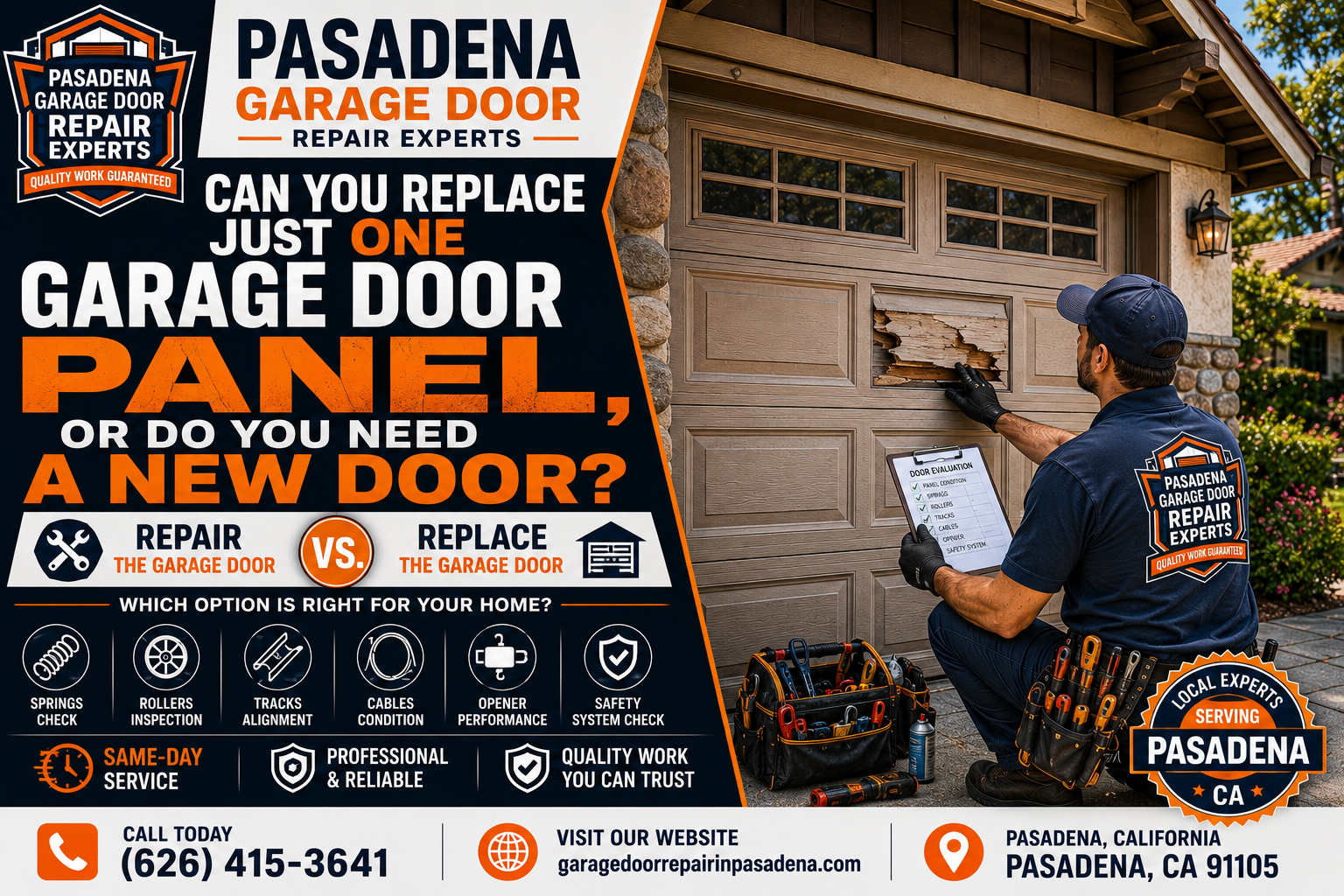
Can You Replace Just One Garage Door Panel, or Do You Need a New Door?
A dented, bent or damaged garage door section does not automatically mean the complete garage door needs to be replaced. In many cases, one section can be replaced when the damage is localized, the rest of the garage door remains structurally sound and a compatible replacement section is still available for the specific door.
The decision becomes more complicated when the damaged section is badly creased, multiple sections are affected, the door has become crooked, hinges or tracks were damaged in the same impact, the original model is no longer available or a replacement section would be difficult to match in color, construction or design.
This guide from Pasadena Garage Door Repair Experts explains how Pasadena homeowners can decide between garage door panel replacement and complete garage door replacement without assuming that every cosmetic dent requires a new door.
Can You Replace Just One Garage Door Panel?
Yes. One garage door panel—or, more accurately on many sectional garage doors, one door section—can often be replaced without replacing the entire garage door when the damage is limited to that section, a compatible replacement is available and the remaining sections, tracks, hinges, rollers and counterbalance system remain suitable for continued use.
A complete new garage door may make more sense when several sections are damaged, the door is badly distorted, the original section is no longer available, matching the construction or finish is impractical, structural hardware has been affected, or the overall condition of the existing door makes investing in one replacement section less practical.
The key decision is not simply whether a dent is visible. The garage door should be evaluated for structural alignment, section compatibility and safe operation before deciding whether to repair one section or replace the complete door.
Garage Door “Panel” vs. “Section”: What Do These Terms Mean?
Homeowners commonly use the word panel to describe one horizontal piece of a sectional garage door.
Within the garage-door industry, the word section is often the more precise term for the complete horizontal portion that runs from one side of the door to the other.
A typical sectional residential garage door is made from several horizontal sections connected by hinges.
As the door opens, those sections pivot relative to one another so the door can transition from the vertical tracks beside the opening into the curved and horizontal tracks above the garage.
That construction is what makes single-section replacement possible on many doors.
Instead of treating the door as one solid slab, the damaged horizontal section may sometimes be removed and replaced while compatible sections above and below it remain in service.
DASMA publishes standardized terminology for sectional garage doors and technical guidance for checking garage doors for damage and considering component substitution. Homeowners should still follow manufacturer-specific recommendations for the exact door involved.
In this guide, “panel replacement” and “section replacement” are used in the way most Pasadena homeowners search for the service, but the important concept is replacing one compatible horizontal section without unnecessarily replacing the complete door.
When Does Replacing Just One Garage Door Panel Make Sense?
Single-panel replacement can be a practical option when the problem is genuinely localized.
The strongest candidates generally share several characteristics:
- Only one section has significant damage.
- The rest of the garage door remains in good mechanical condition.
- The tracks have not been substantially bent or displaced.
- Rollers and hinges remain properly aligned or can be appropriately repaired.
- A compatible replacement section is available.
- The replacement section can reasonably match the door's construction.
- The garage door can be correctly balanced after the repair.
A common example is localized vehicle impact.
A bumper may dent the bottom or middle section while the sections above it remain straight. If the damaged section can be replaced with a compatible section and the impact did not significantly damage the track, bottom fixtures, cables or surrounding structure, replacing one section may restore the door without replacing the entire assembly.
Another example is localized deterioration or damage to one section while the remainder of a relatively serviceable garage door remains in acceptable condition.
The decision should still consider appearance, section availability and the age of the complete door.
1 How Extensive Is the Garage Door Damage?
The first question is whether the damage truly stops at one section.
A dent that appears visually isolated can sometimes transmit force through hinges, roller brackets, reinforcement struts or adjacent sections.
Localized cosmetic damage
A shallow dent or surface damage may affect appearance without substantially altering how the section supports the rest of the door.
Depending on material and construction, minor cosmetic damage may not require section replacement at all.
Manufacturer guidance should be followed because repair techniques differ between steel, aluminum, wood, composite and insulated sandwich-style sections.
Deep crease
A deep horizontal or diagonal crease deserves more attention.
A section must resist bending as it travels and support hinges and related hardware. If a deep crease has reduced its rigidity, merely making the dent look flatter may not restore the original structural behavior.
Damage around a hinge
Damage where a hinge attaches can be more important than a larger cosmetic dent in the center of a section.
The hinge transfers movement between adjacent sections. If the metal, composite material or mounting area surrounding the hinge has torn, cracked or distorted, the problem can affect how the section bends through the track radius.
Damage near the edge of the section
Side-edge damage can affect roller position.
If a section twists enough to move the roller stem relative to the track, the door may scrape, bind or become more likely to derail.
Damage involving multiple sections
Once several sections are significantly damaged, the economics and practicality change.
Replacing two or three sections individually can involve a large portion of the complete door assembly. At that point, comparing the complete repair scope with a properly specified new door becomes reasonable.
2 Which Garage Door Section Is Damaged?
The location of the damaged section matters because the top, middle and bottom sections do not all perform exactly the same role.
Bottom section damage
The bottom section often includes the bottom weather seal and may include fixtures associated with the lift cables.
This makes bottom-section repair particularly important from a safety perspective.
A homeowner should not remove or loosen bottom brackets connected to the cable system as a do-it-yourself panel replacement project.
If a vehicle has pushed the lower corner inward, the repair evaluation should also consider the vertical track, lower roller, bottom bracket, cable and weather seal.
Middle section damage
Middle sections commonly carry hinges and may include reinforcement depending on the door.
A localized middle-section dent may be a relatively straightforward candidate for section replacement if adjacent sections and hardware remain sound.
However, a deep crease can change the section's stiffness and affect the way hinges align.
Top section damage
The top section can be mechanically important because the automatic opener arm commonly connects near the top of the garage door.
Depending on the door and opener configuration, the top section may include reinforcement intended to distribute opener loads.
A badly bent top section should therefore be evaluated not only for appearance but also for the condition of the opener attachment and reinforcement.
Window section damage
If the affected section contains windows, the replacement section may need to match the existing glazing pattern, insert design and construction.
In some circumstances, individual glazing components may be replaceable; in others, section replacement can be more appropriate. Manufacturer information is important because designs vary.
3 Is the Correct Replacement Garage Door Section Still Available?
Section availability is one of the biggest practical factors in deciding between one-panel replacement and a new garage door.
A garage door section is not simply a sheet of metal cut to the same width.
Compatibility can depend on:
- Manufacturer.
- Model or product line.
- Door width.
- Section height.
- Panel design.
- Thickness.
- Insulation construction.
- Edge profile.
- Hinge layout.
- Reinforcement.
- Glazing configuration.
Clopay's guidance on replacement sections advises identifying the model, section size, color and whether the required piece is a top, bottom or middle section.
Clopay's damaged garage-door section guidance also distinguishes minor surface repairs from major damage that warrants professional evaluation.
Discontinued garage doors
A door can remain mechanically functional long after its exact model has stopped being manufactured.
That becomes a problem if one section is later damaged.
A visually similar current-model section is not automatically compatible with an older door.
Differences in section thickness, joint profile, hinge location or weight can make substitution inappropriate.
Identify the door before ordering parts
Useful identification may come from a manufacturer label, model information, serial number, original paperwork or details on the existing door.
The correct approach is to identify the system before assuming a replacement panel can be ordered.
4 Will a New Garage Door Panel Match the Existing Door?
Mechanical compatibility and visual compatibility are separate questions.
A replacement section can fit and operate correctly but still look noticeably different from the sections around it.
This happens because garage doors are exposed to:
- Sunlight.
- Heat.
- Dust.
- Rain and moisture.
- Cleaning products.
- Normal finish aging.
Pasadena's sunlight can make finish matching particularly relevant on an older sun-facing garage door.
A new factory-finished section may have the original color while surrounding sections have faded gradually.
Same color name does not guarantee identical appearance
Even when the manufacturer still offers a color with the same name, production changes and weathering of the existing sections can result in a visible difference.
Amarr notes that replacement of one section is possible for many doors when the model remains available, but color variation can occur over time.
See the manufacturer's garage door section replacement guidance for an example of this consideration.
Is a color mismatch only cosmetic?
Usually, a finish mismatch is primarily an appearance issue if the replacement section is otherwise mechanically correct.
For some homeowners, that is acceptable.
For others—particularly where the garage door is a prominent part of the front elevation—the difference may make complete replacement more attractive.
The decision is subjective and should be discussed before ordering the section.
5 What Condition Is the Rest of the Garage Door In?
Section replacement makes the most sense when the remaining garage door is worth keeping.
Age by itself does not automatically condemn a garage door.
A better question is whether the remaining sections and related hardware are still in suitable condition.
Inspect the other sections
Look for:
- Rust.
- Cracking.
- Delamination.
- Previous impact damage.
- Warping.
- Severe fading.
- Water deterioration on applicable materials.
- Hinge mounting areas beginning to fail.
If one damaged section is surrounded by several deteriorated sections, replacing only the newest visible problem may not address the overall door condition.
Inspect the hardware independently
A newer-looking garage door can still have worn rollers or hinges.
Conversely, an older door can remain mechanically serviceable if its components have been maintained and replaced appropriately over time.
The decision should therefore be based on actual condition rather than an arbitrary age cutoff.
6 Does the Replacement Match the Door's Construction and Insulation?
Garage-door sections can differ significantly even when they look similar from the driveway.
A section may be:
- Single-layer steel.
- Steel with insulation.
- Multi-layer steel and insulation.
- Aluminum.
- Wood.
- Composite.
- Glazed aluminum-and-glass construction.
Replacing one section with a different construction can affect more than appearance.
Thickness, rigidity and weight may change.
Why section weight matters
Garage-door springs are selected and adjusted to counterbalance the weight of the door.
If replacement work substantially changes the door's weight, the counterbalance relationship should be evaluated.
DASMA lists technical guidance specifically addressing adding weight to a garage-door assembly and garage-door component substitution.
The association also emphasizes that its technical information is not a substitute for the individual manufacturer's instructions.
Homeowners can review DASMA's technical data sheets for sectional garage doors when researching industry terminology, damage inspection and component considerations.
7 Did the Impact Also Damage Hinges, Rollers or Tracks?
A garage door panel should not be evaluated in isolation when the damage resulted from an impact.
A vehicle can push a section inward while transferring force into the hardware at its edges.
Hinges
A hinge can bend or pull against its mounting area.
If the section is replaced but a bent hinge is reused without evaluation, the roller connected to that hinge may approach the track at the wrong angle.
Rollers
Roller stems can bend and wheels can be damaged after impact.
A roller may still sit inside the track but wobble or bind during operation.
Tracks
Vertical tracks are vulnerable to vehicle and storage impacts.
A section replacement does not correct a track that has been bent inward or moved from its intended position.
Reinforcement
Depending on the section and door design, reinforcement struts or opener reinforcement may also be affected.
The complete impact path should be inspected before the repair scope is finalized.
8 Will Panel Replacement Affect Garage Door Balance?
This is an important mechanical question that homeowners may not consider when focusing on the visible dent.
Springs counterbalance garage-door weight.
If a replacement section is properly matched to the original construction, the overall weight should remain reasonably consistent with the intended system.
If the replacement section differs substantially in construction or weight, however, the counterbalance system may no longer behave exactly as before.
Why the opener is not the solution to added weight
The automatic opener is not intended to compensate for an improperly balanced garage door.
If the completed door becomes significantly heavier or behaves differently, the appropriate response is to evaluate door balance rather than simply increasing opener force.
Door balance should be checked after structural work
Once a replacement section and necessary hardware are installed, the door should be evaluated through controlled operation.
The bottom edge should remain reasonably level, rollers should travel through the tracks normally and the opener should not have to fight abnormal mechanical resistance.
Can a Dented Garage Door Panel Be Repaired Instead of Replaced?
Sometimes.
Whether repair is appropriate depends on the door material, panel construction, location of the dent and whether the damage is merely cosmetic or has altered structural behavior.
Small cosmetic dents
Some minor dents on certain uninsulated metal sections may be cosmetically improved without replacing the complete section.
Manufacturer guidance should control because materials behave differently.
Clopay, for example, distinguishes between minor damage and major section damage and recommends professional evaluation when damage is substantial.
Deep creases
A crease is more concerning than a shallow smooth dent because the metal or structural material may have folded.
Even if the visible crease can be made less noticeable, the section may no longer have the same rigidity.
Torn or cracked material
Material that has split, torn, cracked or separated generally requires a different evaluation from a simple dent.
Damage around hinges
Cosmetic repair is less attractive if hinge mounting areas have been distorted.
The section must continue supporting hardware through repeated operating cycles.
Insulated sandwich sections
Some insulated doors have multiple layers bonded together.
Crushing or separation within the section can be difficult to evaluate from the exterior alone.
A replacement section may be more appropriate when the construction itself has been significantly compromised.
When Does a Complete New Garage Door Make More Sense?
Replacing the entire garage door should not be the automatic answer to one dent.
There are, however, situations where full replacement deserves serious consideration.
Multiple sections are significantly damaged
If an impact has bent two, three or more sections, individual section replacement may approach the scope of rebuilding a large percentage of the door.
Comparing that repair with a complete door becomes reasonable.
The original model is discontinued
A replacement section cannot be assumed compatible simply because it has a similar stamped design.
If the original manufacturer no longer supplies an appropriate section and no approved compatible solution exists, complete replacement may be the practical route.
The remaining sections are deteriorated
Replacing one new section in a door where the other sections have significant rust, cracking, delamination, warping or prior impact damage may not represent the most useful long-term repair.
The replacement would be visually unacceptable
A dramatic finish mismatch can matter when the garage door occupies a large portion of the home's front elevation.
Some homeowners accept a temporary or modest color difference.
Others prefer a consistent appearance.
Structural alignment is severely compromised
A major impact may affect the door sections, tracks, hinges and reinforcement together.
At some point the project is no longer simply “replace one panel.”
The homeowner already planned a door upgrade
If a homeowner was already considering different insulation, windows, appearance or door construction, significant panel damage can become a logical point to compare repair with planned replacement.
That remains a homeowner decision rather than proof that the existing door cannot be repaired.
Replace One Garage Door Panel vs. Replace the Whole Door
| Condition | Single-Panel Replacement May Make Sense | Complete Door Replacement May Be Worth Comparing | What Should Be Verified |
|---|---|---|---|
| One localized dent | Often, if section remains compatible and damage warrants replacement | Usually not solely because of a minor isolated dent | Section structure and cosmetic expectations |
| One deeply creased section | Often possible if a matching section is available | If remaining door condition is poor or section unavailable | Hinges, rollers, section rigidity and availability |
| Two or more damaged sections | Possible in some cases | Increasingly worth comparing | Total repair scope versus complete replacement |
| Discontinued model | Only if approved compatible section can be identified | May become more practical | Manufacturer, model, section profile and construction |
| Severe color fading | Mechanically possible if section matches construction | May be preferred for consistent appearance | Actual color difference before ordering |
| Bent track after impact | Panel may still be replaceable | Depends on total door and track damage | Track alignment and roller condition |
| Damaged hinge mounting area | Section replacement may be appropriate | If several sections have structural damage | Section material and hinge support |
| Older door in otherwise good condition | Possible if correct section remains available | Compare if parts availability is limited | Actual condition, not age alone |
| Widespread rust or deterioration | Less attractive if other sections are failing | Often more reasonable to compare | Condition of all sections |
| Different replacement section weight | Only if compatibility is confirmed | Consider correct complete system instead | Door construction and counterbalance |
What Happens During Professional Garage Door Panel Replacement?
Section replacement should begin with identification and diagnosis rather than immediate disassembly.
The general process includes several decision stages.
1. Identify the garage door
The manufacturer, model, width, section height, design, construction and color may need to be identified so that a compatible replacement can be sourced.
2. Inspect the impact area
The damaged section is evaluated together with adjacent sections, hinges, rollers, tracks and reinforcement.
3. Inspect the complete door movement
If the door can be safely operated, movement can reveal whether the impact created binding or misalignment elsewhere.
If the door is unstable or badly damaged, it should not be cycled simply for testing.
4. Confirm section availability
A section should not be ordered based only on approximate appearance.
Compatibility should be established as accurately as possible.
5. Discuss appearance
Before the replacement is ordered, the homeowner should understand whether the new section may look newer or differ in finish from the older sections.
6. Replace the damaged section using appropriate procedures
Garage-door sections are large moving components integrated with hinges, rollers and, depending on section location, cable or opener-related hardware.
The exact replacement procedure varies by door design.
7. Recheck alignment
Hinges and rollers should return to the intended geometry.
The door should not scrape or move diagonally because the new section has been installed.
8. Evaluate door balance and final operation
The complete door should move in a controlled manner and remain reasonably level through travel.
The automatic opener should then operate a mechanically sound door rather than compensate for unresolved structural problems.
Do You Need a New Garage Door Opener When Replacing One Panel?
Usually not simply because one garage-door section is being replaced.
The opener and the door are separate systems.
If the existing opener was operating appropriately before the panel damage and was not damaged during the incident, there may be no reason to replace it.
When the opener deserves inspection
If a vehicle impact bent the top section or if the opener continued trying to move a badly jammed door, inspect:
- The opener arm.
- The attachment point on the top section.
- Top-section reinforcement.
- The trolley or carriage.
- The rail.
- Mounting hardware.
An opener that stopped because the damaged door was binding should not automatically be diagnosed as failed.
Correct the mechanical door condition first and then determine whether an opener issue remains.
Why Should the Rest of the Garage Door Be Inspected When Only One Panel Is Damaged?
Localized panel damage can reveal problems beyond the visible dent, particularly after vehicle impact or when the section has been operating while bent.
Hinges, rollers, tracks, lift cables and door balance can all be affected by a structural change in one section.
That is why the evaluation should not end once the dented section has been identified.
If you also want to understand the broader inspection points that help identify developing mechanical wear, our guide to a garage door tune-up in Pasadena explains how springs, cables, rollers, tracks, balance, opener operation and safety systems can be checked together.
For panel replacement, that broader inspection helps answer an important question: is the damaged section the entire problem, or did the same event also affect the components that guide and support the door?
Safe Checks Pasadena Homeowners Can Make After Garage Door Panel Damage
Homeowners can collect useful information without dismantling the garage door.
Look at the door from outside
Stand back and compare the left and right sides.
Does the door appear level?
Does one section bow farther inward or outward than the others?
Look at the damaged section from inside
Without touching high-tension hardware, look for a deep crease, torn material, bent reinforcement or damage around hinge mounting locations.
Look at adjacent sections
Impact can transfer into the section above or below.
Look for new gaps or areas where two sections no longer meet evenly.
Look at visible hinges
Does a hinge appear bent or pulled away from its normal position?
Look at the tracks
Check for obvious dents, bends or track brackets moved by the impact.
Look at the rollers
Do the visible rollers remain in the tracks?
Is a roller stem visibly bent?
Check for loose cables from a distance
If one lift cable is hanging or appears substantially different from the other, stop treating the issue as simple cosmetic panel damage.
Note whether the opener was used after the impact
Repeatedly attempting to operate a bent door can create secondary stress.
Photograph identifying labels
A clear manufacturer, model or serial label can help determine whether a compatible replacement section remains available.
What Homeowners Should NOT Do When a Garage Door Panel Is Damaged
A garage-door panel may look like ordinary sheet material, but it is part of a large moving system connected to hinges, rollers, springs and lift cables.
Do not:- Remove a bottom bracket connected to a lift cable.
- Loosen cable drums.
- Wind or unwind torsion springs.
- Adjust winding cones.
- Reconnect lift cables under tension.
- Force a badly crooked door straight.
- Operate a door with rollers substantially outside their tracks.
- Stand beneath an unstable partially open garage door.
- Increase opener force to push a damaged door through binding.
- Substitute a visually similar section without confirming compatibility.
A damaged bottom section deserves particular caution because cable-related hardware may be attached near its lower corners.
The objective is to evaluate the door without releasing stored spring force or changing how the door is supported.
What if the Exact Replacement Garage Door Panel Is No Longer Made?
This is one of the most common reasons a seemingly simple panel repair becomes a larger decision.
Garage-door product lines change over time.
Manufacturers can discontinue models, redesign section joints, change insulation systems or update finishes.
If the exact original section is unavailable, there are several questions to answer.
Is there an approved compatible section?
Manufacturer or product information may identify a current replacement section suitable for the existing door.
Does the new section physically mate with the existing sections?
Section joints must interact correctly as the door bends through the curved track.
Does the hinge layout match?
Hardware placement affects section articulation and roller position.
Is the weight comparable?
A material change can affect total door weight and therefore the counterbalance system.
Will the appearance be acceptable?
Even an approved mechanical substitute can have a different stamping or finish.
If no appropriate compatible section can be sourced, complete door replacement may be a cleaner solution than fabricating an improvised panel substitution.
Can You Mix Old and New Garage Door Panels?
Yes, when the new section is genuinely compatible with the existing door.
That is essentially what single-section replacement does.
But “old and new” should not be confused with “different and approximately similar.”
A new section needs to work mechanically with the older sections.
Compatibility can involve:
- Section joint shape.
- Thickness.
- Overall dimensions.
- Hinge locations.
- Roller geometry.
- Insulation construction.
- Reinforcement requirements.
- Door weight.
A color difference may be acceptable to the homeowner.
A structural incompatibility is different.
The replacement should first be mechanically appropriate; appearance can then be discussed separately.
Can You Replace Two Garage Door Panels Instead of the Whole Door?
Sometimes.
A sectional garage door can potentially have more than one damaged section replaced if compatible sections are available and the remaining door is worth retaining.
The decision becomes increasingly economic rather than purely technical as more sections are involved.
If a four-section door needs two major sections replaced, a substantial portion of the visible and structural door is already being rebuilt.
That is the point where homeowners should compare:
- The cost and availability of multiple replacement sections.
- Additional damaged hardware.
- The condition of the remaining sections.
- Appearance matching.
- The cost and features of a complete replacement door.
There is no universal rule that says “two panels always means new door.”
The appropriate decision depends on the actual door and repair scope.
Does a Damaged Garage Door Panel Affect Home Security?
It can, depending on the extent of damage.
A shallow cosmetic dent may have little effect on security.
A badly bent section that prevents the door from closing completely is different.
Security becomes a greater concern when:
- The door cannot reach the floor.
- A large gap remains along one side.
- A section has torn open.
- The door cannot latch or remain closed normally.
- Track damage prevents full closing.
Garage access is particularly important for attached garages because the garage may provide another path into the home.
If structural panel damage prevents normal closing, address the mechanical condition instead of repeatedly running the opener against the obstruction.
Does One Damaged Panel Affect Garage Door Insulation?
Potentially.
An insulated section can contain foam or another insulating layer between exterior and interior materials.
A major impact can crush, separate or distort that construction.
Even when the exterior dent appears localized, insulation inside the section may have been compressed.
If the garage is attached to conditioned living space or used as a workshop, insulation consistency may matter more to the homeowner.
A replacement section should ideally be compatible not only in size but also in construction and thermal design.
Mixing significantly different section constructions can also change section weight.
That is another reason not to order a replacement based only on exterior appearance.
What if a Car Hit the Garage Door?
Vehicle impact is one of the clearest examples of why panel damage should trigger a broader inspection.
Start by determining where the vehicle made contact.
Center impact
A center impact may primarily deform one or more sections.
Inspect nearby hinges and reinforcement because the force can travel beyond the visible dent.
Corner impact
A lower-corner impact can involve substantially more hardware.
The roller, track, bottom fixture and lift cable may be close to the impact point.
A corner hit is therefore less likely to be “just a panel” without further evaluation.
Impact while the door is moving
If a vehicle contacts the garage door while it is partially open, the door can be displaced in the tracks as well as dented.
Stop operating the opener if the door becomes crooked or rollers are no longer correctly positioned.
Do not test severe damage repeatedly
Homeowners sometimes press the remote several times after an impact to see whether the garage door “still works.”
If the door is already binding, repeated opener operation can add stress to hinges, tracks, rollers and the opener attachment.
Is It Worth Replacing One Panel on an Older Garage Door?
It can be.
Door age should be considered, but condition and parts availability are more useful than age alone.
An older garage door may still be a strong candidate for one-section replacement if:
- The remaining sections are structurally sound.
- Compatible parts remain available.
- Tracks and hinges remain usable.
- The door is properly balanced.
- The homeowner accepts any finish variation.
Conversely, a relatively newer garage door that has sustained major multi-section impact damage can still be a candidate for complete replacement.
The appropriate question is therefore:
What condition will the complete garage door be in after the proposed panel repair is finished?
If replacing one section returns the system to proper structural and mechanical condition, retaining the remaining door can be reasonable.
If one-section replacement leaves multiple deteriorated components or creates major compatibility compromises, comparing a new door makes more sense.
How Much Does Garage Door Panel Replacement Cost in Pasadena?
There is no responsible universal price for garage-door panel replacement.
The price depends on more than the size of the visible dent.
Relevant factors can include:
- Manufacturer and garage-door model.
- Whether the original section is still available.
- Section width and height.
- Top, middle or bottom section location.
- Steel, aluminum, wood, composite or other material.
- Insulated versus non-insulated construction.
- Window or glazing configuration.
- Finish and color.
- Number of damaged sections.
- Hinge condition.
- Roller condition.
- Track damage.
- Reinforcement damage.
- Cable or bottom-fixture damage.
- Door balance.
- Labor and installation complexity.
- Additional components damaged by the original impact.
Why a photograph alone may not establish the final repair cost
A photograph is useful for showing visible damage and identifying door style.
It may not reveal whether a track is bent, whether a roller stem has shifted or whether the damaged section has altered door balance.
A more accurate repair decision depends on identifying the complete scope.
Compare like-for-like options
When comparing panel replacement with complete door replacement, compare the actual finished outcomes.
One option may include one replacement section and hardware correction.
Another may involve a completely new door assembly.
The lowest initial part cost does not automatically represent the best repair if significant additional damage remains unresolved.
Garage Door Panel Replacement Considerations for Pasadena Homes
Pasadena contains a mix of older homes, remodeled properties, attached garages, detached garages and architecturally prominent garage doors.
Those conditions can influence panel-replacement decisions.
Sun exposure and color matching
Pasadena's sunny Southern California conditions can make finish aging relevant.
A garage door facing strong afternoon sun may have faded gradually over time.
A brand-new factory section can therefore look different from neighboring older sections even when the original color designation is technically the same.
Older Pasadena homes
Older homes may have garage doors installed many years after the house was built, and different components may have been updated at different times.
Do not assume the age of the house tells you the age of the garage door.
Manufacturer and model identification should come from the door itself or reliable documentation.
Detached garages
Detached garage doors may receive less daily attention.
When panel damage occurs, inspect the remaining sections for pre-existing deterioration rather than focusing only on the newest dent.
Attached garages
A garage door attached to the home can affect security, vehicle access and everyday household routines.
A damaged section that prevents proper closing may therefore be more than a cosmetic issue.
HOA and design considerations
Some homeowners may have exterior design requirements associated with their property or homeowners association.
Before changing the overall garage-door appearance, homeowners should confirm any applicable private property requirements.
Pasadena neighborhood context
Residential context may naturally include Old Pasadena, Bungalow Heaven, Hastings Ranch, Madison Heights and San Rafael Hills.
These neighborhood references describe Pasadena residential contexts and do not imply separate Pasadena Garage Door Repair Experts offices or storefronts.
The primary geographic entity remains Pasadena, California 91105, within Los Angeles County and the San Gabriel Valley.
Does Garage Door Panel Replacement Require a Permit in Pasadena?
Permit requirements depend on the actual scope of work, and homeowners should not assume that every garage-door panel repair requires a permit.
Replacing one compatible damaged section is a different scope from modifying the structural garage opening or performing a larger installation project.
When a project expands beyond a simple section repair—particularly if structural work or a complete new installation is involved—the City of Pasadena is the appropriate authority to confirm current permit requirements.
The City of Pasadena Building & Safety Division administers building-safety functions, while the Pasadena Permit Center provides development review and permitting services.
Do not interpret this article as saying that every garage-door repair or replacement requires a permit. Verify the current requirement based on the actual scope when there is uncertainty.
Questions to Ask Before Approving Garage Door Panel Replacement
Homeowners can make a better repair decision by understanding why one option is being recommended over another.
Useful questions include:
- Is the damage limited to one section?
- Is the damaged section still structurally usable?
- What manufacturer and model is my garage door?
- Is the exact replacement section still available?
- If not, is there an approved compatible section?
- Will the color or finish differ from the existing sections?
- Does the replacement have the same insulation and construction?
- Will the replacement change the weight of the garage door?
- Did the impact damage any hinges?
- Are the rollers still straight and moving normally?
- Did either track move or bend?
- Is the bottom bracket or cable system involved?
- Is the top-section opener attachment damaged?
- Will door balance be checked after replacement?
- How does the panel-replacement option compare with a new door?
If contractor verification is appropriate for the project, California homeowners can review the California CSLB D-28 Doors, Gates and Activating Devices classification .
This article does not make a particular licensing claim about Pasadena Garage Door Repair Experts. Current contractor information should be independently verified where applicable.
Garage Door Panel Replacement Red Flags
Panel replacement should restore the door as a working system, not simply hide the most visible dent.
Potential red flags include:
- Ordering a section without identifying the door model.
- Assuming every visually similar panel is interchangeable.
- Ignoring a bent track after vehicle impact.
- Ignoring a bent roller stem or damaged hinge.
- Installing a substantially different-weight section without checking balance.
- Increasing opener force to compensate for post-repair binding.
- Loosening bottom cable brackets casually.
- Giving homeowners instructions to adjust torsion springs.
- Promising an exact color match without checking the aged finish.
- Automatically recommending a complete new door for every small dent.
- Automatically recommending one-panel repair despite widespread door deterioration.
The better decision is the one supported by the condition of the complete door.
Why Consider Pasadena Garage Door Repair Experts for Panel Damage?
Pasadena Garage Door Repair Experts is a local garage-door repair company serving homeowners and residential property customers in Pasadena, California.
A useful panel-damage evaluation should determine whether the visible section is the complete problem or one part of a larger impact condition.
Relevant inspection may include:
- Garage door panel damage.
- Section compatibility.
- Hinge condition.
- Roller condition.
- Track alignment.
- Panel reinforcement.
- Door balance.
- Opener attachment after top-section damage.
- Panel replacement versus complete door replacement.
The goal is to determine the most appropriate repair scope according to the actual condition of the garage door rather than automatically assuming that one dent requires an entirely new door.
Visit Pasadena Garage Door Repair Experts or call (626) 415-3641 to describe the damaged garage-door section and ask about current repair availability in Pasadena.
Pasadena Garage Door Panel Repair Service Area
The primary geographic focus is Pasadena, California 91105, within Los Angeles County and the San Gabriel Valley.
Pasadena residential context may naturally include Old Pasadena, Bungalow Heaven, Hastings Ranch, Madison Heights and San Rafael Hills.
These references provide local geographic context and do not imply separate Pasadena Garage Door Repair Experts offices or storefront locations.
Pasadena homeowners can call (626) 415-3641 to describe panel dents, creases, impact damage, door misalignment or other visible section problems and ask about current garage-door repair availability.
Frequently Asked Questions About Garage Door Panel Replacement
Can you replace just one garage door panel?
Yes. One garage-door section can often be replaced when the damage is localized, the rest of the door remains structurally serviceable and a compatible replacement section is available. The door model, section construction, dimensions, hardware and overall alignment should be verified before ordering the replacement.
Is it cheaper to replace one garage door panel than the whole door?
It can be, but the final comparison depends on the actual repair scope. One-section replacement is most attractive when only one section is damaged and compatible parts are readily available. If several sections, tracks or related hardware are damaged, comparing the complete repair with a new garage door becomes more useful.
Can a dented garage door panel be repaired without replacing it?
Sometimes. Minor cosmetic damage on certain garage-door materials may be repairable, while deep creases, tears, damaged hinge mounting areas or structural distortion may make section replacement more appropriate. Manufacturer guidance should be considered because garage-door construction varies.
What if my garage door panel is discontinued?
If the original section is no longer manufactured, determine whether the manufacturer has an approved compatible replacement. A visually similar section should not automatically be substituted because thickness, joint profile, hinge layout, insulation and weight can differ. If no appropriate section exists, complete door replacement may be worth considering.
Will a new garage door panel match the color of my old panels?
Not always exactly. Existing garage-door sections can fade or weather after years of sun and environmental exposure. A new factory section may therefore look somewhat different even when it carries the same original color designation. Homeowners should discuss appearance before ordering.
Can I replace two damaged garage door panels instead of buying a new door?
Possibly. More than one section can sometimes be replaced when compatible sections remain available and the rest of the garage door is worth retaining. As the number of damaged sections increases, however, it becomes more useful to compare the complete section-repair cost with a properly specified new door.
Do I need a new garage door opener when replacing a panel?
Usually not solely because a garage-door panel is being replaced. If the existing opener was working correctly and was not damaged during the impact, it may remain usable. The opener should be inspected when the top section, opener arm or door alignment was affected.
Can a damaged garage door panel make the door come off track?
Yes, severe panel distortion can change hinge and roller geometry and contribute to track binding or derailment. Impact can also directly bend a track or roller bracket. If the garage door becomes crooked or a roller leaves the track, stop normal operation and diagnose the complete mechanical condition.
Should I replace the entire garage door if only one panel is damaged?
Not automatically. A complete new door is more worth considering when multiple sections are damaged, the original replacement section is unavailable, the remaining sections are deteriorated, structural damage is widespread or the repair would create unacceptable compatibility or appearance compromises.
Who can inspect a damaged garage door panel in Pasadena?
Pasadena homeowners can contact Pasadena Garage Door Repair Experts at (626) 415-3641 to describe a dented, bent or damaged garage-door section and ask about current panel repair, panel replacement or garage-door replacement availability in Pasadena, California.
Find Pasadena Garage Door Repair Experts on Google Maps
You can also view Pasadena Garage Door Repair Experts on Google Maps .
Damaged Garage Door Panel in Pasadena?
One damaged garage-door section does not automatically mean you need to replace the entire door.
The right decision depends on the extent of the damage, section availability, door construction, color matching and whether the impact also affected hinges, rollers, tracks or door alignment.
Call Pasadena Garage Door Repair Experts at (626) 415-3641 to describe the damaged panel and ask about current garage-door panel repair, section replacement or complete replacement options in Pasadena, California.
Safety reminder: do not remove bottom cable brackets, adjust cable drums, wind or unwind torsion springs, reconnect tensioned lift cables or force a badly damaged or off-track garage door.
Related Pasadena Garage Door Topics
- What Does a Garage Door Tune-Up Include—and How Often Should Pasadena Homeowners Get One?
- The Pasadena Garage Door Maintenance Checklist: Springs, Rollers, Tracks, Cables and Opener
- Garage Door Came Off Track in Pasadena? What to Do—and What Not to Do
- Broken or Frayed Garage Door Cable? 7 Warning Signs Pasadena Homeowners Should Know
- Garage Door Repair vs. Replacement in Pasadena: Which One Makes More Sense?