

Garage Door Came Off Track in Pasadena? What to Do—and What Not to Do
A garage door that has come off track is more than an inconvenience. When one or more rollers leave their intended track, the door can become crooked, bind during movement, hang unevenly, twist its sections or place unusual loads on the lift cables, hinges, springs and automatic opener.
The safest response is generally to stop operating the garage door, keep people and vehicles away from the opening, and inspect the visible condition from a clear position. A roller outside the track may be the obvious symptom, but the original cause may involve a bent track, damaged roller, loose lift cable, cable-drum problem, spring failure, hinge damage or vehicle impact.
This guide from Pasadena Garage Door Repair Experts explains what Pasadena homeowners should do when a garage door comes off track, which warning signs help identify the cause, and which repairs should not be attempted while the door or counterbalance system is unstable.
What Should You Do if Your Garage Door Comes Off Track?
Stop using the automatic opener, keep people and vehicles away from the garage door, and inspect the visible rollers, tracks, lift cables and springs from a safe position. Do not force the door open or closed, pry rollers back into the track, loosen cable drums, remove bottom brackets, adjust torsion springs or repeatedly cycle the opener.
If the garage door is fully closed and appears stable, leaving it closed is usually safer than testing it again. If it is partially open, severely crooked or hanging unevenly, do not stand beneath it or attempt to guide it downward by hand.
An off-track condition should be diagnosed according to its cause. The visible roller may have left the track because of a bent track, worn roller, damaged hinge, cable problem, cable drum issue, spring imbalance or impact.
Reinstalling the roller without correcting the original problem may allow the garage door to come off track again.
What Does “Garage Door Off Track” Actually Mean?
A sectional garage door normally moves through two track assemblies, one on the left side and one on the right.
Rollers attached to the garage-door sections travel inside those tracks. The vertical tracks guide the door upward from the floor. Curved track sections transition the door from vertical movement into the horizontal tracks above the garage.
When a garage door is described as “off track,” one or more rollers are no longer positioned correctly inside that intended path, or the door has become sufficiently misaligned that normal roller travel is no longer possible.
The amount of derailment can vary dramatically.
One upper roller might sit just outside the horizontal track while the door remains almost level. In a more serious condition, several rollers can leave one side, the door can hang diagonally and a lift cable can become visibly loose.
That means “off track” is not the diagnosis. It is the condition.
The diagnosis is the reason the roller no longer follows the track.
These systems interact. A cable that loses tension can make the door crooked. A crooked door can push a roller against the track edge. A bent track can force a roller outward. A worn roller can tilt or seize. A damaged hinge can change the angle at which the roller enters the track.
Accurate repair requires understanding that relationship.
Six Immediate Steps to Take When a Garage Door Comes Off Track
1 Stop using the garage door opener
Do not repeatedly press the wall control or remote in an attempt to make the opener pull the garage door straight.
The opener is designed to move a mechanically functional, counterbalanced garage door. It is not designed to realign a roller, correct a loose cable or overcome a bent track.
If one side is mechanically jammed while the opener continues pulling from the upper center of the door, additional stress can reach the top section, hinges, rollers, opener arm and rail.
2 Keep people, pets and vehicles clear
An unstable garage door can move unexpectedly.
A door that appears stationary can still shift if a roller moves, a cable slips or stored spring force redistributes through the system.
Avoid walking beneath a partially open off-track door.
3 Compare the left and right sides
From a safe distance, determine whether one side is significantly higher than the other.
Look for:
- A roller outside the track.
- A cable hanging loose.
- A track that appears bent.
- A hinge that appears distorted.
- A lower corner that is substantially higher or lower.
- A panel that appears twisted.
4 Look for signs of impact
Vehicle contact is an important clue.
A bumper can strike the lower garage-door section before the door is fully open. A bicycle, ladder, storage rack or other object can hit a vertical track.
Note the exact area of impact because a track, roller, hinge or door panel may have shifted.
5 Look at cables and springs without touching them
A cable hanging loose on one side can indicate that the cable has broken, slipped off its drum or lost normal tension because the door has become crooked.
A visible gap in a torsion spring can indicate spring failure.
These conditions change the safety profile substantially.
6 Leave the garage door in its safest stable position
If the door is already fully closed and appears stable, avoid reopening it simply to test the system.
If the garage door is stuck partially open, do not improvise a lowering procedure if the rollers, cables or springs are visibly abnormal.
What NOT to Do When Your Garage Door Is Off Track
Do not keep running the opener
Powered operation can increase the misalignment and potentially pull additional rollers out of position.
Do not pry the track open around the roller
Bending the track lip outward may allow a roller to fit temporarily, but it can permanently alter the track's geometry and ability to retain the roller.
Do not remove the bottom roller bracket
Bottom brackets are commonly connected to the lift cables and counterbalance system.
DASMA warns that bottom brackets connected to the spring system can be under extreme tension and should be adjusted or loosened only by trained personnel.
Do not loosen cable drums
Cable drums control how the lift cables wind and unwind from the torsion shaft.
Changing their position can alter left-to-right cable tension and affect garage-door balance.
Do not adjust torsion springs
Winding cones, spring anchors and torsion shafts can store substantial mechanical force.
An off-track condition is not corrected by casually adding or removing spring tension.
Do not stand beneath an unstable garage door
This is especially important when the door is partially open or hanging unevenly.
Do not force the garage door straight by hand
A garage door can bind harder as it becomes crooked.
Pushing or pulling one side may twist the sections, move cables or place a person directly beside unstable components.
Cause #1: The Garage Door or Track Was Hit
Impact can quickly alter the relationship between the garage door, rollers and tracks.
The impact does not have to destroy the garage door panel.
A relatively localized hit near one lower corner can bend a track, distort a roller bracket, damage a hinge or change the position of the door enough to affect roller travel.
Common impact situations
- A vehicle begins backing out before the door is fully open.
- A bumper contacts the lower section.
- A bicycle falls against a vertical track.
- A ladder hits a track bracket.
- Large furniture or appliances strike track hardware.
After an impact, inspect more than the roller that is outside the track.
Look at whether the track itself is bent, whether the hinge holding the roller has distorted and whether the garage-door section has creased or bowed.
If impact occurred near the bottom corner, the cable attachment and bottom bracket also deserve attention.
Cause #2: The Garage Door Track Is Bent, Loose or Shifted
Tracks establish the path through which garage-door rollers travel.
When a track changes position or shape, a roller may no longer approach the opening correctly.
Bent vertical track
A dent can narrow the track and create a pinch point.
As the roller reaches that point, it may stop rotating freely or begin climbing the side of the track.
Loose jamb bracket
Vertical tracks are supported by brackets connected to the surrounding structure.
If a bracket becomes loose or is damaged, the track can move when a roller passes through it.
Track positioned too close to the garage door
Excessively tight track spacing can cause rollers or hinges to bind.
Homeowners may hear scraping or grinding before a roller finally leaves the track.
Horizontal track damage
Derailment can also happen after the door has moved above the opening.
A worn upper roller, damaged horizontal track or problem around the curved track section can allow an upper roller to come out.
Genie’s garage-door maintenance guidance recommends checking that rollers remain inside the tracks throughout door travel and checking tracks for bending, creases, damage and loose mounting.
Cause #3: A Garage Door Roller Is Worn, Broken or Displaced
Garage-door rollers move through the tracks during every operating cycle.
A roller can contribute to derailment when:
- The wheel cracks.
- The bearing seizes.
- The stem bends.
- The roller develops excessive wobble.
- The hinge holding the roller becomes damaged.
- The roller wheel separates from the stem.
Roller wear often produces warning symptoms before complete derailment.
The garage door may rumble, grind or make repetitive clicking sounds.
A roller may visibly wobble while traveling through the track.
The important question after a derailment is whether the roller itself failed or whether another condition forced an otherwise serviceable roller out of the track.
Replacing every roller without examining track alignment, cables and hinges can miss the actual cause.
Cause #4: A Lift Cable Broke, Came Loose or Came Off the Drum
Cable trouble is one of the most important conditions to consider when a garage door suddenly becomes crooked.
On many torsion-spring systems, lift cables connect near the lower corners of the garage door and wind around drums mounted to the torsion shaft.
The spring system supplies counterbalance force while the cables transfer lifting force to the garage door.
If one cable loses its proper position, the left and right sides may stop moving together.
Symptoms can include:
- One side rising faster than the other.
- One side remaining closer to the floor.
- A cable hanging loosely beside the track.
- A cable bunching or crossing on its drum.
- The garage door becoming noticeably crooked.
- A roller binding or leaving the track.
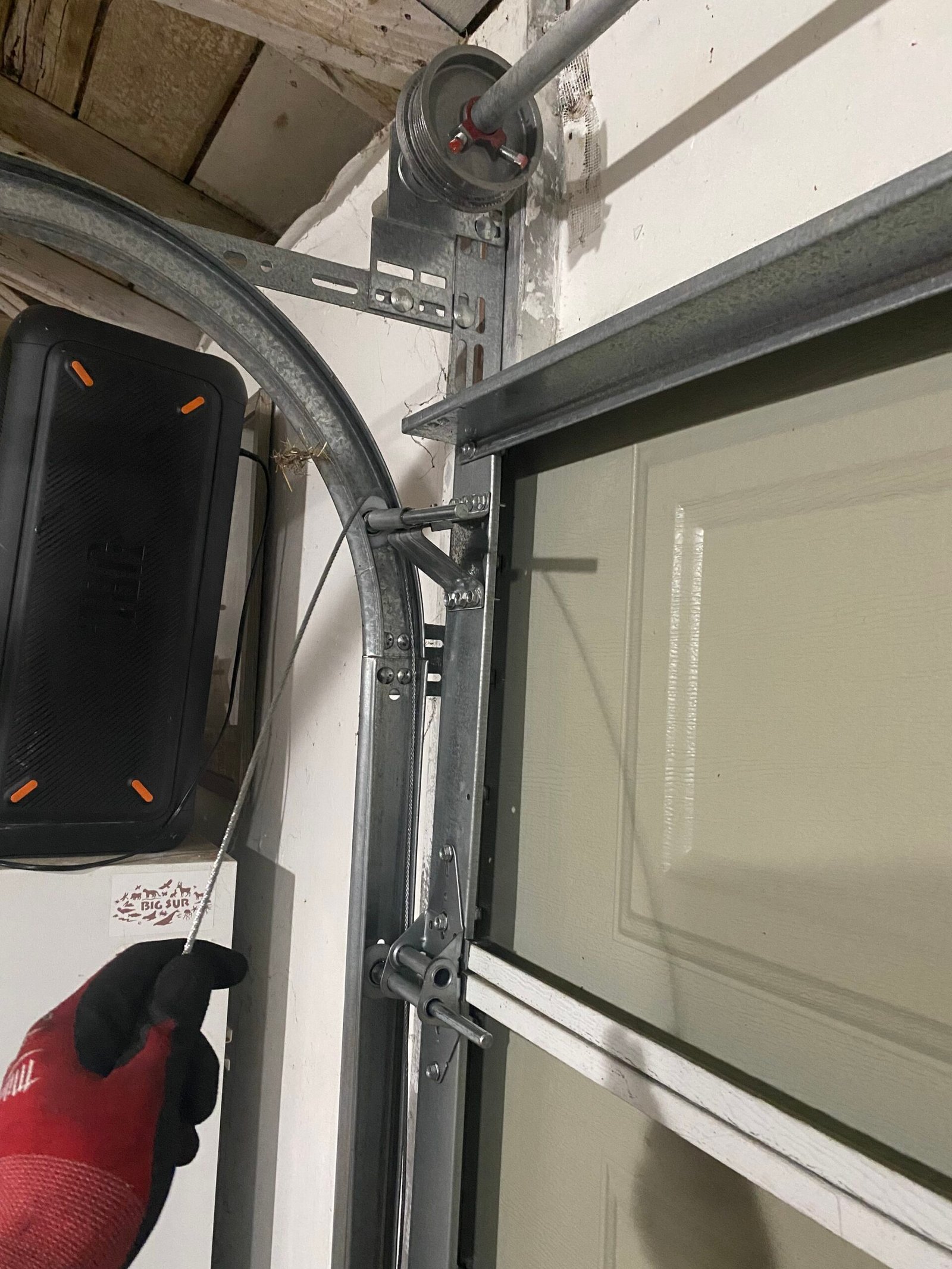
DASMA recommends visual inspection of the cables connecting the spring system to the bottom brackets and warns that frayed or worn cables are at risk of breaking.
Do not grab a slack cable or attempt to rewind it onto the drum.
A loose-looking cable may still be part of a system carrying substantial stored force.
Cause #5: A Spring or Counterbalance Problem Changed Door Movement
Springs counterbalance much of the garage door's weight.
The opener is designed to move a door whose spring system has already made that weight manageable.
If a spring fails, the garage door can become unusually heavy and the opener may struggle.
Spring failure does not automatically make a roller leave the track, but abnormal balance can place additional load on cables, rollers, hinges and opener components.

Signs a spring problem may be involved
- A visible separation or gap in a torsion spring.
- A loud bang before the garage door stopped operating normally.
- The door suddenly becoming extremely heavy.
- The opener lifting the door only a short distance.
- A cable becoming loose after spring failure.
If a spring is visibly broken while the garage door is also off track, both conditions should be evaluated before normal operation resumes.
Cause #6: A Hinge, Roller Bracket or Garage Door Panel Is Damaged
The position of each roller depends partly on the hardware supporting it.
A good roller attached to a bent hinge can still approach the track at the wrong angle.
Bent or cracked hinge
Hinges allow sectional garage doors to articulate as they move through the curved portion of the track.
If a hinge bends, the roller stem can shift relative to the door.
Loose mounting area
Hinge fasteners can loosen or mounting holes can become damaged.
The resulting movement can allow the roller to wobble more than intended.
Damaged garage-door panel
A panel that is bowed, creased or twisted can change the distance between the left and right roller positions.
This is especially relevant after vehicle impact.
A complete off-track inspection should therefore include the door sections and hardware, not only the metal track.
Cause #7: An Obstruction or Binding Point Forced the Door Sideways
Garage doors rely on both sides moving through their tracks together.
If one side encounters significant resistance while the opener continues pulling from the center, the garage door can begin twisting.
Possible binding conditions include:
- A bent section of track.
- A seized roller.
- A broken hinge.
- An object lodged beside the track.
- A cable winding incorrectly.
- Impact-damaged hardware.
The first warning may be scraping, grinding or popping at the same point during every cycle.
Increasing opener force is not an appropriate solution to mechanical binding.
Cause #8: The Opener Kept Pulling on a Garage Door That Was Already Jammed
The automatic opener may not create the initial failure, but repeated powered operation can worsen it.
Consider a roller that begins binding in a damaged track.
The opener continues pulling from the upper center of the garage door while that roller remains stuck.
The result can be:
- Door-section flexing.
- Additional hinge stress.
- Track deformation.
- Another roller being pulled sideways.
- Opener-arm stress.
- Rail or trolley stress.
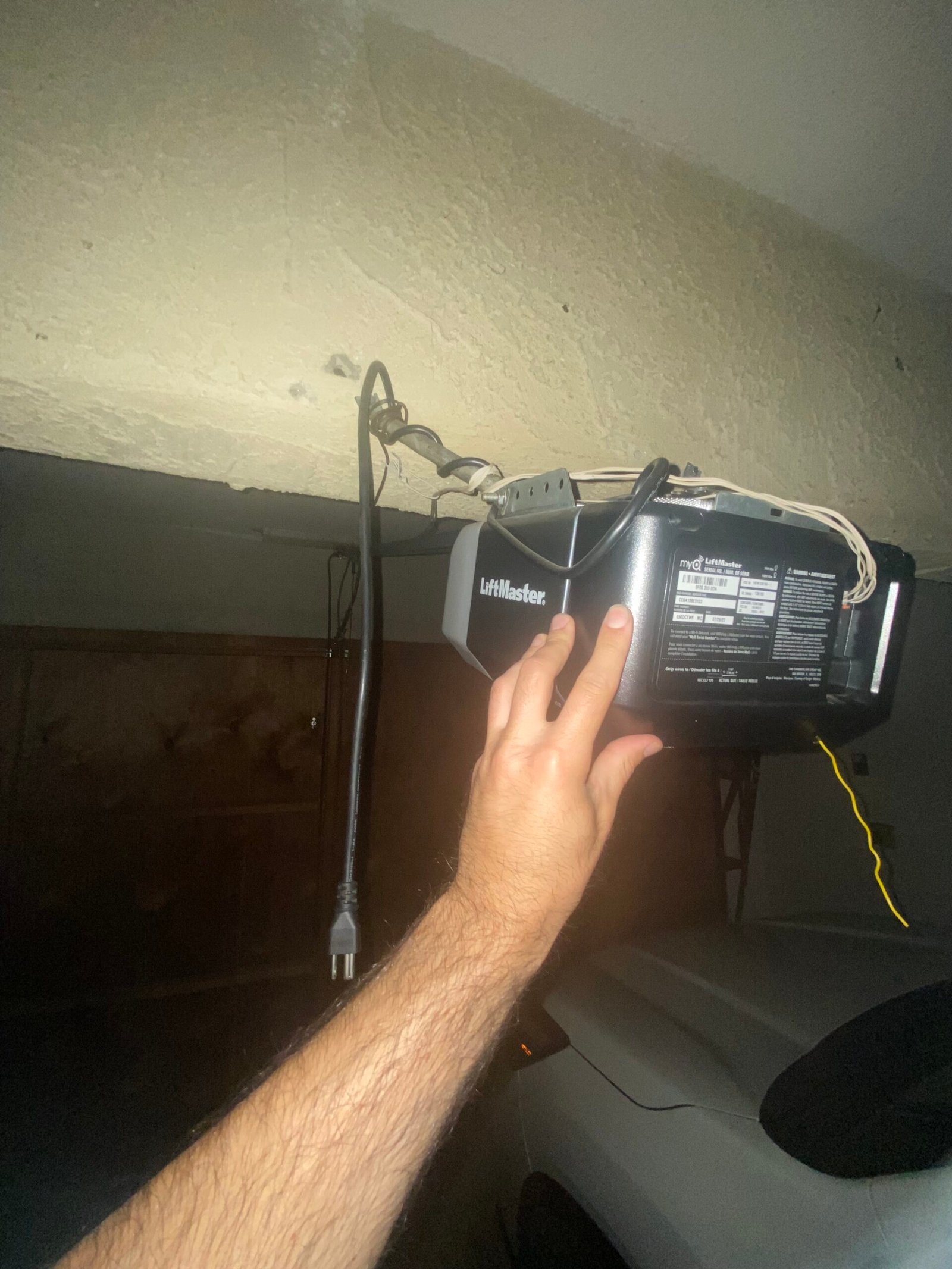
A stronger opener does not correct a mechanically unstable garage door.
Restore correct door movement first.
Why Is My Garage Door Crooked After Coming Off Track?
A crooked garage door usually means the left and right sides are no longer moving or being supported equally.
Possible causes include:
- A broken lift cable.
- A cable that has come off its drum.
- A roller outside the track.
- A bent vertical track.
- A damaged hinge or roller bracket.
- A spring or balance problem.
- Impact damage.
The bottom edge of a properly operating sectional garage door should remain reasonably level during travel.
If one side is several inches higher than the other, stop the automatic opener.
Do not have one person push on the low side while someone else presses the wall control.
That approach combines human force with motor force while people are standing immediately beside an unstable door.
Could a Broken or Frayed Cable Be Why the Garage Door Came Off Track?
Yes. A garage-door cable problem can contribute directly to crooked movement and eventual derailment.
If one lift cable breaks or comes off its drum, the two sides of the garage door may no longer rise evenly.
As the door twists, rollers can press sideways against the tracks and one or more rollers may eventually come out.
The reverse sequence can also occur: a roller or track problem may make the garage door crooked first, which can then cause one cable to lose normal tension.
If you see frayed wire strands, a loose cable, uneven lifting or a cable outside its drum grooves, review these garage door cable warning signs before attempting further door operation.
Understanding the cable condition is especially important because simply putting an off-track roller back into place will not correct unequal cable support.
Should You Pull the Emergency Release When the Garage Door Is Off Track?
Do not automatically pull the emergency-release cord on a crooked, partially open or visibly unstable off-track garage door.
The emergency release disconnects the automatic opener from the garage door.
On a mechanically healthy and properly balanced door, that allows manual movement.
An off-track garage door may not be mechanically healthy or properly balanced.
The opener may currently be providing some restraint to a door whose cables, rollers or springs are abnormal.
Disconnecting the opener can change how the door moves.
Avoid casually disconnecting the opener when:
- The door is partially open.
- The garage door is badly crooked.
- A cable hangs loose.
- A spring is visibly broken.
- Several rollers have left the track.
- The door appears to be hanging primarily from one side.
If the door is fully closed and stable, manufacturer instructions may allow the opener to be disconnected in specific diagnostic situations.
But an unstable off-track condition should not be treated as an ordinary manual-release situation.
Can You Manually Close an Off-Track Garage Door?
Manual operation is not automatically safer than powered operation when a garage door has left its tracks.
The garage door can still be:
- Very heavy.
- Twisted.
- Unevenly supported.
- Attached to damaged cables.
- Connected to a broken or unbalanced spring system.
A partially open door can also change balance as it passes through the curved track.
If the door is visibly crooked, forcing the higher side downward can make the lower side bind harder.
If vehicle access is blocked, do not prioritize moving the vehicle over safely stabilizing the door.
Describe the exact door position when requesting service.
Safe Off-Track Garage Door Checks Pasadena Homeowners Can Make
1. Check the bottom edge
Is the door level or significantly angled?
2. Locate the displaced roller
Observe where the roller left the track without putting fingers between the roller and track.
3. Compare both lift cables
Is one visibly slack, frayed or hanging?
4. Look at the cable drums
Is a cable visibly outside its normal drum grooves?
5. Look at the torsion spring
A visible gap can indicate a broken spring.
6. Examine the tracks visually
Look for bends, dents, creases or brackets separated from their mounting.
7. Check visible rollers
Note cracked wheels, bent stems or obvious severe wobble.
8. Check hinges and door sections
Look for bending, cracking, distortion or impact damage.
9. Remember what happened immediately beforehand
Did the door make a grinding noise, experience a vehicle impact or become crooked before the roller came out?
10. Note exactly where the door was
Failure near the floor can point toward different components than failure as a roller enters the curved track.
11. Photograph the condition
A photo from a safe position can help explain the door angle, cable condition and roller location without touching anything.
12. Stop observing if the door moves
If an unstable door shifts or settles, move away.
Off-Track Garage Door Symptom Comparison
| What You Notice | Possible Cause | Safe Observation | What Not to Do | Repair Priority |
|---|---|---|---|---|
| One roller outside the track | Roller wear, track damage, hinge problem or impact | Note roller location and track condition | Do not pry the track open | Prompt inspection |
| Door several inches higher on one side | Cable, drum, track or roller problem | Compare cables and tracks | Do not force the door straight | High |
| Loose cable hanging beside track | Broken/displaced cable or cable off drum | Visual inspection only | Do not pull cable or loosen drum | High |
| Bent vertical track after vehicle impact | Impact damage | Identify location and extent | Do not hammer loaded track | Prompt inspection |
| Door binds at the same height | Bent track, worn roller, hinge or obstruction | Observe roller at that location | Do not increase opener force | Inspect before continued cycling |
| Loud bang followed by heavy or crooked door | Possible spring or cable-system failure | Look for spring gap and loose cable | Do not operate opener | High |
| Grinding before roller leaves track | Roller bearing or metal contact | Check visible roller and track | Do not keep cycling door | Prompt inspection |
| Opener rail flexes while door is crooked | Door is mechanically jammed | Stop opener | Do not use motor force to straighten it | High |
| One upper roller out while door is closed | Roller, hinge or horizontal track issue | Leave door closed if stable | Do not reopen just to test it | Prompt inspection |
| Several rollers out on one side | Severe derailment or cable/impact problem | Keep area clear | Do not manually lift door | High |
Can a Garage Door Come Off Track Without a Broken Cable?
Yes.
Cable failure is an important possible cause, especially when the door becomes crooked, but derailment can occur even when both lift cables remain intact.
Other causes include:
- Bent vertical track.
- Broken or severely worn roller.
- Bent hinge.
- Loose track mounting.
- Panel distortion.
- Vehicle impact.
- Mechanical obstruction.
Two cables that appear tensioned do not prove the door is safe to operate.
The roller and track geometry still need to be correct.
Can a Broken Spring Cause a Garage Door to Come Off Track?
A broken spring can contribute indirectly to an off-track condition.
Springs provide counterbalance force. Tracks and rollers guide movement. Cables connect the lifting system to the door.
If a spring breaks, the garage door may become much heavier.
The opener may strain and another weak component can become more obvious.
For example, a worn roller or poorly aligned track may bind more severely when the door is no longer correctly counterbalanced.
However, a broken spring does not automatically cause a roller to leave its track.
If both conditions exist, both should be diagnosed.
Why You Should Not Hammer a Bent Track While the Garage Door Is Loaded
A bent track may look like something that can be reshaped quickly with a hammer or pry bar.
The problem is that an off-track garage door may already be pressing against the damaged track under significant load.
Striking or bending the track can suddenly release the roller or door section.
Hammering can also:
- Distort the track opening.
- Create a new pinch point.
- Change spacing between the track and door.
- Damage track brackets.
- Leave a weak location where a roller can exit again.
Correct track repair should restore the proper geometry rather than simply making enough temporary space for the roller to pass.
Does an Off-Track Garage Door Always Need New Rollers?
No.
A roller should be replaced because it is worn, broken or otherwise unsuitable for continued service—not merely because it happened to leave the track.
An intact roller can be forced out by:
- A cable problem.
- A bent track.
- A damaged hinge.
- Vehicle impact.
- A twisted panel.
Conversely, roller failure can be the original cause.
Signs of physical roller damage can include:
- A cracked wheel.
- A bent stem.
- A seized bearing.
- A missing wheel.
- Extreme wobble.
Inspection should distinguish displacement from actual component failure.
What Happens if You Keep Using a Garage Door That Is Slightly Off Track?
Continued operation can turn a relatively localized problem into a larger repair.
Each cycle can add stress to:
- The displaced roller.
- Nearby rollers.
- Tracks.
- Hinges.
- Door sections.
- Lift cables.
- Opener arm.
- Opener rail and drive system.
A roller that is beginning to ride along the track edge can fully exit during the next cycle.
A bent track can distort further as the roller repeatedly forces through it.
The garage door can also become stuck in a less convenient and less stable position.
Treat visible derailment as a reason to stop normal operation.
Can an Off-Track Garage Door Damage the Automatic Opener?
Yes.
If the automatic opener repeatedly tries to move a jammed or crooked garage door, abnormal stress can reach the opener system.
Possible affected components include:
- The opener arm.
- The top-section reinforcement.
- The trolley.
- The rail.
- Chain or belt components.
- Gears or sprockets.
- Mounting hardware.
After the mechanical garage-door problem is corrected, inspect the opener for new noise, damaged attachment hardware or abnormal travel.
Do not automatically assume the opener itself needs replacement merely because it stopped when the door jammed.
It may have stopped because the door became too difficult to move.
When Does an Off-Track Garage Door Need Professional Repair?
Professional inspection makes sense when the repair involves an unstable door, high-tension counterbalance components or mechanical damage that must be corrected before the rollers can travel normally.
Consider further repair when:
- One or more rollers are outside the track.
- The garage door is substantially crooked.
- A lift cable is loose, frayed or broken.
- A cable has come off its drum.
- A vertical or horizontal track is bent.
- A track bracket has pulled from its mounting.
- A lower roller or bottom bracket is involved.
- A torsion spring is visibly broken.
- The garage door is stuck partially open.
- Several rollers are out on one side.
- A panel or hinge has major impact damage.
- The opener continued pulling against the jammed door.
Pasadena Garage Door Repair Experts can be contacted at (626) 415-3641 to describe the problem and ask about current garage-door repair availability in Pasadena.
Off-Track Garage Door Problems in Pasadena Homes
Pasadena contains a wide variety of residential garage configurations.
Some older homes have detached garages and older sectional-door systems. Updated properties may have newer tracks, rollers, torsion systems and automatic openers.
That variety means an off-track condition should be diagnosed according to the actual garage door rather than assumptions about the age of the home.
Tight storage areas
Bicycles, ladders, shelving and household storage can end up close to vertical tracks in smaller garages.
Keeping those areas clear can reduce accidental impact.
Frequent daily use
A garage door used as a primary household entrance cycles more frequently.
More cycles mean more repeated movement at the rollers, hinges, tracks, cables and opener.
Vehicle access
Beginning to back out before the garage door is fully open can cause contact with a lower section or track area.
Even a relatively small impact can affect track alignment.
Older and updated systems can be mixed
A newer garage-door opener does not necessarily mean the rollers, tracks and cables were replaced at the same time.
The whole door system should be considered when diagnosing derailment.
Pasadena geographic context
Residential context may naturally include Old Pasadena, Bungalow Heaven, Hastings Ranch, Madison Heights and San Rafael Hills.
These neighborhood references do not imply separate Pasadena Garage Door Repair Experts offices.
The primary geographic entity remains Pasadena, California 91105, within Los Angeles County and the San Gabriel Valley.
How Much Does Off-Track Garage Door Repair Cost in Pasadena?
There is no responsible universal price for an off-track garage door because derailment describes the condition, not the complete repair.
A single upper roller displaced from an otherwise intact track is substantially different from a garage door with:
- Several rollers out.
- A bent track.
- A cable off its drum.
- A broken spring.
- Impact-damaged panels.
Repair cost can vary according to:
- Number of rollers affected.
- Roller condition.
- Track damage.
- Track alignment.
- Cable condition.
- Cable-drum condition.
- Spring condition.
- Door dimensions.
- Door weight.
- Hinge condition.
- Panel damage.
- Opener damage.
- Impact damage.
- Parts required.
- Labor and repair complexity.
A useful repair quote should explain why the garage door came off track and what must be corrected before normal operation resumes.
How to Reduce the Chance of Your Garage Door Coming Off Track Again
Watch roller condition
Rollers should remain inside their tracks and should not display severe wobble, cracking or binding.
Pay attention to changing sounds
Repetitive grinding, scraping or popping at the same door position can indicate a developing roller or track problem.
Keep storage away from tracks
Do not lean bicycles, tools, lumber or ladders against vertical track assemblies.
Watch garage-door alignment
The bottom edge should remain reasonably level during travel.
A new side-to-side difference deserves attention before complete derailment occurs.
Visually inspect cables
Look for obvious fraying, slack or cable position changes without touching or adjusting the cable.
Do not let the opener overpower mechanical resistance
If the garage door begins binding at one height, identify the reason rather than increasing opener force.
Allow the garage door to open completely before driving through
Vehicle contact can damage panels, rollers, tracks and hinges.
Questions to Ask Before Approving Off-Track Garage Door Repair
The diagnosis should explain more than where the roller came out.
Useful questions include:
- What caused the garage door to come off track?
- Which rollers are displaced?
- Are the rollers damaged or simply out of position?
- Is either track bent?
- Did a track bracket move?
- Are the hinges damaged?
- Is any door section distorted?
- Are both lift cables correctly positioned?
- Did either cable come off its drum?
- Are the cables frayed or damaged?
- Is the spring system functioning normally?
- Is the garage door correctly balanced?
- Did the opener sustain damage during the jam?
- Does any track section require replacement?
- What must be corrected to prevent recurrence?
California homeowners researching door-system contractors can review the California CSLB D-28 Doors, Gates and Activating Devices classification .
This article does not make a specific licensing claim about Pasadena Garage Door Repair Experts. Current contractor information should be independently verified where applicable.
Off-Track Garage Door Repair Red Flags
Potential warning signs of an incomplete diagnosis include:
- Putting the roller back without identifying why it came out.
- Ignoring a visibly loose cable.
- Ignoring a cable outside its drum.
- Ignoring a broken spring.
- Continuing to run the opener while the garage door is crooked.
- Increasing opener force to push through track resistance.
- Bending a badly damaged track without checking alignment.
- Ignoring impact damage to a hinge or panel.
- Replacing rollers without inspecting the original cause.
- Loosening bottom brackets without accounting for spring tension.
- Giving homeowners torsion-spring adjustment instructions.
The goal of repair is not merely to make the door move again.
The garage door should return to controlled, level travel and the cause of the derailment should be corrected.
Why Consider Pasadena Garage Door Repair Experts for an Off-Track Door?
Pasadena Garage Door Repair Experts serves homeowners and residential property customers in Pasadena, California.
A useful off-track garage-door inspection should determine why the door became misaligned rather than treating the visible displaced roller as the entire problem.
Relevant inspection may include:
- Off-track garage door diagnosis.
- Garage door roller inspection.
- Track alignment inspection.
- Garage door cable inspection.
- Cable-drum condition.
- Spring and balance inspection.
- Hinge inspection.
- Panel and impact-damage inspection.
- Garage door opener inspection after a jam.
The objective should be to restore controlled, aligned garage-door movement while correcting the reason the roller left the track.
Visit Pasadena Garage Door Repair Experts or call (626) 415-3641 to describe the off-track condition and ask about current service availability.
Pasadena Off-Track Garage Door Service Area
The primary geographic focus is Pasadena, California 91105, within Los Angeles County and the San Gabriel Valley.
Residential Pasadena context may naturally include Old Pasadena, Bungalow Heaven, Hastings Ranch, Madison Heights and San Rafael Hills.
These neighborhood references provide local context and do not imply separate Pasadena Garage Door Repair Experts offices or storefronts.
Pasadena homeowners can call (626) 415-3641 to describe the door position, cable condition, displaced rollers or track damage and ask about current garage-door repair availability.
Frequently Asked Questions About Off-Track Garage Doors
What should I do immediately if my garage door comes off track?
Stop using the automatic opener, keep people and vehicles clear, and inspect the rollers, tracks, cables and springs visually from a safe position. Do not force the garage door open or closed or attempt to pry rollers back into place while the door is unstable.
Can I put a garage door roller back on the track myself?
An off-track roller can be connected to a bent track, damaged hinge, loose cable, cable-drum problem, spring issue or unstable door. Avoid loosening high-tension components or forcing a crooked garage door merely to reinstall the roller.
Why did my garage door suddenly come off track?
Common causes include vehicle or storage impact, a bent track, worn or broken roller, damaged hinge, cable coming off a drum, spring or balance problems and mechanical binding. The repair should identify the original cause before simply resetting the roller.
Why is my garage door crooked on one side?
A crooked garage door can indicate unequal support or guidance between the two sides. Possible causes include a broken or displaced cable, cable-drum problem, off-track roller, bent track, damaged hinge or counterbalance problem.
Can a broken garage door cable make the door come off track?
Yes. If one lift cable breaks or comes off its drum, the door can become crooked and place rollers sideways against the tracks. A severely misaligned roller can then leave the track.
Can I use the garage door opener when one roller is off track?
No. Continuing powered operation can pull on a garage door that is already misaligned and may damage additional rollers, tracks, hinges, panels or opener components.
Should I pull the emergency release if the garage door is off track?
Do not automatically pull the emergency release on a crooked, partially open or unstable garage door. Disconnecting the opener can change how the unsupported door moves, especially when a cable or spring problem is present.
Can a bent garage door track be repaired?
Some track damage can be corrected, while badly bent, creased or damaged sections may require replacement. The objective should be restoring the correct track geometry and roller path rather than creating temporary clearance.
Does an off-track garage door mean I need a new garage door?
Not necessarily. Many off-track conditions involve repairable rollers, tracks, cables, hinges or alignment problems. More extensive work may be appropriate when severe structural panel or impact damage is present, but derailment alone does not automatically require complete door replacement.
Who can inspect an off-track garage door in Pasadena?
Pasadena homeowners can contact Pasadena Garage Door Repair Experts at (626) 415-3641 to describe the door position, displaced rollers, loose cables or damaged tracks and ask about current garage-door repair availability.
Find Pasadena Garage Door Repair Experts on Google Maps
You can also view Pasadena Garage Door Repair Experts on Google Maps .
Garage Door Off Track in Pasadena?
If your garage door is crooked, one or more rollers have left the track, a cable is hanging loose or the door is stuck partially open, stop using the automatic opener and keep people and vehicles clear of the opening.
Do not pry rollers back into place, loosen cable drums, remove bottom brackets or adjust torsion springs while the garage door is unstable.
Call Pasadena Garage Door Repair Experts at (626) 415-3641 to describe the off-track condition and ask about current garage-door repair availability in Pasadena, California.
Safety reminder: do not force a badly off-track door, stand beneath an unstable door, adjust cable drums, reconnect tensioned lift cables, remove bottom brackets or wind or unwind torsion springs.
Related Pasadena Garage Door Topics
- Broken or Frayed Garage Door Cable? 7 Warning Signs Pasadena Homeowners Should Know
- 10 Warning Signs Your Garage Door Spring Is About to Break
- Why Is My Garage Door So Loud? What Grinding, Squeaking, Popping and Rattling Mean
- What Counts as a Garage Door Emergency? 7 Problems That Need Same-Day Repair
- The Pasadena Garage Door Maintenance Checklist: Springs, Rollers, Tracks, Cables and Opener