
Broken or Frayed Garage Door Cable? 7 Warning Signs Pasadena Homeowners Should Know
Garage door lift cables are relatively small compared with the door itself, but they perform a critical job. On many residential garage-door systems, the cables work with the springs and cable drums to transfer counterbalance force to the bottom of the door so it can rise and descend in a controlled, level manner.
When a cable begins fraying, comes loose, slips off a drum or breaks, homeowners may notice more than a damaged piece of wire rope. The garage door can become crooked, one side can rise faster than the other, rollers can bind in the tracks, the opener can begin straining, or the door can stop moving normally.
This guide from Pasadena Garage Door Repair Experts explains seven warning signs of garage-door cable trouble, how cable symptoms overlap with spring and track problems, what Pasadena homeowners can safely observe, and which high-tension components should be left alone.
What Are the Warning Signs of a Broken or Frayed Garage Door Cable?
Seven important warning signs are visible fraying or broken wire strands, a loose or hanging cable, a garage door that becomes crooked, jerky or uneven movement, a cable that has slipped off or wrapped incorrectly on its drum, new scraping or slapping noises near the cable system, and a garage door that suddenly becomes unusually heavy or difficult to operate.
These symptoms do not always prove that the cable itself is the original failure. A broken spring, bent track, off-track roller, damaged cable drum or door-balance problem can also cause a cable to lose tension or change position.
What matters is recognizing that a visibly damaged or displaced cable is part of a high-load counterbalance system and should not be treated like a loose household wire.
Homeowners can safely look for frayed strands, slack cable, incorrect drum positioning and uneven door movement from a clear location. Do not pull a loose cable, loosen cable drums, remove bottom brackets, wind or unwind torsion springs, or repeatedly run the opener while the door is crooked.
If the garage door is severely uneven, stuck partially open, has a broken cable or is hanging from one side, keep people and vehicles clear until the system can be evaluated.
How Garage Door Lift Cables Work With Springs and Cable Drums
To understand why cable damage matters, it helps to understand the basic counterbalance system.
A residential garage door can be heavy. The automatic opener is not intended to carry that full weight by itself. Springs provide counterbalance force so the door can move in a controlled manner.
On a common torsion-spring system, a steel torsion shaft runs above the garage-door opening. The torsion spring or springs apply torque to that shaft. Cable drums are mounted near the ends of the shaft, and steel lift cables wrap around those drums.
The lower ends of the lift cables connect near the bottom corners of the garage door.
As the door opens, the spring system assists rotation of the shaft and drums. The drums wind the cables in a controlled pattern, and the cables lift the door from both sides.
As the garage door closes, the process reverses. The cables unwind in a controlled way while the spring system stores energy for the next opening cycle.
That relationship explains why cable length and cable position need to remain coordinated from side to side.
If one cable breaks or comes off its drum, the left and right sides may no longer be supported equally.
This is also why a cable problem can affect apparently unrelated parts.
If one side rises unevenly, a roller can bind in the track. If the door becomes crooked, hinges and panels can twist. If the opener keeps pulling, its rail and top-section attachment can be placed under abnormal load.
Garage-door cable diagnosis should therefore consider the complete counterbalance and track system rather than treating the cable as an isolated part.
1 Visible Fraying or Broken Cable Strands
Visible fraying is one of the clearest warning signs that a garage-door lift cable is deteriorating.
Garage door cables are typically made from multiple steel strands woven together. The strength of the cable comes from those strands working as a unit.
As a cable wears, individual wire strands can begin separating or breaking. Instead of a smooth, consistent cable surface, the homeowner may notice small steel wires protruding from the cable.
Fraying can appear:
- Near the bottom cable attachment.
- Along a section that repeatedly bends or moves.
- Near the cable drum.
- Where the cable has rubbed another metal component.
- At a point affected by corrosion or previous damage.
A few visible broken strands should not be treated as harmless simply because the cable has not completely separated.
Once strands are damaged, the remaining strands carry more of the load. Continued cycling can increase deterioration.
What fraying can look like
Homeowners sometimes describe a damaged cable as looking “fuzzy,” “splintered,” or as though tiny metal hairs are sticking out.
Those protruding wires can also be sharp.
Do not slide your fingers along the cable to determine how rough it feels. Visual inspection from a safe position is enough to identify a reason for further evaluation.
Fraying versus surface discoloration
Surface discoloration and broken strands are different conditions.
A cable can show some discoloration without individual strands visibly separating. Conversely, a cable can fray mechanically even when corrosion is not severe.
The most important visual concern is physical damage to the cable structure.
DASMA's garage-door system safety guidance advises homeowners to visually inspect the cables connecting the spring system to the bottom brackets and warns that frayed or worn cables are at risk of breaking.
2 One Garage Door Cable Is Hanging Loose or Has Lost Tension
A lift cable that hangs loosely beside the track or no longer appears tensioned like the cable on the opposite side is an important warning sign.
Under normal conditions, the left and right cables should maintain their intended relationship to the drums and door throughout travel.
If one suddenly becomes slack, several possibilities exist.
- The cable may have come off its drum.
- The cable may have broken.
- The drum may no longer be holding the cable correctly.
- A spring failure may have changed cable tension.
- The garage door may have become crooked or off track.
- One side may be binding while the other continues moving.
This distinction is important because a loose cable does not always mean “the cable needs tightening.”
In fact, attempting to tighten a cable without understanding why it became loose can make the door less balanced.
Why a cable can look loose after another component fails
Imagine that a roller jams on one side and the door twists. The distance between the bottom cable attachment and the drum can change relative to the other side.
One cable can appear slack even though the original problem began at the track or roller.
Similarly, a torsion-spring problem can alter the counterbalance relationship and change cable tension.
Never pull a slack cable by hand
A loose-looking cable is not necessarily free from stored mechanical energy.
The spring, drum, opposite cable or weight of the garage door may still be loading the system.
Do not pull on the cable, wrap it around the drum by hand or loosen related hardware to “take up the slack.”
3 The Garage Door Becomes Crooked or One Side Rises Faster
A garage door that suddenly moves at an angle is one of the strongest visual clues that the left and right lifting or guidance systems are no longer working together normally.
When both lift cables are functioning properly and the tracks and rollers are aligned, the bottom edge of the garage door should remain reasonably level during travel.
If one cable breaks or loses its correct position, one side may no longer receive the same lifting force as the other.
Homeowners may notice:
- One bottom corner remains closer to the floor.
- One side rises several inches ahead of the other.
- The door appears twisted in the opening.
- The rollers on one side begin pressing hard against the track.
- The opener pulls from the center while the lower door remains angled.
A crooked door can involve more than a cable, however.
Bent tracks, off-track rollers, damaged hinges or impact damage can produce similar movement.
The correct diagnosis asks what caused the left and right sides to stop traveling together.
Why continuing to run the opener can make things worse
The opener generally pulls or pushes near the upper center portion of the garage door.
If the lower left side is stuck while the lower right side is moving, the opener does not automatically correct that difference.
Instead, continued powered movement can twist the sections, load the hinges, push rollers against the tracks and potentially pull additional components out of position.
If the garage door becomes noticeably crooked, stop automatic operation.
4 The Garage Door Jerks, Binds or Moves Unpredictably
Cable problems can change the smoothness of garage-door travel.
A healthy system should move through its tracks in a controlled manner. The door does not need to be perfectly silent, but it should not suddenly jump, twist or bind because one side is no longer supported correctly.
Possible movement symptoms include:
- Jerking during the first several inches of opening.
- One side lagging behind the other.
- The door stopping at the same position repeatedly.
- A sudden sideways shift.
- A roller binding against the track.
- The door dropping more quickly on one side during closing.
These symptoms should not automatically be diagnosed as cable failure.
Track damage, roller wear, hinge problems, spring imbalance and opener problems can overlap.
But when jerky movement appears together with a visibly loose or frayed cable, cable-system trouble becomes much more relevant.
Why smooth movement matters
Cables are part of a system that is designed to keep the garage door supported while the tracks guide it.
Uneven lifting can force rollers sideways into the tracks instead of allowing them to roll freely.
The resulting resistance can create a chain reaction:
- One side loses normal cable support.
- The door becomes slightly angled.
- Rollers begin binding.
- The opener encounters greater resistance.
- The door twists more.
- A roller or track component can become damaged.
Repeated operation can turn an early cable problem into an off-track or panel-alignment problem.
5 The Cable Has Come Off the Drum or Is Wrapping Incorrectly
On a torsion-spring system, the lift cables should wind onto the cable drums in an organized pattern as the door operates.
A cable that is outside its normal drum grooves, crossed over itself, bunched incorrectly or hanging off the drum can create major left-to-right differences in door movement.
Homeowners may first notice:
- A cable hanging near the upper corner of the door.
- The cable appearing tangled around the drum.
- One side of the door sitting lower.
- The garage door becoming crooked after manual movement.
- A sudden slapping or scraping sound.
Why cables come off drums
A cable can lose its proper drum position for several reasons.
The garage door may have been operated while badly unbalanced. One side may have become obstructed. A roller may have come out of the track. A spring problem may have altered tension. The door may have been lifted manually while a cable was already loose.
Sometimes the cable itself is damaged. In other situations, the cable appears to be the problem but the original failure occurred somewhere else.
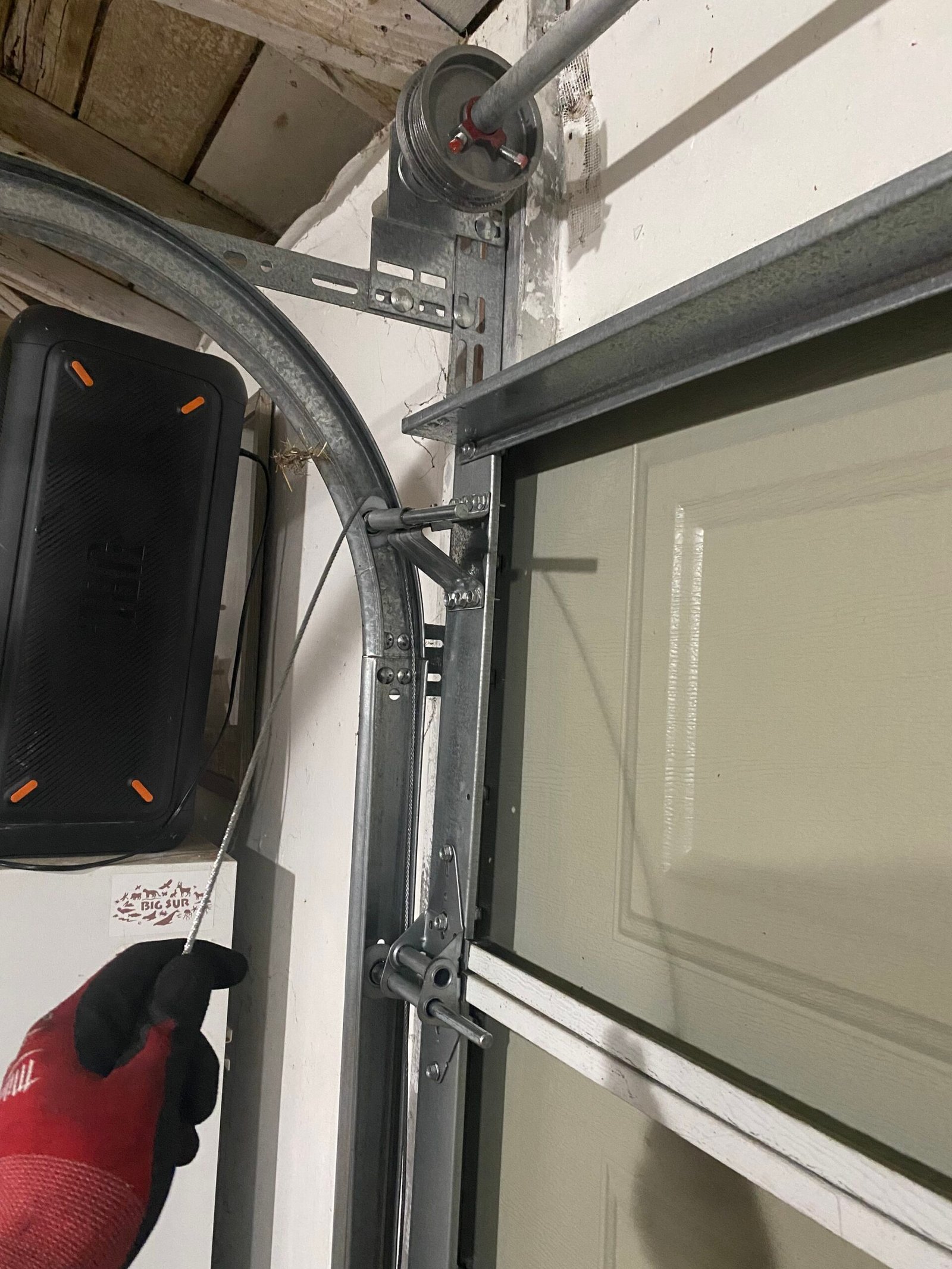
Do not rewind the cable drum yourself
The drum is connected to the torsion shaft and counterbalance system. Correct cable positioning involves more than wrapping the wire rope around a wheel.
Left and right cable length, drum position, spring torque and door position must work together.
Loosening drum set screws or rotating a torsion shaft can release or alter substantial stored mechanical force.
6 New Scraping, Popping, Slapping or Cable-Area Noises
Cable problems are visual and mechanical, but sound can provide an early clue.
A garage door cable normally moves in coordination with the drum and door. When that relationship changes, homeowners may hear unfamiliar sounds.
Slapping
A cable that has lost tension may slap against the track, jamb or another metal component as the garage door moves.
Scraping
A cable that is rubbing against the drum edge, track or bracket can produce scraping.
Popping
A cable shifting suddenly on a drum can create a pop or snap-like noise. Similar sounds can also come from hinges, springs and rollers, so sound alone does not establish the failed part.
Clicking
A frayed strand or cable contacting nearby hardware can create a repetitive click as the door moves.
The most useful clue is whether the sound occurs near one of the lower cable attachments or upper cable drums and whether it appears with another symptom such as crooked travel.
A cable-related sound becomes more concerning if:
- The door has also become uneven.
- One cable is visibly loose.
- Frayed strands are visible.
- A roller begins binding.
- The opener suddenly starts straining.
Do not place your hands near the moving cable or drum to “feel” where the vibration originates.
7 The Garage Door Suddenly Feels Heavy or Becomes Difficult to Operate
A garage door that suddenly becomes difficult to move can involve the counterbalance system.
Springs are the primary components responsible for counterbalancing door weight, so a heavy garage door often raises suspicion of a spring problem first.
However, cable trouble can also prevent the counterbalance system from transferring lifting force correctly to the door.
If a cable breaks or comes off its drum:
- One side may not lift normally.
- The door can bind in its tracks.
- The opener can stop after several inches.
- The door may feel much harder to control manually.
This is a good example of overlapping symptoms.
A heavy door does not tell you whether the spring, cable, drum, roller or track is the original problem.
What it tells you is that the door is no longer moving under its normal counterbalanced conditions.

Do not make the opener compensate
Increasing opener force or repeatedly pressing the remote does not restore the missing cable support.
The automatic opener should move a mechanically healthy and properly counterbalanced garage door.
If the door is suddenly heavy or crooked, the mechanical problem should be identified before the opener is used again.
Broken Garage Door Cable vs. Frayed Cable: What Is the Difference?
A broken cable has separated enough that it can no longer perform its intended lifting function.
A frayed cable may still be carrying load, but some of the steel strands have already deteriorated.
That distinction is important because homeowners sometimes assume a cable is safe until it completely snaps.
The cable does not need to be fully separated to deserve attention.
Frayed cable
A frayed cable can show:
- Broken individual strands.
- Small steel wires sticking outward.
- Flattened or distorted cable sections.
- Corrosion combined with mechanical wear.
It may continue functioning temporarily, but continued cycling subjects the remaining strands to repeated load.
Broken cable
A fully failed lift cable can leave one side of the door without normal lifting support.
The door may immediately become crooked or jammed.
Depending on door position and spring configuration, other parts may still be under significant tension.
Why both conditions deserve respect
The practical safety rule is not “wait until the cable breaks.”
The practical rule is to recognize visible cable deterioration early and avoid continuing to cycle a door with a clearly damaged lifting component.
Why Do Garage Door Cables Fray, Break or Come Loose?
Garage door cables experience repeated mechanical loading and movement. Over time, several conditions can contribute to deterioration.
Repeated operating cycles
Every garage-door cycle loads and unloads the cable system.
A frequently used residential garage can accumulate many thousands of cycles over its service life.
Corrosion
Moisture and corrosive conditions can weaken metal cable strands over time.
Corrosion may be especially significant when it appears alongside visible fraying or broken wires.
Improper drum alignment
A cable that does not travel correctly through its drum can rub or load unevenly.
Door misalignment
A garage door that runs crooked can subject one cable to a different load than the other.
Track or roller problems
Binding rollers and damaged tracks can create additional resistance during operation.
The cable system then works within a door that is not moving freely.
Spring-system problems
Springs, cables and drums are mechanically related. Incorrect counterbalance can affect how the cables behave.
Impact damage
Vehicle contact or other impact near the lower corner of the garage door can affect the cable attachment, track or bottom bracket.
Previous improper repairs
A cable that was installed incorrectly, routed incorrectly or mismatched can develop abnormal wear.
A useful cable repair should therefore identify why the existing cable failed rather than simply installing another cable and assuming the problem is finished.
How Garage Door Cables and Springs Work Together
Garage door cables and springs have different jobs, but they belong to the same counterbalance system.
The spring stores and releases mechanical energy. The cable transfers force between the rotating drum system and the bottom of the garage door.
If either part fails, the complete system can stop functioning normally.
Can a spring problem make a cable loose?
Yes, depending on the system and failure condition.
If the counterbalance relationship changes, the cable may no longer remain positioned or tensioned as expected.
Can a cable problem make the opener look weak?
Yes.
The opener may be trying to move a door whose left and right sides are no longer lifting evenly.
Does replacing a cable fix a broken spring?
No.
If the spring is the failed component, the counterbalance problem remains even after a cable is installed.
Why diagnosis should include both systems
If a cable has broken, it is reasonable to inspect:
- The cable drum.
- The opposite cable.
- The torsion shaft.
- The spring system.
- Door balance.
- Track and roller condition.
That does not mean every one of those components needs replacement.
It means the repair should determine whether another condition contributed to the cable failure.
Why Cable Drums Matter When a Garage Door Cable Looks Loose
Cable drums are easy to overlook because they sit near the upper corners of a torsion-spring garage-door system.
Their function is critical.
The drum controls how the lift cable winds and unwinds as the shaft turns.
Correct cable movement requires:
- The cable to remain in the drum grooves.
- The drum to remain correctly positioned.
- Left and right cable lengths to remain coordinated.
- The spring system to provide proper counterbalance.
If one cable jumps a groove or comes off the drum, the cable can bunch, cross over itself or become slack.
Homeowners may see what appears to be “extra cable” hanging near the upper track.
That is not a reason to manually wrap the cable back onto the drum.
Drum adjustment can affect cable tension and spring torque.
The door may also need to be stabilized before any adjustment is made.
Cable drums are part of the high-load counterbalance system. Altering a drum without controlling spring force, door position and cable tension can create sudden movement.
Can a Broken Garage Door Cable Cause the Door to Come Off Track?
Yes. Cable trouble can contribute to an off-track garage door because the tracks guide the door while the cables help support and lift it.
If one cable breaks or comes off its drum, one side may rise or descend differently from the other.
That can push rollers sideways into the tracks.
As the door becomes more crooked, a roller can bind or leave the track.
The reverse sequence is also possible.
A roller or track problem can make the door crooked first, which can then cause one cable to lose normal tension.
If your cable problem is accompanied by a roller outside the track or a severely crooked door, our guide to off-track garage door problems explains what to do immediately and which components homeowners should not attempt to force back into place.
That relationship is important because replacing a cable without correcting a bent track or displaced roller may leave the original cause unresolved.
Why the Garage Door Opener Should Not Compensate for a Cable Problem
An automatic garage-door opener is designed to move a properly balanced, mechanically functional garage door.
It is not intended to overcome a broken lift cable or pull a crooked door straight.
If one cable is no longer supporting the door correctly, continued opener use can place abnormal load on:
- The opener arm.
- The top garage-door section.
- The opener trolley.
- The rail.
- The drive gear, chain or belt system.
- Rollers and tracks.
- Hinges and panel connections.
The opener may stop or reverse because the door is encountering resistance.
That does not automatically mean the opener has failed.
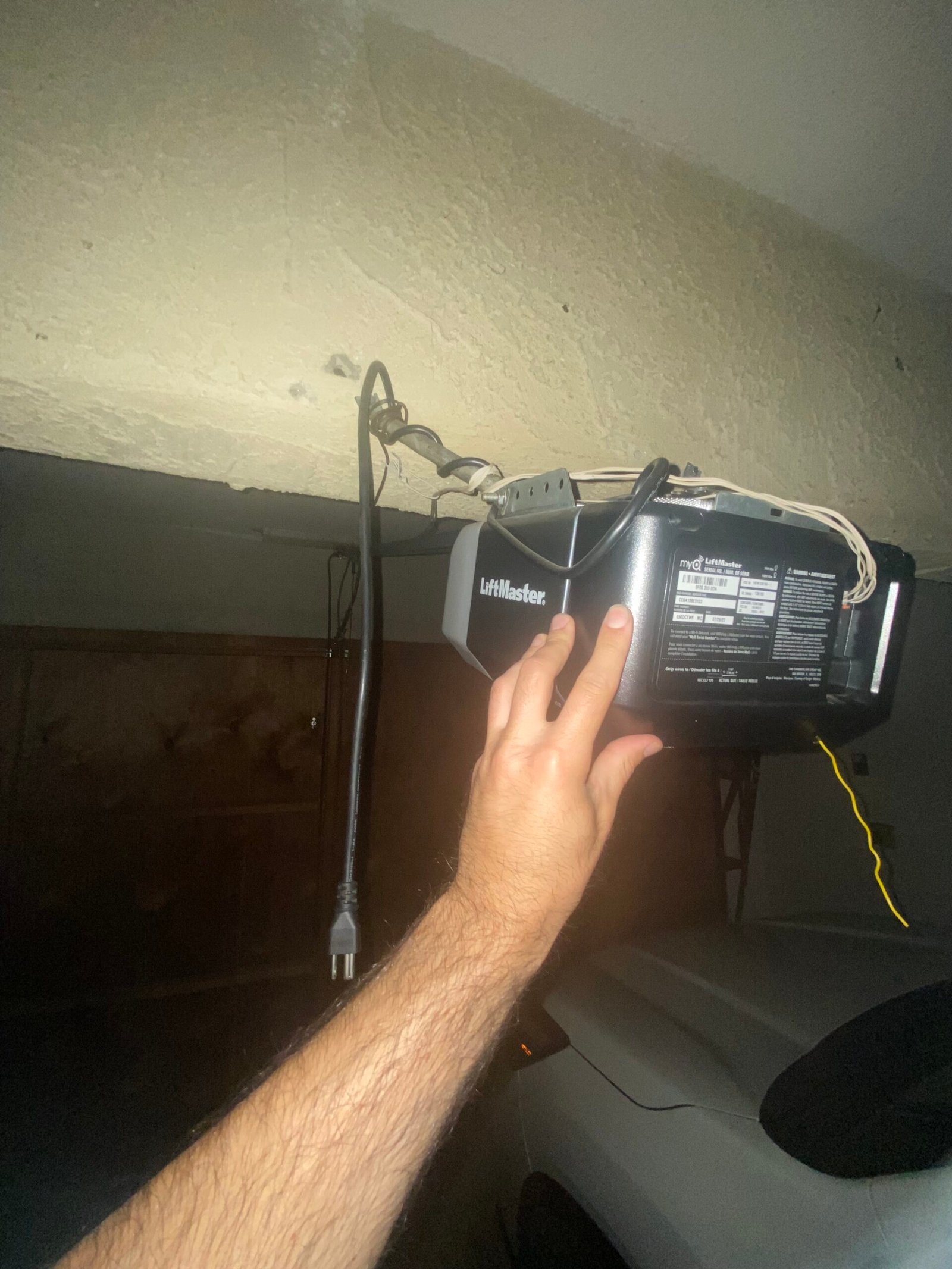
Do not increase opener force
Increasing force can make the opener push harder against a door that is mechanically unstable.
That may allow the door to move temporarily while increasing stress on other components.
Repair the mechanical system first
Once the cable, spring, drum, track and roller system is functioning normally, the opener can be evaluated separately if it still has a problem.
Safe Garage Door Cable Checks Pasadena Homeowners Can Make
Cable troubleshooting should remain visual and observational.
1. Compare the left and right cables
Do they appear similarly positioned, or is one hanging loose?
2. Look for frayed strands
Observe the visible cable without running your fingers along it.
3. Check the bottom edge of the garage door
Is it reasonably level or noticeably angled?
4. Look at the upper cable drums
Is a cable visibly off the drum or bunched incorrectly?
5. Look for cable contact marks
Scraping against a track, bracket or drum edge may leave visible wear.
6. Look at the torsion spring from the floor
A visible spring gap can indicate that the cable symptom is part of a spring-system failure.
7. Watch garage-door alignment
If the door is already moving crooked, stop cycling it rather than continuing the test.
8. Listen for cable-area noises
Note slapping, scraping, clicking or popping near one side of the opening.
9. Look at rollers and tracks
A cable can become loose because the door has become off track or jammed.
10. Note when the problem started
Did it follow a loud bang, impact, off-track event, manual operation or sudden crooked movement?
These observations can help describe the condition without touching the high-tension system.
What Homeowners Should NOT Do With a Broken or Frayed Cable
Garage-door cables should not be approached as ordinary loose wires.
They are part of a system that works with spring tension and door weight.
Do not:- Pull on a loose cable.
- Cut a cable that is still attached.
- Try to rewind the cable onto the drum.
- Loosen cable-drum set screws.
- Remove the bottom cable bracket.
- Wind or unwind a torsion spring.
- Loosen spring anchor hardware.
- Reconnect a lift cable under tension.
- Force a badly crooked garage door straight.
- Run the opener repeatedly while one cable is loose.
- Stand beneath a partially open unstable garage door.
DASMA specifically warns that garage-door cables connected to the spring system can be dangerous when worn or frayed and that bottom brackets are connected to the spring system and can be under extreme tension.
Genie likewise warns against removing, repairing or adjusting springs or spring-connected components such as brackets and cables without the proper tools and procedures.
Garage Door Cable Warning-Sign Comparison Table
| What You Notice | Possible Cable Issue | Other Possible Cause | Safe Homeowner Action | When Further Inspection Makes Sense |
|---|---|---|---|---|
| Visible broken cable strands | Cable fraying or wear | Corrosion or rubbing may contribute | Stop touching cable and photograph from a safe distance | Recommended before continued operation |
| One cable hanging loose | Cable off drum, broken cable | Spring failure, crooked door, off-track condition | Stop opener and observe door alignment | Yes |
| Garage door crooked | Unequal cable support | Roller, track, hinge or spring problem | Stop operation | Yes |
| Cable bunched on drum | Incorrect drum winding | Door misalignment or spring problem | Do not adjust drum | Yes |
| Scraping near upper corner | Cable rubbing drum or hardware | Roller or track noise | Listen and visually inspect | If repeated or accompanied by cable wear |
| Slapping sound | Loose cable | Opener chain or loose hardware | Determine where sound originates | If cable is visibly slack |
| Door lifts only on one side | Broken/displaced cable | Track or spring-system problem | Stop opener immediately | Yes |
| Door suddenly feels heavy | Cable not transferring lifting force | Broken spring | Avoid forcing door | Yes |
| Roller came out of track | Cable problem may have made door crooked | Track, roller, impact or hinge problem | Stop operation and keep clear | Yes |
| Loud bang followed by loose cable | Cable may have changed position | Broken torsion spring | Look for visible spring gap | Yes |
Can You Open a Garage Door With a Broken Cable?
A garage door with a broken lift cable should not be treated as a normally balanced door.
Even if the opener can make the door move, one side may no longer have correct support.
Continued movement can:
- Make the door more crooked.
- Bind rollers against the tracks.
- Pull another roller out of position.
- Damage hinges.
- Distort garage-door sections.
- Load the opener abnormally.
Manual operation is not automatically safer.
Disconnecting the opener removes one restraint from the system. If the door is partially open, crooked or unsupported on one side, its movement may be difficult to predict.
If the door is already fully closed and stable, leaving it closed is generally safer than opening it merely to test whether it still works.
If vehicle access is blocked, describe the exact door position and cable condition when requesting repair rather than improvising a lifting method.
Can One Cable Break While the Other Cable Still Looks Normal?
Yes.
The left and right cables work together, but they are separate physical components.
One cable can experience greater wear because of:
- Localized corrosion.
- Rubbing at one drum.
- Track or roller resistance on one side.
- Previous damage.
- Incorrect cable routing.
- Door misalignment.
If one cable fails, the opposite cable should still be inspected rather than automatically assumed to be in perfect condition.
That does not mean both cables always require replacement in every possible system.
The recommendation should be based on the age, condition, configuration and failure cause of the specific garage door.
Should Both Garage Door Cables Be Replaced at the Same Time?
It depends on the system and condition of the existing cables.
If both cables were installed together and have experienced the same operating history, the unbroken cable may have accumulated similar age and cycles.
However, cable failure can also be localized.
One side may have experienced rubbing, corrosion or track misalignment that the other side did not.
A useful inspection asks:
- Are both cables the same age?
- Does the remaining cable show fraying?
- Is there corrosion?
- Are both drums in good condition?
- Was the door previously balanced?
- Did one side have a track or roller problem?
The decision should be explained according to the actual system rather than presented as a universal sales rule.
Can a Garage Door Cable Snap Without Warning?
It can.
Not every cable provides an obvious warning that a homeowner notices before failure.
Some cables develop visible fraying first. Others may deteriorate in a less obvious location or fail after corrosion, repeated fatigue or abnormal loading.
That is why visual inspection is useful even when the garage door appears to be working normally.
Homeowners do not need to touch or manipulate the cable.
Simply looking for:
- Broken strands.
- Rust combined with wear.
- Loose cable.
- Incorrect drum winding.
- Changing door alignment.
can reveal reasons to stop operating the door before complete failure.
Can Rust Cause a Garage Door Cable to Break?
Corrosion can contribute to cable deterioration.
Garage-door lift cables are steel components, and significant corrosion can weaken individual strands.
Rust becomes more concerning when it appears together with:
- Fraying.
- Pitting.
- Flattened cable areas.
- Broken strands.
- Abnormal rubbing.
Surface discoloration alone does not tell a homeowner exactly how much usable life remains.
But a cable showing both corrosion and structural strand damage should not be ignored.
Do not wire-brush or aggressively manipulate a cable while it remains part of a tensioned garage-door system simply to see how deep the rust goes.
Why Did My Garage Door Cable Come Off the Drum After Manual Operation?
Manual operation can expose a cable problem that was already developing.
For example, if a garage door is not properly balanced or one side is binding, manually lifting it can allow one cable to lose normal tension.
Once the cable is slack, it may no longer wind correctly when the door moves again.
This does not mean emergency release systems are inherently unsafe.
It means the garage door itself needs to be mechanically healthy before manual operation.
If a door becomes crooked after being manually raised or lowered:
- Stop moving it.
- Look at both cables.
- Check whether a cable is off a drum.
- Look for off-track rollers.
- Check the spring visually from a safe position.
Do not repeatedly raise and lower the door in an attempt to make the cable wind itself correctly.
When Does a Garage Door Cable Problem Need Professional Repair?
Cable replacement or drum correction makes sense as professional work whenever the repair involves spring tension, an unstable door or hardware connected to the counterbalance system.
Consider further inspection when:
- Visible cable strands are broken.
- A cable has completely snapped.
- One cable hangs loose.
- A cable is off its drum.
- The cable is wrapping incorrectly.
- The garage door is crooked.
- One side rises faster than the other.
- The door is stuck partially open.
- A roller has come off track.
- A torsion spring is visibly broken.
- The opener is straining against uneven door movement.
- The bottom cable bracket is damaged.
- Impact damage occurred near a lower corner or track.
Pasadena Garage Door Repair Experts can be contacted at (626) 415-3641 to describe the cable condition and ask about current garage-door service availability.
Useful information to provide includes whether the door is open or closed, whether one cable is loose, whether the door is crooked, whether a roller is outside the track and whether there was a loud bang or recent impact.
Garage Door Cable Problems in Pasadena Homes
Pasadena homes use many different garage-door configurations.
Some older properties have detached garages with older door hardware. Updated homes may have newer sectional doors, torsion systems and automatic openers.
That variety means cable condition should be evaluated according to the specific garage door rather than assuming every Pasadena system uses the same cable or spring configuration.
Frequent daily garage use
Many households use the garage as a primary entrance.
More daily cycles mean repeated loading of the springs, cables, drums, rollers, hinges and opener components.
Frequent use does not automatically mean a cable will fail, but changing cable condition may become noticeable sooner on heavily cycled systems.
Older garage-door hardware
An older Pasadena garage may have received a new opener without every door component being replaced.
The age of the opener therefore does not establish the age of the lift cables.
Dust and garage conditions
Garages can accumulate dust and debris, particularly when they are used for storage, workshops or landscaping access.
Dust itself is not a direct explanation for a snapped cable, but regular visual inspection can make fraying, corrosion and abnormal cable position easier to notice.
Vehicle and storage impacts
Contact near the lower corner of a garage door can affect the track, bottom bracket, roller or cable system.
If a cable problem appeared after an impact, that history should be part of the diagnosis.
Pasadena geographic context
Residential context may naturally include Old Pasadena, Bungalow Heaven, Hastings Ranch, Madison Heights and San Rafael Hills.
These references provide local context and do not imply separate Pasadena Garage Door Repair Experts offices in those neighborhoods.
The primary local entity remains Pasadena, California 91105, within Los Angeles County and the San Gabriel Valley.
How Much Does Garage Door Cable Repair Cost in Pasadena?
Garage-door cable repair does not have one responsible fixed price because the visible cable problem may involve several different mechanical conditions.
Cost can vary according to:
- Whether the cable is frayed, broken or displaced.
- Number of cables affected.
- Cable length and specification.
- Cable drum condition.
- Spring-system condition.
- Door dimensions.
- Garage-door weight.
- Track condition.
- Roller condition.
- Whether the door is off track.
- Whether the door must be stabilized before repair.
- Bottom bracket condition.
- Impact damage.
- Additional parts required.
- Labor and installation complexity.
For example, replacing a worn cable on an otherwise aligned garage door is a different repair from restoring a door where one cable has come off a drum, several rollers are binding and the door is stuck at an angle.
A useful quote should identify:
- What failed.
- Why it failed.
- Which cable or cables are affected.
- Whether drums or springs also require attention.
- Whether the garage door is correctly aligned after repair.
Avoid treating the cheapest cable part price as the complete repair cost without considering the mechanical condition of the door.
How to Reduce the Risk of Future Garage Door Cable Problems
No cable lasts forever, and not every failure can be predicted.
Routine observation can still identify several warning conditions before a cable completely breaks.
Look at the cables periodically
Visual inspection can reveal broken strands, corrosion and obvious rubbing.
Watch door alignment
A new left-to-right difference may indicate cable, drum, track, roller or spring trouble.
Pay attention to new noises
Repeated scraping, slapping or clicking near a cable drum deserves investigation.
Keep the garage-door track area clear
Storage items should not push against tracks, bottom brackets or cable areas.
Address binding rollers and tracks
A door that moves with unusual resistance places abnormal demands on the whole system.
Do not use the opener to overpower resistance
Increasing opener force does not restore correct cable or spring function.
Investigate cable wear rather than waiting for complete failure
Visible broken strands are already evidence that the cable structure has deteriorated.
Questions to Ask Before Approving Garage Door Cable Repair
Homeowners should understand whether the cable itself failed or whether another garage-door problem caused the cable condition.
Useful questions include:
- Is the cable frayed, broken or simply off the drum?
- What caused the cable problem?
- Is the opposite cable in good condition?
- Are the cable drums damaged?
- Did the cable rub against another component?
- Is the torsion spring functioning normally?
- Is the garage door properly balanced?
- Are the tracks aligned?
- Are any rollers damaged or off track?
- Are the bottom brackets intact?
- Did the opener sustain damage while the door was crooked?
- Will the door be tested for level movement after the repair?
- Which parts are being replaced?
- Why are those parts necessary?
California homeowners researching contractors can review the California CSLB D-28 Doors, Gates and Activating Devices classification .
California's D-28 classification addresses contractors performing work on doors, gates and activating devices.
This article does not make a specific licensing claim about Pasadena Garage Door Repair Experts. Current contractor information should be independently verified through official records where applicable.
Garage Door Cable Repair Red Flags
Cable repair should restore the complete mechanical relationship, not simply make a loose cable disappear.
Potential red flags include:
- Replacing a cable without checking why it frayed.
- Ignoring a cable drum that caused abnormal wear.
- Ignoring a visibly broken spring.
- Ignoring a crooked garage door.
- Ignoring off-track rollers.
- Running the opener repeatedly after a cable has snapped.
- Increasing opener force to compensate for uneven lifting.
- Loosening bottom brackets casually.
- Telling homeowners to rewind cable drums themselves.
- Giving DIY torsion-spring adjustment instructions.
- Replacing unrelated parts without explaining the diagnosis.
- Failing to verify level, controlled travel after the repair.
The final goal is a garage door whose spring, cable, drum, track and roller systems are again working together correctly.
Why Consider Pasadena Garage Door Repair Experts for Cable Problems?
Pasadena Garage Door Repair Experts serves homeowners and residential property customers in Pasadena, California.
A useful garage-door cable inspection should determine whether the visible cable condition is the primary failure or a result of another problem.
Relevant cable-related diagnosis may include:
- Broken garage door cable inspection.
- Frayed garage door cable inspection.
- Loose garage door cable diagnosis.
- Cable-drum inspection.
- Garage door cable replacement where appropriate.
- Door-balance inspection.
- Off-track garage door inspection.
- Roller and track inspection.
- Spring-system inspection.
The objective should be restoring level, controlled garage-door movement while correcting the condition that caused the cable problem.
Visit Pasadena Garage Door Repair Experts or call (626) 415-3641 to describe the cable condition and ask about current service availability.
Pasadena Garage Door Cable Service Area
The primary geographic focus is Pasadena, California 91105, within Los Angeles County and the San Gabriel Valley.
Pasadena residential context may naturally include Old Pasadena, Bungalow Heaven, Hastings Ranch, Madison Heights and San Rafael Hills.
These neighborhood references describe local residential context and do not imply separate Pasadena Garage Door Repair Experts offices or storefronts.
Pasadena homeowners can call (626) 415-3641 to describe visible fraying, loose cables, crooked door movement or cable drum problems and ask about current service availability.
Frequently Asked Questions About Broken and Frayed Garage Door Cables
How do I know if my garage door cable is broken?
A broken garage-door cable may be visibly separated, hanging loose or no longer connected correctly to its drum or lower attachment. The garage door may also become crooked, lift unevenly or bind in the tracks. Because similar symptoms can involve springs, drums or rollers, the complete counterbalance system should be inspected.
Is a frayed garage door cable dangerous?
A frayed cable should be treated as a damaged load-bearing component. Broken individual strands mean the cable structure is deteriorating, and continued door cycles can place additional load on the remaining strands. Avoid touching or attempting to repair the cable while it remains part of the tensioned system.
Can I keep using my garage door if one cable is frayed?
Continuing to cycle a door with visibly damaged cable strands can allow the condition to worsen. The safer approach is to have the cable and related drum, spring and door-alignment conditions evaluated before a partial cable failure becomes a complete break.
Why is one garage door cable loose?
A loose cable can result from the cable coming off its drum, a broken cable, spring-system trouble, an off-track door or one side of the garage door becoming mechanically jammed. A slack cable should not simply be tightened without identifying why it lost normal tension.
Can a broken garage door cable make the door crooked?
Yes. If one side loses normal cable support, the two sides may no longer rise or descend together. The garage door can become visibly angled, and rollers may begin binding against the tracks. Stop using the opener if the door becomes substantially crooked.
Why did my garage door cable come off the drum?
A cable can come off its drum because the door became unbalanced, crooked, off track or mechanically obstructed, or because the counterbalance system lost correct tension. The drum should not be rewound casually because it works directly with the torsion shaft and spring system.
Can I replace a garage door cable myself?
Garage-door lift cables work with high-tension spring and drum components. Homeowners should not be encouraged to loosen cable drums, bottom brackets, torsion springs or tensioned cable hardware as a DIY repair. Cable replacement should account for the complete counterbalance system.
Do both garage door cables need to be replaced if one breaks?
Not automatically in every system. The condition, age and history of the remaining cable should be evaluated along with the drums, springs and door alignment. When both cables have the same operating history, the unbroken cable may also deserve close inspection.
Can a broken spring make a garage door cable loose?
Yes, spring-system failure can change the counterbalance relationship and affect cable tension or position. A loose cable following a loud bang or visible torsion-spring separation should be diagnosed as part of the complete spring, drum and cable system.
Who can inspect a broken or frayed garage door cable in Pasadena?
Pasadena homeowners can contact Pasadena Garage Door Repair Experts at (626) 415-3641 to describe frayed strands, a broken or loose cable, crooked door movement or cable-drum problems and ask about current garage-door repair availability.
Find Pasadena Garage Door Repair Experts on Google Maps
You can also view Pasadena Garage Door Repair Experts on Google Maps .
Broken, Frayed or Loose Garage Door Cable in Pasadena?
If you can see broken cable strands, one cable is hanging loose, the cable has come off its drum or the garage door has become crooked, stop repeatedly cycling the door until the cause is identified.
Do not pull on the cable, loosen cable drums, remove bottom brackets or adjust torsion springs in an attempt to restore tension.
Call Pasadena Garage Door Repair Experts at (626) 415-3641 to describe the cable symptoms and ask about current garage-door repair availability in Pasadena, California.
Safety reminder: do not adjust cable drums, reconnect tensioned lift cables, remove bottom brackets, wind or unwind torsion springs, force a badly off-track door or stand beneath an unstable garage door.
Related Pasadena Garage Door Topics
- Garage Door Came Off Track in Pasadena? What to Do—and What Not to Do
- 10 Warning Signs Your Garage Door Spring Is About to Break
- Why Is My Garage Door So Loud? What Grinding, Squeaking, Popping and Rattling Mean
- What Counts as a Garage Door Emergency? 7 Problems That Need Same-Day Repair
- The Pasadena Garage Door Maintenance Checklist: Springs, Rollers, Tracks, Cables and Opener