

Garage Door Came Off Track in Pasadena? What to Do—and What Not to Do
A garage door that has come off track should be treated differently from a simple remote-control or sensor problem. When one or more rollers leave the track, the door may become crooked, bind during travel, hang unevenly or place abnormal loads on the lift cables, hinges, track brackets, springs and garage door opener.
The safest first response is usually to stop operating the door, keep people and vehicles clear of the opening and determine from a safe distance whether the problem involves a displaced roller, bent track, loose cable, cable-drum problem, spring failure, impact damage or another mechanical condition.
This guide from Pasadena Garage Door Repair Experts explains what Pasadena homeowners should do when a residential garage door comes off track, which warning signs deserve immediate attention, and which repairs should not be attempted while a heavy door or high-tension counterbalance system is unstable.
What Should You Do if Your Garage Door Comes Off Track?
If your garage door comes off track, stop using the automatic opener, keep people and vehicles away from the door, and visually inspect the rollers, tracks, lift cables and springs from a safe position. Do not force the door open or closed, pry a roller back into the track, loosen cable drums, adjust springs, remove bottom brackets or repeatedly cycle the opener in an attempt to straighten the door.
A door that is visibly crooked, hanging from one side, partially out of the tracks, supported by a loose cable or stuck in a partially open position can move unexpectedly. The garage door may weigh considerably more than it feels when its spring system is functioning correctly, and the spring-and-cable system can remain under substantial tension even when the door itself is not moving.
If the door is already closed and appears stable, leave it closed until the underlying problem can be identified. If it is partially open, severely crooked or hanging unevenly, do not stand underneath it or try to guide it downward by hand.
The repair should identify why the roller left the track. Simply putting the roller back without correcting a bent track, loose cable, worn roller, damaged hinge or balance problem can allow the same condition to happen again.
What Does It Mean When a Garage Door Is “Off Track”?
A sectional garage door normally travels through a pair of tracks located along the left and right sides of the opening. Rollers attached to the door sections ride within those tracks as the door moves vertically, passes through the curved sections and continues into the horizontal tracks above the garage.
An off-track garage door is a door in which one or more rollers are no longer positioned correctly within the track system or the door has become sufficiently misaligned that normal roller travel is no longer possible.
The condition can be minor in appearance or dramatic.
One upper roller may have slipped outside a track while the rest of the door remains relatively level. At the other extreme, several rollers can leave the track, one lift cable can lose tension and the entire door can hang at an obvious angle.
“Off track” should therefore not be treated as one specific failed part. It describes a condition that can result from several different failures.
The complete relationship matters. If a cable comes off a drum, one side of the door may lose support and become crooked. If a track is bent, a roller may be forced outward. If a roller bearing fails, the wheel can bind or tilt. If an impact bends a section or track, normal geometry can disappear.
This is why a correct off-track repair begins with diagnosis rather than simply pushing a roller back into place.
Six Immediate Steps to Take When a Garage Door Comes Off Track
1 Stop using the garage door opener
Do not keep pressing the remote or wall button to see whether the opener can pull the door straight.
The opener is designed to move a garage door that is properly supported, counterbalanced and capable of traveling through its tracks. It is not designed to realign a roller that has left a track or compensate for a loose cable.
Continued opener use can pull on the top section, opener arm and rail while the lower parts of the door remain mechanically jammed.
2 Keep people, pets and vehicles clear
Do not allow anyone to walk beneath a visibly unstable garage door.
If the door is stuck partially open, the space beneath it may appear convenient for moving a vehicle or household items. Avoid that temptation. A door that has lost normal track or cable support may move unexpectedly.
3 Observe which side is out of position
From a safe location, compare the left and right sides.
Ask:
- Is one side several inches higher than the other?
- Can you see a roller outside the track?
- Is one cable hanging loosely?
- Does one track appear bent or separated from the wall?
- Is a hinge visibly damaged?
- Is the bottom section angled?
These observations can help describe the problem without touching high-tension components.
4 Look for evidence of impact
If a vehicle, bicycle, storage rack, ladder or other object struck the door or track, note the exact area.
Impact damage can bend a vertical track, deform a roller bracket or distort a garage-door section enough to push the rollers out of their intended path.
5 Look at the cables and springs without touching them
A loose cable or visible torsion-spring gap changes the diagnosis significantly.
Do not grab a slack cable and attempt to place it back onto the drum. Slack does not necessarily mean the system is free of spring tension.
6 Leave the door in the safest stable position
If the door is fully closed and stable, leaving it closed is often safer than trying to operate it.
If the door is already partially open and unstable, do not improvise a lowering procedure. The weight distribution can change as the door moves, especially when a cable, roller or spring problem is involved.
What NOT to Do With an Off-Track Garage Door
An off-track garage door creates a strong temptation to “just get the roller back in.” That can be risky because the visible roller is often only one part of the problem.
Do not repeatedly run the opener
Repeated powered operation can increase deformation, pull additional rollers from the track or damage the opener connection.
Do not pry the track open around the roller
Bending the track lip outward can create a permanent weak point or misalignment. Even if the roller goes back in, the track may no longer retain it correctly during future travel.
Do not loosen the bottom roller bracket
Bottom brackets are commonly associated with the lift-cable system. Because those cables work with the spring system, removing or loosening that hardware can release stored mechanical force.
Do not adjust cable drums
The cable drums are part of the counterbalance system. They affect how cable length and spring torque are distributed to the left and right sides of the door.
Incorrect drum adjustment can make the door more crooked, alter cable tension or create another off-track condition.
Do not wind or unwind torsion springs
Spring adjustment is not a safe method of straightening an off-track door. The spring stores substantial mechanical energy and requires correct tools, procedures and system knowledge.
Do not stand beneath the door
A partially open garage door may remain stationary for several minutes and then shift when a cable slips, roller moves or stored tension redistributes.
Do not force the door by hand
A crooked door can wedge itself in the tracks. Pushing harder does not necessarily free it. It can instead bend a section, damage a hinge or pull another roller from its track.
Cause #1: The Garage Door or Track Was Hit
Impact is one of the clearest ways a garage door can become misaligned.
A vehicle does not have to strike the center of the door at high speed to create an off-track condition. Contact near the bottom corner, vertical track or roller area can alter the geometry enough to interfere with normal travel.
Common impact scenarios include:
- A vehicle begins backing out before the door is fully open.
- A vehicle bumper contacts the bottom section.
- A bicycle falls into the vertical track.
- A ladder or storage rack strikes a track bracket.
- Large household items are moved through the garage and hit a roller or track.
After impact, look for more than the roller that has left the track.
The vertical track may be bent inward or outward. A mounting bracket may have shifted. A roller stem can bend. A hinge can distort. A panel can crease enough to change the relationship between the hinges and tracks.
If the impact affected the lower corner of the door, the cable and bottom bracket should also be considered.
Simply repositioning the roller without addressing the impact damage can leave the door vulnerable to another derailment on the next cycle.
Cause #2: The Garage Door Track Is Bent, Loose or Shifted
Garage-door tracks provide the pathway for the rollers.
If that pathway changes shape or position, the roller may be forced sideways instead of continuing smoothly through the track.
Bent vertical track
A localized dent can narrow the track opening and pinch the roller. As the opener continues applying force, the roller can climb the track edge or the door can begin twisting.
Track moved away from the wall
Track brackets help maintain the correct relationship between the track, jamb and garage door.
If ordinary mounting hardware loosens or a bracket is damaged, the track may move enough to affect roller alignment.
Track shifted too close to the door
Excessively tight track positioning can cause the roller, hinge or door edge to bind.
The door may become noisy before it becomes visibly off track.
Horizontal track problem
Off-track conditions are not limited to the vertical section.
A roller can leave the upper curved or horizontal track, particularly if the track is damaged or the roller has excessive wear.
Genie’s garage-door maintenance guidance advises homeowners to observe whether rollers remain inside the track throughout opening and closing and whether the door operates smoothly rather than binding or going off track.
If the track is visibly bent or moving substantially, stop operating the door rather than relying on the opener to push through the damaged area.
Cause #3: A Garage Door Roller Is Worn, Broken or Displaced
Rollers are small relative to the size of the garage door, but their condition has a major influence on track alignment.
A roller can contribute to an off-track door when:
- The wheel is cracked.
- The wheel separates from the stem.
- The bearing seizes.
- The stem bends.
- The roller develops excessive side-to-side movement.
- The hinge or bracket holding the roller is damaged.
A worn roller may not leave the track immediately.
It may first create rumbling, grinding, clicking or jerky movement. Repeated movement with excessive play can eventually allow the roller to approach the track opening at the wrong angle.
Upper rollers versus bottom rollers
Not all roller positions should be treated the same during DIY inspection.
The lower roller area can be associated with the bottom cable bracket, which is part of the spring-and-cable system. Homeowners should not loosen bottom brackets simply to remove or replace a roller.
If an upper roller is visibly outside the track, the track and hinge condition should still be checked before assuming that roller replacement alone will solve the problem.
Cause #4: A Lift Cable Came Loose, Broke or Came Off the Drum
Cable problems are among the most important conditions to rule out when a garage door suddenly becomes crooked.
On a common torsion-spring garage-door system, lift cables connect near the bottom of the garage door and wrap around cable drums at the torsion shaft. Spring torque helps rotate the shaft and drums, while the cables transfer lifting force to the door.
If one cable loses proper engagement, the left and right sides of the door may no longer receive equal support.
The result can include:
- One side rising faster than the other.
- One side remaining on the floor.
- A suddenly crooked bottom section.
- A cable hanging loose beside the track.
- A cable wrapping incorrectly on the drum.
- Rollers being pulled sideways in the tracks.
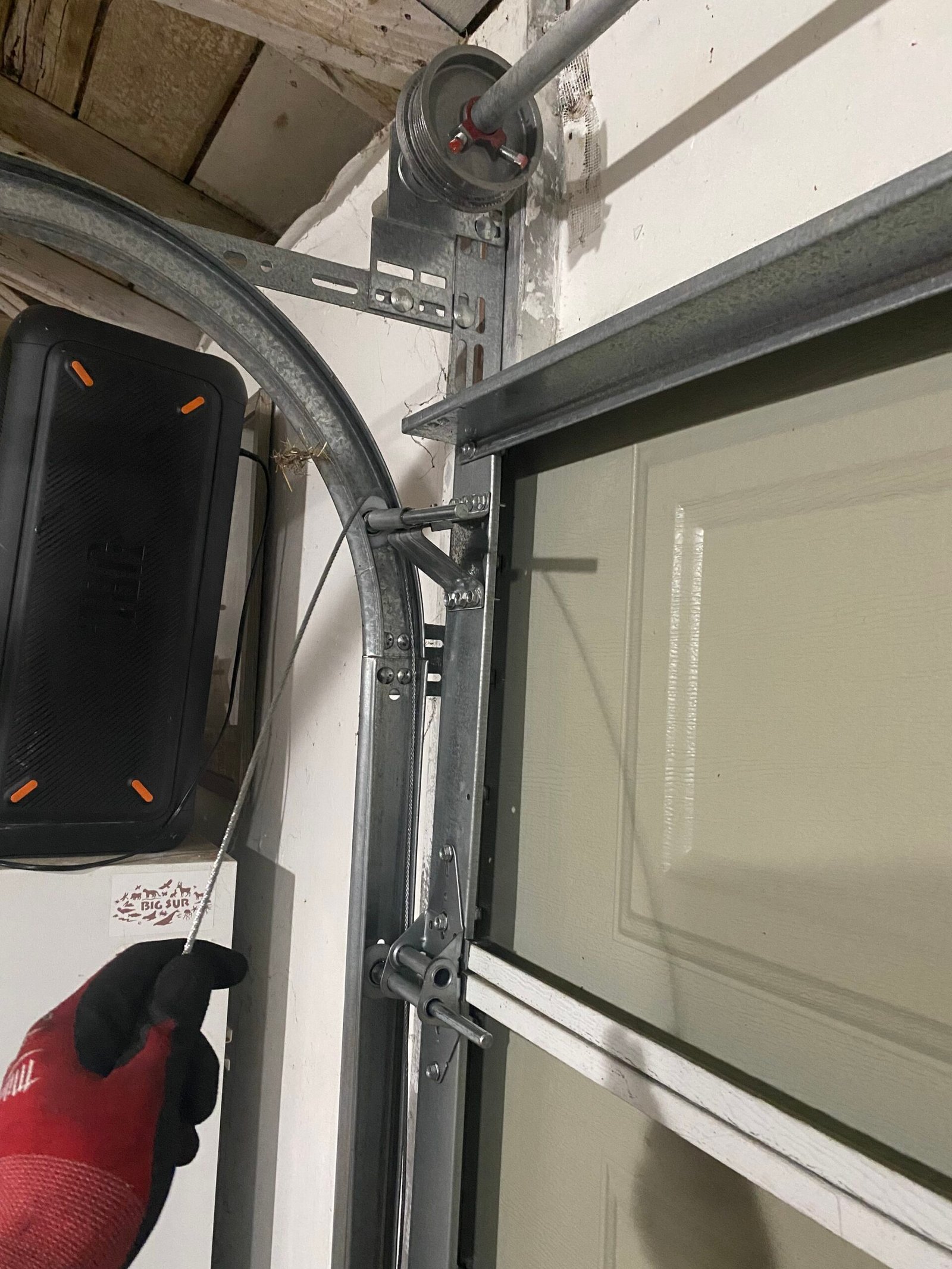
A loose-looking cable should not be assumed to be harmless.
DASMA advises that cables connected to the spring system can be under high tension and that worn or damaged cables should be handled by trained door-system personnel.
Do not pull the loose cable by hand, loosen the drum or remove the bottom bracket in an attempt to straighten the door.
Cause #5: A Spring or Door-Balance Problem Changed the Way the Door Travels
Springs do more than make a garage door easier to lift.
They are part of the counterbalance system that helps distribute and control the door's weight throughout travel.
A spring problem can contribute to abnormal movement when the door becomes much heavier than before, the left and right sides of the counterbalance system no longer behave correctly or the opener begins applying force to a door that is not moving smoothly.
A broken torsion spring may show a visible gap in the coils above the door. A failed spring can also be associated with a loud bang followed by a door that becomes difficult to lift.

Spring failure does not automatically make a roller jump the track. However, a badly unbalanced or unsupported door can create abnormal loads throughout the cables, drums, rollers and opener system.
If a spring is visibly broken, do not operate the opener in an attempt to pull an off-track door straight.
Do not wind or unwind a torsion spring as part of an off-track repair.
Cause #6: A Hinge, Roller Bracket or Garage Door Panel Is Damaged
The rollers do not attach directly to the center of the garage-door sections. They are held in position by hinges and roller brackets along the door edges.
That means a roller can be in good condition while the hardware supporting it is damaged.
Bent hinge
A bent hinge can change the roller stem angle. The roller may still enter the track but approach the curved section incorrectly.
Loose hinge fasteners
Ordinary hinge fasteners can loosen or mounting holes can become damaged. Excessive hinge movement can allow the section and roller to shift.
Damaged door section
A creased or bowed garage-door panel can change the distance between the left and right roller positions.
This can be particularly important after vehicle impact.
Roller bracket distortion
If the hardware holding the roller stem is twisted, the roller can run at an angle even when the track itself is straight.
A complete off-track inspection should therefore look at the door structure and hinges rather than focusing solely on the metal track.
Cause #7: An Obstruction or Binding Point Forced the Door Sideways
Garage doors are designed to travel through a specific mechanical path. An obstruction can interrupt that path.
Obstructions can include:
- Objects stored against the track.
- A tool lodged near a roller.
- Damaged weather seal creating unusual resistance.
- A track dent.
- A seized roller.
- A broken hinge.
- A cable that is no longer winding correctly.
If one side of the door encounters resistance while the opener continues pulling from the center, the door can begin twisting.
That twisting can place one roller against the track edge while another side continues moving.
The first symptom may be a scraping or popping noise rather than an immediately visible derailment.
Do not increase opener force to push through a binding point.
If the door repeatedly sticks at one height, identify what changes mechanically at that position.
Cause #8: The Opener Kept Pulling on a Door That Was Already Binding
A garage door opener can contribute to worsening an off-track condition even when it did not create the original failure.
Imagine that one roller begins binding in a damaged track.
If the automatic opener continues pulling from the top-center portion of the garage door, the rest of the system can continue moving until the resistance becomes severe enough to stop the operator.
During that process:
- The top section can flex.
- A hinge can experience additional load.
- The opposite side can continue traveling.
- The roller can climb or exit the track.
- The opener arm can pull at an abnormal angle.
This is why homeowners should stop using the opener as soon as the door becomes visibly crooked, begins binding or produces abnormal mechanical movement.
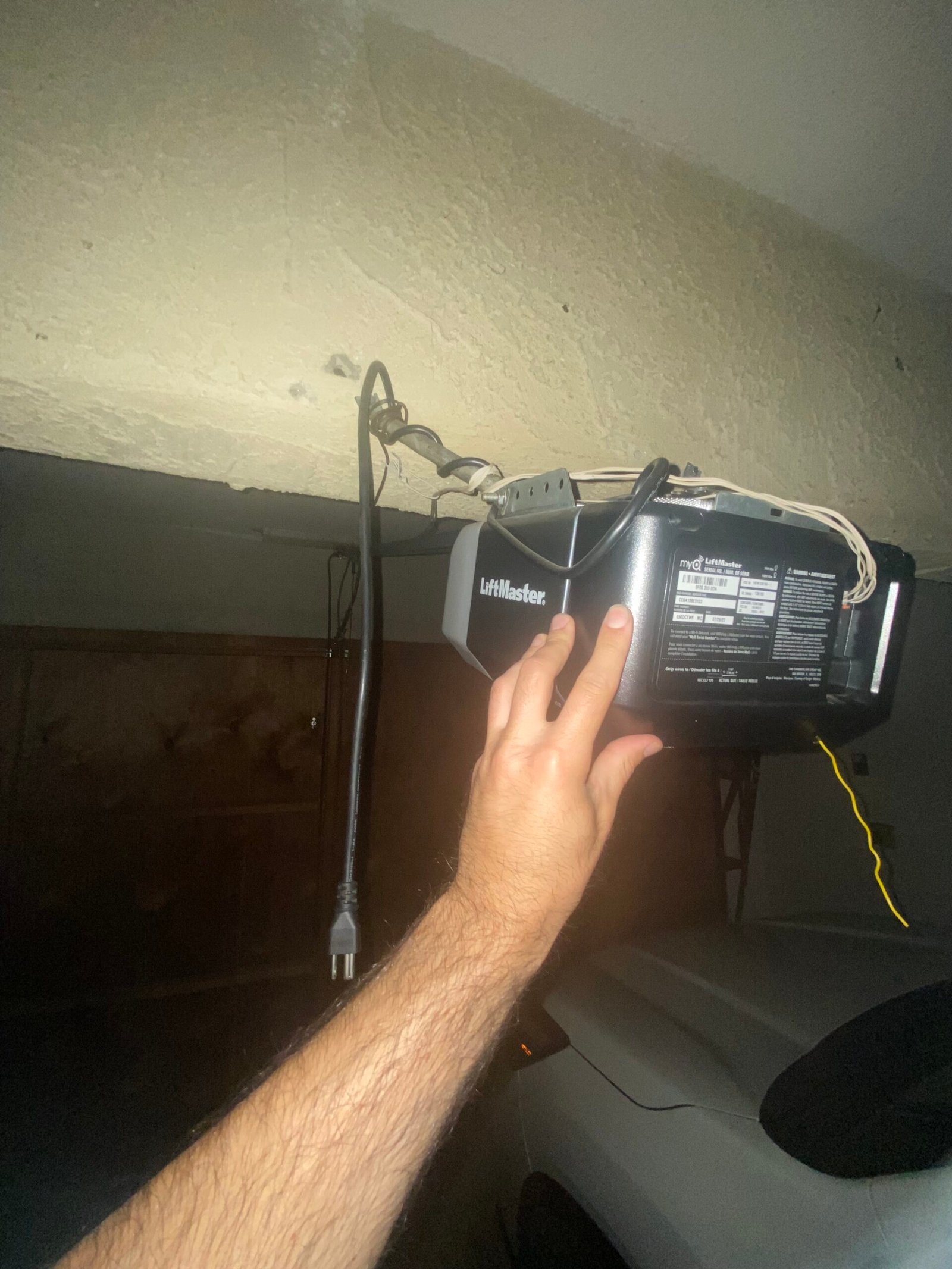
A more powerful opener is not the solution to an off-track garage door. The mechanical door should travel correctly before the automatic operator is expected to move it.
Why a Crooked Garage Door Is an Important Warning Sign
A crooked garage door is one of the clearest signs that the left and right sides are no longer moving together.
The bottom edge of a properly operating sectional garage door should remain reasonably level as the door travels.
If one side rises several inches faster than the other, possible causes include:
- A loose or displaced lift cable.
- A cable that has come off a drum.
- A roller that has left the track.
- A roller or hinge that has failed.
- A track that is bent or obstructed.
- A spring/counterbalance problem.
- Impact damage.
A crooked door should not be “straightened” by pushing on the low side while someone operates the opener.
That approach can place a person directly beside or beneath unstable components while the opener adds force.
Instead, stop operation and determine which support or guidance component has lost normal function.
If the crooked door is partially open, treat the area beneath it as unsafe until the system is stable.
Why Off-Track Garage Doors and Cable Problems Often Appear Together
Garage door tracks guide movement, but the cables help support and lift the door.
That relationship means a track problem can affect a cable, and a cable problem can affect the way rollers sit in the tracks.
Cable comes off the drum first
If one cable loses its proper position on the cable drum, one side of the door can lose normal support. As the door becomes crooked, rollers can bind or leave the track.
Roller comes off track first
A door that twists after a roller derailment can change cable tension from side to side. One cable may appear looser even though the original failure started at the track or roller.
Track impact affects the bottom corner
A vehicle or storage object can damage the vertical track near the lower cable attachment area. Several components may therefore be affected at once.
Why cable diagnosis matters before resetting the roller
If the cable has slipped on the drum, simply returning a roller to the track does not restore correct left-to-right cable length or door balance.
The door can immediately become crooked again.
Do not loosen cable drums, bottom brackets or other high-tension counterbalance components in an attempt to reset an off-track garage door.
What Happens When a Garage Door Roller Leaves the Track?
The result depends on which roller leaves and where the door is positioned.
One upper roller leaves the horizontal track
The door may remain relatively level, but the affected section can sag or twist. Continuing operation may pull additional rollers out of alignment.
A roller leaves the curved section
The curved track is where the garage-door section changes direction from vertical to horizontal.
A damaged roller or misaligned track can create noticeable popping, grinding or binding at this transition.
Lower roller leaves the vertical track
This can be particularly concerning because lower door hardware is near the lift-cable attachment system.
Do not remove the bottom bracket to reinstall the roller.
Several rollers leave one side
The door can become severely crooked and may no longer have reliable guidance on that side.
Keep clear of the opening and do not attempt to cycle the door.
The appropriate repair should verify track alignment, roller condition, hinge condition, cable positioning and door balance before normal operation resumes.
Safe Checks Pasadena Homeowners Can Make Before Off-Track Repair
Homeowner troubleshooting should remain observational.
1. Look at the bottom edge of the door
Is it level or obviously angled?
2. Look for rollers outside the track
Do not reach between the roller and track. Simply note the location.
3. Compare the left and right cables
Is one visibly slack or hanging?
4. Look at the torsion spring
A visible gap can indicate a broken spring.
5. Inspect the track visually
Look for dents, bends, separation from the wall or obvious impact marks.
6. Look at roller wheels
Note cracking, missing wheels, bent stems or severe wobble.
7. Inspect visible hinges
Look for cracks, distortion or fasteners that have pulled from the section.
8. Note any recent impact
Tell the technician exactly where the garage door, track or frame was hit.
9. Note where the door was when it failed
Did the problem happen near the floor, halfway up or as the door entered the horizontal tracks?
10. Remember any warning noises
Grinding, popping, scraping or rattling immediately before derailment can help identify whether the track, roller, hinge or opener was already developing a problem.
11. Stop if the door shifts during observation
Do not remain near a door that is actively settling or moving.
12. Photograph the condition from a safe distance
A clear photo of the track, cable and door angle can help explain the problem when requesting service without touching the system.
Off-Track Garage Door Symptom Comparison Table
| What You Notice | Possible Cause | Safe Observation | What Not to Do | Professional Inspection? |
|---|---|---|---|---|
| One roller visibly outside track | Track damage, roller wear, hinge issue, impact | Note location and track condition | Do not pry track open | Recommended |
| Door is several inches higher on one side | Cable, drum, roller, track or spring problem | Compare both cables and tracks | Do not force door straight | Yes |
| Loose cable hanging beside track | Cable off drum, broken cable or alignment problem | Visual inspection only | Do not pull cable or loosen drum | Yes |
| Track visibly bent after vehicle impact | Impact damage | Identify exact damaged area | Do not hammer track while door is loaded | Recommended |
| Door binds at same height every time | Bent track, worn roller, hinge or obstruction | Observe the roller at that height | Do not increase opener force | If binding persists |
| Loud bang followed by crooked/heavy door | Possible spring or cable-system failure | Look for spring gap and cable condition | Do not operate opener | Yes |
| Grinding before roller came out | Roller bearing or track contact | Check visible roller and track wear | Do not keep cycling door | Recommended |
| Opener rail flexes while door stays crooked | Mechanical door jam | Stop opener immediately | Do not use motor force to straighten door | Yes |
| Door closed but one upper roller is out | Roller, hinge or track problem | Leave door closed and stable | Do not reopen just to test it | Recommended |
| Multiple rollers out on one side | Severe derailment, track/cable/impact issue | Keep area clear | Do not attempt manual lifting | Yes |
Should You Pull the Garage Door Emergency Release When the Door Is Off Track?
Do not automatically pull the emergency-release cord on an off-track, crooked or partially open garage door.
The emergency release disconnects the garage door from the automatic opener. On a mechanically healthy, properly balanced door, this allows manual operation.
An off-track door is different.
The opener may currently be providing some restraint to a door whose rollers, cables or spring system are not functioning normally.
Disconnecting the opener without understanding the door's condition can allow the door to move unexpectedly.
Particularly avoid disconnecting when:
- The garage door is partially open.
- The door is severely crooked.
- One or more cables are loose.
- A spring is visibly broken.
- Several rollers have left the track.
- The door appears to be hanging from one side.
- The door shifts or settles while stationary.
If the garage door is fully closed, stable and still correctly supported, emergency-release procedures may be used in some diagnostic situations according to the opener manufacturer's instructions.
But an obviously off-track door should not be treated as a normal manual release situation.
Can Driving an Off-Track Garage Door Damage the Automatic Opener?
Yes. Repeatedly operating an opener against a binding or crooked garage door can place abnormal stress on the opener.
Possible affected components include:
- Opener arm.
- Top-section reinforcement.
- Trolley.
- Rail.
- Chain or belt drive components.
- Gears or sprockets.
- Motor system.
- Ceiling mounting hardware.
A garage door opener is not intended to overcome a derailment.
If one side of the door is jammed while the opener continues pulling from the center, the opener may flex the top section or apply twisting force to the door.
This can turn a track or roller repair into a broader opener or panel problem.
What if the opener already strained or stopped?
After the door's mechanical problem is repaired, the opener should be inspected for abnormal noise, damaged attachment hardware, travel problems or drive-system damage before repeated use.
Do not automatically replace the opener merely because it stopped during the off-track event. It may have stopped because the door became too difficult to move.
Did the Garage Door Make Grinding, Popping or Rattling Noises Before It Came Off Track?
Off-track problems often appear sudden, but a garage door can provide mechanical clues before a roller finally leaves the track.
A worn roller bearing can grind. A loose track bracket can rattle. A damaged hinge can pop as a section enters the curved track. A roller rubbing against a bent track can scrape repeatedly at the same height.
If the garage door had recently become louder, that history is useful when diagnosing the derailment.
Our guide to noisy garage door causes explains how grinding, squeaking, popping and rattling can point toward rollers, hinges, tracks, springs, opener components and other mechanical conditions.
The relationship is particularly relevant when a sound repeatedly occurred at the exact location where a roller later left the track.
Noise alone does not prove that derailment was inevitable, but changing mechanical sound can provide an early reason to inspect a garage door before movement becomes unstable.
Can You Close an Off-Track Garage Door Manually?
A homeowner should not assume that manual operation is safer than using the opener once a garage door has come off track.
Manual operation removes the opener as the powered moving force, but the door itself may still be:
- Extremely heavy.
- Twisted.
- Supported unevenly.
- Partially outside its tracks.
- Connected to a damaged cable system.
- Attached to a broken or unbalanced spring system.
A heavy door can also change direction suddenly as it moves through the curved track.
If the door is visibly crooked or one side is unsupported, pushing down on the higher side can make the low side bind harder.
If the door is partially open, attempting to lower it manually can expose the person to the area beneath the unstable door.
If vehicle access is the concern, do not prioritize getting the car out over stabilizing the door safely.
Describe the position of the door when requesting service so the condition can be evaluated appropriately.
Can a Garage Door Come Off Track Without a Broken Cable?
Yes.
Cable failure is an important cause of crooked and off-track garage doors, but it is not the only cause.
A door can derail because of:
- A bent track.
- A worn roller.
- A broken roller wheel.
- A bent hinge.
- Panel distortion.
- Vehicle impact.
- Track mounting movement.
- Mechanical binding.
This matters because a homeowner may see two apparently tight cables and assume the door is safe to operate.
Cable appearance does not establish that the rollers, hinges and tracks are correctly aligned.
Likewise, a loose cable does not prove that the cable itself was the original problem. It may have become slack after the door twisted because of a roller or track failure.
Diagnosis should reconstruct the sequence of the failure where possible.
Can a Garage Door Come Off Track Because of a Broken Spring?
It can contribute indirectly.
The spring system provides counterbalance force, while tracks and rollers guide the door and cables transfer lifting force.
If the spring system fails, the garage door may become much heavier and the opener may struggle to move it.
That increased load can expose another weak component such as a cable, roller or track.
However, a broken spring does not automatically mean a roller will leave the track.
If a garage door is both off track and has a broken spring, both conditions must be addressed as part of the complete counterbalance and movement system.
Do not replace or adjust the spring solely to “pull” the door back into alignment.
The track, rollers, cables and door structure should also be inspected.
Why You Should Not Hammer a Bent Garage Door Track Back Into Shape While the Door Is Loaded
A bent track may look like a simple piece of sheet metal that can be straightened with a hammer.
The problem is that an off-track garage door can be pressing against that track under significant load.
Striking or bending the track while the roller is trapped against it can cause the roller or door section to move suddenly.
Hammering can also:
- Distort the track opening.
- Create sharp bends.
- Change spacing between the door and track.
- Damage the track bracket.
- Leave the track unable to retain the roller correctly.
Track repair should restore correct geometry rather than simply create enough space for the roller to fit temporarily.
If the track has substantial impact damage, replacement of the damaged track section may be more appropriate than repeated bending.
Does an Off-Track Garage Door Always Need New Rollers?
No.
The roller should be replaced when its condition justifies replacement, not merely because it happened to leave the track.
A structurally sound roller can leave a perfectly good track if another component forces the door sideways.
For example:
- A cable can come off a drum.
- A hinge can bend.
- A vehicle can push the door into the track.
- A track bracket can move.
Conversely, a damaged roller may be the actual cause.
Look for:
- Cracked wheel material.
- Missing wheel.
- Bent stem.
- Seized bearing.
- Excessive wobble.
- Severe wear.
The repair should distinguish a roller that needs replacement from a roller that was simply displaced by another problem.
What Happens if You Keep Using a Garage Door That Is Slightly Off Track?
A slightly misaligned door can become a much larger repair if operation continues.
Each cycle can increase stress on:
- The displaced roller.
- Adjacent rollers.
- Hinges.
- Track brackets.
- Garage-door sections.
- Lift cables.
- The opener arm.
- The opener rail and drive system.
A roller that is just beginning to climb the track edge can fully leave on the next cycle.
A cable that is winding incorrectly can become more displaced.
A bent track can become further distorted as the roller repeatedly forces its way through the damaged area.
The door may also become stuck in a more difficult position, such as halfway open.
Treat a visible off-track condition as a reason to stop normal operation, not as a noise or cosmetic issue that can be watched for several weeks.
When Does an Off-Track Garage Door Need Professional Repair?
Professional inspection is appropriate whenever the repair involves an unstable door, high-tension counterbalance components or damage that must be corrected before the rollers can travel normally.
Consider professional off-track repair when:
- One or more rollers have left the track.
- The garage door is visibly crooked.
- A lift cable is loose, frayed or displaced.
- A cable has come off a drum.
- The vertical or horizontal track is bent.
- A track bracket has pulled away from its mounting.
- A bottom roller or bottom bracket is involved.
- A torsion spring is visibly broken.
- The door is stuck partially open.
- The door is hanging unevenly.
- Several rollers are out on one side.
- A panel or hinge has significant impact damage.
- The opener strained or continued pulling after the door jammed.
- The door cannot be safely stabilized without moving high-tension components.
Pasadena Garage Door Repair Experts can be reached at (626) 415-3641 to describe the condition and ask about current garage-door repair availability in Pasadena.
Helpful information to provide includes whether the door is open or closed, which side is crooked, whether a cable is loose, whether a spring is visibly broken and whether the problem followed an impact.
Off-Track Garage Door Problems in Pasadena Homes
Pasadena has a wide variety of residential garage configurations.
Some older Craftsman and bungalow properties have detached garages with older track and door systems. Other Pasadena homes have updated attached garages with newer sectional doors and automatic openers.
That variety means an off-track problem should be diagnosed according to the actual door rather than assumptions about its age or neighborhood.
Tight residential garages
Some older residential garages have limited clearance around the tracks. Stored items, bicycles, shelving and tools can end up close to moving door components.
Keeping the track area clear can reduce accidental impacts.
Garage used as a primary entrance
Pasadena households that use the garage door repeatedly throughout the day accumulate more movement at rollers, hinges, cables and opener components.
High daily usage does not automatically cause derailment, but wear may become noticeable sooner on frequently cycled systems.
Vehicle access
Backing into or out of the garage before the door has fully opened is a common type of accidental impact scenario.
Even contact that does not appear to destroy the panel can move a track or roller bracket enough to affect alignment.
Warm temperatures and dust
Southern California garages can become warm and dusty, particularly when the door remains open during household or landscaping projects.
Dust is not itself a reason for a garage door to jump the track, but routine inspection can help reveal roller wear, loose hardware and other changing conditions before they become severe.
Pasadena geographic context
Residential context can naturally include Old Pasadena, Bungalow Heaven, Hastings Ranch, Madison Heights and San Rafael Hills.
These neighborhood references do not imply separate business offices.
The primary local entity for this article remains Pasadena, California 91105, within Los Angeles County and the San Gabriel Valley.
How Much Does Off-Track Garage Door Repair Cost in Pasadena?
There is no responsible universal price for an off-track garage door because “off track” describes the symptom rather than the complete repair.
A single displaced roller caused by a loose upper hinge is very different from a door that has several rollers out, a bent track, a cable off the drum and panel damage after vehicle impact.
Repair scope can depend on:
- Number of rollers out of position.
- Roller condition.
- Hinge condition.
- Track alignment.
- Track damage.
- Cable condition.
- Cable-drum condition.
- Spring condition.
- Door balance.
- Panel damage.
- Door dimensions.
- Door weight.
- Opener damage.
- Impact damage.
- Parts required.
- Labor required.
- Complexity of safely stabilizing the door.
A useful repair quote should identify what caused the derailment and what components must be corrected before normal operation resumes.
Homeowners should be cautious about a diagnosis that simply says “put door back on track” without explaining why it came off.
How to Reduce the Chance of Another Off-Track Garage Door
Not every derailment can be prevented, especially accidental vehicle impacts. Routine observation can nevertheless identify several conditions before they become major problems.
Watch roller condition
Rollers should remain inside the tracks and travel without severe wobbling, grinding or binding.
Listen for changing noises
A new scrape, grind, pop or repetitive rattle deserves investigation when it occurs at the same door position on every cycle.
Keep storage away from the tracks
Avoid leaning ladders, bicycles, lumber, tools or storage containers against vertical tracks and sensor brackets.
Watch the bottom edge
The door should remain reasonably level during normal travel.
A new side-to-side difference can indicate cable, track, roller or balance problems before complete derailment.
Look at lift cables
Visually check for obvious fraying, slack or displacement without touching or adjusting the cables.
Inspect ordinary track mounting visually
A track should not visibly move away from the jamb every time a roller passes through it.
Do not let the opener mask mechanical resistance
If the garage door begins sticking or slowing at one height, identify the cause rather than increasing opener force.
Allow the garage door to open fully before driving through
Vehicle impact with a partially open door can damage sections, tracks, hinges and rollers.
Questions to Ask Before Approving Off-Track Garage Door Repair
A clear diagnosis should explain more than where the roller came out.
Useful questions include:
- What caused the garage door to come off track?
- Which rollers are out of position?
- Are the rollers damaged or simply displaced?
- Is either track bent?
- Did a track bracket move?
- Are the hinges damaged?
- Is any garage-door panel distorted?
- Are both lift cables in their correct positions?
- Did either cable come off the drum?
- Are the cables frayed or damaged?
- Is the spring system functioning normally?
- Is the garage door properly balanced?
- Did the opener sustain damage while the door was jammed?
- Does any track section require replacement?
- Which parts are being replaced and why?
- What must be corrected to prevent the same roller from coming out again?
California homeowners researching door-system contractors can also review the California CSLB D-28 Doors, Gates and Activating Devices classification .
CSLB describes this classification as covering installation, modification and repair of residential, commercial and industrial doors and related activating devices.
This article does not make a particular licensing claim about Pasadena Garage Door Repair Experts. Current licensing information should be independently verified through official records where applicable.
Off-Track Garage Door Repair Red Flags
A professional repair should make the complete garage door mechanically stable rather than simply make it move again.
Potential red flags include:
- Resetting the roller without checking why it left the track.
- Ignoring a loose cable.
- Ignoring a cable that has come off the drum.
- Ignoring a visibly broken spring.
- Running the opener repeatedly while the door remains crooked.
- Increasing opener force to overcome a track problem.
- Bending a severely damaged track without checking alignment.
- Ignoring impact damage to the panel or hinge.
- Replacing every roller without identifying the original failure.
- Loosening bottom brackets without accounting for cable tension.
- Giving a homeowner instructions to wind or unwind torsion springs.
- Failing to inspect the opener after it strained against a jammed door.
- Quoting unrelated repairs without explaining why they are necessary.
The final test is whether the garage door has returned to controlled, aligned movement and the cause of the derailment has been corrected.
Why Consider Pasadena Garage Door Repair Experts for an Off-Track Door?
Pasadena Garage Door Repair Experts serves residential garage-door customers in Pasadena, California.
An off-track diagnosis should examine the system that allowed the door to become misaligned rather than treating the visible roller as the only problem.
Relevant inspection may include:
- Off-track garage door diagnosis.
- Garage door roller inspection.
- Garage door track inspection.
- Garage door cable inspection.
- Cable-drum condition.
- Spring and door-balance inspection.
- Garage door hinge inspection.
- Panel and impact-damage inspection.
- Garage door opener inspection after a jam.
The goal is to restore aligned, controlled door movement and determine why the garage door came off track in the first place.
Visit Pasadena Garage Door Repair Experts or call (626) 415-3641 to describe the off-track condition and ask about current garage-door service availability.
Pasadena Off-Track Garage Door Service Area
The primary geographic focus for this guide is Pasadena, California 91105, within Los Angeles County and the San Gabriel Valley.
Residential Pasadena context may naturally include Old Pasadena, Bungalow Heaven, Hastings Ranch, Madison Heights and San Rafael Hills.
These neighborhood references provide geographic context and do not imply separate Pasadena Garage Door Repair Experts physical locations.
Homeowners can call (626) 415-3641 to describe the door position, roller condition, visible cables or track damage and ask about current service availability for their Pasadena property.
Frequently Asked Questions About Garage Doors Coming Off Track
What should I do immediately if my garage door comes off track?
Stop using the automatic opener, keep people and vehicles away from the door, and observe the tracks, rollers, cables and springs from a safe position. Do not force the garage door open or closed or attempt to pry a roller back into the track while the door is unstable.
Can I put a garage door roller back on the track myself?
An off-track roller can be connected to a larger problem involving a bent track, damaged hinge, loose cable, cable drum, spring or unstable door. Homeowners should not loosen high-tension components or force a crooked door in order to reinstall a roller. Professional diagnosis is appropriate when the door is visibly off track or unstable.
Why did my garage door suddenly come off track?
Common causes include vehicle or storage impact, a bent track, worn or broken roller, damaged hinge, cable coming off a drum, spring or balance problems and mechanical binding. The repair should identify the original cause rather than simply reset the roller.
Why is my garage door crooked on one side?
A crooked garage door can indicate that the two sides are no longer receiving equal support or guidance. Possible causes include a loose or displaced cable, cable-drum problem, off-track roller, bent track, damaged hinge or counterbalance problem. Stop operation if the difference is significant.
Can a broken garage door cable make the door come off track?
Yes. If one lift cable breaks or comes off its drum, one side of the garage door can lose normal support and become crooked. That change in alignment can cause rollers to bind or leave the tracks. Do not attempt to reconnect tensioned garage-door cables yourself.
Can I use the garage door opener when one roller is off track?
No. Continuing to use the opener can pull on a door that is already misaligned, potentially damaging additional rollers, tracks, hinges, panels or opener components. Stop powered operation until the track and roller condition is corrected.
Should I pull the emergency release if my garage door is off track?
Do not automatically pull the emergency release on a crooked, partially open or unstable garage door. Disconnecting the opener can change how the unsupported door moves. A visibly off-track door should be evaluated before the opener is disconnected casually.
Can a bent garage door track be repaired?
Some track problems can be corrected, while substantially bent, creased or damaged track sections may require replacement. The important issue is restoring correct track geometry and roller travel rather than simply creating enough clearance for the door to move temporarily.
Does an off-track garage door mean I need a new garage door?
Not necessarily. Many off-track conditions involve repairable rollers, tracks, cables, hinges or alignment problems. More extensive door work may become relevant if there is severe structural panel damage or major impact damage, but derailment alone does not automatically require a complete new door.
Who can inspect an off-track garage door in Pasadena?
Pasadena homeowners can contact Pasadena Garage Door Repair Experts at (626) 415-3641 to describe the off-track condition, door position, visible roller, track or cable problems and ask about current repair availability.
Find Pasadena Garage Door Repair Experts on Google Maps
You can also view Pasadena Garage Door Repair Experts on Google Maps .
Garage Door Off Track in Pasadena?
If your garage door is crooked, a roller has left the track, a cable is hanging loose or the door is stuck partially open, stop using the automatic opener and keep people and vehicles clear of the opening.
Do not pry rollers into place, loosen cable drums, adjust torsion springs or remove bottom brackets while the door is unstable.
Call Pasadena Garage Door Repair Experts at (626) 415-3641 to describe the problem and ask about current off-track garage-door repair availability in Pasadena, California.
Safety reminder: do not force a badly off-track door, stand beneath an unstable door, adjust cable drums, reconnect tensioned lift cables or wind or unwind torsion springs.
Related Pasadena Garage Door Topics
- Why Is My Garage Door So Loud? What Grinding, Squeaking, Popping and Rattling Mean
- Broken or Frayed Garage Door Cable? 7 Warning Signs Pasadena Homeowners Should Know
- 10 Warning Signs Your Garage Door Spring Is About to Break
- What Counts as a Garage Door Emergency? 7 Problems That Need Same-Day Repair
- The Pasadena Garage Door Maintenance Checklist: Springs, Rollers, Tracks, Cables and Opener