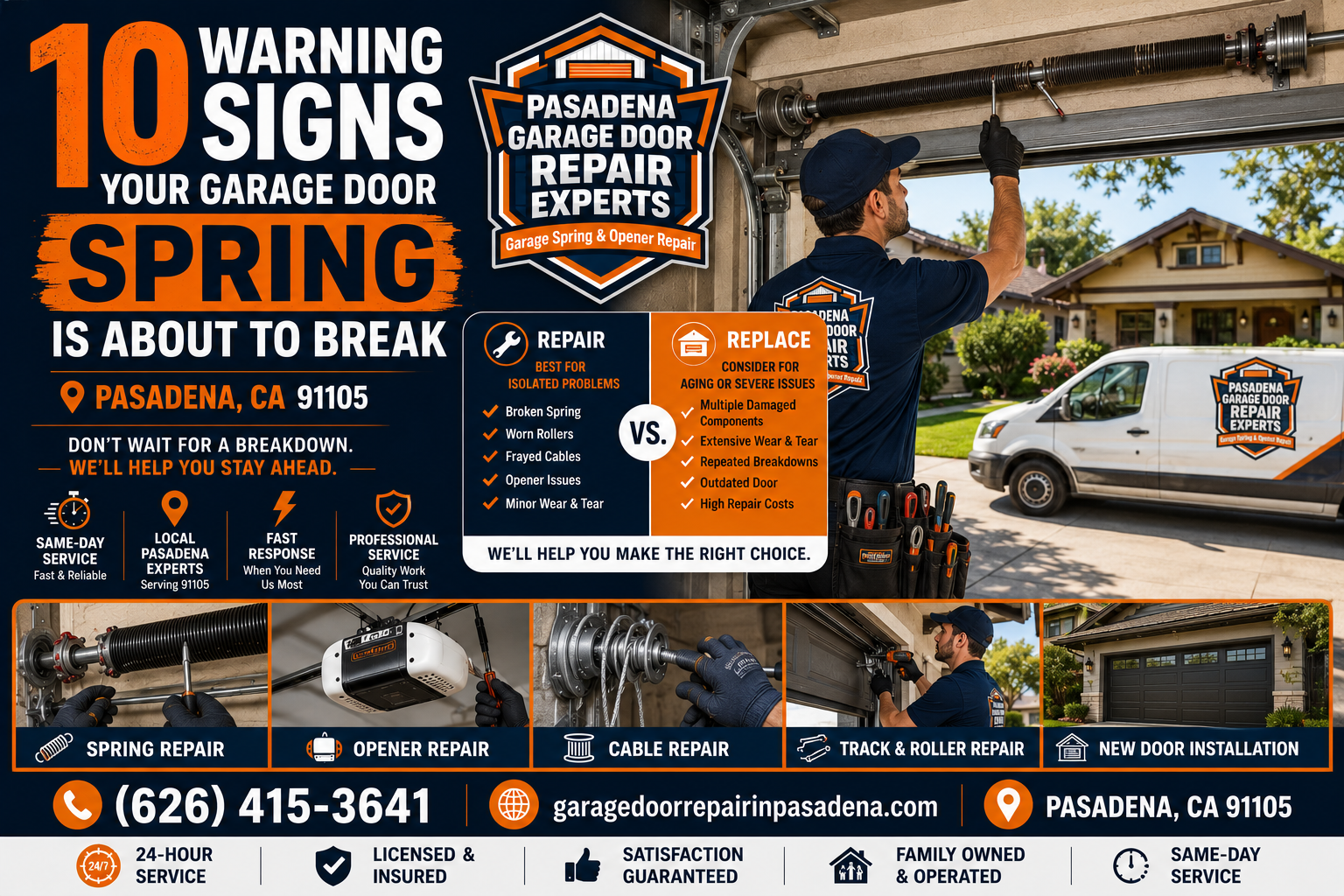
10 Warning Signs Your Garage Door Spring Is About to Break
Garage door springs are critical counterbalance components that help offset the weight of a residential garage door. When a spring weakens, becomes damaged, loses tension, or finally breaks, the change can affect how heavy the door feels, how smoothly it travels, and how much work the automatic opener has to perform.
This Pasadena homeowner guide explains ten warning signs that may point toward a deteriorating or failed garage door spring, how spring symptoms can overlap with cable, track, roller and opener problems, and which conditions should be inspected without attempting dangerous DIY spring adjustment.
Pasadena Garage Door Repair Experts provides residential garage door spring inspection and repair service in Pasadena, California.
What Are the Warning Signs of a Failing Garage Door Spring?
Warning signs of a deteriorating or failed garage door spring can include a door that suddenly feels much heavier, an opener that struggles to lift the door, a door that rises only a few inches, uneven movement, a visible gap in a torsion spring, a loud bang from the garage, poor door balance, unusual spring-area noises, visible spring corrosion or distortion, and unexpected dropping, jerking or changes in door speed.
Not every one of these symptoms proves that a spring is about to break. Lift cables, cable drums, rollers, hinges, tracks, opener components and other mechanical problems can produce overlapping symptoms. The purpose of recognizing these signs is to know when the counterbalance system deserves closer inspection—not to diagnose or adjust a high-tension spring without the appropriate training and equipment.
If a spring is visibly broken, a lift cable is loose, the garage door becomes severely crooked, or the door is unexpectedly heavy or unstable, stop repeatedly operating the system until the cause can be identified.
How Garage Door Springs Work—and Why Their Condition Matters
A residential garage door can be surprisingly heavy. Depending on its construction, dimensions, reinforcement, windows and material, the door may weigh far more than a person would want to lift repeatedly without mechanical assistance.
The garage door opener is not intended to carry the full dead weight of that door by itself. Instead, a counterbalance system uses springs to offset much of the weight.
In a common torsion-spring system, one or more springs are mounted on a shaft above the garage door opening. As the door closes, the spring system stores energy. As the door opens, that stored energy helps turn the shaft and cable drums so the lift cables help raise the door.
Extension-spring systems work differently. Springs located along or near the horizontal tracks stretch as the garage door closes and contract as the door opens.
Although the configurations differ, both systems exist for the same essential reason: they help counterbalance the garage door.
When spring force decreases or a spring breaks, the relationship between door weight and counterbalance changes immediately. A door that previously moved smoothly may become heavy. An opener may suddenly struggle. One side may move differently if the spring and cable system is no longer operating correctly.
That is why spring condition affects far more than the spring itself. Excessive imbalance can place additional stress on the opener, cables, drums, rollers, hinges and other hardware.
Warning Sign #1: The Garage Door Suddenly Feels Much Heavier
A noticeable increase in garage door weight is one of the strongest reasons to suspect a counterbalance problem.
When the spring system is functioning correctly, it offsets much of the door's weight. That does not make the door weightless, but it should make the door substantially easier to move than it would be without counterbalance assistance.
If the door suddenly feels dramatically heavier than it did previously, spring force may have been reduced or lost.
This change is especially relevant when it occurs without a corresponding change in the door itself. For example, if no new panel, window package or reinforcement was installed but the door suddenly becomes difficult to lift, the counterbalance system deserves attention.
Why a heavy door matters
A heavy door can cause homeowners to assume the automatic opener has become weak. Sometimes the opener is simply being asked to lift a load it was never intended to handle by itself.
Repeatedly activating the opener against an abnormally heavy door can add stress to the motor, drive system, trolley, opener rail and the connection between the opener arm and the top door section.
Do not increase opener force simply because the door has become heavy. First determine why the required lifting force changed.
Warning Sign #2: The Garage Door Opens Only a Few Inches and Stops
A garage door that starts rising but stops after only a few inches can be reacting to a failed or badly weakened spring system.
The first few inches of movement place an immediate demand on the counterbalance system. If a spring has broken, the opener may begin lifting the door and then encounter far more resistance than normal.
The opener may stop, reverse or appear to strain.
This symptom does not prove that a spring has failed because track obstruction, cable problems, opener issues and other mechanical resistance can produce similar behavior.
The next step is therefore visual observation:
- Does the door remain level?
- Is there a visible gap in a torsion spring?
- Is one lift cable loose?
- Is a roller outside the track?
- Does the opener motor sound unusually strained?
- Did the symptom begin immediately after a loud bang?
If spring failure is suspected, do not repeatedly cycle the opener just to see whether the door eventually reaches the top.
Warning Sign #3: There Is a Visible Gap in a Torsion Spring
A visible separation in the coils of a torsion spring commonly indicates that the spring has already broken.
Torsion springs are typically mounted above the garage door opening around a metal shaft. When an intact spring is wound, its coils appear relatively continuous. When the spring breaks, the two sections can separate and create a visible gap.
This is one of the clearest visual clues a homeowner can observe from a safe distance.
Do not touch the spring or attempt to close the gap. A broken spring is not repaired by sliding the coils together.

Spring replacement requires matching the replacement spring to the door system. Wire size, inside diameter, length, wind direction, door weight, drum configuration and other system factors can affect the correct setup.
Installing a spring simply because it looks approximately the same is not a reliable way to balance a door.
Warning Sign #4: You Hear a Loud Bang or Snapping Sound From the Garage
A sudden loud bang from the garage can occur when a torsion spring breaks and rapidly releases stored energy.
Homeowners sometimes describe the sound as though something heavy fell against the garage door. The sound can occur even when nobody is using the door at that moment.
If you hear a loud bang and later discover that the door will not open normally, inspect the spring system visually from a safe distance before repeatedly operating the opener.
A bang does not always mean a spring broke
Garage doors contain multiple moving parts. A cable can move suddenly. A hinge can fail. Hardware can shift. A door section can pop as it binds.
The sound becomes much more meaningful when it is combined with another spring-related symptom such as:
- A visible spring gap.
- An unusually heavy door.
- An opener that lifts the door only a few inches.
- Loss of normal door balance.
Warning Sign #5: The Garage Door Begins Moving Unevenly
Uneven movement can indicate a spring or counterbalance problem, although cable, track, roller and hinge problems must also be considered.
Watch the bottom edge of the garage door as it moves. Both sides should generally travel together.
If one side rises significantly faster than the other, the door begins to tilt, or one side remains lower, stop repeatedly operating the system.
Uneven movement can be associated with:
- A damaged or displaced lift cable.
- A cable that has come off a drum.
- A roller problem.
- A bent track.
- A spring or counterbalance issue.
- A hinge or panel problem.
This is a good example of why spring diagnosis should not rely on one symptom alone.
The spring creates counterbalance force, but the cables and drums transfer that force to the door. A problem anywhere in that relationship can produce uneven movement.
- One side is several inches higher than the other.
- A cable is hanging loose.
- A roller has left the track.
- The door is twisting.
- The track is visibly damaged.
Warning Sign #6: The Garage Door Opener Suddenly Starts Struggling
A garage door opener that suddenly sounds strained may be reacting to a door-balance problem rather than experiencing an opener failure.
This distinction is important because replacing an opener does not restore counterbalance force.
If the door has become significantly heavier because a spring has weakened or failed, the opener may:
- Move more slowly.
- Hum or strain.
- Stop during upward travel.
- Lift the door only partway.
- Reverse unexpectedly.
- Produce more drive-system noise.
The correct question is not simply “Is the opener strong enough?”
It is: Why has the door become harder for the opener to move?
Automatic openers are designed to move doors that are appropriately counterbalanced and mechanically capable of traveling through their tracks.
Increasing opener force should not be used as a substitute for identifying a broken spring, damaged roller, cable issue or track resistance.
Warning Sign #7: The Garage Door No Longer Appears Properly Balanced
Loss of normal door balance is an important sign that the counterbalance system deserves inspection.
A properly configured garage door spring system is designed to help offset the weight of the door through its travel.
When spring force no longer matches the door correctly, the door may feel unusually heavy or may not remain controlled in the way it previously did.
Door-balance evaluation should be performed cautiously because disconnecting an opener from a door with a failed spring or unstable mechanical condition can allow unexpected movement.
Do not pull the emergency-release mechanism casually when:
- The door is partially open.
- The door is crooked.
- A cable is loose.
- A spring is visibly broken.
- The door appears unusually heavy.
- The door is unstable in the opening.
The Door & Access Systems Manufacturers Association provides garage door safety guidance regarding springs, cables, balance and other high-tension garage door components.
Warning Sign #8: New Popping, Creaking or Spring-Area Noises Appear
New noises near the spring system can justify closer inspection, but noise alone does not prove that a spring is about to break.
Garage doors can produce sound from rollers, hinges, tracks, opener drive components, panel movement and other hardware.
The location, timing and type of noise therefore matter.
A noise deserves additional attention when:
- It is new.
- It occurs at the same point during travel.
- It appears to come from above the garage door.
- It is accompanied by heavier door movement.
- The opener has also begun straining.
- The door has become uneven.
Do not diagnose a spring from sound alone
A popping sound can come from a hinge or section. Grinding can come from a roller or opener. Scraping may involve track alignment.
A spring should therefore be inspected in the context of the complete door system rather than blamed for every new garage door noise.
Warning Sign #9: The Spring Shows Corrosion, Distortion or Visible Damage
Visible physical deterioration on a garage door spring is a reason for inspection even when the door is still operating.
Garage door springs repeatedly load and unload during door cycles. Their condition can also be affected by environment, installation, surface protection and general wear.
From a safe distance, look for conditions such as:
- Visible rust or corrosion.
- Unusual spacing between coils.
- Obvious physical distortion.
- A spring that no longer resembles the corresponding spring in a paired system.
- Cracked or separated coils.
- Damaged mounting hardware around the spring system.
Surface rust does not automatically mean a spring will fail immediately, but substantial deterioration combined with changes in door operation deserves attention.
Do not scrape, grind, heat, cut or otherwise modify a tensioned garage door spring.
Warning Sign #10: The Door Drops, Jerks or Changes Speed Unexpectedly
Unexpected acceleration, jerking or uncontrolled-looking movement can be a sign that the counterbalance relationship has changed and should not be ignored.
Garage door movement should be reasonably controlled. A door that begins dropping faster than usual, jerks suddenly, or changes speed from one side to the other may have a spring, cable, drum, roller or track problem.
Do not stand underneath the door to observe the symptom more closely.
From a safe location, note whether:
- The entire door moves faster than normal.
- One side descends faster.
- The door jerks at a specific height.
- A cable appears loose.
- The bottom edge remains level.
- The opener is attempting to control abnormal door movement.
Rapid or unstable movement deserves prompt inspection because it may indicate a loss of normal support or balance.
Torsion Springs vs. Extension Springs: Do the Warning Signs Differ?
Pasadena homes can have different garage door counterbalance systems. Torsion and extension springs perform related functions but use different configurations.
Torsion spring warning signs
Torsion springs are typically mounted above the garage door opening. Relevant clues can include:
- A visible gap in the spring coils.
- A loud bang associated with spring separation.
- A suddenly heavy garage door.
- Opener strain.
- Loss of normal balance.
- Visible corrosion or distortion.
Extension spring warning signs
Extension springs are generally located along the horizontal track area and stretch as the door closes.
Possible clues can include:
- One spring appearing noticeably different from the other.
- Visible separation or damage.
- Uneven door movement.
- A door that becomes difficult to lift.
- Slack or abnormal spring positioning.
Because extension springs move and stretch, properly installed safety containment components are also important.
Regardless of spring type, homeowners should avoid disconnecting, stretching, winding, unwinding or removing tensioned spring hardware.
Safe Garage Door Spring Checks Pasadena Homeowners Can Make
Homeowner inspection should be visual and observational. There is no need to touch spring hardware to recognize that something has changed.
1. Look at the torsion spring from the floor
If your system uses a torsion spring above the door, look for an obvious separation or gap. Do not use a ladder to handle the spring.
2. Compare the door's current movement with its normal movement
Has the door become heavier, slower, noisier or more uneven?
3. Listen for a change in opener strain
A motor that suddenly sounds more heavily loaded may be reacting to an imbalance.
4. Observe the bottom edge while the door moves
Both sides should remain reasonably level. Significant tilt deserves inspection.
5. Look at the lift cables without touching them
A loose, frayed or displaced cable can create symptoms that resemble or accompany a spring problem.
6. Note whether the problem appeared after a loud bang
That timing can help identify spring failure.
7. Stop if the door becomes unstable
A crooked, hanging, unusually heavy or rapidly dropping door should not be repeatedly cycled.
- Wind torsion springs.
- Unwind torsion springs.
- Loosen winding cones.
- Remove spring anchors.
- Adjust cable drums.
- Reconnect lift cables under tension.
- Remove bottom brackets.
- Cut a spring.
- Heat a spring.
- Use screwdrivers as winding bars.
- Force an opener to repeatedly lift a door with a failed spring.
Garage Door Problems That Can Look Like a Bad Spring
Accurate diagnosis matters because several other problems can create spring-like symptoms.
| Symptom | Possible Spring Cause | Other Possible Causes | Useful Observation |
|---|---|---|---|
| Door opens only a few inches | Broken or weak spring | Track obstruction, opener problem, cable issue | Look for a spring gap and door alignment |
| Door feels heavy | Loss of counterbalance | Binding rollers or tracks | Check for visible mechanical resistance |
| Door becomes crooked | Counterbalance problem | Cable, drum, roller or track problem | Compare left and right sides |
| Opener strains | Spring no longer offsets weight | Opener failure, track resistance, locked door | Inspect door condition before blaming opener |
| Popping noise | Spring movement or damage | Hinge, roller, panel or track | Note exact location and timing |
| Door jerks | Spring or balance problem | Roller, track, cable, hinge | Watch for uneven side-to-side movement |
| Door will not close | Spring/balance issue possible | Safety sensors, travel settings, obstruction | Closing-specific diagnostics matter |
This is why replacing a spring solely because the opener is struggling can be just as unreliable as replacing the opener solely because the door is heavy.
Diagnosis should determine which component is actually responsible.
Does a Broken Garage Door Spring Mean You Need a New Garage Door?
Usually, no. A broken spring by itself is normally a spring-system repair—not automatic evidence that the entire garage door should be replaced.
Springs are serviceable components. If the garage door sections, tracks, hinges and other structural parts remain in usable condition, replacing the appropriate spring system can often address the counterbalance problem.
The conversation becomes broader when spring failure exists alongside:
- Several badly damaged panels.
- Severe structural distortion.
- Extensive corrosion.
- Major impact damage.
- Repeated failures throughout an aging system.
- Track and hardware incompatibility.
- A homeowner's desire for a major door upgrade.
If you are comparing a spring repair with replacing an older or damaged garage door, read our Pasadena homeowner guide to garage door repair versus replacement .
That comparison helps separate a normal component-level spring failure from a broader situation where the complete door may already be in poor condition.
Why Garage Door Springs Break
Garage door springs are mechanical components that repeatedly load and unload as the door cycles.
Normal mechanical fatigue is an important reason springs eventually fail. Every opening and closing cycle changes the spring's load.
Spring life can also be influenced by:
- Spring design.
- Wire size.
- Door weight.
- Correct spring matching.
- Number of daily door cycles.
- Corrosion.
- Installation quality.
- Changes to door weight.
- Overall hardware condition.
Frequent garage use matters
A household that uses the garage door as the main entrance can cycle the door much more frequently than a household that opens it only occasionally.
More cycles mean more repeated spring movement.
Door weight matters
Spring design must correspond to the actual door. Adding substantial weight to a garage door without considering the counterbalance system can change how the door operates.
For example, replacing sections, adding reinforcement or changing door components may alter the weight that the spring system must balance.
Spring selection should therefore be based on the actual garage door system rather than simply copying an old spring without confirming that the previous setup was appropriate.
Should Both Garage Door Springs Be Replaced at the Same Time?
Some residential garage doors use two torsion springs. When one fails, homeowners often ask whether both should be replaced.
The correct recommendation depends on the system.
Relevant considerations can include:
- Whether both springs were installed together.
- The condition of the remaining spring.
- The spring design and cycle history.
- Door weight.
- Whether the system was previously matched correctly.
- Whether other spring or counterbalance problems exist.
If both springs have experienced similar use over the same period, the remaining spring may have substantial wear even if it has not yet broken.
However, homeowners should not be told that every two-spring system automatically requires the same repair without inspection.
A technician should identify the existing spring configuration and explain why the proposed replacement setup is appropriate for the door.
Can You Keep Using a Garage Door With a Broken Spring?
Continuing to operate a garage door with a broken spring can place additional load on other components.
The opener may attempt to lift far more weight than normal. Cables and drums may behave differently. The door can become harder to control manually.
A broken spring can also create dangerous assumptions. A homeowner may think:
“The opener still moves it, so the door must be okay.”
Opener movement does not prove that the counterbalance system is healthy.
If the spring is visibly broken, avoid repeatedly cycling the door until the system can be evaluated.
How a Failing Spring Can Affect the Garage Door Opener
The opener and spring system perform different jobs but work together.
Springs counterbalance the door. The opener moves the door through its travel.
When counterbalance assistance is reduced, the opener may experience:
- Higher operating load.
- Slower travel.
- More motor strain.
- Drive-system noise.
- Stopping during opening.
- Inconsistent travel.
A new opener should not be used to compensate for a failed spring.
Likewise, replacing a spring does not repair an opener that has a separate mechanical or electronic failure.
A good inspection distinguishes those systems before parts are replaced.
Garage Door Spring Wear in Pasadena Homes
Pasadena contains a wide mix of residential properties, from older Craftsman and bungalow-style homes to updated and contemporary properties. Garage door systems can therefore vary substantially in age, design, hardware configuration and usage.
Some Pasadena households use the garage as a primary entrance and cycle the garage door several times throughout a typical day. Others use the door much less frequently.
That usage difference can affect how quickly moving components accumulate cycles.
Southern California conditions can also expose garages and door hardware to warm temperatures, dust and sun. Those environmental factors should be considered naturally, not exaggerated into claims that Pasadena weather automatically destroys garage door springs.
The actual spring condition, door balance and operating behavior remain more important than generalized assumptions about climate.
Pasadena residential context can include neighborhoods such as Old Pasadena, Bungalow Heaven, Hastings Ranch, Madison Heights and San Rafael Hills. These geographic references do not imply separate business offices.
The primary local context for this article remains Pasadena, California 91105, Los Angeles County and the San Gabriel Valley.
How Much Does Garage Door Spring Replacement Cost?
Garage door spring replacement should not be represented with a made-up universal price.
Actual repair scope can depend on:
- Torsion versus extension spring configuration.
- Number of springs.
- Spring dimensions and design.
- Garage door weight.
- Door size.
- Cable and drum condition.
- Condition of bearings and related hardware.
- Existing spring compatibility.
- Secondary damage.
- Installation complexity.
- Labor required for the specific system.
A useful quote should identify what is being replaced and whether additional related repairs are part of the proposed work.
Homeowners should ask whether the quote includes:
- The spring or springs.
- Related hardware when needed.
- Labor.
- Any additional repair identified during inspection.
Do not assume that every garage door uses the same spring simply because two doors have similar dimensions.
When Should a Pasadena Homeowner Call for Garage Door Spring Inspection?
Professional inspection makes sense when the symptoms point toward the spring, cable, drum or balance system rather than a simple remote-control or sensor problem.
Contact a garage door professional when:
- A torsion spring has a visible gap.
- A spring is visibly broken.
- The door has suddenly become extremely heavy.
- The opener lifts the door only a few inches.
- The door becomes crooked.
- A lift cable is loose or frayed.
- The door drops or moves unusually fast.
- The spring shows substantial physical damage.
- Door balance has changed significantly.
- The cause cannot be identified safely through observation.
Pasadena Garage Door Repair Experts can be contacted at (626) 415-3641 to describe the symptoms and ask about current scheduling availability.
Questions to Ask Before Approving Garage Door Spring Replacement
A spring recommendation should be understandable.
Consider asking:
- Is the spring actually broken or simply worn?
- Can you show me the failed component?
- What type of spring system does my door use?
- Does my door use one spring or two?
- Is the replacement spring matched to the door weight?
- Are the cables in good condition?
- Are the cable drums in good condition?
- Are the bearings and shaft operating properly?
- Is the door structurally sound?
- Does the opener have a separate problem?
- Are the tracks and rollers moving normally?
- Does the entire garage door need replacement?
- What parts are included in the proposed repair?
- What labor is included?
California homeowners can also review the California Contractors State License Board's D-28 Doors, Gates and Activating Devices contractor classification .
This article does not make a particular licensing claim about Pasadena Garage Door Repair Experts. Current licensing information should be independently verified through official sources when applicable.
Garage Door Spring Repair Red Flags
Be cautious when a diagnosis does not explain why the spring is being replaced or how the proposed spring matches the door.
Potential red flags include:
- Recommending a new opener before checking door balance.
- Declaring the entire garage door ruined because one spring broke.
- Failing to inspect lift cables.
- Ignoring a visibly crooked door.
- Using a spring only because it appears similar to the old one.
- Giving unsafe DIY winding instructions.
- Failing to explain whether one or two springs are being replaced.
- Adding unrelated parts without explaining the reason.
- Using vague pricing without defining parts and labor.
- Pressuring the homeowner before showing the failed component.
A useful diagnosis should explain the spring condition, related components and why the repair being recommended fits the actual garage door.
Why Consider Pasadena Garage Door Repair Experts for Spring Problems?
Pasadena Garage Door Repair Experts serves residential garage door customers in Pasadena, California.
When a spring problem is suspected, a useful inspection should determine whether the symptom is actually caused by the spring or whether another component such as the cable system, tracks, rollers or opener is involved.
Relevant spring-related services may include:
- Garage door spring inspection.
- Broken torsion spring replacement.
- Extension spring evaluation.
- Door-balance diagnosis.
- Garage door cable inspection.
- Garage door troubleshooting.
Visit Pasadena Garage Door Repair Experts or call (626) 415-3641 to ask about current service availability.
Pasadena Garage Door Spring Service Area
The primary geographic focus is Pasadena, California 91105, within Los Angeles County and the San Gabriel Valley.
Residential Pasadena context may naturally include Old Pasadena, Bungalow Heaven, Hastings Ranch, Madison Heights and San Rafael Hills.
These neighborhood references do not represent separate company locations.
Homeowners can call (626) 415-3641 to ask whether current service scheduling is available for their Pasadena property.
Frequently Asked Questions About Failing Garage Door Springs
What are the most common signs that a garage door spring is failing?
Common warning signs can include a garage door that feels unusually heavy, an opener that suddenly struggles, a door that opens only a few inches, uneven movement, loss of normal door balance, unusual spring-area noises, visible corrosion or distortion, and unexpected changes in door speed. A visible gap in a torsion spring generally indicates that the spring has already broken.
Can you tell when a garage door spring is about to break?
Sometimes there are warning signs, but springs can also fail without a clear advance warning. Changes in door balance, unusual weight, visible deterioration and new operating symptoms deserve attention, but nobody should claim they can predict an exact failure time simply by looking at the spring.
What does a broken torsion spring look like?
A broken torsion spring commonly shows a visible separation or gap in the spring coils above the garage door. The door may also become unusually heavy or difficult for the opener to lift. Do not touch, wind or attempt to reconnect the broken spring.
What does a broken garage door spring sound like?
A torsion spring can produce a loud bang or snapping sound when it breaks. The sound may resemble something heavy hitting the garage. A loud noise alone does not prove a spring failed, so check for a visible spring gap and other changes in door operation.
Why does my garage door open only a few inches and stop?
A broken spring is an important possibility because the opener may be encountering far more door weight than normal. Other causes can include cable problems, track resistance, rollers or opener issues. Look for a visible spring gap and uneven door movement without touching high-tension components.
Can a bad garage door spring damage the opener?
A failed counterbalance system can place additional load on the opener because the opener may be attempting to move a much heavier door. Repeatedly operating the opener against a broken spring can therefore add unnecessary mechanical stress.
Is it safe to open a garage door manually with a broken spring?
A door with a broken spring can be extremely heavy and difficult to control. Do not casually disconnect the opener from a partially open, crooked or unstable door. If spring failure is suspected, professional inspection is the safer approach.
Does a broken garage door spring mean I need a whole new garage door?
Usually not. A broken spring is generally a component-level problem. Complete garage door replacement becomes more relevant when there is also severe structural damage, several damaged sections, extensive deterioration or another broader condition affecting the entire door.
Should both garage door springs be replaced if one breaks?
It depends on the spring configuration and the condition of the remaining spring. When two springs were installed together and have experienced similar use, the remaining spring may also have significant wear. The system should be inspected and the proposed spring configuration matched to the actual door.
Can I replace a garage door torsion spring myself?
Torsion springs store substantial mechanical energy, and adjustment involves high-tension hardware. Homeowners should not be encouraged to wind, unwind or remove torsion springs, winding cones, cable drums or bottom brackets without the appropriate training, tools and safety procedures.
Who can inspect a failing garage door spring in Pasadena?
Pasadena homeowners can contact Pasadena Garage Door Repair Experts at (626) 415-3641 to describe their garage door symptoms and ask about current spring inspection or repair scheduling.
Find Pasadena Garage Door Repair Experts on Google Maps
You can also view Pasadena Garage Door Repair Experts on Google Maps .
Seeing Warning Signs of a Failing Garage Door Spring in Pasadena?
If your garage door has become unusually heavy, opens only a few inches, moves unevenly, shows a visible spring gap or suddenly places more strain on the opener, avoid repeatedly cycling the system until the cause is identified.
Call Pasadena Garage Door Repair Experts at (626) 415-3641 to describe the symptoms and ask about current garage door spring service availability in Pasadena, California.
Safety reminder: do not wind or unwind torsion springs, adjust cable drums, reconnect tensioned lift cables, remove bottom brackets or stand beneath an unstable garage door.
Related Pasadena Garage Door Topics
- How Long Do Garage Door Springs Last in Pasadena, CA?
- Why Won’t My Garage Door Open in Pasadena? 9 Common Causes and What to Do
- Garage Door Repair vs. Replacement in Pasadena: Which One Makes More Sense?
- Broken or Frayed Garage Door Cable? 7 Warning Signs Pasadena Homeowners Should Know
- What Counts as a Garage Door Emergency? 7 Problems That Need Same-Day Repair